
London, February 1892. Fog the colour of weak tea lies in the streets, and my crates have come through the docks with only one cracked bulb among them. In two days I lecture to the Institution of Electrical Engineers, in the country of Faraday, before men whose papers I read as a student by candlelight. They have seen my Columbia experiments described in print and half of them, I am told, do not believe a word. The question I mean to put before them is simple to state and strange to hear: what does a circuit need with a second wire, when the world around it can carry the current home?
"A most curious feature of alternate currents of high frequencies and potentials is that they enable us to perform many experiments by the use of one wire only."
Nikola Tesla, "Experiments with Alternate Currents of High Potential and High Frequency", lecture before the Institution of Electrical Engineers, London, February 1892
London, 1 February 1892. The coil in its zinc box
I have spent the day re-building the disruptive discharge coil on a bench lent to me, because nothing travels across an ocean and arrives as it left. I set down its dimensions here so that if anything breaks I can make it again from this page.
The coil stands in a box of thick hardwood, covered outside with zinc sheet soldered all round. Two spools of hard rubber are held ten centimetres apart by bolts and nuts, also of hard rubber. Each spool is a tube about eight centimetres inside diameter and three millimetres thick, with two flanges twenty-four centimetres square screwed upon it, the space between the flanges about three centimetres. The secondary is the best gutta-percha-covered wire, twenty-six layers of ten turns on each spool, the two halves wound oppositely and joined in series over the primary. The primary is wound in two parts, also oppositely, on a wooden spool; each part has four layers of twenty-four turns. The cloth between layers is cotton. There are about five centimetres of oil on every side, and the empty corners of the box are packed with wood to save oil.
Calculation
The ratio of conversion, which the engineers will ask for.
- Secondary: 26 layers × 10 turns = 260 turns on each half; two halves, so 520 turns in all.
- Primary: 4 layers × 24 turns = 96 turns on each part.
- Primary parts in series: 192 turns. Ratio 192 : 520 = 1 : 2.7.
- Primary parts in multiple: 96 effective turns. Ratio 96 : 520 = 1 : 5.4.
Margin
I wrote those ratios in my lecture notes and then added a line, because it must be said: with currents vibrating many hundred thousand times a second the ratio of turns gives not even an approximate idea of the ratio of the electromotive forces. The secondary has its own period, set by its self-induction and the capacity of its turns and terminals. When the primary oscillation is tuned to it, the secondary rings like a bell and its potential climbs far above anything the turns would predict; out of tune, it lies dull. A transformer of iron obeys its turns; my coil obeys its resonance.
Calculation
The insulation between layers, which is where these coils die. Suppose the secondary reaches 50,000 volts end to end.
- Volts per turn, if the potential were spread evenly: 50,000 ÷ 520 ≈ 96 volts.
- Each layer has ten turns, so one layer carries about 960 volts from end to end.
- The layers are wound back and forth. At the turning end, the last turn of one layer lies next to the first turn of the next, almost at the same potential. At the far end, the first turn of the lower layer lies against the last turn of the upper, twenty turns apart along the wire: 20 × 96 ≈ 1,920 volts across a thickness of cotton cloth and oil.
- Hence the cloth must be thick enough to hold two thousand volts with a margin, and it need not be thicker; any excess only pushes the turns away from the primary and weakens the coupling.
The evenly spread potential is the best case. At the instant the oscillation starts, the front of the wave may crowd the first few turns with the whole pressure. I have seen this happen: the first layer punctured, the rest untouched. The oil heals small faults by sweeping the bubbles away, which is why I trust oil above every solid.
London, 3 February 1892. One wire, before the Institution of Electrical Engineers
I began by naming the man whose work had first turned me to this science. I could not leave him out: "It is a name associated with the most beautiful invention ever made: it is Crookes!" I read his description of radiant matter at college, in translation, once only, and I can recite it still.
Then the experiments, and I give them in the order I showed them because the order was an argument. An exhausted bulb with a single leading-in wire, joined to one terminal of the coil: the carbon button inside rose to vivid incandescence. The energy went in by one wire, through the button, and out through the glass to the room, partly by bombardment and partly by induction, as through the coatings of a condenser. A coated tube: I connected my own body to its wire, and it lit; I held it by the glass alone, acting inductively, and it lit again. No second wire anywhere.
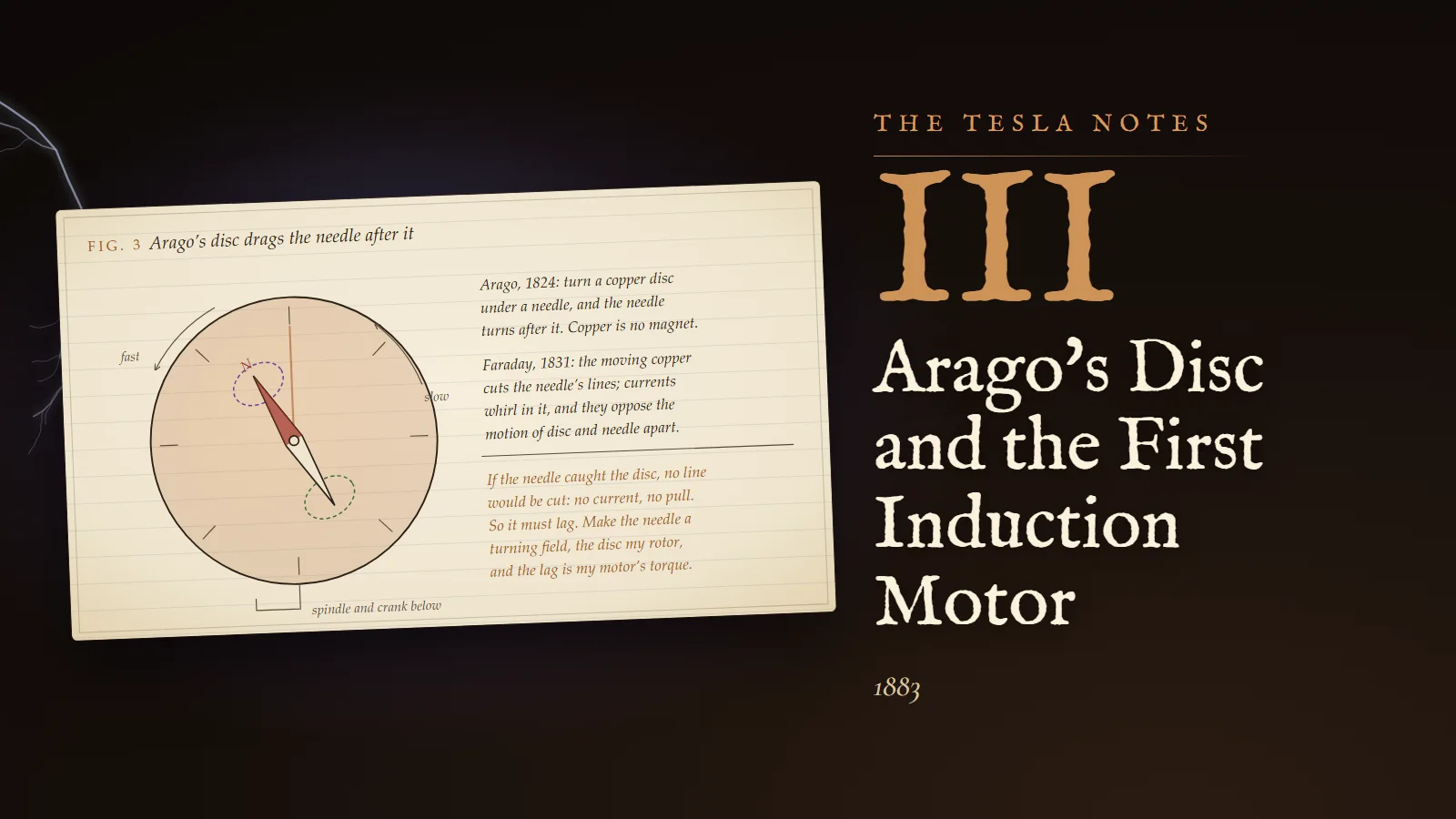
Then the motor. I wound a primary on an iron core with a secondary close to it, its ends joined, and a copper disc free to turn in the field of both. Fed from an alternator by two wires, it turns; that is well known. I connected one end of the motor coil to one terminal of the high-tension coil and left the other end free in the air. Nothing. I touched the free end with an object in my hand, and the disc spun. An exhausted tube put in series lit brilliantly, showing a strong current. Then I hung a small metal sheet on a cord and joined it to the free end in place of my body, and the disc turned as before. In the lecture I said that in this case the plate acts as a condenser in series with the coil, counteracting its self-induction and allowing a strong current to pass. That is the sentence I wish to work out properly tonight.
Calculation
One wire, a lamp, and a plate hung in the air. Where does the current go? Into the plate, and from the plate, as electric displacement, across the air to the walls, the floor and the earth, and through the earth back to the other terminal of the coil. The plate and the room are the two coatings of a condenser. The circuit is closed, but through the medium instead of through copper.
- Let the coil give an effective potential V at frequency f, behind its own resistance, which I put at about 5,000 ohms for this coil at these frequencies.
- The lamp: a sixteen-candle lamp, about 220 ohms hot, at full light with half an ampere.
- The plate: a capacity to the room of C. For a man standing on an insulated stool I estimate about a hundred centimetres, or 1.1 × 10⁻¹⁰ farad; I take the plate the same.
- The plate opposes the alternating current with 1/(ωC), where ω = 2πf.
- Without the motor coil, the current is I = V ÷ √(R² + (1/(ωC))²), with R = 5,000 + 220 = 5,220 ohms.
Now numbers. At V = 10,000 volts and f = 20,000 periods a second:
1/(ωC) = 1 ÷ (2π × 20,000 × 10⁻¹⁰) ≈ 79,600 ohms.
The current is 10,000 ÷ √(5,220² + 79,600²) ≈ 10,000 ÷ 79,800 ≈ 0.125 ampere. The lamp takes I²R = 0.125² × 220 ≈ 3.4 watts: a dull red glow. Raise the frequency to 100,000 and the plate's opposition falls to 15,900 ohms; the current rises to about 0.6 ampere, and the lamp shines at full brightness. Lower it to the 60 periods of a commercial machine and the opposition is 26 million ohms; the current is 0.4 milliampere, and the lamp is cold glass.
The current through a capacity grows in direct proportion to the frequency. This is the entire reason why one wire suffices for me and fails for every central station in the world.
Margin
And the motor coil? It has self-induction L, whose opposition ωL grows with frequency while the plate's falls. The two act against one another, so the total opposition is √(R² + (ωL − 1/(ωC))²), and at the frequency where ωL = 1/(ωC) they cancel entirely and only the resistance is left. That is what I meant by the plate counteracting the self-induction. For my estimated hundred centimetres of plate and a motor coil of about 2½ henrys, the two balance near 10,000 periods. There the current is limited only by resistance, and with 10,000 volts it would be nearly two amperes: enough to burn out the lamp, and to heat a thick copper wire red. This is why I said that on a single line we may pass an inappreciable current along the wire and yet obtain at a chosen point a heavy current capable of fusing a thick copper wire. The greater the self-induction of the coil, the smaller need be the plate.
I have made the whole thing into Plate XIV. Move the frequency and watch the current climb; shrink the plate and watch it fall; press the button to put the motor coil in series, and find the frequency where the lamp blazes.
Experiment No. 1
To show the Institution that an insulator, to these currents, is a path. I attached two plates of wire gauze to the terminals, set them apart and let a small spark pass. I inserted a thick plate of one of the best dielectrics between them; and instead of preventing the discharge, as everyone expects of an insulator, it aided it, and the spark changed into luminous streams spread over the face of the plate. The dielectric, by its greater specific inductive capacity, carries more displacement than the air it replaces. To an alternating current of this frequency an insulator is a conductor of a particular kind.
Royal Institution, 4 February 1892. Faraday's chair
I had meant to leave for Paris this morning, where I am also promised. Sir James Dewar would not hear of it. He brought me to the Royal Institution yesterday, after the lecture, pushed me into a chair and poured out half a glass of a brown fluid that sparkled in all sorts of colours. "Now," said he, "you are sitting in Faraday's chair and you are enjoying whiskey he used to drink." I succumbed. I gave the demonstration again tonight in the hall where Faraday lectured, at his own table.
At the close Lord Rayleigh proposed the vote of thanks. He said that he had himself experimented with discharges and had been satisfied at two thousand per second, and that we had seen tonight ten or twenty thousand. He said that I had "the genius of a discoverer." Sir Frederick Bramwell seconded. I had prepared nothing to say, and said what I felt: that we younger ones are taking the lift, and the older ones were content with the stairs. I meant it as a tribute. The stairs were built by the men in that room.
Reflection
Rayleigh wished aloud that "our great electrician, whose name appeared before us in letters of fire" were present to propose the motion. He was not in the room. I spelled the names of the men I revere in bent tubes because a name in light is the only tribute an electrician can give that is made of his own work. Lord Rayleigh's words have done something to me that no newspaper could. I had never thought of myself as having a gift of discovery. I thought I had a gift of seeing machines. If a man like Rayleigh says it, I must be worthy of it, and that means I must stop making beautiful experiments and choose one great problem.
Calculation
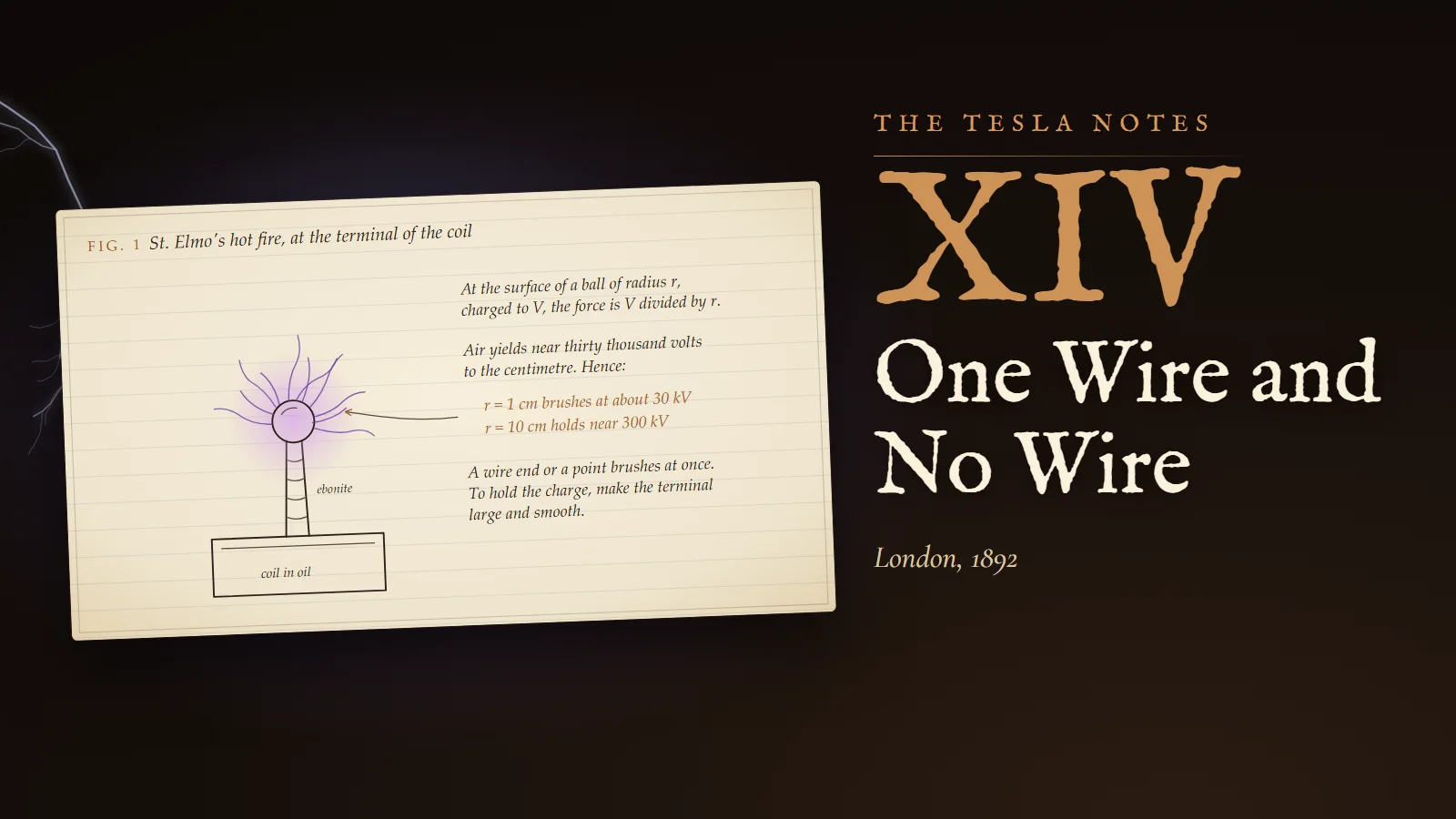
On the brushes. Several men asked tonight why the terminals of my coil are balls and not points, when points make the finer show. The answer is a line of arithmetic.
- A ball of radius r, alone in space and charged to potential V, has at its surface an electric force E = V/r.
- Air at ordinary pressure gives way, and begins to brush, at about thirty thousand volts to the centimetre, by the best measures I know.
- A ball of one centimetre radius therefore begins to brush near V = 30,000 × 1 = 30,000 volts.
- A ball of ten centimetres radius holds 300,000 volts before it brushes.
- A wire end or a point has a radius of a fraction of a millimetre. It brushes at a few thousand volts and bleeds away the charge in light and ozone.
Hence, to hold a high potential, make the terminal large and smooth. To make a show, use points. For a million volts I should need a ball of at least thirty-three centimetres radius; and the bigger the ball, the greater its capacity, and the more charge the coil must supply each alternation. I see already where this leads, and it frightens me a little.
Draftsman's note
Fig. 1: a brass ball two centimetres across on an ebonite column over the coil box, drawn at the moment the brush is fullest. The streamers are drawn in violet and kept curved, because they never run straight: each seeks the path of least resistance through air already broken by the last. The halo is the faint glow that precedes the streamers, visible only in a darkened room.
Experiment No. 2
The rotating brush, which I showed in both lectures and still do not understand. In a highly exhausted bulb with no leading-in wire, hung from a terminal, a brush forms that is sensitive to an astonishing degree. When the bulb hangs globe downward the brush always rotates clockwise. If an observer walks round it, it keeps to the side opposite him. A small permanent magnet two metres away slows it or speeds it. I said, and believe, that in the southern hemisphere it would turn the other way and on the equator not at all, because I think the earth's magnetism drives it. At its fastest it very likely turns in step with the alternations, say ten thousand times a second. I have tried to measure that with a light mica fan and failed. A notebook is the right place to admit it.
London, 6 February 1892. An evening with Mr. Crookes
Dinner with William Crookes, who has been kinder to me than I deserve. After the meal the talk turned to spiritualism, in which he is deeply engaged, and he argued for it with the same patience with which he once argued for radiant matter. I was susceptible to him as to no other man, because it was his work, read when I was a student, that made me embrace the electrical career. I could not agree, and I could not wholly dismiss him either. I came back to the hotel and lay awake thinking of my mother, who has the most remarkable powers of intuition of anyone I know, and who writes that she is not well.
Calculation
Crookes asked me whether my one-wire currents are waves of the kind Hertz has found. I answered that they cannot be, for a reason of size. The length of a wave is the speed of light divided by the frequency:
λ = v/f, with v ≈ 300,000 kilometres a second.
- At 10,000 periods, λ = 300,000 ÷ 10,000 = 30 kilometres.
- At 100,000 periods, λ = 3 kilometres.
- My lecture table, and even my wire "many miles long" wound on its frame, are short beside such lengths when they lie in a heap; the current is nearly the same at every point of a short circuit, as in any condenser circuit.
- Hertz's oscillators are a metre or two long and vibrate perhaps a hundred million times a second, so his waves are a few metres long and fly off across the room.
My currents are the charging currents of capacities, carried by conduction and displacement, and they follow the conductor and the earth. His are free waves in space. I have satisfied myself that mine are the useful ones.
Paris, 1892. Two societies, and a letter from Gospić
The lecture again, before the Société Internationale des Électriciens and the Société Française de Physique, with Paris in its best humour and every possible honour pressed upon me. I fled from London and now I flee from Paris; I cannot work among compliments. I was arranging the apparatus for the last time when the letter came from home. My mother is gravely ill. I have left the crates in the care of the Society and taken the first train east.
Reflection
In the train I tried to read and could not. I find that I am calculating instead: the hours to Vienna, the hours to Zagreb, the carriage to Gospić. When I am frightened, I count. My mother taught me to tie knots in a thread with my eyes shut. She invented looms and implements, and would have been an inventor of the first order had she not lived so far from the world. Everything I am began in her hands.
Gospić, April 1892. My mother
I reached her in time. She knew me. For days I sat at her bed until I was so exhausted by pain and long watching that they carried me to a house two blocks away to sleep. I lay there thinking that if she died while I was gone, she would surely give me a sign, and every fibre in my brain was strained in expectation. Towards morning I fell into a sleep, or a swoon, and saw a cloud carrying angelic figures, one of whom gazed at me with love and slowly took on my mother's features. I woke to an indescribably sweet song of many voices, and in that instant I knew she had died. And it was true.
Margin
Written months later. I have found the cause, and I record it because I will not let a fact stand unexplained. The figures in the cloud were a painting I had seen, by a celebrated artist, representing one of the seasons as a cloud of angels that seemed to float in the air; it had struck me forcibly, and only my mother's likeness was new. The music was the choir of the church nearby, singing the early mass of Easter morning. Nothing in the night was outside the laws of nature. I wrote to Crookes while still under the impression of it, and I am glad now that I can write to him again with the explanation.
Reflection
After the funeral I was ill for weeks. When I could walk I went up into the mountains alone. One afternoon I took shelter from a storm under an overhanging rock. The clouds hung heavy and the rain held back, until a flash of lightning came, and a moment after, a deluge. It came to me that the energy of the lightning was nothing beside the energy of the water hanging in that cloud, raised there by the sun; the lightning only released it, like a sensitive trigger. If we could produce electrical effects of the right kind, we could release the rain where we chose: water deserts, make rivers, drive turbines. It would require electrical forces of the order of those in nature. A hopeless undertaking. I have decided to try it, and the same means would serve for the transmission of energy without wires. My mother would have laughed and told me to eat something first.
Bonn, 1892. Dr. Hertz
On my way back to America I went to Bonn to see Dr. Heinrich Hertz, whose experiments set me on fire three years ago in Paris, and with whose interpretation I now disagree. I took my observations with me. With the oscillation transformer I had repeated his phenomena, greatly magnified, and found them open to another and, I think, more plausible explanation: much of what he took for waves in the ether I believe to be effects of the air, which damps a rapidly vibrating circuit of high pressure as a fluid damps a tuning fork, so that his circuits cannot have vibrated at the rates he calculated.
He received me courteously and listened. When I had finished he seemed disappointed to such a degree that I regretted my trip, and I parted from him sorrowfully. I do not think he was offended. I think he was sad that a man who could make his effects a thousand times stronger should see in them something other than what he had proved.
Calculation
The arithmetic of our disagreement, written in the train to Hamburg. A Hertzian oscillator radiates in proportion to the square of its length divided by the wavelength, as I understand his theory; a short antenna on a long wave hardly radiates at all. Take an elevated terminal thirty metres high, worked at 10,000 periods: its height is a thousandth of the wavelength of 30 kilometres, and its radiation by that rule is of the order of a millionth part of what it would be at a half wave. Nearly all its energy goes into charging the earth and the air around it and coming back. This is exactly what I want. I wish to put energy into the earth as into a reservoir and draw it out at a distance, and I have no wish to scatter it into space where no one can collect it.
Reflection
I sail for New York this week. I take home three things from this year: Rayleigh's sentence, which I will try to deserve; the storm in the mountains, which is the largest idea I have ever had; and my mother's silence, which I will carry until I die. The work begins on Fifth Avenue, in a new laboratory, as soon as I land.
Problems I set myself
1. My London coil has 520 secondary turns and two primary parts of 96 turns each. With the primary parts in multiple and 1,000 volts on the primary at a low frequency, what secondary potential would the turns predict? Why is that figure useless for my high-frequency work?
Answer. In multiple the primary acts as 96 turns, so the ratio is 520 ÷ 96 ≈ 5.4 and the secondary would give about 5,400 volts. At high frequency the secondary is a resonant circuit with its own period; near resonance its potential is multiplied by its sharpness of tuning, far beyond the turns ratio, and away from resonance it falls below it. The turns ratio describes only a transformer whose coupling is tight and whose own capacity is negligible.
2. A lamp of 220 ohms hangs on one wire from a coil giving 10,000 effective volts behind 5,000 ohms; the far side of the lamp goes to a plate of 50 picofarads. Find the current and the lamp's power at 10,000 and at 100,000 periods a second.
Answer. At 10,000: 1/(ωC) = 1 ÷ (6.28 × 10⁴ × 5 × 10⁻¹¹) ≈ 318,000 ohms; I ≈ 10,000 ÷ √(5,220² + 318,000²) ≈ 0.031 ampere; power 0.031² × 220 ≈ 0.2 watt. At 100,000: 1/(ωC) ≈ 31,800 ohms; |Z| = √(5,220² + 31,800²) ≈ 32,200 ohms; I ≈ 0.31 ampere; power ≈ 21 watts. Ten times the frequency gives ten times the current until the resistance begins to dominate.
3. What self-induction must a motor coil have to resonate with a plate of 100 picofarads at 10,000 periods? What current flows at resonance under the conditions of Problem 2, if the coil adds 300 ohms?
Answer. Resonance needs ωL = 1/(ωC), so L = 1/(ω²C) = 1 ÷ ((6.283 × 10⁴)² × 10⁻¹⁰) = 1 ÷ 0.395 ≈ 2.53 henrys. At resonance only resistance remains: 5,000 + 220 + 300 = 5,520 ohms, so I = 10,000 ÷ 5,520 ≈ 1.8 amperes. The lamp, rated at half an ampere, would take more than thirteen times its rated power and burn out at once.
To the student who reads this later
You will write my Margin in one line. The impedance of the series circuit is Z = R + j(ωL − 1/(ωC)), the current is I = V/Z, and resonance is where the imaginary part vanishes, at ω₀ = 1/√(LC). Your phasor diagram shows the voltage across the plate and the voltage across the coil each far larger than the source near resonance, pointing in opposite directions and cancelling. That is the quantitative form of "the plate counteracts the self-induction". Mr. Heaviside had coined the word impedance six years before my London lecture; it took the work of Steinmetz and Kennelly in the years just after to make the complex method the common tongue of engineers.
The return through the room is displacement current, ∂D/∂t, as surely as the current in the lamp filament is conduction. My one-wire lamp is a circuit that closes through a capacitor whose second plate is the world. As long as the circuit is small beside the wavelength, everything I did is quasi-static and your lumped-element formulas hold exactly. Single-wire earth return lines, which carry power to remote farms in several countries today, close their circuit through the conductivity of the ground at mains frequency, which is a different mechanism from mine; but the idea that the second wire may be the earth was the same instinct.
On the brush: the rule E = V/r for an isolated sphere is right. The breakdown strength of air near thirty kilovolts per centimetre holds for large, smooth electrodes; for small radii the onset field is higher, as F. W. Peek measured in the 1910s, because a discharge needs room to grow. On the rotating brush I was guessing. A discharge carrying current does feel the earth's magnetic field, but no one has repeated my experiment carefully enough to say whether my hemisphere rule is true.
On Hertz I was wrong, and I will not pretend otherwise. His waves were real, his frequencies were close to what he calculated, and Maxwell's theory has been confirmed in every particular, including the radio waves that now carry your voice. My calculation in the Bonn entry is correct as far as it goes: a short antenna on a long wave radiates very little, and the energy near it is stored and returned. You call that the near field, and you use it in every wireless charger and contactless card. But I took the near field for the whole of nature. If you want to see the difference, build a small coil and a tuned receiving loop a few centimetres away, and measure how the received voltage falls as you move the loop away: as the inverse cube of distance near the coil, as the inverse first power far away.
If you would like to argue with me about Hertz, or anything else in these pages, come and ask me.
Sources and liberties
The Tesla Notes are a modern reconstruction written in Nikola Tesla's voice by Eternal Gardens. Dates, patents, lectures, apparatus and quotations come from the sources below; the private reflections, the order of the working and the sketches are ours.
- N. Tesla, "Experiments with Alternate Currents of High Potential and High Frequency", lecture before the Institution of Electrical Engineers, London, February 1892 (the coil, the single-wire experiments, the rotating brush, the tribute to Crookes): Wikisource
- "Mr. Tesla's Lecture at the Royal Institution", Electrical Review, 12 February 1892, p. 192 (Rayleigh's vote of thanks, Bramwell, Tesla's reply), transcribed at: teslauniverse.com
- N. Tesla, "My Inventions", Electrical Experimenter, 1919, chapters IV and V (Dewar and Faraday's chair; Crookes and spiritualism; his mother's death; the storm in the mountains): Wikisource
- N. Tesla, "The True Wireless", Electrical Experimenter, May 1919 (the visit to Hertz at Bonn in 1892): Wikisource
- N. Tesla, "The Problem of Increasing Human Energy", Century Magazine, June 1900 (the air damping Hertz's circuits): Wikisource
- Nikola Tesla Museum, Belgrade, list of Tesla's lectures (London, 3 and 4 February 1892; Paris, 1892): tesla-museum.org
- F. W. Peek, Dielectric Phenomena in High Voltage Engineering (New York: McGraw-Hill, 1915).
The dated days of 1 and 6 February, the dinner with Crookes as a single evening, the Hamburg train, and the estimates of the coil's resistance, the plate's capacity and the motor coil's self-induction are ours; Tesla says only that he was in London "in company with" Crookes when spiritualism was discussed, two or three months before his mother's death. The Paris lecture date is given in some sources as 19 February 1892 and in others as March, so we leave it undated. Whose name the tubes spelled at the Royal Institution is not recorded in the reports we read; popular accounts say it was Sir William Thomson's, and the frequent claim that Kelvin sat in the audience is unverified.