
New York, May 1891. The laboratory on Grand Street smells of ozone and hot shellac, and the windows are papered over so that I can see the faintest glow. In nine days I must stand before the American Institute of Electrical Engineers at Columbia College and show them a light that has no wire running to it. I have done it a hundred times in this room. Tonight the question is harder than the trick: what, exactly, lights the tube? If I cannot say it in numbers, I have no right to say it in a lecture hall.
"The ideal way of lighting a hall or room would, however, be to produce such a condition in it that an illuminating device could be moved and put anywhere, and that it is lighted, no matter where it is put and without being electrically connected to anything."
Nikola Tesla, "Experiments with Alternate Currents of Very High Frequency and Their Application to Methods of Artificial Illumination", AIEE, Columbia College, 20 May 1891
175 Grand Street, 11 May 1891. The tube that lit in empty air
I write down first what I saw, before I let myself explain it. In November of last year, if my memory serves, I built a transformer for one purpose: to make an electric field in a room strong enough to light an exhausted tube that touched nothing. The first trial succeeded. I stood in the dark with a glass tube two feet long in my hand, the coil roaring on its bench, and the tube was full of a soft violet light from end to end. Charles, who winds my coils, said nothing for a long time and then asked whether he might hold it. He held it as a man holds a sleeping bird.
The apparatus, as it now stands for the lecture. The source is my alternator of 384 pole projections, giving close to ten thousand complete periods a second, which is twenty thousand alternations in the language of our journals. It feeds the primary of a coil immersed in oil. The secondary is joined to two sheets of zinc, each five feet square, hung by silk cords from the ceiling. For the experiments in this notebook I hang them one above the other, six feet apart, the upper from the beams and the lower on insulating blocks a little above the floor. On the platform at Columbia they will hang on either side of me. The coil, worked hard, gives sparks of five inches between its knobs. I estimate fifty thousand volts at the crest of each wave.
Calculation
The field in the middle of the space, where the sheets look nearly like two plates of a condenser.
- Distance between the sheets: six feet, or 183 centimetres.
- Greatest difference of potential: 50,000 volts.
- Electric force midway, if the field were uniform: E = V/d = 50,000 ÷ 183 ≈ 273 volts per centimetre.
- A tube 60 centimetres long, laid along that force, has between its ends 273 × 60 ≈ 16,400 volts at the crest.
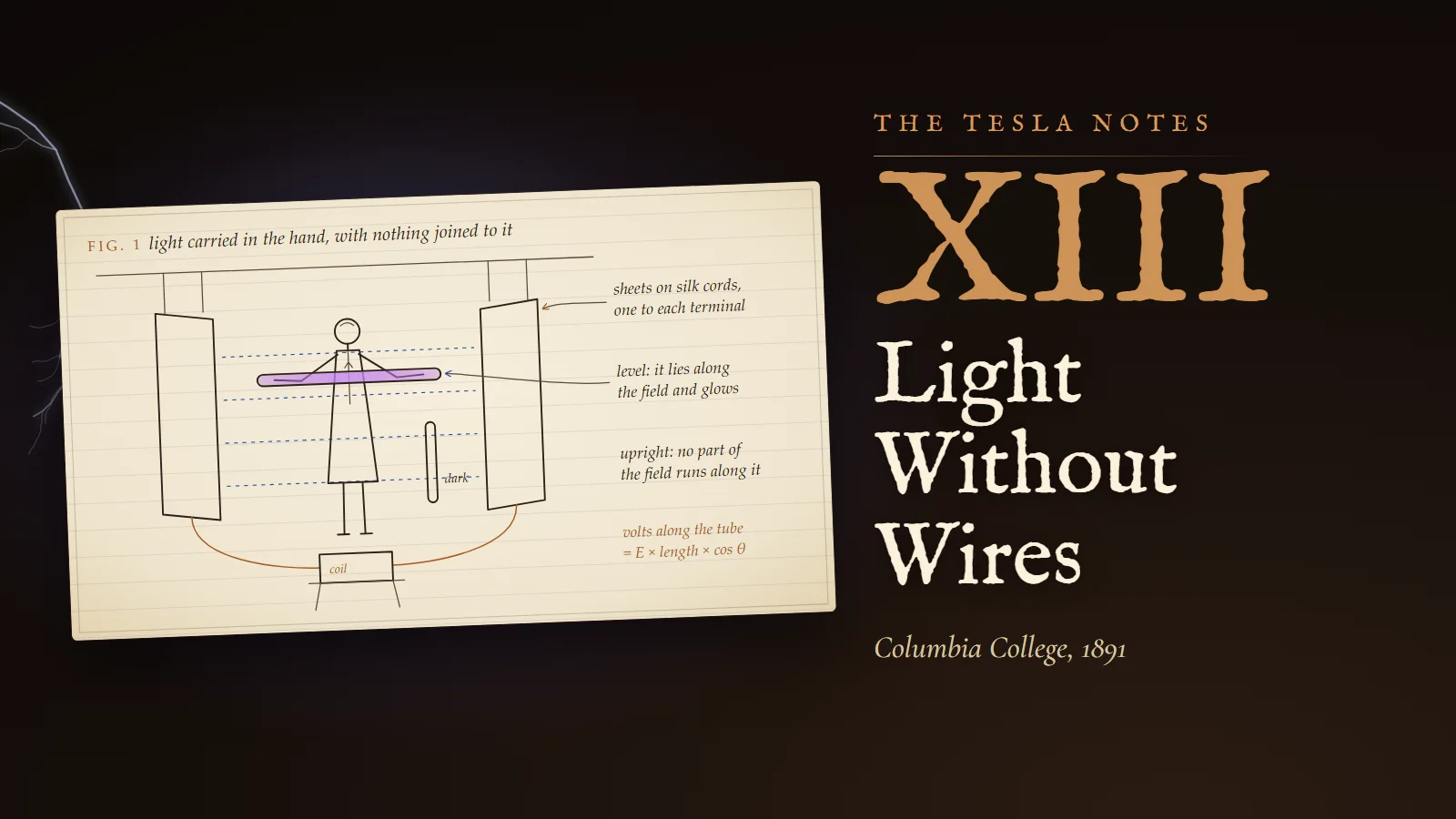
- The same tube laid across the force has nothing between its ends. Every point of it stands at the same potential.
Step 5 is the whole secret, and I nearly walked past it. The tube does not care how strong the field is around it. It cares how much of the field runs along it.
Margin
I first wrote that the brightness follows the strength of the field at the place where the tube is held, as the brightness of a lamp follows the current through it. That is wrong, and Experiment No. 2 below shows it. A tube in the strongest part of the field, held crosswise, is dark. The proper rule is: the difference of potential between the ends of the tube is E·ℓ·cos θ, where ℓ is its length and θ the angle between the tube and the lines of force. Where the field bends, as it does beyond the edges of the sheets, the rule must be applied piece by piece, adding up the part of the force along each short length of the glass.
Experiment No. 1
Apparatus as above. A tube of thin glass, 60 centimetres long and about 2½ centimetres in diameter, exhausted on the mercury pump to what I judge to be a millimetre of mercury, with no electrode of any kind sealed in it. Procedure: carry it slowly from the floor sheet towards the ceiling sheet, always held upright. Result: it lights at once and stays alight at every height, a little brighter near the edges of the sheets where the force crowds together, and it remains faintly luminous even a foot or two beyond them, where the lines curl out into the room. The tube in my hand, and my hand, feel nothing.
Grand Street, 13 May 1891. How the field gets through the glass
A careful man will object: glass is an insulator, so no current can enter the tube, and without a current there can be no light. I raised the objection against myself for two nights. The answer is that the current enters as it enters a condenser. The air inside the tube, once broken down, is a conductor; the glass wall is the dielectric; the field outside is the other plate. Each alternation the charge in the gas rushes to one end of the tube and then to the other, and the glass lets the electric displacement through, as Maxwell taught, without letting a single particle through. At ten thousand periods the rush happens twenty thousand times a second, and every rush lights the gas.
The quantity that governs the charging current of a condenser is its capacity multiplied by the rate of change of the potential. That is why frequency is everything here. Double the frequency and the same capacity passes twice the current under the same potential. Raise it a hundredfold and a pinch of glass becomes as good as a copper wire.
Calculation
I test my own statement for the lecture, that a lamp may be fed through its glass instead of through a sealed wire. Take a condenser surface of forty square centimetres, glass of good quality one millimetre thick, and twenty thousand alternations a second. I claimed approximately 9,000 volts are needed. Let me see whether the figure is honest.
- Capacity of a plane condenser, in electrostatic measure: C = KS/(4πd), in centimetres.
- For good glass I take the specific inductive capacity K ≈ 6.5. The books give six to ten according to the kind of glass.
- C = 6.5 × 40 ÷ (4π × 0.1) = 260 ÷ 1.257 ≈ 207 centimetres.
- One microfarad is 900,000 centimetres, so C ≈ 2.3 × 10⁻⁴ microfarad, or 2.3 × 10⁻¹⁰ farad.
- Frequency: 20,000 alternations a second is f = 10,000 complete periods, so ω = 2πf ≈ 62,800.
- Opposition of the condenser to the alternating current: 1/(ωC) = 1 ÷ (62,800 × 2.3 × 10⁻¹⁰) ≈ 69,000 ohms.
- A small button lamp wants, by my trials, about one eighth of an ampere. The potential needed across the glass is then 0.125 × 69,000 ≈ 8,600 volts.
About 9,000 volts. The figure stands. Now the same lamp on the 133 periods of the Pittsburgh machines: the opposition of the glass rises in the ratio 10,000 ÷ 133 ≈ 75, to more than five million ohms, and the potential needed rises to some 650,000 volts. No coil I possess, and no insulation in the world, would hold it. At low frequency this lamp is impossible; at high frequency it is easy. That single ratio is my argument.
Draftsman's note
Fig. 1 shows the arrangement as it will stand on the platform: the two sheets on their cords, the coil on its table between their leads, and myself between them with a tube in each hand. The level tube lies along the force and glows; the upright one lies across it and is dark. I have drawn the field as dashed horizontal lines and kept the sheets turned a little towards the viewer so that their area shows. Sheets five feet square, zinc, No. 24 gauge; cords of braided silk; the coil box is one foot by two.
Experiment No. 2
The same tube, held at the centre of the space, turned by steps on a wooden protractor clamped to a stand, so that my hands are well away. The coil steady at what I judge to be 50,000 volts. Readings of brightness by eye against a standard tube, and the potential along the tube by the rule of the Margin:
- 0°, along the force: brightest; 16.4 kilovolts end to end.
- 30°: very bright; 14.2 kilovolts.
- 60°: plainly dimmer; 8.2 kilovolts.
- 75°: faint; 4.2 kilovolts.
- 85°: flickers and goes out; 1.4 kilovolts.
- 90°: dark.
The tube goes out between 84° and 85°. Taking cos θ = 1,500 ÷ 16,400 ≈ 0.091 gives θ ≈ 84¾°, so my tube needs about 1,500 volts end to end, or some twenty-five volts to each centimetre of its length, to keep the gas alight at this exhaustion. I record the figure as my estimate; it will change with every tube and every pump.
Columbia College, 20 May 1891. Before the Institute
The hall was full and the lecture ran longer than I had promised. I began with the ether, because I wished them to understand from the first minute that what they were about to see is a disturbance of the medium and has nothing to do with wires. Then the coil. I showed the five forms the discharge takes as the frequency is raised: first the thin, feeble thread, then the sheaves of sparks, then the spray of silver-white sparks, and at last, when the frequency is highest, the brushes, which stream from the terminals so freely that the coil refuses to spark at all, even when the hand is put into the stream. I called the great brush from a terminal near the laminated core "St. Elmo's hot fire", because it is a flame and it is hot, and within minutes the whole hall smelled of ozone.
Then I turned down the gas, walked between the two sheets with my tubes, and the room went quiet in the particular way that I have learned to listen for. A tube in each hand, raised, lowered, turned. I turned one crosswise and let it die, and turned it back and let it live again, so that they should see the law of Experiment No. 2 with their own eyes. I have drawn the same thing as Plate XIII; drag the tube anywhere you like, turn it with the slider, and watch the glow follow only the part of the field that runs along it.
Calculation
For the passage on safety I had worked the following on the train of thought that the audience would surely ask about. A tube four feet long with coatings of foil at its ends needs a certain charging current to glow at a given brightness. Call the capacity of the coatings to the gas C and the current I. Then the potential required is
V = I/(ωC).
At twenty thousand alternations a second ω is some 75 times larger than at 133 periods. Hence the low-frequency tube must be driven at 75 times the potential for the same light. A man touching that coating at low frequency meets a terrible pressure; at high frequency, a modest one. I said in the lecture, and believe, that with the ordinary low frequencies the shock from such a tube might seriously injure those not used to it, whereas at twenty thousand alternations it can be kept equally bright with no effect felt at all.
Margin
Something in that argument troubles me, and a notebook is where a man is allowed to be troubled. My body is itself a condenser to the room; call its capacity a hundred centimetres. The current that passes through me when I touch the coating is about ωC·V, where C is now the capacity of my body. At high frequency ω is 75 times larger and V is 75 times smaller, so the product is the same. The same current flows through my arm in both cases. Yet one kills and the other is not even felt. So the difference cannot lie in the quantity of electricity alone. Some property of the nerves must refuse to answer a call that reverses twenty thousand times a second, as the ear refuses a note too high to hear. I do not know what that property is. I said in the lecture that these currents are incomparably less dangerous than low ones, and I added, because it is true, that they are not to be thought altogether harmless: received from a machine of low resistance, or through condensers, they burn.
Reflection
When it was over they came up to the platform in a crowd, and men I had admired for years held my tubes and asked me where the wires were hidden. Mr. Martin of the Electrical Engineer was among them. I went home alone afterwards and could not sleep. It is a dangerous thing to be applauded for a demonstration, because the applause attaches to the trick and the trick is the smallest part. The large part is a sentence I spoke at the very end, and I copy it here so that I am held to it:
"We are whirling through endless space with an inconceivable speed, all around us everything is spinning, everything is moving, everywhere is energy. There must be some way of availing ourselves of this energy more directly."
The tube in the empty room is the first proof that the medium itself can carry what I wish to deliver. A lamp today; tomorrow, power.
Grand Street, 28 May 1891. The bill for the light
A week of letters and visitors, and I have done nothing useful except this sum, which an engineer must do before he dreams. What does it cost the coil to keep the field in the room?
Calculation
- Capacity of the two sheets to one another, by the plane formula: S = 152 × 152 ≈ 23,100 square centimetres, d = 183 centimetres, C = S/(4πd) = 23,100 ÷ 2,300 ≈ 10 centimetres.
- The sheets are farther apart than they are wide, so much of the field spills round the edges, and their capacity to the walls adds more. I double the figure: C ≈ 20 centimetres, or 2.2 × 10⁻¹¹ farad.
- Charging current at the crest: I = ωCV = 62,800 × 2.2 × 10⁻¹¹ × 50,000 ≈ 0.069 ampere.
- Effective value, dividing by √2: about 0.049 ampere. One twentieth of an ampere fills the room with a field that lights tubes anywhere in it.
- But this current is ninety degrees from the potential. It charges the sheets in one quarter of a period and gives the energy back in the next. The coil supplies the true loss only: the heating of the tubes, the brushes from the edges of the sheets, the warming of the cords and the air.
The energy stored in the field at the crest is ½CV² = ½ × 2.2 × 10⁻¹¹ × (50,000)² ≈ 0.028 joule. A trifle, exchanged twenty thousand times a second. The room is a reservoir that is filled and emptied, and the lamps drink from it in passing. If the reservoir could be made the size of the earth, the lamps could stand anywhere upon it. I write that sentence and look at it for a long while.
Experiment No. 3
To learn what part of the coil's work the room wastes. With no tubes present, I measured the heating of the primary with a thermometer in the oil over twenty minutes: a rise of 6°F. With six tubes alight between the sheets, the rise was 7½°F. By this crude reckoning the tubes take perhaps a fifth of the wasted energy and the brushes, the dielectric losses in the cords and the heating of the coil itself take the rest. The tubes are the smallest consumer in the room. That is a fact to remember the next time a journal calls the experiment efficient.
New York, 30 July 1891. A citizen
This morning I swore the oath and became a citizen of the United States. I walked back to Grand Street by way of the Battery, where I landed seven years ago with some poems, a package of calculations and very little else, and I stood for a while watching the ferries. I owe this country my motors, my laboratory and my audience, and it owes me nothing.
Reflection
Letters come every week now from London and from Paris asking me to repeat the lecture. I have declined them all. There is too much to do here: the coil must be made to stand higher potentials without breaking down; the tubes must be made brighter and the brushes from the sheets must be suppressed; and I wish to know whether one plate is enough, with the earth for the other. If a single sheet near the ceiling and the ground beneath the floor will do, then the room has become one terminal of my coil and the earth the other, and I have only to ask how large a room can be.
Charles has wrapped the Columbia tubes in flannel and laid them in a drawer. I took one out tonight and held it near the coil, and it lit for me as it did that first time in November. I am not yet tired of it.
Problems I set myself
1. Two sheets two metres apart carry a peak difference of potential of 40,000 volts. A tube 50 centimetres long is held at the centre at 60° to the lines of force. What potential acts end to end? If the tube needs 1,250 volts to stay lit, at what angle does it go dark?
Answer. E = 40,000 ÷ 200 = 200 volts per centimetre. Along the tube, E·ℓ·cos θ = 200 × 50 × cos 60° = 200 × 50 × 0.5 = 5,000 volts. At full alignment it would have 10,000 volts, so it goes dark when cos θ = 1,250 ÷ 10,000 = 0.125, that is, θ ≈ 82.8°.
2. A lamp is fed through a glass wall 2 millimetres thick and 25 square centimetres in area, with specific inductive capacity 7, at 5,000 complete periods a second. What potential drives one tenth of an ampere through the glass? What if the frequency is doubled?
Answer. C = KS/(4πd) = 7 × 25 ÷ (4π × 0.2) = 175 ÷ 2.513 ≈ 69.6 centimetres, which is 69.6 × 1.113 ≈ 77.5 × 10⁻¹² farad. 1/(ωC) = 1 ÷ (2π × 5,000 × 7.75 × 10⁻¹¹) ≈ 411,000 ohms. V = 0.1 × 411,000 ≈ 41,000 volts. At 10,000 periods the opposition halves, and so does the potential: about 20,500 volts.
3. The sheets of Grand Street have a capacity of 20 centimetres and are charged to 50,000 volts at the crest, 10,000 times a second. Find the crest charging current, the energy stored at the crest, and the greatest rate at which energy flows into the field and back.
Answer. C = 20 × 1.113 × 10⁻¹² ≈ 2.2 × 10⁻¹¹ farad. I = ωCV = 6.28 × 10⁴ × 2.2 × 10⁻¹¹ × 5 × 10⁴ ≈ 0.069 ampere. Energy ½CV² ≈ 0.028 joule. The instantaneous power is v·i = V sin ωt × I cos ωt = ½VI sin 2ωt, whose greatest value is ½ × 50,000 × 0.069 ≈ 1,700 volt-amperes, flowing in and out twice each period and averaging zero.
To the student who reads this later
You have a better name for what I called the passage of displacement through the glass. Maxwell's term in Ampère's law, ∇ × H = J + ∂D/∂t, says that a changing electric field acts as a current. Through a condenser of capacity C the current is i = C dv/dt, and for a sinusoid at angular frequency ω you write it as I = jωCV, the j recording the quarter period by which the current leads. My "opposition of the condenser" is your capacitive reactance, X = 1/(ωC). Everything in my Columbia calculations survives in this notation, and you can check each one in a minute.
I spoke of the ether under strain. You no longer need the ether; the field itself carries the energy, and Poynting's vector, E × H, shows you where it flows. On the light I was half right. I spoke of molecular bombardment; you know that free electrons in the gas are driven by the field along the tube, gain energy between collisions, and excite and ionise the atoms they strike. The glass walls charge up and cancel the field across the tube, so only the component along it can drive a current. That is the deeper reason for my cosine law. You use the same physics every day: electrodeless induction lamps, and the capacitively coupled plasmas at 13.56 megahertz that etch the circuits in your machines. A fluorescent tube held under a high-voltage transmission line will glow faintly for the same reason mine did.
On the body I must be honest. My explanation, that high frequency is safer because it needs less potential, was incomplete, and my own Margin shows why. The real reason is that nerve and muscle membranes are excited by the charge that a pulse deposits on them, and a current that reverses quickly deposits too little before it turns back. The threshold for feeling and for stimulation rises roughly in proportion to frequency above about a kilohertz; the international guidelines on low-frequency exposure tabulate it. Do not repeat the popular story that the current flows only on the skin: at ten kilohertz the skin depth in the body is measured in metres. Heating remains at every frequency, and radio-frequency burns are real. I said so at Columbia and I say it again.
If you wish to see my law, hold a compact fluorescent lamp or a short fluorescent tube near a plasma globe or a small commercial teaching coil and turn it slowly. It will dim as the cosine. Keep one hand in your pocket and stay well away from anything that sparks.
If you would like to argue about any of this with me, come and ask me.
Sources and liberties
The Tesla Notes are a modern reconstruction written in Nikola Tesla's voice by Eternal Gardens. Dates, patents, lectures, apparatus and quotations come from the sources below; the private reflections, the order of the working and the sketches are ours.
- N. Tesla, "Experiments with Alternate Currents of Very High Frequency and Their Application to Methods of Artificial Illumination", lecture before the AIEE, Columbia College, 20 May 1891, as reprinted in T. C. Martin (1894): tfcbooks.com/tesla/1891-05-20.htm
- T. C. Martin, The Inventions, Researches and Writings of Nikola Tesla (New York: The Electrical Engineer, 1894), scan on Wikimedia Commons: Commons PDF
- N. Tesla, "My Inventions", Electrical Experimenter, 1919, chapter IV (the November 1890 experiment; the five-inch coil): Wikisource
- US Patent 454,622, "System of Electric Lighting", filed 25 April 1891, granted 23 June 1891: Google Patents
- US Patent 447,920, "Method of Operating Arc-Lamps" (the many-pole alternator), granted 10 March 1891: Google Patents
- W. B. Carlson, "Places of Invention: Nikola Tesla's Life in New York", Gotham Center for New York City History, 2013 (the Grand Street laboratory): gothamcenter.org
- W. B. Carlson, Tesla: Inventor of the Electrical Age (Princeton University Press, 2013), for the naturalisation of 30 July 1891, as cited in: Wikipedia, "Nikola Tesla"
- ICNIRP, "Guidelines for limiting exposure to time-varying electric and magnetic fields (1 Hz to 100 kHz)", Health Physics 99 (2010): icnirp.org
The lecture is quoted from the 1894 reprint; the closing sentence is printed there with a typesetter's slip ("mart be"), corrected here to "must be". The assistant "Charles", the zinc gauge, the striking voltage of twenty-five volts per centimetre, the thermometer readings of Experiment No. 3 and the doubling of the sheets' capacity are our reconstruction and Tesla's estimates, not his records. The 9,000-volt condenser figure, the sheets on insulating cords, the body-safety statement and the five forms of discharge are his.