
New York, June 1884, a city that looks to me a hundred years behind Europe and moves faster than any city I have seen. I landed with a few coins, a book of poems and a package of calculations, and a letter that Mr. Batchelor says will put me in front of Thomas Edison. I have come to redesign the Edison machines. I have also come with a question that I mean to put to the greatest electrician in America, in numbers he cannot dismiss: why is his whole system chained to the copper in its streets, and what would set it free?
If he had a needle to find in a haystack he would not stop to reason where it was most likely to be, but would proceed at once, with the feverish diligence of a bee, to examine straw after straw until he found the object of his search.
Nikola Tesla on Thomas Edison, New York Times, 19 October 1931
New York, June 1884. Is this America?
The first hour. A burly policeman twirling a stick as thick as a log. I asked him politely for directions. Six blocks down, then to the left, he said, with murder in his eyes. Is this America, I asked myself. It is a century behind Europe in civilisation. In the Arabian tales the genii carry people from the world of realities into a land of dreams. I have been carried the other way. What I left was beautiful and artistic; what I see is machined, rough and unattractive, and there is more energy in one street of it than in all of Graz.
Reflection
I have met him. I was amazed at this man who, without early advantages or scientific training, has accomplished so much. I have studied a dozen languages, read everything from Newton's Principia to the novels of Paul de Kock, spent my best years in libraries, and for a moment in his presence I felt that most of my life had been wasted. It was a moment. He works by trial, endlessly, with a vigour I have never seen in a human being, and he has a contempt for book learning that he does not trouble to hide. I work by seeing. We shall either get on very well or not at all.
Calculation
His lamp, measured on my first day at Goerck Street, where the Edison Machine Works are. On a circuit of about 110 volts, a lamp of sixteen candles takes, as near as I can read the instrument, half an ampere.
- Hot resistance: R = V/I = 110 ÷ 0.5 = 220 ohms.
- Power: P = VI = 110 × 0.5 = 55 watts, about 3½ watts for each candle.
- A hundred lamps in parallel: 50 amperes at 110 volts, 5.5 kilowatts.
The lamps are all in parallel across two wires, so that each can be turned off without disturbing the others. That is good engineering. It means every lamp takes its current at the low pressure of 110 volts, and that, I suspect, is the trouble.
New York, summer 1884. The Oregon
The steamship Oregon, the fastest passenger ship afloat, had both her lighting dynamos disabled, and her sailing was held up. The superstructure had been built over them after they were installed, so they could not be taken out of the hold. Edison was much annoyed. In the evening I took my instruments aboard and stayed all night.
Experiment No. 1
Apparatus: a battery, a galvanometer, a set of resistance coils, the ship's own crew for the heavy work. Procedure: with the machines stopped, I measured the resistance between successive bars of each commutator, all the way round. In a sound armature every section has the same resistance, and the readings march evenly; a short circuit shows as a section with too little, a break as a section with none at all, since the galvanometer then sees only the other path round the ring. I found several of each. Shorts where the insulation had chafed or charred, breaks where a joint had cracked under vibration. I cut out what could not be mended, bridged across the broken sections, rewound what I could, and dried the rest. Result: both machines running by four in the morning.
Reflection
At five o'clock, walking up Fifth Avenue towards the shop, I met Edison with Batchelor and a few others, going home to bed. "Here is our Parisian running around at night," he said. I told him I had come from the Oregon and repaired both machines. He looked at me in silence and walked away. When he had gone some distance I heard him say: "Batchellor, this is a d-n good man." Since then I have had full freedom in directing the work.
Margin
My hours since: from half past ten in the morning until five the next morning, every day. Edison says that he has had many hard-working assistants but that I take the cake. I take it as he means it. He works the same hours and sleeps on a bench in the laboratory, and he does not eat properly, and somebody should make him.
New York, autumn 1884. The arithmetic of copper
I am designing standard machines for the Company: twenty-four types, with short cores, of uniform pattern, to replace the old ones. It is good work and I am good at it. But at night I do another calculation, the one I came across the ocean to do, and it concerns the street outside.
The station on Pearl Street has supplied current since September 1882, and the men tell me its district is about a quarter of a square mile. Every lamp in it is fed at 110 volts through copper mains laid under the street. The Company's engineers say that a station can serve customers within a mile or so, and no further. I want to know why, in an equation.
Calculation
Let the station deliver the power P to customers at a distance d, through two wires of copper each of length d and cross-section A, at the pressure V. Let ρ be the specific resistance of copper, and let x be the fraction of P that we allow to be wasted in the wires.
- The current is I = P/V.
- The resistance of the line, out and back, is R = ρ · 2d/A.
- The power lost as heat in it is I²R = (P/V)² · 2ρd/A.
- As a fraction of P: x = I²R/P = 2Pρd ÷ (V²A).
- Solving for the section: A = 2Pρd ÷ (xV²).
- The volume of copper is A times the length of wire, 2d: volume = 4Pρd² ÷ (xV²).
There it is, the whole tyranny in one line. For a given power and a given fraction lost, the copper grows as the square of the distance and falls as the square of the pressure. Double the distance and you need four times the copper. Double the pressure and you need a quarter.
Margin
And the drop in pressure at the far end: IR ÷ V = (P/V)(R)/V = PR/V², which is x itself. The fraction of pressure lost and the fraction of power lost are the same number. For a motor that may not matter. For a carbon lamp it matters very much, because its light falls much faster than its pressure. By my rough trials, a lamp given a tenth less than its proper pressure loses something like a third of its light. So the Edison engineers keep the drop to a few per cent, and so they need even more copper than my example below.
Calculation
How far, then, can 110 volts go? Take the stoutest main a gang of men will lay without cursing me, a copper rod one inch across, and hold the drop to three per cent, which the lamps will tolerate.
- Section: π × (12.7 mm)² = 507 square millimetres.
- One hundred lamps take 50 amperes. Three per cent of 110 volts is 3.3 volts, so the line, out and back, may have R = 3.3 ÷ 50 = 0.066 ohm.
- Length of conductor allowed: L = RA/ρ = 0.066 × 507 ÷ 0.0172 = 1,945 metres, out and back.
- Distance: 973 metres, six tenths of a mile.
- With two hundred lamps on the same main the current doubles and the distance halves: three tenths of a mile.
So the engineers' "mile or so" is generous. Every district of a few hundred houses wants its own station, its own engine, its own coal cart in the street, and the whole of a great city must be cut into little districts each with a smoking heart. It works. It is magnificent. It cannot light a country.
Calculation
Numbers. One hundred lamps, 5,500 watts, at the end of one mile, with a tenth of the power lost. Copper: specific resistance about 0.0172 ohm for a wire one metre long and one square millimetre in section; density 8.89.
- d = 1 mile = 1,609 metres. V = 110.
- A = 2 × 5,500 × 0.0172 × 1,609 ÷ (0.10 × 110²) = 304,400 ÷ 1,210 = 252 square millimetres. A round rod of 17.9 millimetres diameter, nearly three quarters of an inch.
- Length of conductor, out and back: 3,219 metres.
- Volume: 252 × 10⁻⁶ × 3,219 = 0.81 cubic metres.
- Mass: 0.81 × 8,890 = 7,200 kilograms, about 15,900 pounds, seven tons of copper to light one hundred lamps a mile away.
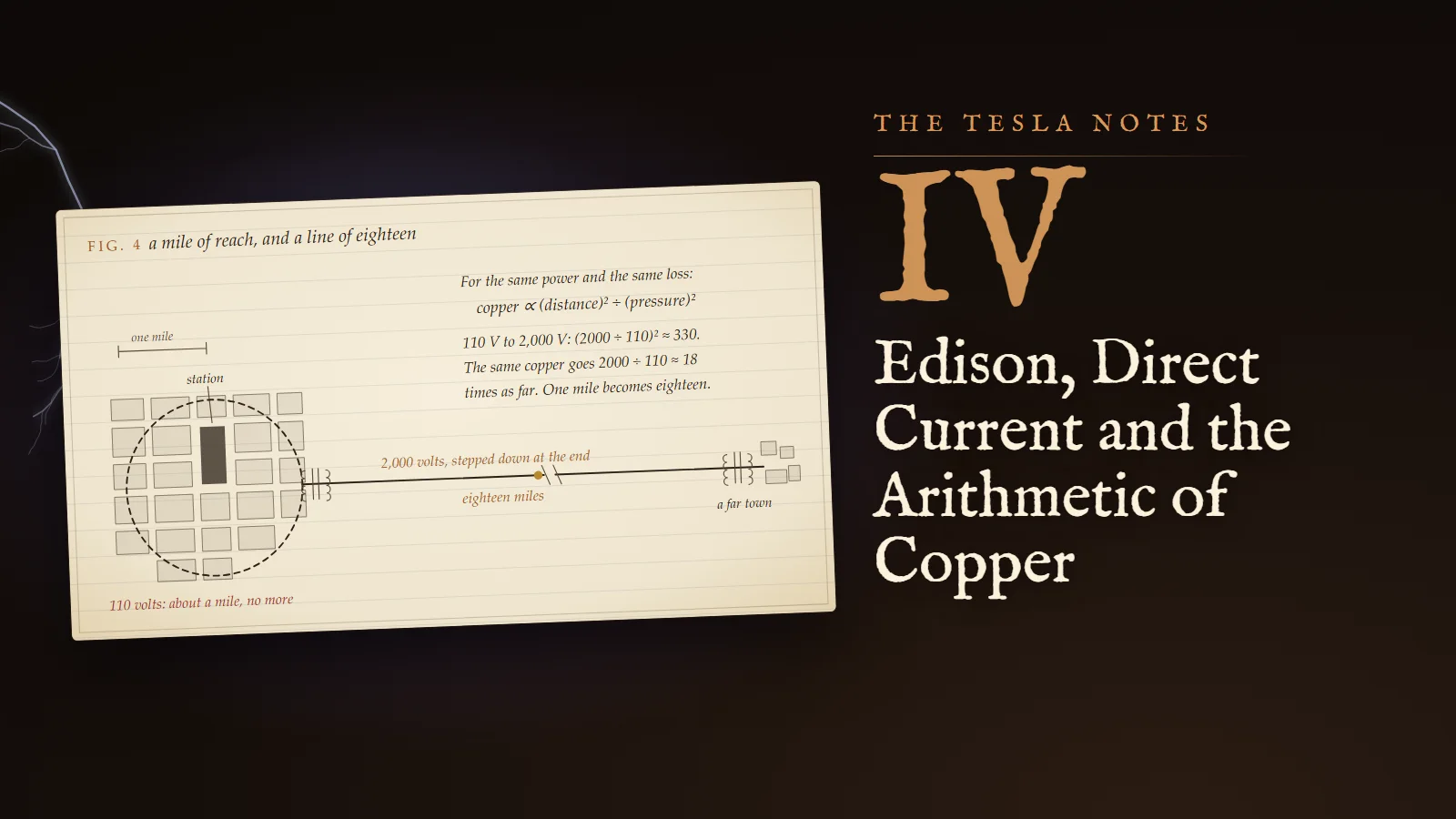
Now the same lamps, the same mile, the same tenth lost, but with the line at 2,000 volts and the pressure brought down to 110 at the far end by some means I shall come to.
- The copper falls as 1/V²: the factor is (2,000 ÷ 110)² = 18.18² = 330.6.
- Mass: 7,200 ÷ 330.6 = 21.8 kilograms, about 48 pounds.
- Or keep the seven tons of copper and the same loss, and ask how far one may go. The copper goes as d²/V², so for fixed copper d goes as V: 2,000 ÷ 110 = 18 times as far. The one mile becomes eighteen.
Fifteen thousand nine hundred pounds against forty-eight. I worked it three times because I did not believe it. It is correct. It is merely the square, and the square is merciless.
Draftsman's note
Fig. 4 is a map of a city that is no city in particular: a grid of blocks, the station at the middle, and round it, dashed in red, the circle of about a mile that 110 volts can reach without ruinous copper. From the edge of the circle a single line runs out across open country to a far town eighteen miles away. Converters at each end, drawn as pairs of coils on an iron core. The line is thin. That is the point of the drawing.
I have made an instrument of it, Plate IV. Choose the pressure, the distance, the number of lamps and the thickness of the wire, and read the current, the pressure the lamps receive, the power lost and the weight of copper in the line.
Calculation
Edison is no fool, and he has seen part of this. His answer is the three-wire system, patented in March of last year. Two outer wires at 220 volts between them, a third wire in the middle, and the lamps connected between the middle wire and either outer wire, half on each side. I check what it saves.
- When the two sides are balanced, the middle wire carries no current; the lamps are in effect two in series across 220 volts.
- For the same power, the outer wires carry half the current of the two-wire system: I′ = P/220 = I/2.
- For the same loss, (I/2)² R′ = I² R, so R′ = 4R. Each outer wire may have a quarter of the section. The two outer wires together hold a quarter of the copper of the two-wire line.
- The middle wire, if made as thick as an outer one, adds half as much again: ¼ × 3/2 = 3/8.
- Therefore the three-wire line needs 3/8 of the copper, a saving of 62½ per cent.
A clever saving. It is my equation applied with V = 220 in place of 110, plus the price of the third wire. It does nothing to the square of the distance. To reach eighteen times as far with the same copper one needs eighteen times the pressure, and no one will put 2,000 volts into a parlour lamp. One needs to raise the pressure for the journey and lower it at the door. With continuous currents there is no way to do that without a motor and a dynamo at every street corner. With alternating currents an induction coil does it, with no moving part at all. I said so at the Works. I was told that alternating current is dangerous and that Mr. Edison does not care for it.
New York, December 1884. Good-bye to the Edison Machine Works
The twenty-four machines are done. They replace the old ones; they run cooler and they spark less, which, after Graz, I find pleasing.
Reflection
I set down the facts plainly, so that my later self cannot improve them. The Manager had promised me fifty thousand dollars on the completion of this task. I completed it and asked for the money. It turned out to be a practical joke. I have resigned. Across the pages of this book for the last weeks of December I have written a farewell to the Edison Machine Works, and I mean it.
Margin
It was a painful shock, and I examine my part in it. A company that refused a junior man a few dollars a week of increase was never going to hand him fifty thousand, and a sober man would have asked for the promise in writing. I am not yet a sober man about money. I trusted a word given lightly because I gave mine heavily. The lesson is cheap at the price, though it does not feel cheap tonight.
Reflection
Of Edison himself I will write only what I have seen. He would find a needle in a haystack by examining every straw, with the diligence of a bee, and he would find it. A little theory and calculation would save him most of the labour, and he would not thank me for saying so. His genius is real and his method is wasteful, and both facts will be true of him when the rest of us are forgotten.
Rahway, 1885 to 1886. The arc lamp they wanted
Almost at once after I left the Works, certain gentlemen proposed to form an arc light company under my name. I agreed. Here at last, I thought, was the chance to build the motor. When I raised it with my new associates, Mr. Lane and Mr. Vail of Rahway in New Jersey, they said: "No, we want the arc lamp. We don't care for this alternating current of yours." So I am making them an arc lamp, and a dynamo for it, and a system for the streets of Rahway.
Draftsman's note
The lamp, for the patent: two carbons, the upper one movable, fed downward as they burn by electromagnets acting through a clutch, so that the arc keeps its length without the flicker of the ordinary lamps and without dash-pots or clockwork. A second patent covers the commutator of the dynamo: arc-light machines run at a high electromotive force, and their commutators spark badly, and I have a construction that prevents it. Graz again. The disease follows me across the ocean and I keep inventing medicines for it, while the cure, which is to have no commutator at all, sits unused in my head.
Calculation
Arc lamps teach something that the Edison men forget. An arc takes, as near as I can measure, about 45 to 50 volts and 10 amperes, and the arc lamps of a street are connected in series, one after another round a single loop, so that the same current passes through all of them.
- Thirty lamps at 50 volts in series: 1,500 volts at 10 amperes, 15 kilowatts.
- Let the loop be four miles long in all, 6,437 metres, and allow 5 per cent lost: 750 watts at 10 amperes, so R = 750 ÷ 10² = 7.5 ohms.
- A = ρL/R = 0.0172 × 6,437 ÷ 7.5 = 14.8 square millimetres, a wire of 4.3 mm.
- Copper: 14.8 × 10⁻⁶ × 6,437 × 8,890 = 847 kilograms.
- The same 15 kilowatts sent two miles at 110 volts with the same 5 per cent lost, by my equation: volume = 4 × 15,000 × 1.72 × 10⁻⁸ × 3,219² ÷ (0.05 × 110²) = 17.7 cubic metres, or 157,000 kilograms.
- The ratio, 157,000 ÷ 847 = 185, is (1,500 ÷ 110)² = 186, as it must be.
So high pressure on a street is already practised, by every arc-light company in the country, with continuous current, in series. The arc men have the economy of high pressure and pay for it with a dangerous circuit and lamps that cannot be switched one by one. The Edison men have safe parallel lamps and pay for them with copper. Nobody has both. Alternating current, raised and lowered by converters, gives both.
Margin
In 1886 my system of arc lighting was perfected and adopted for factory and municipal lighting, and then the gentlemen formed another company to run it and left me out. I have a beautifully engraved certificate of stock, of hypothetical value. I keep it in this book as a bookmark.
New York, winter 1886 to 1887. Two dollars a day
I am digging ditches. The Western Union is laying cables and pays two dollars a day for men with shovels, and I am a man with a shovel. My learning in science, mechanics and literature seems a mockery in the frozen ground.
Reflection
And yet the ditch is instructive. I am laying, with my own hands, the conductors whose copper I calculated at Goerck Street. I know to the pound what they cost, and the foreman does not. The foreman of this work, Mr. Alfred Brown, has noticed that his labourer talks about induction motors. He has listened. He knows a lawyer in Englewood, Mr. Charles Peck. I have told Brown of my schemes for making motive power from heat by the magnetism of iron, which vanishes when iron is heated to redness and returns when it cools, and it is these, more than the motor, that catch their interest. We have talked three evenings now. I think they will back me.
Calculation
What I shall put before them, written as a plan of battle.
- Copper rules every system of distribution: volume = 4Pρd² ÷ (xV²). The only weapon against d² is V².
- High pressure is safe on a line and unsafe in a house. It must be raised for the line and lowered at the house.
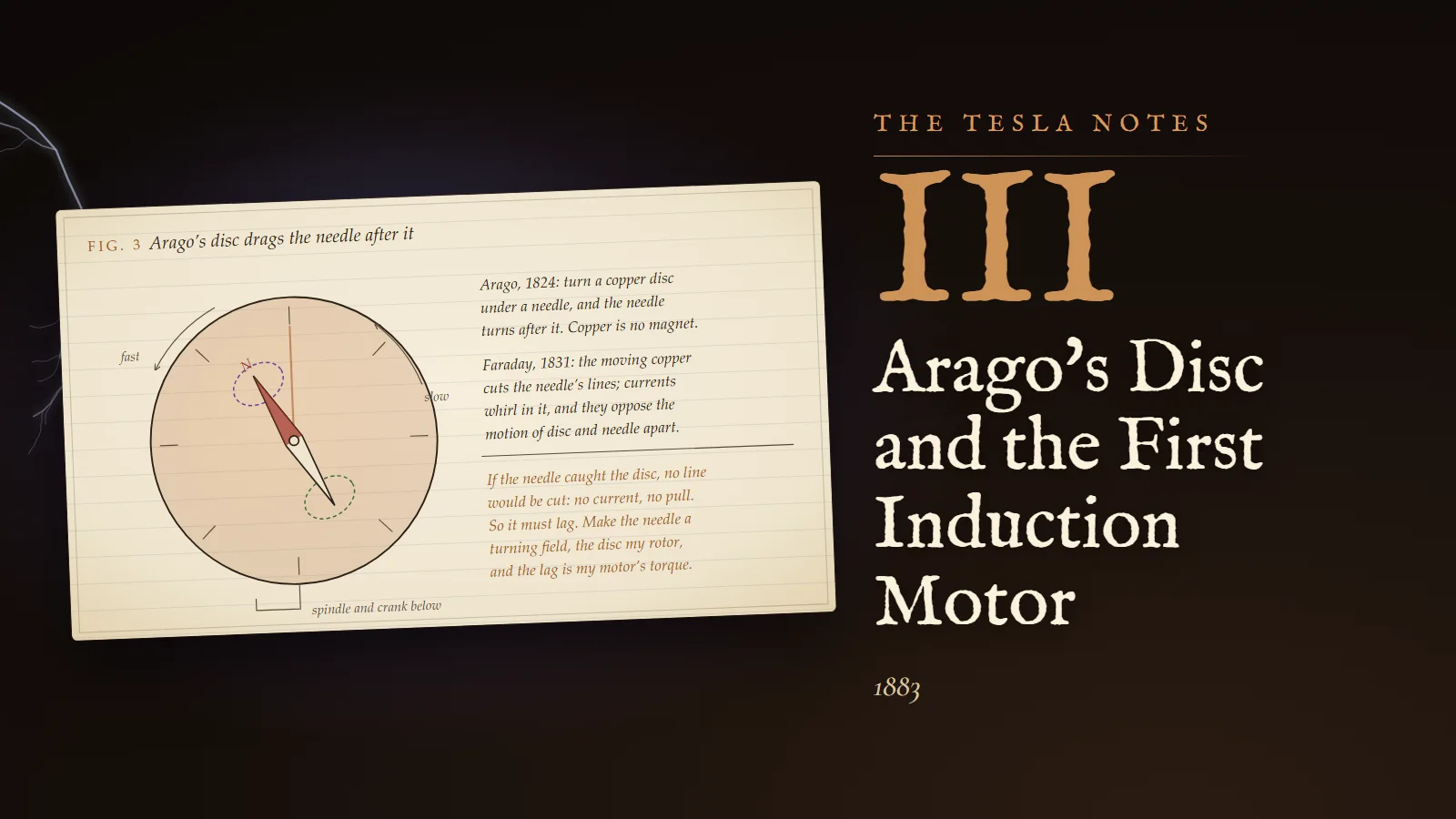
- Only alternating currents can be raised and lowered without machinery: an induction coil, a ring of iron with two windings, does it by Faraday's own law of 1831. In Europe they are already trying such converters for lighting.
- But a system that can light lamps and cannot drive motors will never be a system of power. There is no good alternating current motor in the world.
- Except mine. Two or three currents of different phase, a field that turns, a rotor of copper touching nothing. I have had it running in Strassburg since the summer of 1883.
Points 1 to 3 are the reason the world will want alternating current. Point 5 is the reason it will have to come to me.
Margin
April 1887. The Tesla Electric Company is organised, with a laboratory and facilities. Brown and Peck take a third, I take a third, and a third goes back into the work. I am to have a shop, and a machinist, and I shall build the motors exactly as I see them. After three years in this country I shall at last put copper and iron where my head has been.
Problems I set myself
1. Two hundred lamps, each taking 0.5 ampere at 110 volts, are to be supplied at a distance of half a mile with 5 per cent of the power lost in the line. Find the section of each copper conductor and the mass of copper. Compare with the example of one hundred lamps at one mile with 10 per cent lost.
Answer. P = 200 × 55 = 11,000 watts; d = 805 metres; x = 0.05. A = 2Pρd ÷ (xV²) = 2 × 11,000 × 0.0172 × 805 ÷ (0.05 × 12,100) = 304,600 ÷ 605 = 503 square millimetres, a rod 25.3 mm across. Mass = 503 × 10⁻⁶ × 1,610 × 8,890 = 7,200 kilograms. The same seven tons as the example: the copper goes as Pd²/x, and here P is doubled, d² is quartered and x is halved, so the product is unchanged.
2. In the three-wire system, suppose the middle wire is made half the section of an outer wire. What fraction of the two-wire copper is needed for the same loss when the sides are balanced?
Answer. The outer wires together need a quarter of the two-wire copper, each outer wire one eighth. A middle wire of half an outer's section adds one sixteenth. The total is 1/4 + 1/16 = 5/16, or 31¼ per cent, a saving of 68¾ per cent. The thin middle wire is safe only while the lamps on the two sides are nearly balanced, since it carries the difference of their currents.
3. A line at 110 volts loses 10 per cent of its power in the copper. Without changing the copper or the power delivered, the pressure is raised to 1,000 volts by converters. What fraction is lost now? And how much farther could the line reach with its original 10 per cent loss?
Answer. The fraction lost goes as 1/V² for fixed copper and power: 0.10 × (110 ÷ 1,000)² = 0.10 × 0.0121 = 0.0012, about one eighth of one per cent. For the same loss and copper the distance goes as V, so the line could reach 1,000 ÷ 110 = 9.1 times as far: the copper goes as d²/V², so with copper and loss fixed, d grows in proportion to V.
To the student who reads this later
The equation of this notebook is the reason your world is wired the way it is. Your transmission lines run at hundreds of thousands of volts because the copper, or aluminium, goes as d²/V², and your houses are fed at a few hundred volts because people live in them. Your engineers would write my calculation as P_loss = I²R with R = ρL/A, and they would add what I left out: the inductance and capacitance of long lines, the heating limits of conductors, and the corona that breaks out round wires at very high pressure.
Be fair to Edison, as I was not always. The obstacle to long-distance direct current was the difficulty of changing its pressure, which nothing in 1884 could do without rotating machinery. When engineers later learned to convert direct current to alternating and back with mercury-arc valves and then with transistors of great power, direct current came back for the longest lines: a high-voltage direct current cable linked Gotland to the Swedish mainland in 1954, and today such links cross seas and continents. Edison's three-wire system lives on in the split-phase supply of North American houses, with 120 volts on either side of a neutral and 240 across the outers. And the war that came between his system and mine, in the years after this notebook, was fought with more fear and less arithmetic than it deserved.
Of the fifty thousand dollars: I wrote in 1919 that the Manager had promised it, and I meant Batchelor. The version in which Edison himself laughs at me and says I do not understand American humour was added by other people, long after. In 1931, when Edison died, I said that a little theory and calculation would have saved him ninety per cent of his labour. I still think so. I also said that the amount of his actual accomplishments was little short of a miracle. I think that too.
What to try: take a reel of thin copper wire, a 12-volt lamp and a 12-volt supply. Measure the lamp's brightness, or its voltage, with ten metres of wire and then a hundred. Then repeat with a pair of small transformers stepping up to 120 volts for the long run and down again at the lamp. You will have made my map on your bench.
If you want to hear about Goerck Street, the Oregon, or the night I worked out the seven tons, come and ask me.
Sources and liberties
The Tesla Notes are a modern reconstruction written in Nikola Tesla's voice by Eternal Gardens. Dates, patents, lectures, apparatus and quotations come from the sources below; the private reflections, the order of the working and the sketches are ours.
- Nikola Tesla, "My Inventions", Electrical Experimenter, 1919, Part IV (arrival, Edison, the Oregon, the twenty-four machines, the fifty thousand dollars, the arc light company, the Tesla Electric Company): https://en.wikisource.org/wiki/My_Inventions
- "Tesla Says Edison Was an Empiricist", New York Times, 19 October 1931 (the haystack and the theory and calculation), transcription: https://teslauniverse.com/nikola-tesla/articles/tesla-says-edison-was-empiricist
- W. Bernard Carlson, "Places of Invention: Nikola Tesla's Life in New York", Gotham Center, 2013 (arrival in June 1884, Goerck Street, the ditch digging, Brown and Peck): https://www.gothamcenter.org/blog/places-of-invention-nikola-teslas-life-in-new-york; and Carlson, Tesla: Inventor of the Electrical Age (Princeton University Press, 2013), for the diary farewell and the dispute over pay.
- US Patent 335,786, Electric-Arc Lamp, filed 30 March 1885, granted 9 February 1886: https://patents.google.com/patent/US335786A/en; US Patent 334,823, Commutator for Dynamo-Electric Machines, filed 6 May 1885, granted 26 January 1886: https://patents.google.com/patent/US334823A/en
- Tesla Electric Light and Manufacturing, Rahway: https://en.wikipedia.org/wiki/Tesla_Electric_Light_and_Manufacturing
- IEEE Milestone, Pearl Street Station, 1882 (opening on 4 September 1882 and the First District of about a quarter of a square mile): https://ethw.org/Milestones:Pearl_Street_Station,_1882
- Edison's three-wire system, US Patent 274,290, granted 20 March 1883: https://patents.google.com/patent/US274290A/en; Samuel Insull to E. H. Johnson, 1 April 1883, on the copper saving: https://edisondigital.rutgers.edu/document/LM003115
The fifty-thousand-dollar story is contested: Tesla's own account blames "the Manager", Charles Batchelor, and historians note that the company refused him a small raise and suggest a disputed bonus; the line about American humour put in Edison's mouth is later embroidery. Tesla's "nearly a year" of night hours conflicts with his roughly six months at the Works. The lamp current, the arc lamp figures and the copper examples are worked illustrations with the physics of the day, and the Oregon testing procedure is our reconstruction of the repair Tesla describes.