
New York, the autumn of 1909. The tower at Shoreham stands unfinished against the sky, the boilers are cold, and the newspapers have found younger wonders. I am fifty-three years old, and I have gone back to the first machines that ever enchanted me: the water wheels I built as a boy in Gospić, in a schoolroom with a few mechanical models, dreaming of the falls of Niagara. Electricity has given me fame and debt in equal measure. Now I want to make a prime mover so simple that a child could understand it and an engineer could not improve it: a turbine with no blades at all. This is the last chapter of these notes, and it ends where every notebook ends, with the hand that wrote it.
"It is absolutely immaterial to me whether I run my turbine in thought or test it in my shop. I even note if it is out of balance."
Nikola Tesla, "My Inventions", chapter I, Electrical Experimenter, 1919
New York, 21 October 1909. A machine without blades
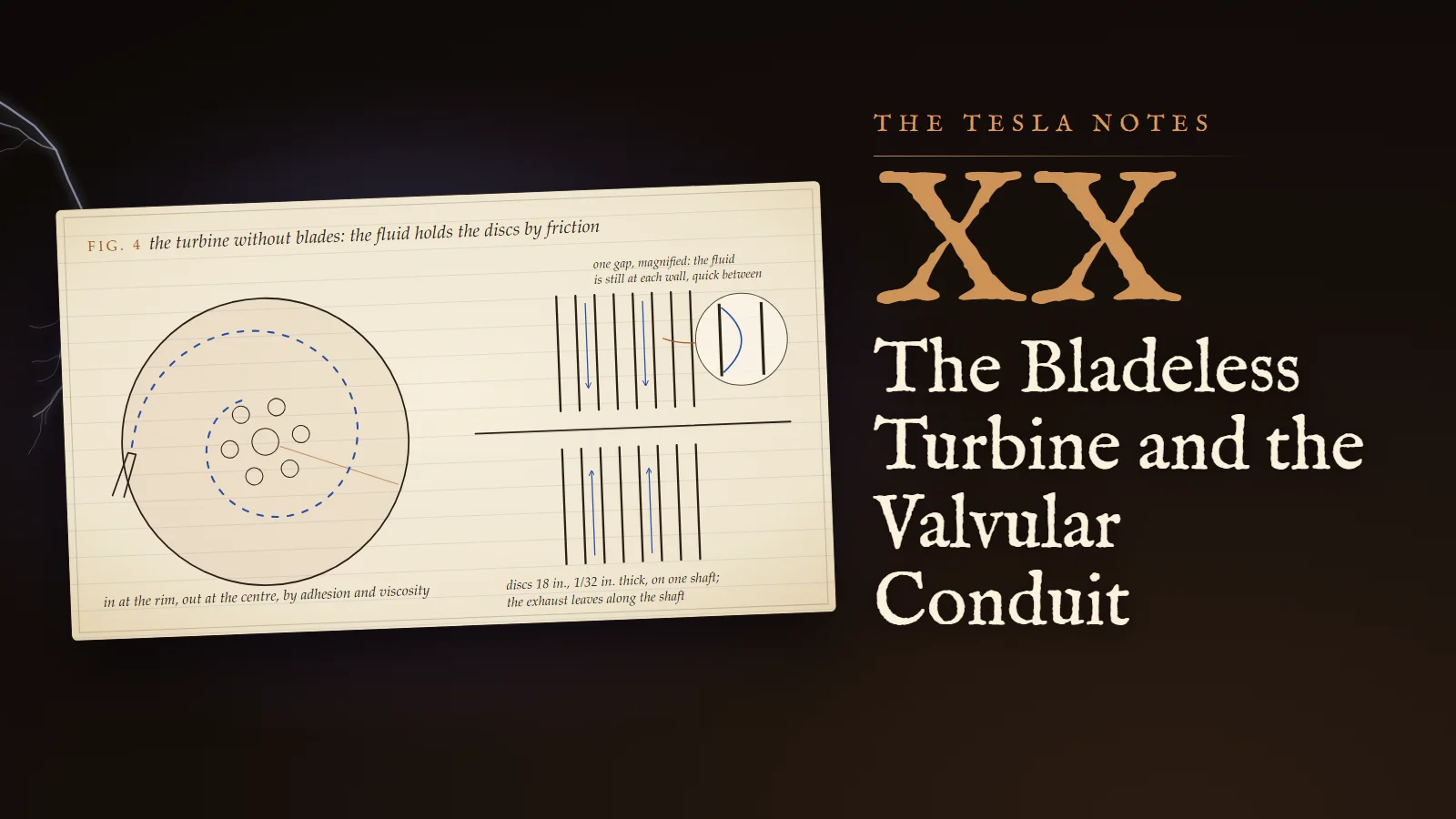
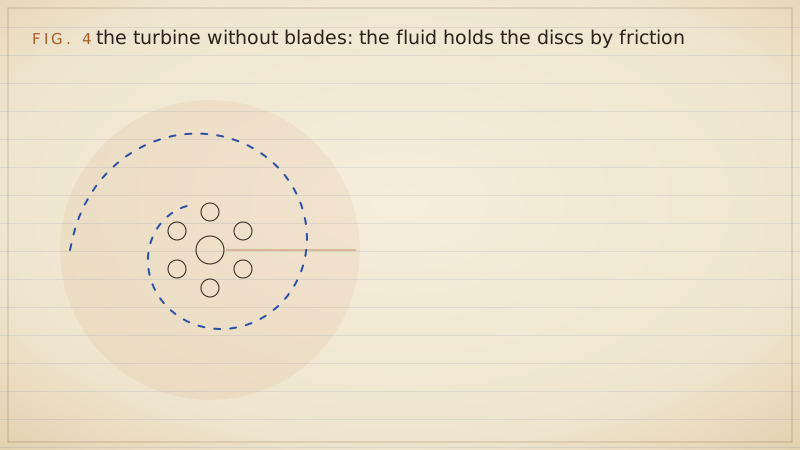
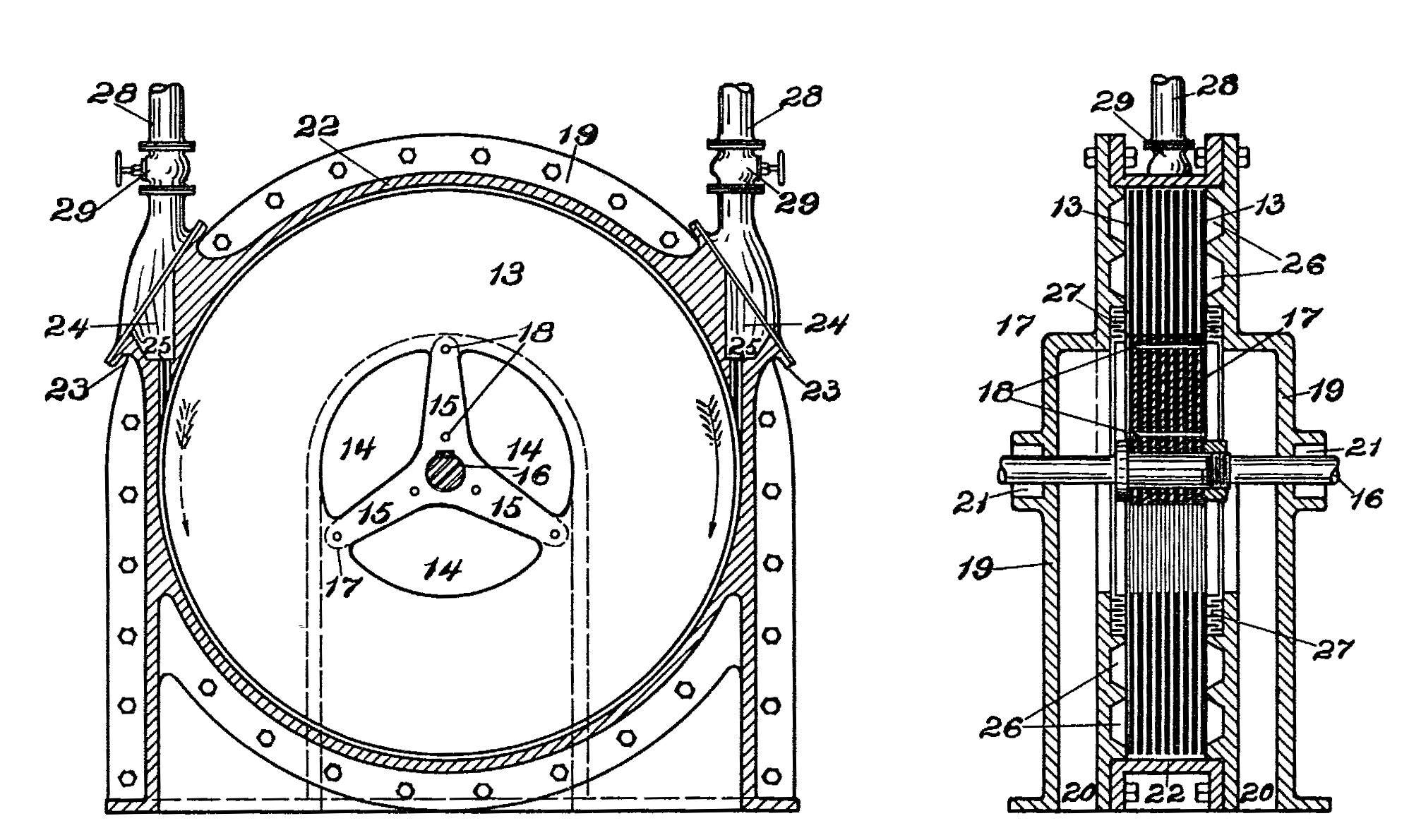
Today I filed the application for the machine I call a fluid propeller, and with it, in my mind, its twin, the turbine. The principle is older than any engine: a fluid clings to a surface it flows over. Every river drags at its bed; the wind drags at a sail even when it does not fill it. In the ordinary turbine the steam strikes blades and is turned aside, and every blade is a place where the steam is shocked and eddies and wastes its energy. I propose instead a stack of flat, thin discs on one shaft, set very close together. The fluid enters at the rim, almost tangentially, and finds its way to the centre in a spiral, leaving at openings near the shaft. As it spirals it drags the discs along by its adhesion and viscosity. There are no blades to strike, no edges to erode, nothing but smooth metal and the friction I have spent my life trying to avoid, now put to work.
The rule for the spacing I have written into the application in these words: "the intervening distance should be the greater, the larger the diameter of the disks, the longer the spiral path of the fluid and the greater its viscosity." It is a rule of proportion, and I want to know where it comes from.
Calculation
The drag of a fluid moving between two parallel walls a distance b apart, slowly enough that it flows in smooth layers.
- Between fixed walls the velocity takes the form of a parabola, nothing at each wall and greatest in the middle. If the mean velocity relative to the walls is ū, the greatest is 3ū/2.
- The slope of the parabola at a wall is 6ū/b, so each wall feels a stress τ = 6µū/b, where µ is the viscosity.
- A slab of fluid of area A between the two walls has volume Ab and feels the drag of both walls: 2 × 6µūA/b. Per unit volume that is 12µū/b², and per unit mass 12νū/b², where ν = µ/ρ is the kinematic viscosity.
- So the motion of the fluid relative to the discs decays as e^(−t/τ), with τ = b²/(12ν).
- For air, ν ≈ 1.5 × 10⁻⁵ square metre per second. With b = 0.5 millimetre: τ = (5 × 10⁻⁴)² ÷ (12 × 1.5 × 10⁻⁵) = 2.5 × 10⁻⁷ ÷ 1.8 × 10⁻⁴ ≈ 1.4 thousandths of a second.
- For water, ν ≈ 1.0 × 10⁻⁶. With b = 0.2 millimetre: τ = 4 × 10⁻⁸ ÷ 1.2 × 10⁻⁵ ≈ 3.3 thousandths of a second.
Here is the meaning of my rule. The fluid must give up its motion to the discs during the time it spends between them. That time is set by the length of the spiral path and the speed. If the gap is too wide, τ is longer than the passage and the fluid rushes out still whirling, its energy carried away in the exhaust. If it is too narrow, the fluid gives up its whirl at once but must be forced inward through a channel so tight that the friction of the inward flow wastes more than the discs receive. Between them lies a best gap. A more viscous fluid couples more strongly, so it can afford a wider gap; a longer path gives it more time, so the same. The rule follows.
Reflection
I built my first small machines of this kind in 1906 and have run them in my shop ever since. I have also run them, more times than I could count, in my head. I do not rush into actual work. I let the idea grow in imagination, change it, operate it, and only when I can see no fault do I give it to the machinist. With the turbine I have been unable to find the fault. That should worry me more than it does.
Waterside Station, New York, 1911. Two hundred horsepower on a table
The New York Edison Company has let me test my turbines at its Waterside station, beside its great reciprocating engines and bladed turbines. I presented the machine to the National Electric Light Association on 15 May. The figures of the large unit as the Engineering News reported them in October: two hundred horsepower developed at a speed of 9,000 revolutions a minute, with steam at 125 pounds gauge exhausting to the atmosphere. The rotor has 25 discs of 18 inches diameter (another writer counts 23). The whole machine occupies a floor space of about 20 by 35 inches and stands about five feet high. It weighs about 400 pounds: two pounds to the horsepower.
Calculation
The speed and the strain.
- Angular speed: ω = 2π × 9,000 ÷ 60 = 2π × 150 ≈ 942 radians per second.
- Speed of the rim: v = ωR = 942 × 0.2286 metre ≈ 215 metres per second, or 707 feet per second. The edge of every disc moves at two thirds of the speed of sound.
- Torque at full power: T = P/ω = (200 × 746) ÷ 942 ≈ 158 newton-metres, about 117 pound-feet. A modest twist; the machine is fast, not strong.
- The stress at the centre of a thin solid disc spinning at ω, by the theory of rotating discs: σ = ((3 + 0.3)/8) ρω²R², where 0.3 is Poisson's ratio for steel and ρ = 7,850 kilograms per cubic metre.
- σ = (3.3/8) × 7,850 × 942² × 0.2286² = 0.4125 × 7,850 × 46,400 ≈ 1.5 × 10⁸ pascals, about 22,000 pounds per square inch. Cut a hole at the centre for the shaft and exhaust, and the stress at its edge nearly doubles.
Good steel bears this cold. Hot, for hours, with steam at the rim and a temperature gradient across every disc, it will slowly stretch and warp. I note this as the danger I have least answered.
The economy. The steam consumption was about 38 pounds per horsepower-hour. How good is that?
- Saturated steam at 125 pounds gauge (about 140 pounds absolute) holds about 1,193 British thermal units per pound.
- Expanded perfectly, without loss, to atmospheric pressure, it would keep about 1,026. The most it can give is 1,193 − 1,026 ≈ 167 units per pound.
- One horsepower-hour is 2,545 units. A perfect machine would need 2,545 ÷ 167 ≈ 15.2 pounds of steam per horsepower-hour.
- My machine used 38. Its efficiency was 15.2 ÷ 38 ≈ 40 per cent of the ideal.
Forty per cent from a single stage, exhausting to the open air, with discs and a casing made in a hurry. I told the reporters that with superheated steam and a condenser I expect ten to twelve pounds per horsepower-hour. That would beat any engine in the world. I believe it. I must also write here that I have not yet done it.
I have drawn the passage of the fluid as Plate XX. Choose a fluid and move the gap between the discs; watch the stream spiral in from the rim and the curve of efficiency below it. The best gap appears where the gap is about equal to the thickness of the layer of fluid that the discs have time to drag along, and it is wider for oil and narrower for steam, exactly as my rule demands.
Experiment No. 1
To measure the power I coupled two identical turbines on one shaft and ran one as a turbine and the other, reversed, as a brake: the steam of the second opposes the first, and the work of the first is read from the pressures and speeds of both. It is a pretty arrangement and it puzzles visitors, who see two engines roaring and no work coming out. A smaller unit with discs of nine and three quarters inches, about the size of a derby hat, gave 110 horsepower and might give twice that.
Margin
6 May 1913: both patents granted, 1,061,142 for the fluid propeller and 1,061,206 for the turbine. In the turbine patent I wrote that the torque is directly proportional to the square of the velocity of the fluid relative to the runner and to the effective area of the discs, and inversely to the distance separating them; and that "The machine will, generally, perform its maximum work when the effective speed of the runner is one-half of that of the fluid." I added at once that for the highest economy the slip should be as small as possible. Greatest power and greatest economy are different aims, and a buyer will ask for both.
New York, 21 February 1916. A conduit that refuses
The war in Europe has filled the newspapers with engines, pumps and aeroplanes, and my mind with the movement of fluids. Today I filed an application for a thing that is almost nothing: a channel cut into a block of metal, with no moving part, which lets fluid pass one way and resists it the other. I call it a valvular conduit. The claim describes "interior walls of such conformation as to permit the free passage of fluid through it in the direction of flow but to subject it to rapid reversals of direction when impelled in the opposite sense."
Draftsman's note
A straight passage, gently zigzagging, with a series of loops or buckets opening off it, alternately on one side and the other. Between each loop and the main channel stands an island of metal shaped like a teardrop. Going forward, the fluid follows the main channel; the mouths of the buckets face downstream and the stream passes them by. Going backward, the stream meets each bucket head on, and a large part of it is turned in, carried round the island through 180 degrees, and thrown back into the main channel against the oncoming flow. Each bucket deflects the fluid through half a circle; a whole cycle, out and back, through a full turn of 360 degrees. Where the turned jet meets the main stream they collide at a relative speed twice that of the flow.

Calculation
An estimate of how well it should refuse. Let u be the speed of the flow and ½ρu² its velocity head, the pressure equivalent of its motion.
- Going forward, through smooth bends, each element might cost the stream a small fraction of a velocity head. Suppose (my estimate) one tenth: a forward loss of 0.1 × ½ρu² per element.
- Going backward, the turned jet meets the main stream at relative speed 2u. The velocity head of that collision is ½ρ(2u)² = 4 × ½ρu², and much of it is destroyed in eddies. Suppose half: a reverse loss of 2 × ½ρu² per element.
- The ratio of resistances, reverse to forward, is then about 2 ÷ 0.1 = 20, whatever the number of elements, since both add up alike.
- With better shaping, and with the sudden reversals of a pulsating flow, in which the stream has no time to settle into an easy path, the ratio should rise far above this.
In the specification I wrote: "The theoretical value of this ratio may be 200 or more, but must be taken as appreciably less". My estimate above is a tenth of 200. I have not measured it. I intend the conduit for pumps and compressors driven by rapid pulsations, where it will act as a slightly leaking valve that never wears and never sticks.
I have made the conduit into Plate XX-b. Choose "Reverse" and watch the stream turned back on itself; choose "Pulsing" and see the fluid creep forward though it is pushed equally both ways. The chart below it is the cruel part, and I have drawn it honestly, from the measurements of a later century.
Milwaukee and New York, 1919. Writing my life
This year I have done two things I never expected to do: I have taken a salary, and I have written my memoirs. Allis-Chalmers in Milwaukee have engaged me to work on turbines. The engineers there are capable men, polite to me and loyal to the bladed machines that pay their wages. And Mr. Gernsback's Electrical Experimenter is printing my recollections in monthly parts, from my childhood to the magnifying transmitter and the art of telautomatics.
Reflection
In one of those parts I told a story against myself, because it is true. I met my old friend from the Westinghouse days, Charles F. Scott, now professor of electrical engineering at Yale, and carried away by the vision I exclaimed, "my turbine will scrap all the heat-engines in the world." Scott stroked his chin and looked away, as though making a mental calculation. "That will make quite a pile of scrap," he said, and left without another word.
He was right in a way he did not intend. I wrote in the same chapter that my turbine is a radical departure, "in the sense that its success would mean the abandonment of the antiquated types of prime movers on which billions of dollars have been spent." My rotating field gave value to existing machinery and new business to every factory. My turbine asked the world to throw its machinery away. That is why the progress of the rotating field was fast and why the progress of the turbine will be slow, if it comes at all.
Margin
Written later, and honestly. The turbine was not adopted, and the conservatism of capital was only one of the reasons. The bladed turbine improved rapidly, stage upon stage, with condensers and superheat, until its steam consumption fell to a fraction of my 38 pounds. My thin discs, at high speed and temperature, tended to stretch and distort, as I feared. And the best spacing holds for one fluid at one rate of flow, so the machine lost its economy whenever the load changed. I licensed the principle where its gentleness was a virtue: in instruments, and in speedometers for fine motor cars, where a disc dragged by viscous air turns a needle smoothly. A great idea made into a small one. I am not too proud to be glad of it.
Hotel New Yorker, 1931 to 1942. Pigeons, birthdays and promises
On my seventy-fifth birthday, in July 1931, Time put my face on its cover, and letters came from men I admire, Einstein among them. I have lived in hotels since the Waldorf in 1900, moving when the bills grew too large for the managers' patience, and since 1934 I have lived at the Hotel New Yorker. The Westinghouse company pays me a hundred and twenty-five dollars a month and my rent, a kindness from the house that built Niagara on my patents. I feed the pigeons in Bryant Park and from my window. In the autumn of 1937, crossing the street on my way to feed them, I was struck by a taxicab. Three ribs were broken. I would not see a doctor. I have doctored myself all my life.
Reflection
Every July the reporters come to lunch, and every July I give them something. One year a motor driven by cosmic rays; one year a beam that could destroy an army two hundred miles away and bring down ten thousand aeroplanes at two hundred and fifty; one year an account of a mechanical oscillator that shook the building on Houston Street in 1898, which became, in the retelling, a machine to split the earth; one year a dynamic theory of gravity, worked out in all details, I said, and a second discovery, that "There is no energy in matter other than that received from the environment." I said of the theory of relativity that it is "like a beggar clothed in purple whom ignorant people take for a king." I have never published the gravity theory. I write here what this notebook requires: those announcements were not supported by the kind of work recorded in the other pages of these notes, with their gauges and capacities and resonance curves. Some were hopes, some were memories enlarged by age, and some, I fear, were the price of being invited to lunch.
Calculation
One promise I can check with the arithmetic I used on Marconi. A beam travels in a straight line. For it to strike an army 200 miles off, the target must be above the horizon of the source.
- Distance: d = 200 miles ≈ 322 kilometres. Radius of the earth: R = 6,371 kilometres.
- The height h from which a straight line just reaches a point on the surface at distance d satisfies, for small angles, h ≈ d²/(2R).
- h ≈ 322² ÷ (2 × 6,371) = 103,700 ÷ 12,742 ≈ 8.1 kilometres.
The beam would have to leave from a height of eight kilometres, higher than any mountain in Colorado, or bend round the earth, which beams do not do. The old man who made that promise at lunch should have sat down with the young man who wrote the entry of 12 December 1901.
Hotel New Yorker, January 1943. The last page
It is very cold. The pigeons come to the sill in the mornings and I let them in when I can. My papers are in trunks, some here, some in storage, some I have not opened in years: the Colorado notebook, the Wardenclyffe accounts, the drawings of discs and conduits. I am eighty-six years old.
Reflection
I have been reading my own pages from Graz, where Professor Poeschl told me that a motor without a commutator was a perpetual motion machine, and I saw that it was not. I read the night in the park at Budapest when I drew the turning field in the sand, and the years when it became the motors of every factory in the world. I read Niagara, and the fire that took my laboratory, and the storm walking away from me across the plains. I find that the things I measured have lasted and the things I only announced have not. That is a law of compensation, and I believe in it. The true rewards are in proportion to the labour, and the labour that was honest still turns the world's machinery. The rest was noise, and I made a great deal of it. Let the student take the measurements and forgive the noise.
Problems I set myself
1. A turbine with discs of 18 inches gives 200 horsepower at 9,000 revolutions per minute. Find the rim speed, the torque, and the steam rate a perfect machine would need if each pound of steam can give at most 167 British thermal units.
Answer. ω = 2π × 150 = 942 rad/s; R = 0.2286 m; rim speed ωR ≈ 215 m/s. P = 200 × 746 = 149,200 W; T = P/ω ≈ 158 N·m. Ideal steam rate: 2,545 ÷ 167 ≈ 15.2 lb per horsepower-hour. At 38 lb per horsepower-hour the machine reached about 40 per cent of the ideal.
2. Air passes through a disc turbine in about 7.4 milliseconds. Estimate the thickness of the layer of air the discs can drag in that time, and so the best gap, taking ν = 1.5 × 10⁻⁵ m²/s. Why does oil need a wider gap?
Answer. The momentum of the discs diffuses into the fluid over a distance δ ≈ √(νt) = √(1.5 × 10⁻⁵ × 7.4 × 10⁻³) = √(1.11 × 10⁻⁷) ≈ 3.3 × 10⁻⁴ m, a third of a millimetre. The best gap is of that order, as Plate XX shows. For oil, ν is about a hundred times larger and the passage slower, so δ is several millimetres and the gap may be correspondingly wider, as the patent says.
3. A valvular conduit with diodicity Di is driven by equal and opposite pulses of pressure. If the pressure needed grows as the square of the flow, how much of the forward stroke is lost on the return? Compare Di = 2 with Tesla's 200.
Answer. With Δp = RQ², the same pressure each way gives a return flow equal to the forward flow times √(R forward ÷ R reverse) = 1/√Di. For Di = 2 the return flow is 1/√2 ≈ 0.71 of the forward, so the net forward displacement per cycle is 1 − 0.71 = 0.29 of the forward stroke. For Di = 200 the return is 1/√200 ≈ 0.07, and the net is 0.93 of the stroke. A measured valve pumps, but less than a third as well as the patent hoped.
To the student who reads this later
You have the last word on my last machines, so let me give you the evidence first.
The disc turbine has been studied carefully since my death. Warren Rice and others measured single-stage machines of my kind working on air and found overall efficiencies of about 36 to 41 per cent, close to the 40 per cent I worked out above from the Waterside steam rate. The flow between the discs can be very efficient in itself, but the nozzles, the exhaust and the losses at the edges of the discs eat the gain. Your engineers use the principle where smoothness matters more than economy: disc pumps for abrasive slurries, blood and fragile fluids, small turbines for students and enthusiasts. My rule for the spacing is now stated as the requirement that the gap be comparable to the thickness of the boundary layer, which is what Plate XX shows.
The valvular conduit came back to life a century after I filed it. Engineers made small versions as fixed-valve micropumps from the 1990s onward. In 2021 Quynh Nguyen, Joanna Abouezzi and Leif Ristroph, at New York University, built a faithful copy and measured it. The diodicity stays near 1 until a Reynolds number of about 100, switches on abruptly between 100 and 300, and is about 2 from 300 to 1,500. The mechanism is the one I described, the turned jets colliding with the main flow, but it works because the reverse flow becomes turbulent at a Reynolds number about ten times lower than in a plain pipe. They also confirmed my conjecture that pulsating flow improves the performance several-fold, and they built a rectifier of four conduits that turns an oscillating piston into a steady current of water. Their verdict on my figure is just: a diodicity of 200 "seems well beyond reach", at least in the regime they studied. I asked for two hundred and nature gave two. It is still a valve without a moving part, and it still works.
And now the part of this notebook I could not write myself.
I died in my room at the Hotel New Yorker on the night of 7 January 1943, alone, of a failure of the heart, and was found the next day. On the 10th the Mayor of New York, Fiorello La Guardia, read a eulogy over the radio. On the 12th about two thousand people came to my funeral at the Cathedral of St. John the Divine; my body was taken to Ferncliff and cremated. Within two days of my death the Office of Alien Property took charge of my belongings, because the government feared that my papers held some weapon. A young engineer from the Massachusetts Institute of Technology, John G. Trump, technical aide to the National Defense Research Committee, examined them at the Manhattan Warehouse on 26 and 27 January. On 30 January he wrote that "it is my considered opinion that there exist among Dr. Tesla's papers and possessions no scientific notes, descriptions of hitherto unrevealed methods or devices, or actual apparatus which could be of significant value to this country or which would constitute a hazard in unfriendly hands." He described my later thinking as "speculative, philosophical, and somewhat promotional" in character. He was right, and I am grateful to him for being exact.
The papers were released to my nephew, Sava Kosanović, and shipped to Belgrade; on 5 December 1952 the Nikola Tesla Museum was founded there, in a villa on Krunska Street, where my ashes rest in a gilded sphere. Its archive holds some 160,000 documents. In 1978 the museum published the Colorado Springs notebook in English, the notebook from which two of the chapters before this one were drawn, its figures exactly as I wrote them, errors and all. In 2003 UNESCO inscribed my archive in its Memory of the World. Somewhere in those boxes are the gauges of wire, the capacities in centimetres, the resonance curves drawn by hand at midnight. They are the best of me.
Twenty chapters ago I was a student in Graz, watching sparks at a commutator and thinking there must be a better way. Look at what came of it, and keep the true parts apart from the legend. The rotating magnetic field turns in nearly every electric motor on earth. Alternating current, stepped up and down by transformers and carried at sixty cycles or fifty, lights your cities, and Niagara was its first great proof. Resonance, tuned circuits and the coupled oscillator are in every radio you own. A boat steered by invisible pulses in 1898 is the grandfather of every remotely guided machine. The earth does ring, faintly, at 7.83 cycles per second, though not in the way I thought. I did not send power around the globe. I did not split the earth, or speak with Mars, or build a ray. I made mistakes in public that I would never have made in a notebook, and the notebook is the better witness.
What I would ask of you is the habit, more than any machine: see the device whole in your mind before you build it; then build it and measure it; then believe the measurement over the vision, every time they disagree. Do that, and the future will be yours by right, because you will have earned it the honest way, which is the only way that lasts.
If you would like to ask me what I would build first if I were starting today, or to quarrel with me over the turbine, the valve or anything in these twenty chapters, come and ask me.
Sources and liberties
The Tesla Notes are a modern reconstruction written in Nikola Tesla's voice by Eternal Gardens. Dates, patents, lectures, apparatus and quotations come from the sources below; the private reflections, the order of the working and the sketches are ours.
- US Patent 1,061,142, "Fluid Propulsion", filed 21 October 1909, granted 6 May 1913: Google Patents; US Patent 1,061,206, "Turbine", granted 6 May 1913: Google Patents
- US Patent 1,329,559, "Valvular Conduit", filed 21 February 1916, granted 3 February 1920: Google Patents
- "Tesla Steam Turbine", Engineering News, 12 October 1911: Tesla Universe transcription; F. P. Stockbridge, "The Tesla Turbine", World's Work, March 1912: Tesla Universe transcription
- N. Tesla, "My Inventions", Electrical Experimenter, 1919 (the turbine in thought, the Scott anecdote, the law of compensation): Wikisource
- W. Rice, "Tesla Turbomachinery", 1991: gyroscope.com (PDF); "Tesla turbine": Wikipedia
- Q. M. Nguyen, J. Abouezzi and L. Ristroph, "Early turbulence and pulsatile flows enhance diodicity of Tesla's macrofluidic valve", Nature Communications 12, 2884 (2021): doi:10.1038/s41467-021-23009-y
- "Tesla, 79, Promises To Transmit Force", New York Times, 11 July 1935, and the prepared statement of 10 July 1937: Tesla Universe; Tesla Universe
- J. G. Trump to W. Gorsuch, 30 January 1943, in the FBI file on Nikola Tesla: p. 174, p. 175
- PBS, "Tesla: Life and Legacy, The Missing Papers": pbs.org; Tesla Memorial Society, the funeral: teslasociety.com
- "Nikola Tesla" (hotels, Westinghouse stipend, the 1937 accident, the 1931 cover) and "Nikola Tesla Museum": Wikipedia; Wikipedia; UNESCO Memory of the World, "Nikola Tesla's Archive": unesco.org
- Drawings: turbine patent; valvular conduit, public domain on Wikimedia Commons
The 1906 turbines are reported in later sources; the 200 horsepower Waterside figures are from the trade press of 1911, and the disc count is given as 25 and as 23. The "death ray", the earthquake oscillator (a 1935 retelling with no evidence from 1898), the cosmic-ray motor and the unpublished theory of gravity are claims made to reporters, never demonstrated. The room number at the Hotel New Yorker, the name of the maid who found him and the sayings often attributed to him about the future being his are unverified and left out. The valve estimate of a ratio of 20, the disc-stress and steam-rate calculations, the horizon calculation and the final entry of January 1943 are our reconstruction.