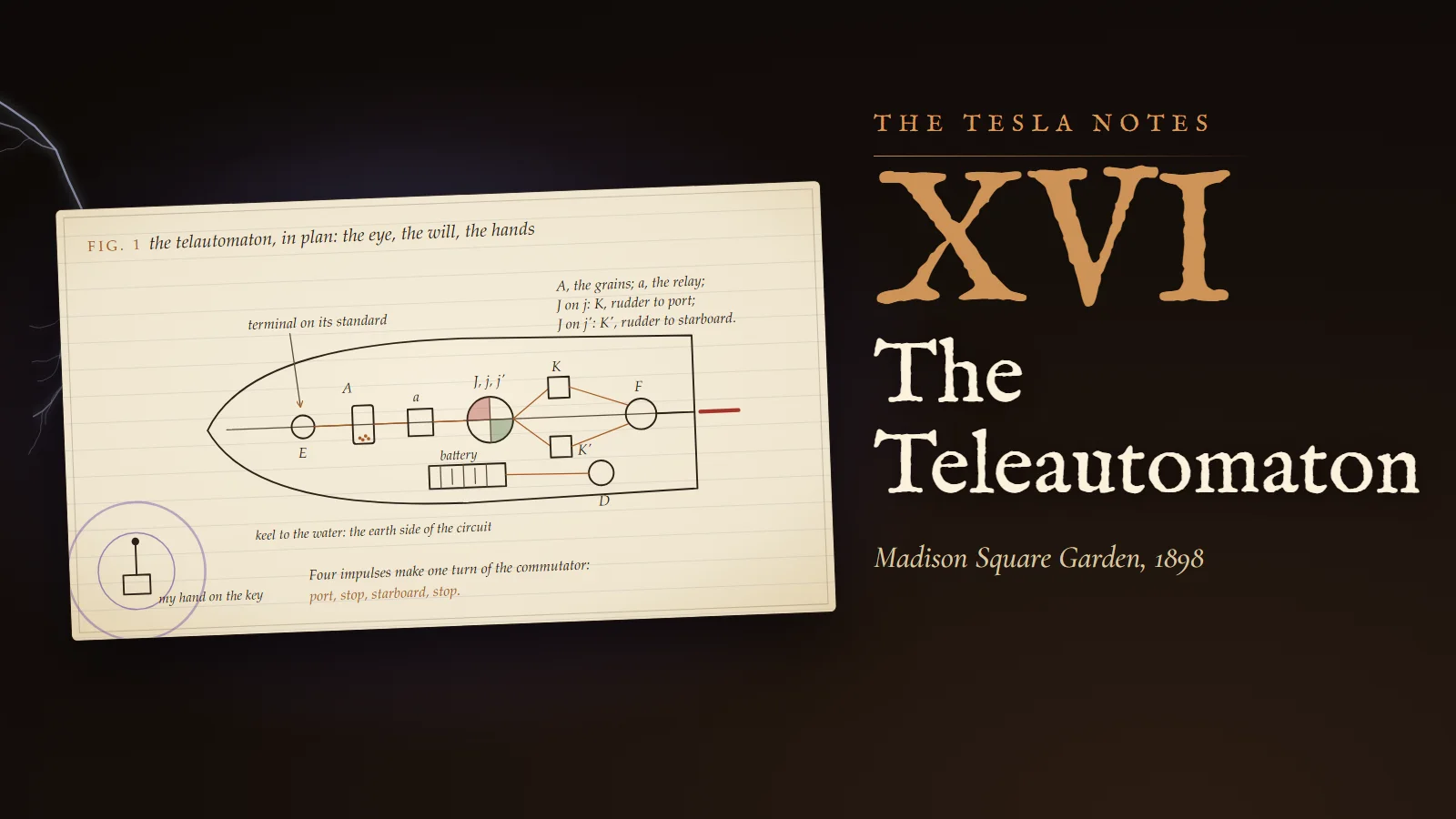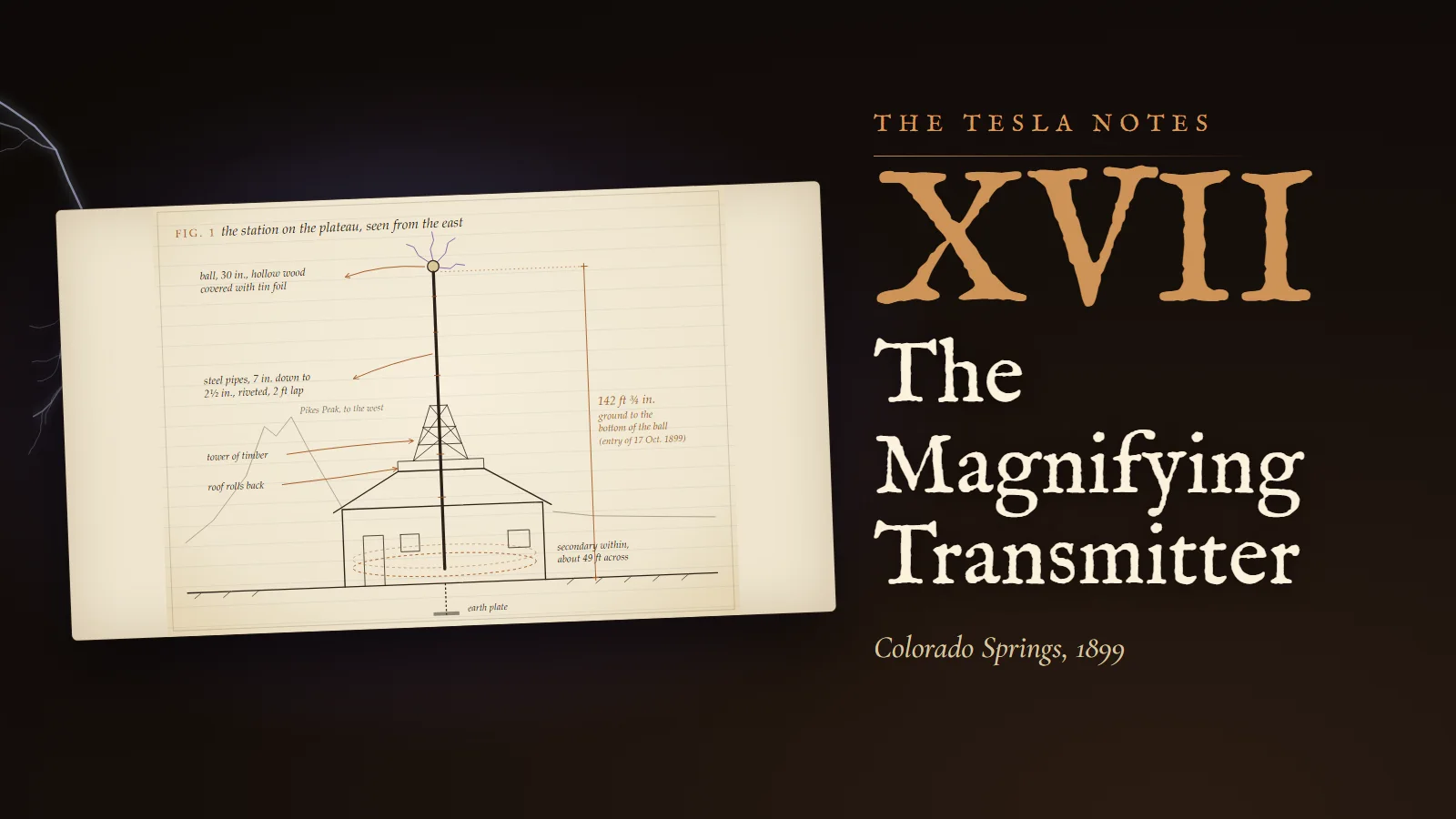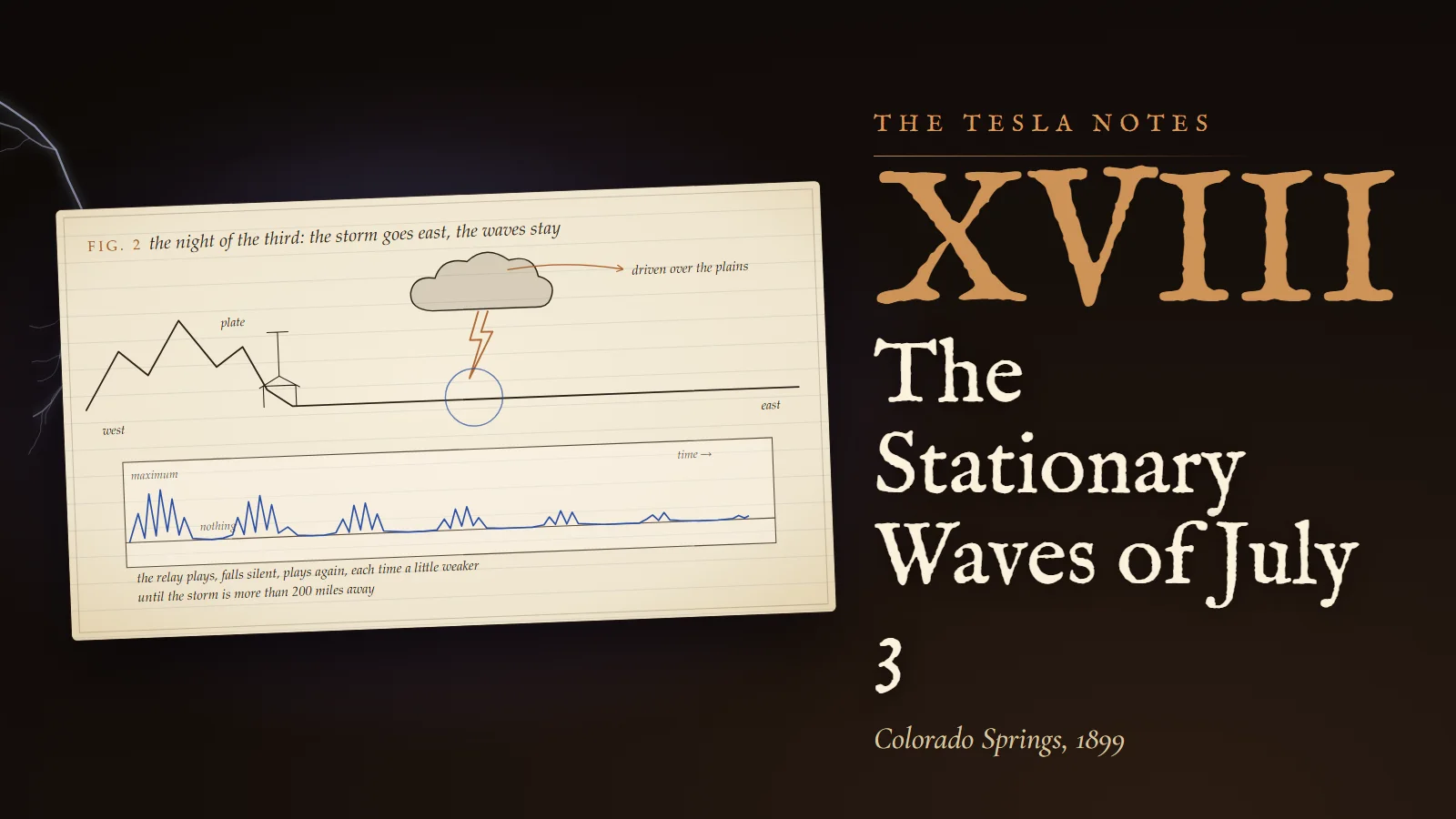

Gospić, in my boyhood. A schoolboy reads a description of Niagara Falls, and pictures a great wheel turned by the water, and tells his uncle he will go to America and build it. New York, 1893 to 1896. The man is thirty-seven, then thirty-nine, then forty. In these years I watched my currents light a city of white palaces beside Lake Michigan, lost every machine I owned in one night of fire, photographed the bones of my own hand, and stood at last beside the wheel. These pages are the record of those years, and they are the hardest I have kept.
"I was fascinated by a description of Niagara Falls I had perused, and pictured in my imagination a big wheel run by the Falls. I told my uncle that I would go to America and carry out this scheme. Thirty years later I saw my ideas carried out at Niagara and marveled at the unfathomable mystery of the mind."
Nikola Tesla, "My Inventions", Electrical Experimenter, March 1919
Chicago, summer 1893. The egg that stands
The Exposition is lit by alternating current. Mr. Westinghouse took the contract from under the Edison company's nose by bidding lower than they would believe, and then had to make a lamp that infringed nobody's patent, a two-piece globe with a ground-glass stopper, and make it by the tens of thousands, in months. His engineers have done it. At night the White City glows from the lagoon to the dome of the Administration Building, and in the Electricity Building there is a complete polyphase system laid out like an anatomy lesson: generators, a switchboard, step-up transformers, a line, step-down transformers, induction motors, synchronous motors and a rotary converter driving a railway motor. The principle of nearly everything on that floor was written in my patents of 1888. I walked through it twice, alone, before anyone recognised me.
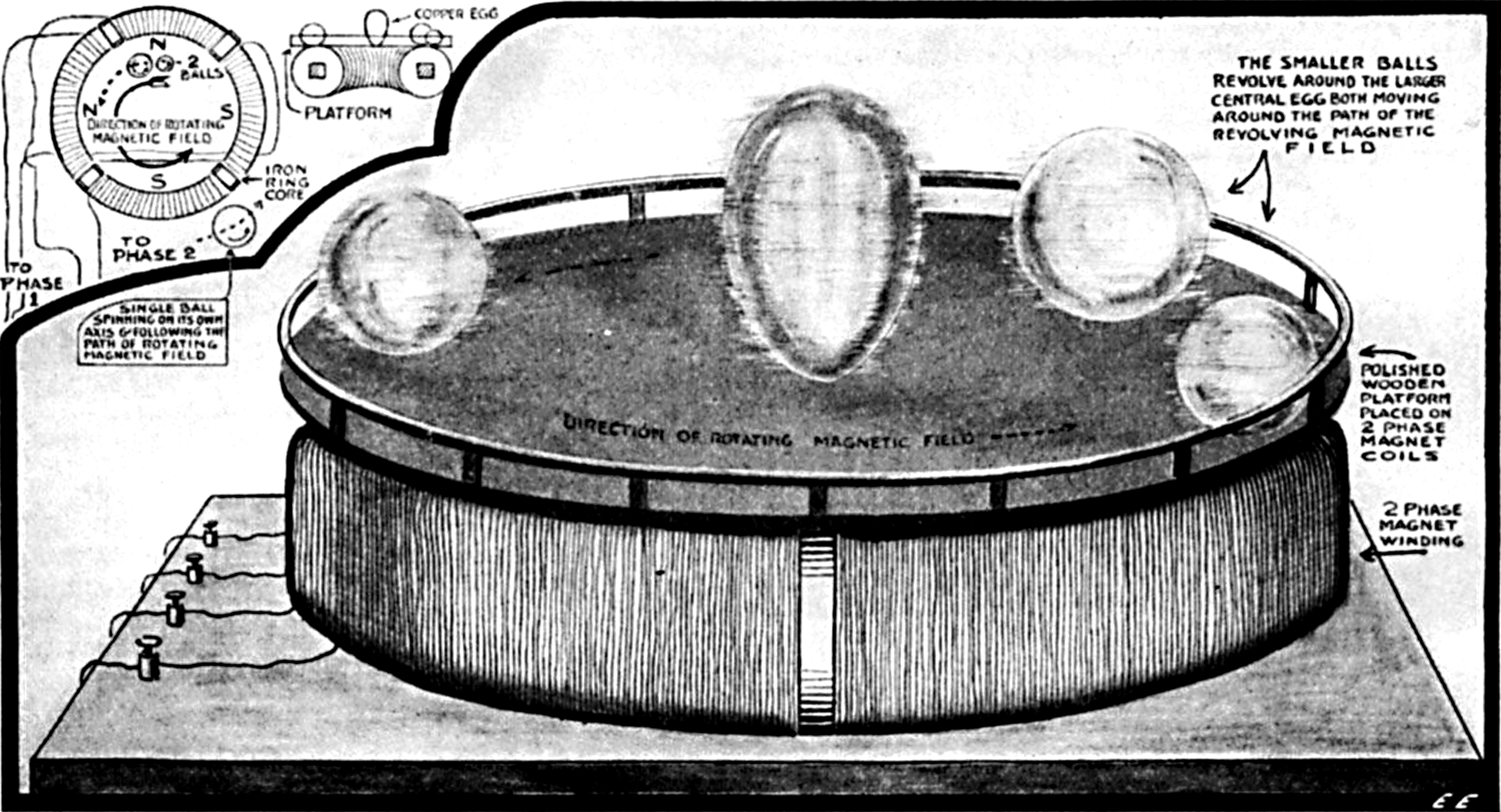
In our own case stands the egg. A copper egg, rather larger than an ostrich's, lies on a polished wooden platform. Beneath the platform is an iron ring wound with four coils, fed with two currents a quarter-period apart. When the current is turned on the egg begins to spin, and as it spins it rises onto its end and stands, turning, to the great delight of the crowds, who have all heard of Columbus and his egg. Copper balls on the platform race round the edge in the same direction.
Calculation
Why the egg turns, for a gentleman of the press who asked me three times and wrote down none of it.
- One pair of coils makes a field along a line, call it x, of strength B₀ cos ωt. The other pair, wound at right angles, makes a field along y of strength B₀ sin ωt, because its current is a quarter-period behind.
- The two add as arrows. The resultant has components (B₀ cos ωt, B₀ sin ωt).
- Its strength is √(B₀² cos² ωt + B₀² sin² ωt) = B₀, the same at every instant.
- Its direction makes the angle ωt with the x line, so it turns uniformly, once in each period.
- At 35 periods a second the field makes 35 revolutions a second, 2,100 a minute.
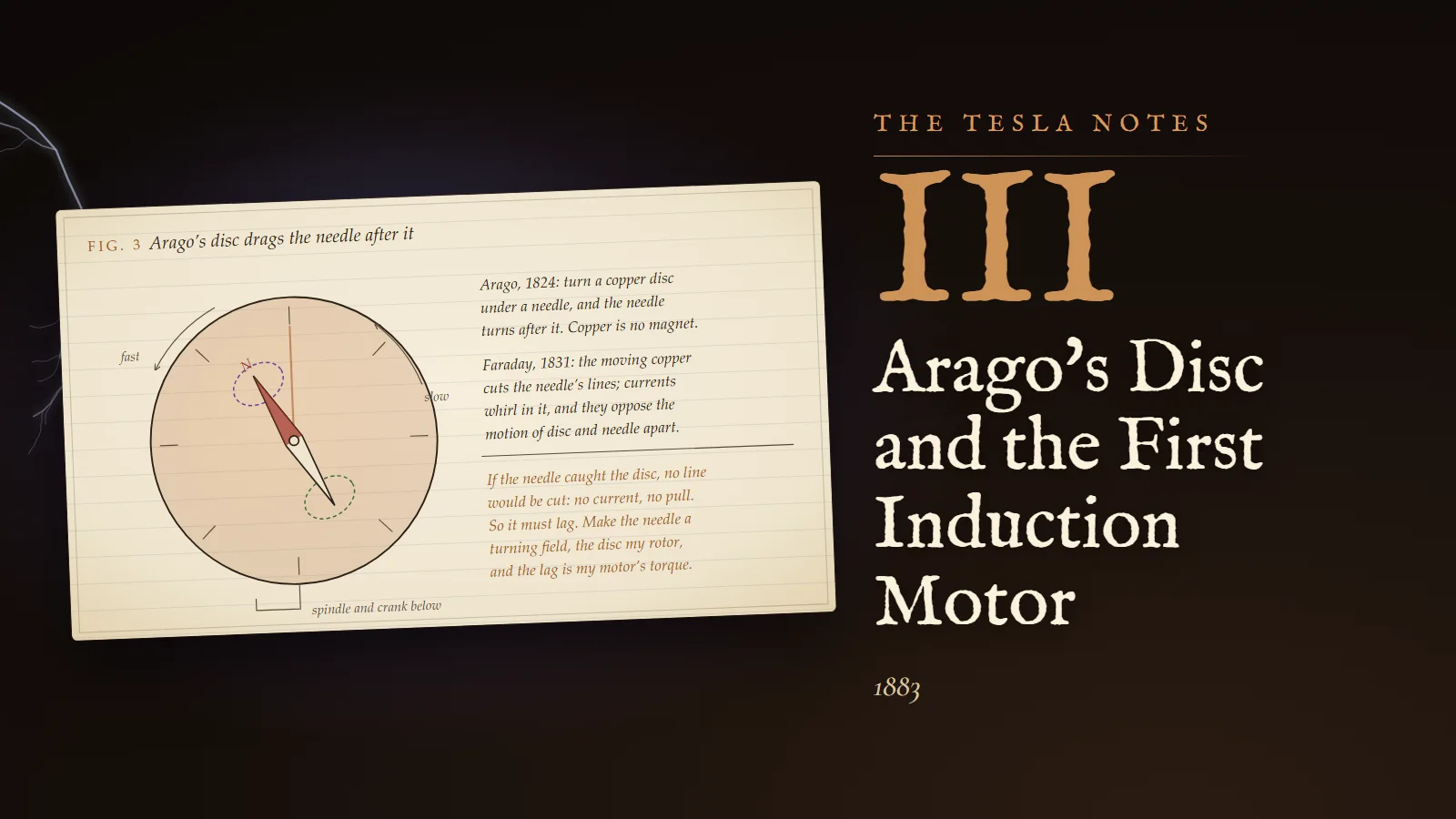
The copper egg is a closed conductor in this turning field. The field sweeps across it and drives currents in it, as in the disc of Arago, and the currents are dragged along by the field that made them. The egg can never quite catch the field, for if it turned as fast as the field there would be no relative motion, no induced current, and no drag. It runs a little behind. That small slip is the whole secret of my induction motor, and here it is on a table for children to stare at.
Experiment No. 1
25 August 1893, before the International Electrical Congress, in the hall beside the Agricultural Building: the mechanical and electrical oscillators. A piston, driven by steam or compressed air, carries the moving conductor of a generator directly, with no crank and no flywheel, and is held to a fixed period by springs. A clock that I meant to keep in step with the oscillator was damaged on the railway, so I had to describe what it would have done. The principle: a mass on a spring vibrates with a period that does not depend on how far it swings.
f = (1/2π) √(k/m)
A moving system of 4 kilograms which I want to vibrate 25 times a second needs a stiffness k = m(2πf)² = 4 × (157.1)² ≈ 98,700 newtons per metre, about ten tonnes-weight per metre of travel. Load the generator more heavily and the stroke shortens; the period stays. Every alternator in a station, driven from such an engine, would keep the same time, and every clock on its circuit with it.
South Fifth Avenue, spring 1894. A million volts, and a visitor
The new laboratory at 33 and 35 South Fifth Avenue occupies the fourth floor. I have more room than I have ever had, fifteen good men, and the conical secondary I designed after my return from Europe is working. In the spring of last year I reached tensions of about one million volts with it. I believe no one else has seen a discharge of this size made by man.
Calculation
What a million volts asks of a terminal.
- The surface force on an isolated ball is E = V/r, and air yields at about 30,000 volts to the centimetre.
- To hold 1,000,000 volts without brushing: r = 1,000,000 ÷ 30,000 ≈ 33 centimetres. A ball two-thirds of a metre across.
- The capacity of such a ball in free space is C = 4πε₀r = 4π × 8.85 × 10⁻¹² × 0.33 ≈ 3.7 × 10⁻¹¹ farad, or 37 picofarads.
- The energy stored at the crest of each wave: ½CV² = ½ × 3.7 × 10⁻¹¹ × 10¹² ≈ 18 joules.
- The coil must fill the terminal and empty it twice in every period. At 50,000 periods that is 18 × 100,000 ≈ 1.8 million joules a second flowing in, and as much flowing back, though only the losses are actually consumed.
Hence the oil, the conical form that keeps the turns of highest potential far from the primary, and the absolute necessity of resonance, because no spark gap I own could supply that rate of exchange by brute force. The coil supplies only what is lost in each swing, and the swing builds up.
Reflection
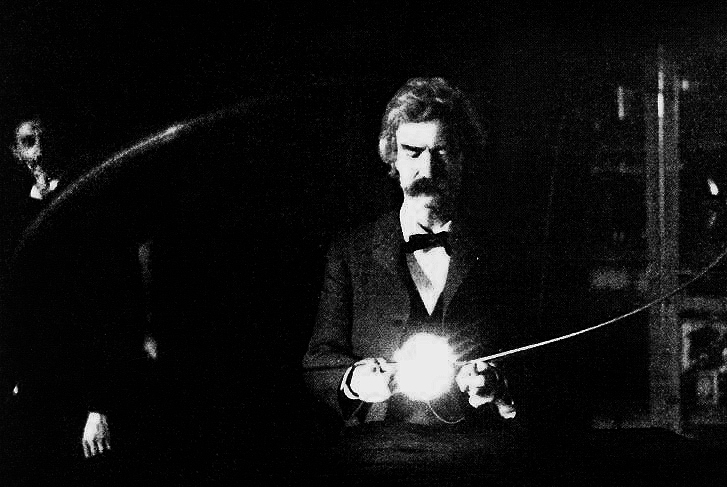
Mr. Clemens came to the laboratory this spring with friends, and I was glad of it; I read his books when I lay ill as a youth and they made me forget my sickness. He stood in the darkened room holding a loop of wire with a lamp in it, which glowed in the high-frequency field, and the photographers took him in its light. Afterward I put him on the mechanical oscillator, a platform I had built for other purposes, which vibrates very rapidly. He enjoyed it enormously, and I said nothing, because I knew what the vibration would shortly do to a man's digestion. In a minute and a half he cried out that I must stop it, and ran for the convenience. I have told no one but this page. He is the kindest man of my acquaintance.
New York, 13 March 1895. The fire
Written in the evening, with a hand that will not keep still.
The night watchman found the fire just before three in the morning. It began on the ground floor, in the premises of Gillis and Geoghegan, whose floors and walls have soaked up the oil of years of pipe fitting, and it went up the building like a lamp wick. By the time the engines came the upper floors were a furnace. My laboratory is utterly wiped out. The oscillators, the conical coil, the motors, the vacuum bulbs, the apparatus I was building for the transmission of energy through the earth, the notes of experiments that I had not yet published: all of it is in the cellar of 35 South Fifth Avenue under the water of the fire hoses. I carried no insurance.
A reporter from the Times found me on the pavement and asked what I would say. I said I was in too much grief to talk. What can I say? It was the work of half my lifetime.
Calculation
I cannot sleep, so I count, as always.
- Apparatus and materials lost: I put the figure at fifty thousand dollars.
- My men: about fifteen, who must be paid while there is nothing for them to do.
- The record of the work: four years of observations since Grand Street, of which perhaps one part in five is printed in my lectures. The rest is in my head, and that, at least, does not burn.
- The lecture I gave at Chicago on the oscillators was never written out fair; the manuscript was in the laboratory.
- Time: I estimate a year to rebuild what I had, if money can be found, and money is precisely what has become scarce since the panic of 1893.
Reflection
Mr. Martin had an article on my work in press for the April Century, with photographs taken in the laboratory. It will appear as a memorial of a place that no longer exists. I have read it in proof and cannot bear to read it again.
I keep returning to one thought. The fire took everything I built, and left everything I know. If my apparatus were the source of my work I would be finished. It never was. I designed every one of those machines whole, in my mind, before a man touched a lathe, and they are still there, every dimension of them. I will rent a floor, buy wire and oil, and begin.
Margin
Written in August. While I was rebuilding at 46 East Houston Street, where I took the new laboratory in July, the first generator at Niagara Falls delivered power, on the 26th of August, to the works of the Pittsburgh Reduction Company beside the canal. Two-phase current, from a machine built on my patents. I was not there. I went back to winding coils.
Houston Street, March 1896. Shadows through forty feet
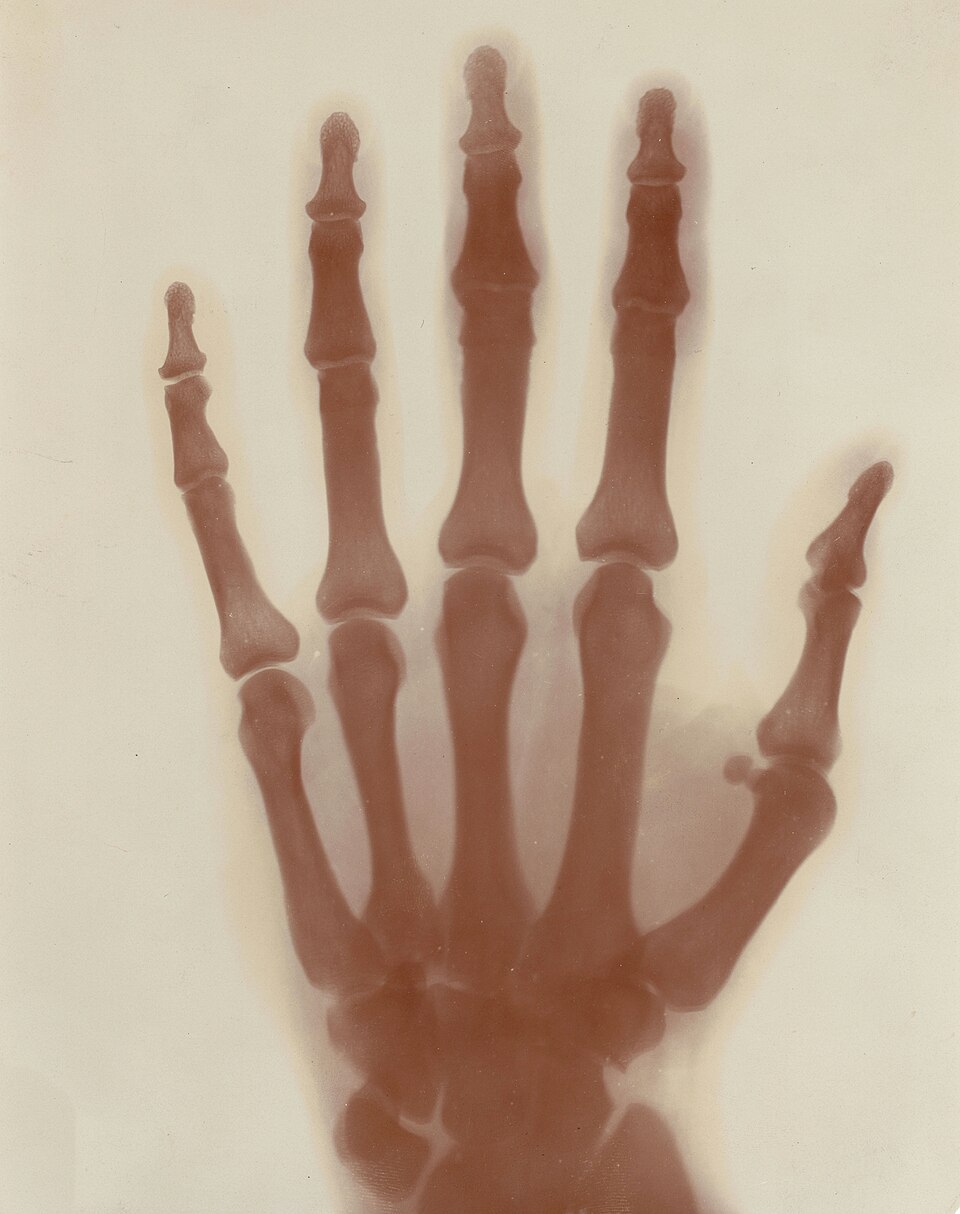
At the turn of the year Professor Röntgen announced a new kind of rays from the walls of a Crookes tube, able to pass through flesh and wood and fog a plate sealed in black paper, leaving the shadows of bones. I had seen my own photographic plates spoiled in the old laboratory in 1894 and put it down to faulty plates. That carelessness will trouble me for the rest of my life.
Since January I have worked at little else. My method differs from Röntgen's: I use a single-electrode bulb excited by my disruptive discharge coil, the other terminal of the coil as far away as possible, so that the stream from the electrode strikes the glass with enormous force. I cool the bulb with jets of air. I believe that we have to deal here with a stream of material particles, thrown off from the electrode with great velocity, and that what passes out through the glass is matter in some state as yet unknown. I am not certain.
Experiment No. 2
On the 14th of this month I wrote to the Electrical Review: I am producing strong shadows at distances of forty feet. I repeat, forty feet and even more. Plates kept in my photographic room on the floor above, fully sixty feet from the bulb, have been fogged without my intending it. The shadowgraph printed in their issue of the 11th was taken through a distance of eighteen inches.
Calculation
What the distance means. If the rays spread from a small source like light, their intensity falls as the square of the distance.
- Forty feet is 480 inches.
- Ratio of distances: 480 ÷ 18 ≈ 26.7.
- Ratio of intensities: 26.7² ≈ 711.
- So at forty feet the plate receives one seven-hundredth of what it received at eighteen inches, and to make the same picture the exposure must be about 711 times as long, or the source 711 times as strong.
I did the second. That is the meaning of "forty feet". A notebook ought to record that it is a statement about the strength of my bulb, and has nothing to do with any special penetrating power of the rays beyond what Röntgen found.
Margin
A reflection test: a copper tube about a foot long, a glass plate set in it at forty-five degrees, the bulb about eight inches off, forty-five minutes of exposure. Approximately two per cent was reflected, if it is reflection at all. And a warning for myself. When the bulb is working hard and I bring my head near it I feel a sudden, sometimes painful, shock in the eye. I do not know what it is. I shall keep my distance until I do, and so should every man who reads of these rays and runs to buy a tube.
Niagara Falls, July 1896. The wheel
I have seen it. Mr. Adams and the engineers of the Cataract Construction Company took me down to the power house beside the canal above the Falls. Water drops down a penstock into the deep wheel pit, through a turbine at the bottom, and away through a tunnel under the town to the river below the Falls. A vertical shaft carries the turning force up out of the pit to a generator of five thousand horse-power on the floor of the house.
I stood beside the first machine and could not speak. Mr. Adams thought I was examining the windings. I was a schoolboy again, telling my uncle what I would do.
Calculation
The generator, in figures.
- Twelve poles, 250 revolutions a minute. A pair of poles passing a coil makes one complete period, so the frequency is f = (poles × revolutions per minute) ÷ 120 = 12 × 250 ÷ 120 = 25 periods a second.
- Output 5,000 horse-power: 5,000 × 746 = 3,730,000 watts.
- Two phases at 2,200 volts each. At unity power factor the current in each phase is 3,730,000 ÷ (2 × 2,200) ≈ 848 amperes.
- Each phase is a separate circuit, the two a quarter-period apart, exactly as in my patents: the rotating field of the egg, sent out to the world on four wires.
Margin
On the 25 periods, which I did not choose and have argued about since 1888. A low frequency suits the rotary converters that turn alternating current into direct for the railways and the aluminium furnaces, suits large slow motors, and keeps down the self-induction of a long line. A high frequency makes lamps steady and transformers small. A transformer's voltage per turn is V = 4.44 f N A B, so for the same core and the same flux density the 25-period transformer needs 2.4 times the turns of a 60-period one, or 2.4 times the iron. And at 25 periods an arc lamp or a carbon filament flickers visibly. The engineers chose for the factories. Time will tell whether they chose for the cities.
I am told that machines built to my own early figures burned up on test, and that Mr. Lamme and his men at Westinghouse redesigned the generators almost entirely. I believe it. The idea of the system is mine; the plant is theirs. I shall say so whenever I am asked, and I suspect the newspapers will not print it.
Niagara Falls, November 1896. Twenty-six miles to Buffalo
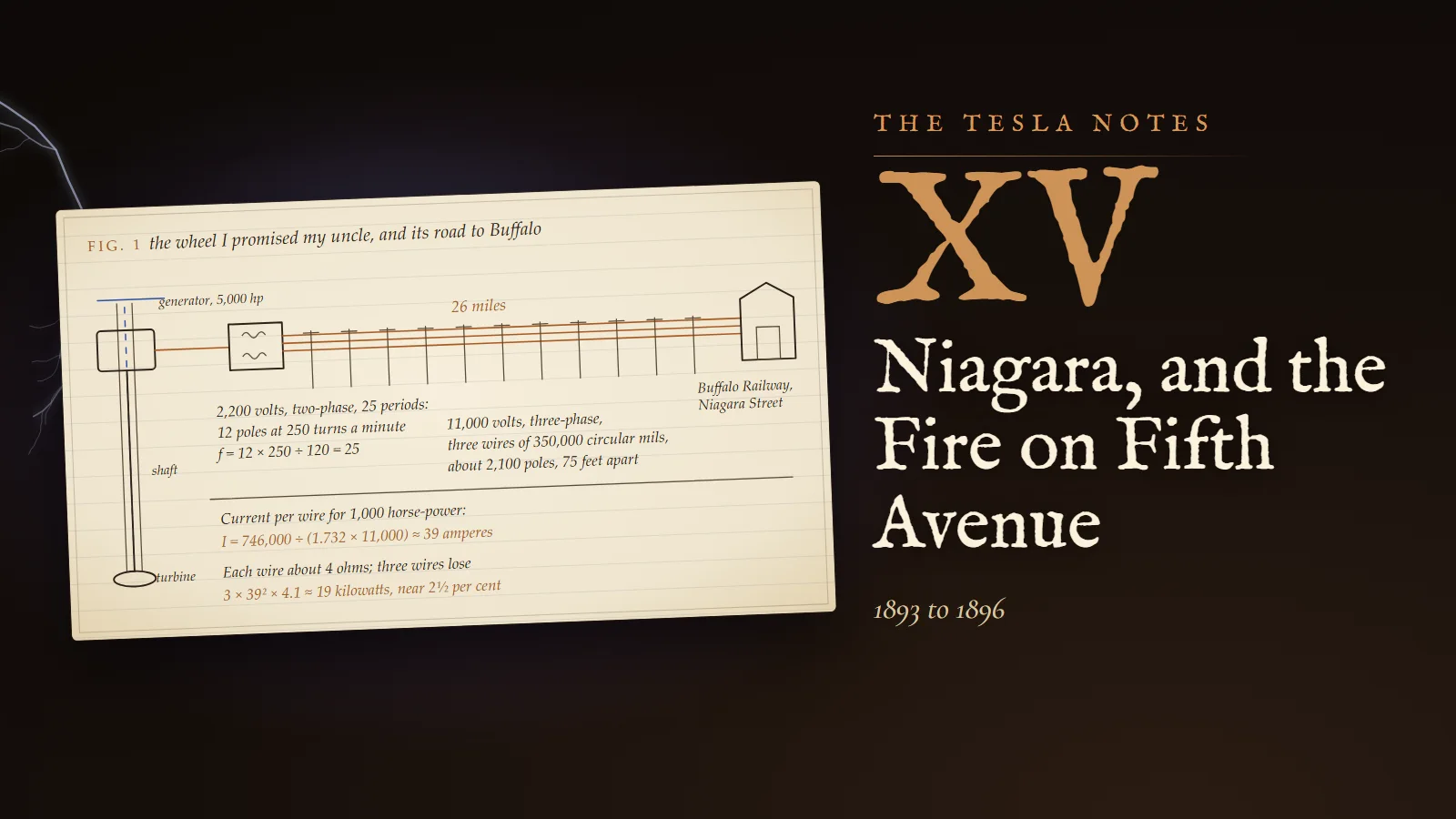
The power is to go to Buffalo by the middle of this month: a thousand horse-power to the Niagara Street station of the Buffalo Railway Company, to run its cars. The line is built by the White-Crosby Company on about 2,100 cedar poles seventy-five feet apart, with bare copper cables. Two step-up transformers of 1,250 horse-power each, connected by Mr. Scott's arrangement, turn the two-phase current of the generators into three-phase at 11,000 volts. I have made a plate of the line to answer every question I could think of, and set the figures out in full below.
Calculation
The line at 11,000 volts, 350,000 circular mils, 1,000 horse-power.
- Length: 26 miles × 5,280 = 137,280 feet.
- Resistance of each wire: R = 10.4 × 137,280 ÷ 350,000 ≈ 4.08 ohms.
- Power: 1,000 × 746 = 746,000 watts. Three-phase current per wire: I = P ÷ (√3 × V) = 746,000 ÷ (1.732 × 11,000) ≈ 39.2 amperes.
- Heat in the copper: 3 × I² × R = 3 × 39.2² × 4.08 ≈ 18,800 watts, about 2.5 per cent of what is sent. Including the fall of voltage along the line, which raises the current slightly, the plate gives 40.2 amperes and 2.6 per cent.
- Copper: one circular mil-foot weighs about 3.03 millionths of a pound, so the three wires weigh 3 × 350,000 × 137,280 × 3.03 × 10⁻⁶ ≈ 437,000 pounds, about 218 tons.
Loss = 3I²R = P²R ÷ V², which falls as the square of the voltage.
The same thousand horse-power at the generator pressure of 2,200 volts would need 196 amperes per wire, and the copper would turn 3 × 196² × 4.08 ≈ 469,000 watts into heat: sixty-three per cent of the power, before the fall of voltage made delivery impossible altogether. To keep 2.5 per cent at 2,200 volts the copper would have to be twenty-five times as heavy, 5,450 tons, more than the whole undertaking could buy. This is why the transformer is the heart of my system, and why direct current, which no transformer can raise, could never have done this.
Margin
The self-induction of the line. Each wire, with its neighbours three feet away, has a reactance per metre of X = 2πf × 2 × 10⁻⁷ × ln(D ÷ 0.7788r). For 350,000 circular mils the radius is about 7.5 millimetres, so ln(914 ÷ 5.85) ≈ 5.05, and over 26 miles X ≈ 6.6 ohms at 25 periods. At 60 periods it would be 16 ohms, four times the resistance, and the fall of voltage at Buffalo would be governed by it. Here, at least, the low frequency earns its keep.
A puzzle for the White-Crosby men, which I shall put to them politely. The printed description gives the cables as 350,000 circular mils, each formed of nineteen No. 10 wires. A No. 10 wire is about 10,380 circular mils, and nineteen of them make about 197,000. Either the strands are larger, near No. 7, or the cable is smaller than stated. I have used 350,000 in my figures; if it is 197,000 the loss is nearly 4½ per cent.
Draftsman's note
Fig. 1 is not to scale: the wheel pit is shortened to fit the page and the line, which in truth is twenty-six miles of poles, is shown as eleven. The sparks running along the wires stand for the flow of energy, which travels in the space around them, and their speed is a convenience of the draughtsman.
Buffalo, the night of 15 to 16 November 1896
A telegram from Mr. Adams's office, which I copy here. The switch at the Falls was closed and the first current went over the line at 8:57 on Sunday evening. The engineers tested and adjusted for three hours. At one minute after midnight, in the first minute of Monday the 16th, power was delivered to the Niagara Street station.
Reflection
Twenty-six miles. Eight years ago, when I described the rotating field to the Institute in New York, the gentlemen of the direct-current school said that alternating current was a toy, dangerous, and impossible to use for motors. Tonight the streetcars of a city of three hundred thousand people run on a two-phase current made at the Falls, raised by transformers to a pressure no direct-current machine could reach, and turned at the other end into the direct current of the trolley wire. In Buffalo the motormen will notice nothing, and that is the finest compliment I could be paid.
I think also of the fire. Twenty months ago I had nothing. The work went on without me, in other men's hands, because it was right. A true idea is a kind of property that cannot be burned.
Buffalo, 12 January 1897. The Ellicott Club
The dinner for the Niagara men, and I was asked to speak. I spoke of the power house as I had seen it in July, and said that it was a monument worthy of our scientific age, a true monument of enlightenment and of peace. I meant every word. The energy of the Falls did not exist for men until today, and it costs no man a coal mine, a smoking chimney, or a child at the coal face. It is the first of the great sources of nature that we have learned to take without taking anything from anyone.
Now I go back to Houston Street. The wheel of my childhood is turning. The storm in the mountains of Lika still waits.
Problems I set myself
1. A Niagara generator has 12 poles and turns at 250 revolutions a minute. Find its frequency. How fast would it have to turn to give 60 periods? If it gives 3,730,000 watts two-phase at 2,200 volts and unity power factor, what current flows in each phase?
Answer. f = 12 × 250 ÷ 120 = 25 periods a second. For 60 periods, n = 60 × 120 ÷ 12 = 600 revolutions a minute, which would put a heavy rotating field magnet under very great stress and is the chief mechanical reason for the low speed. Each phase carries half the power: I = 3,730,000 ÷ (2 × 2,200) ≈ 848 amperes.
2. The 26-mile line has 4.08 ohms in each of its three wires. Compare the loss when 1,000 horse-power is sent at 2,200 volts and at 11,000 volts, ignoring the voltage drop.
Answer. At 2,200 volts: I = 746,000 ÷ (1.732 × 2,200) ≈ 196 amperes; loss = 3 × 196² × 4.08 ≈ 469,000 watts, or 63 per cent. At 11,000 volts: I ≈ 39.2 amperes; loss = 3 × 39.2² × 4.08 ≈ 18,800 watts, or 2.5 per cent. Five times the voltage gives one twenty-fifth of the loss, since loss = P²R ÷ V².
3. A transformer for 2,200 volts at 25 periods has a core of cross-section 0.05 square metre, worked at a flux density of 0.8 tesla at the crest. How many turns must its primary have? How many at 60 periods with the same core?
Answer. From V = 4.44 f N A B: N = V ÷ (4.44 f A B) = 2,200 ÷ (4.44 × 25 × 0.05 × 0.8) = 2,200 ÷ 4.44 ≈ 495 turns. At 60 periods, N = 2,200 ÷ (4.44 × 60 × 0.05 × 0.8) = 2,200 ÷ 10.66 ≈ 206 turns. The 25-period transformer needs 2.4 times as many turns, or with the same turns 2.4 times the iron.
To the student who reads this later
The egg stands up for a reason I did not understand. A spinning prolate body on a surface with friction rises onto its end; you can see it with a hard-boiled egg on a kitchen table, and the full explanation, in which the sliding friction at the point of contact drives the rise, was given only in 2002 by H. K. Moffatt and Y. Shimomura in Nature. My egg was a motor and a puzzle at the same time.
The Niagara frequency of 25 periods lasted far longer than I expected. The cities of the world settled on 50 and 60, and 25-period machines were still at work near the Falls a hundred years later. My arithmetic of the line is the arithmetic you still use: I²R loss, the inverse square of voltage, and reactance that grows with frequency. Today's long lines run at 400,000 to 765,000 volts, and some at a million, for exactly the reason in my Calculation; the very longest go back to direct current, which you can now raise and lower with semiconductor converters, because a direct-current line has no reactance at all. The circle closes in a way I would have enjoyed.
On the rays I was wrong in the theory and right in the caution. X-rays are electromagnetic waves of very short length, as Laue showed in 1912, and they carry no matter. The shock I felt in my eye was most likely the rays acting directly on the retina, which is known to happen. Men who worked with these tubes without shielding in those years suffered burns, lost fingers and died of cancers. If you ever stand near an X-ray source, it is behind lead, and it is measured in sieverts, for good reason.
And on Niagara itself: do not let anyone tell you that I built it. Edward Dean Adams and the Cataract Construction Company financed it; George Forbes advised on the electrical scheme; Benjamin Lamme and the Westinghouse engineers designed the generators; the General Electric company held the contract for the line and its transformers, and the White-Crosby Company built it. My patents describe the system they built, and they paid for the right to use them. That is a large enough share for any man.
If you would like to hear what I felt on the floor of that power house, come and ask me.
Sources and liberties
The Tesla Notes are a modern reconstruction written in Nikola Tesla's voice by Eternal Gardens. Dates, patents, lectures, apparatus and quotations come from the sources below; the private reflections, the order of the working and the sketches are ours.
- N. Tesla, "My Inventions", Electrical Experimenter, 1919, chapters II and V (the Niagara daydream; the million-volt conical coil; the fire): Wikisource
- "Mr. Tesla's Great Loss", New York Times, 14 March 1895: teslauniverse.com
- N. Tesla, "On Roentgen Rays", Electrical Review, 11 March 1896: Wikisource
- N. Tesla, "Tesla's Latest Results", Electrical Review, March 1896 (forty feet; the reflection test; the shock in the eye): Wikisource
- "Niagara Power in Buffalo", Electrical Review, 18 November 1896, vol. 29, no. 21, pp. 247 to 249 (the line, the cables, the times of 15 and 16 November): insulators.info
- N. Tesla, speech at the Ellicott Club, Buffalo, 12 January 1897: PBS
- IEEE Milestone, Adams Hydroelectric Generating Plant, 1895: ETHW
- Edison Tech Center, "Niagara Falls" (generators, frequency, the companies' roles): edisontechcenter.org
- Nikola Tesla Museum, list of lectures (Chicago, 25 August 1893): tesla-museum.org
- H. K. Moffatt and Y. Shimomura, "Spinning eggs, a paradox resolved", Nature 416, 385 (2002): doi.org
The Twain anecdote of the oscillator platform is Tesla's own, told in later interviews and retold by his biographers; we place it in spring 1894 with the photograph. The figures for the oscillator's mass, the conical coil's frequency, the X-ray exposure and the 0.8 tesla transformer are ours, as are the 3-foot wire spacing and the telegram. Tesla's first visit to the Adams plant is given by a single secondary source as 19 July 1896, so we write July. The Electrical Review report calls the Buffalo line three-phase from the generators; the generators were two-phase and Scott-connected transformers made the three-phase, as above. The statement that Tesla built Niagara is a popular myth, and the claim that he anticipated Röntgen with his spoiled plates of 1894 is contested.