
The Showrooming of the Soul
If you spend a Saturday afternoon walking through the Swire Taikoo Li in Chengdu, you are watching the future of global commerce unfold in real-time. You see thousands of people moving through flagship boutiques: Gucci, Hermès, or the latest niche perfume lab. They touch the silk, they photograph the ambience, and they absorb the brand. But look at their hands. They aren't carrying heavy bags. They are holding smartphones. This is showrooming at its most refined. They use the physical store to validate their desire, but the transaction happens in the digital layer. Often, the item is already being dispatched to their home before they’ve finished their evening tea.
The art world has hit its own O2O: Online-to-Offline moment. For the modern collector in China, the museum and the gallery has become the ultimate shopping mall. It is where they go to get some ideas. But when it comes time to buy, they don't look for a salesperson in a stiff suit. They look for a direct line to the source. The traditional gallery, with its hidden price lists and opaque waitlists, is starting to look like a department store that forgot to build a website.
The 1.3 Billion Visit Tasting Session
We often hear people talk about 'Museum Fever' in China as if it were merely a sign of a growing middle class or a thirst for education. It is far more pragmatic than that. With nearly 7,000 institutions across the country and over 1.3 billion annual visits, the museum system acts as the massive R&D department for the collector's eye. It provides the scale and the social proof that a young entrepreneur or a creative professional needs.
When a collector visits the Long Museum in Shanghai or the UCCA in Beijing, they are calibrating their taste. They are seeing the 'cultural silhouette' of the season. In this space, art is supposedly 'official.' But the idea of then going to a gallery to initiate a buy: where the pricing is a secret and the atmosphere is designed to be intimidating, feels like a bad user interface. To a generation raised on transparency and speed, the friction of the old-world gallery model is an unnecessary barrier. They want the 'product' they saw in the museum-gallery-mall, but they want it delivered via a sovereign connection.
In the old days, you bought a painting and a certificate. Today, you buy a relationship and a digital record of the artist’s process.
The Studio as Home Delivery
This is where the 'delivery' side of the O2O analogy takes over. If the museum or gallery is the mall, the artist's studio is the home delivery service: intimate, direct, and incredibly fast. When a collector bypasses the gallery and heads straight to a studio, they are looking for the 'Last Mile' experience. They want to see the paint on the floor and the half-finished canvases. They want to see the artist’s lunch sitting on a side table. This isn't just about saving a gallery commission; it is about the texture of ownership.
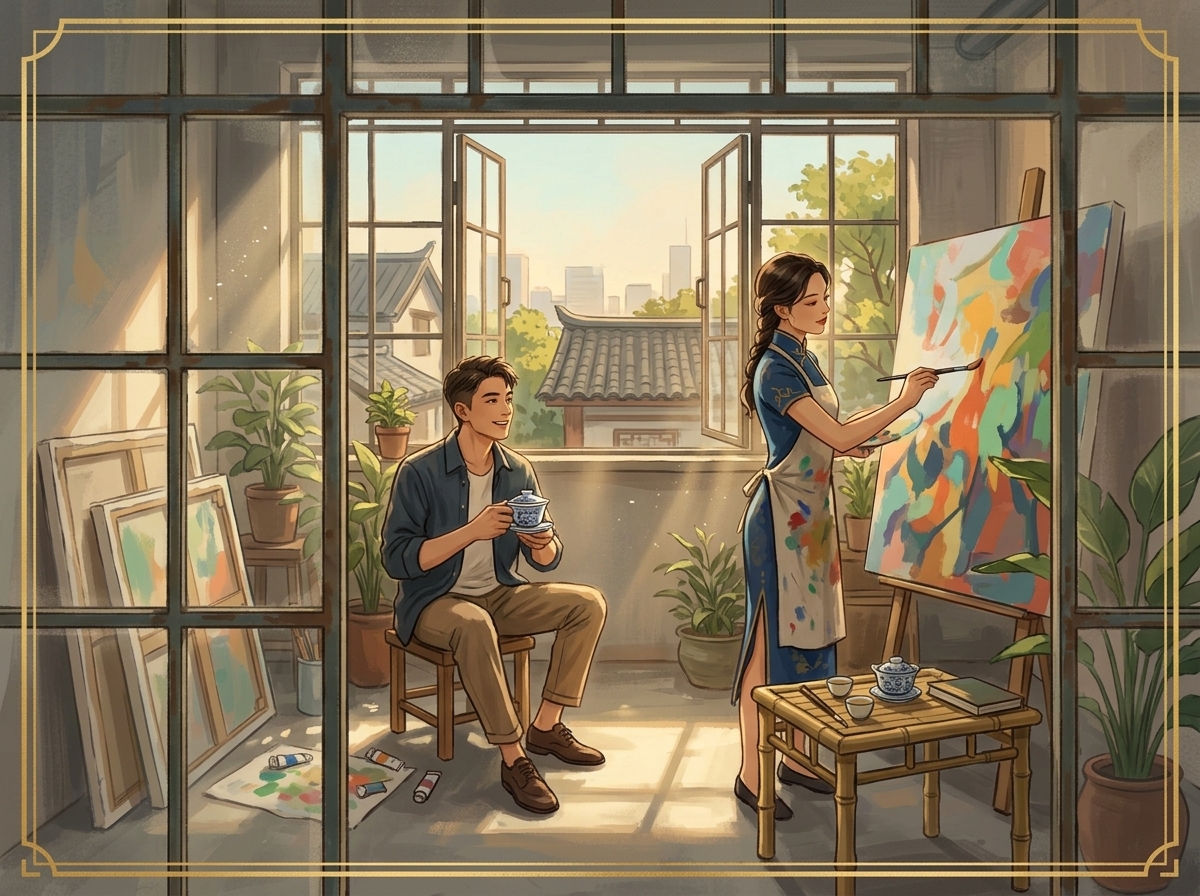
In Chengdu, collectors are increasingly seeking out artists directly, turning the studio visit into a social and transactional ritual. They got ideas in the gallery, but they use their digital connectivity to find the studio and close the deal. The transaction happens over a cup of tea or coffee, a direct WeChat payment, and a handshake. It is frictionless. It is transparent. It feels like a 'founder’s edition' purchase rather than a retail one.
The Rise of the Sovereign Artist
This shift only works because the artist has become sovereign. In the past, an artist needed a gallery to be their 'offline' face. Today, an artist can manage their own showroom through social media, build their own digital legacy provenance and then their own delivery through direct-to-collector relationships. The artist is the brand, the logistics manager, and the storyteller all at once.
Statistics from the luxury sector show that Asian consumers are moving toward 'niche sovereignty.' They want items that feel personal and exclusive. In the art market, this means a collector doesn't want a work that has been sitting in a gallery storage room for six months. They want the one they saw on the artist’s feed that morning, the one that is still wet on the easel. When that work arrives at their home, it isn't just an object; it is a memory of the afternoon they spent in the studio. It is a personal win over the old, slow ways of the world.
The New Creative Ecosystem
We are not seeing the end of the museum. We are seeing the consolidation of a more efficient ecosystem. The 'slow' museum and the 'fast' studio are the two halves of a new way of living with art. The museum provides the air-conditioned spectacle, while the studio provides the intimacy and the direct transaction.
The traditional gallery, standing on the sidewalk and wondering where the customers went, will have to adapt or become a relic. The modern collector isn't waiting for an invitation to the preview. They are already at the artist's table, tea in hand, watching the paint dry on their next acquisition.
