


"The drift is not in the quartz. The drift is in the room."
From Kepler Mission Inquiry, Exhibit 14: Transcript of the Zero-Point Calibrations
For as long as there have been people, there has been one thing all of them could see. Farmers and kings saw it. Soldiers on both sides of every war saw it, and so did children on rooftops in every city on Earth. Wherever you stood, the Moon showed you the same pale face, and that face did not change.
By the spring of 2119, almost everything else had.
For twenty years the ground had been coming apart. Without warning and without a sound, a patch of the world would open onto some other place or some other time, and whatever had stood there would be gone. People called these tears ruptures. A road in Shaanxi folded into a riverbed that had been dry since the Ice Age. A freight train left Rotterdam and pulled into Utrecht twenty minutes before it set out. One quiet evening in Old Shenzhen, half the grandstand of a stadium with eighty thousand seats dropped seventy metres into the earth, and in the years that followed the sea came in over the rest of the old city.
Nobody could explain the ruptures, and nobody could say where the next one would open. So people did what people have always done: they learned to live with it. Children were taught to toss a pebble ahead of their boots to test for ghost paths, quiet strips of ground where space was bent and a step could land somewhere other than where you aimed it. The evening news read out the Stability Index the way it had once read the weather, one number for how safe a place was. A 1 meant ordinary ground. Anything low meant stay away. Cities that could afford it rebuilt themselves on concrete stilts. Cities that could not afford it moved.
Through all of it, the world was at war. Three great powers, the Northern Accord, the Eastern Coalition and the Atlantic Federation, had been fighting for most of a generation. They fought for water, for the coasts that were left, and for whatever ground was still safe to stand on. Each said the others had broken the world. None of them could prove it.
Everyone, on every side, still had the Moon.
On the night the sky broke, Neumann was twenty-two years old and the last person left in the basement of the physics building at McGill University in Montreal.
He was one of the most promising doctoral students in physics at McGill, and he worked in the department's timekeeping laboratory in the basement, a quiet, well-equipped room he had asked for himself. The precision quartz clocks he relied on needed a steady temperature and perfect stillness, and in the whole building only the basement could give them that. For two years he had been trying to describe the ruptures with mathematics of his own, an approach most of his colleagues considered a long shot. Almost everyone who studied the ruptures began by assuming that space itself was flat and steady, and that something else was going wrong inside it. had stopped assuming that.
A little after two in the morning he gave up on an equation, put on his coat and climbed the stairs to go home.
Sherbrooke Street should have been empty. Instead, people were standing in the slush in the middle of the road: a bus driver who had left his doors open, two nurses in hospital scrubs, a man in a dressing gown holding a dog on a lead. Nobody spoke. They were all looking up, and looked up too.
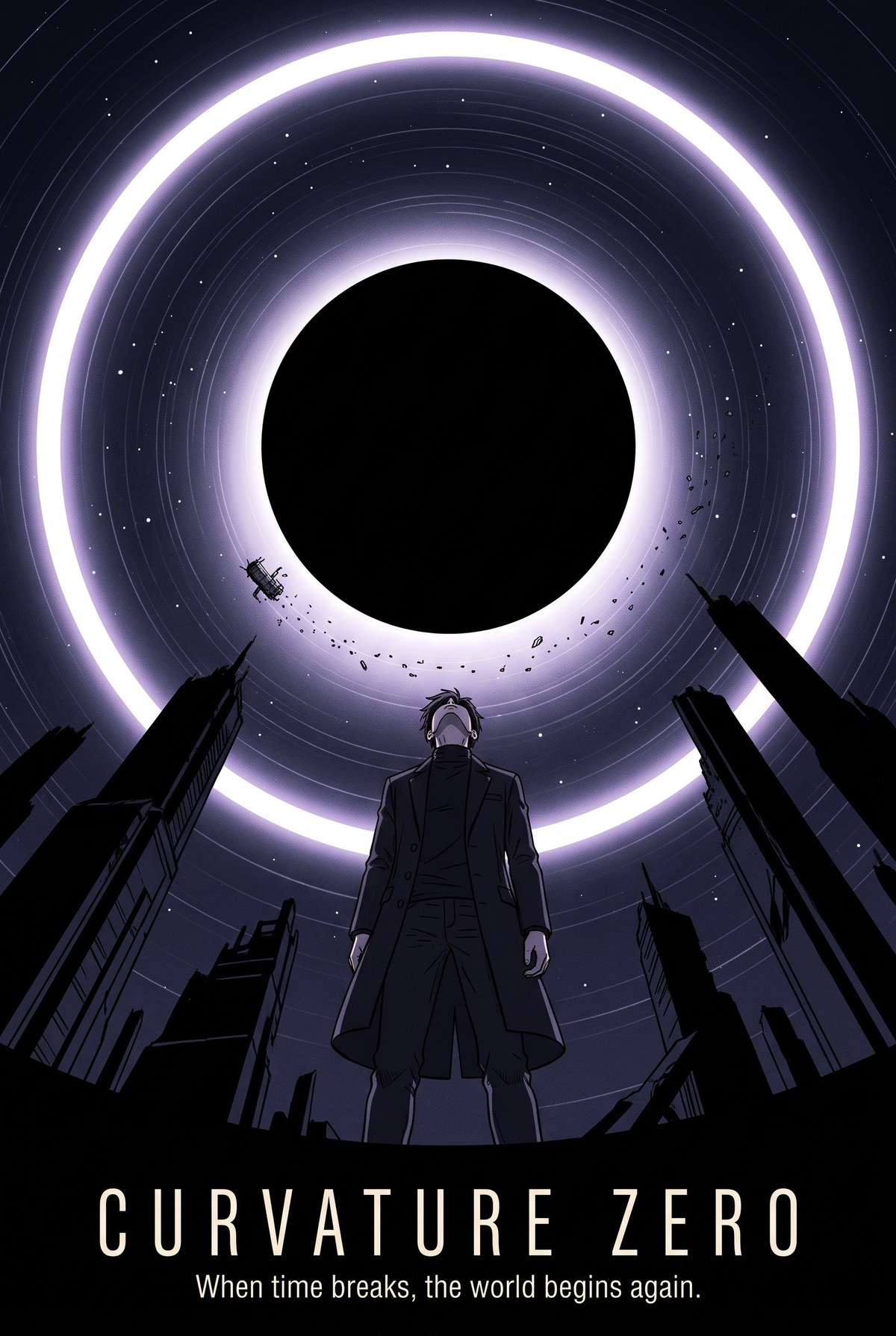
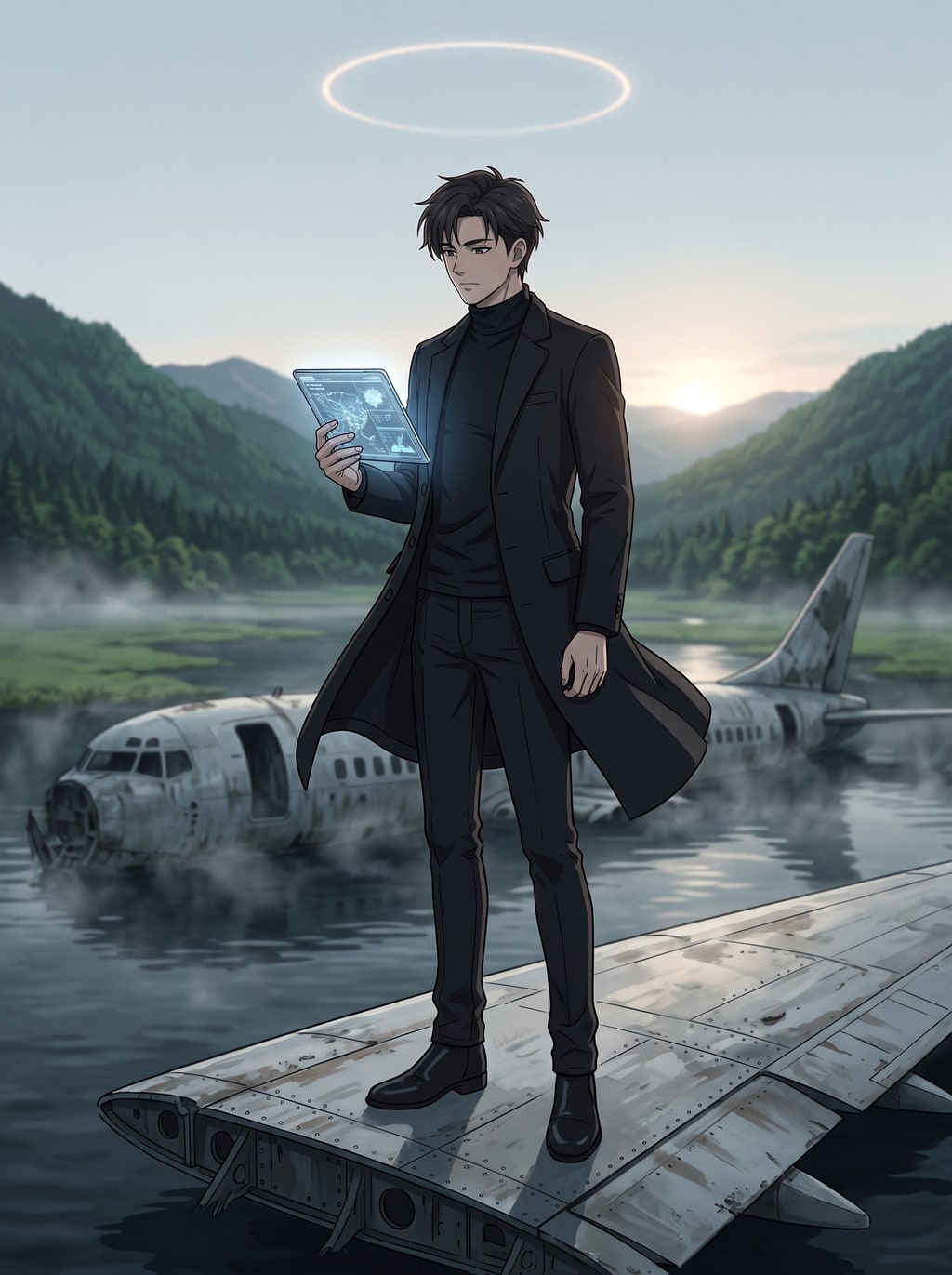
The Moon was almost full, high above the city, and there was a ring around it. Winter cloud sometimes puts a pale ring around the Moon. This one was violet, the colour of a fresh bruise, and it was moving. It turned slowly, the way a film of oil turns on water, and yet no part of it went anywhere. Inside the ring the Moon itself looked wrong. Its familiar face had gone soft at the edges, as if someone were holding it up behind a sheet of moving glass.
"What is it?" one of the nurses said, to no one.
On the screen at the tram stop behind them, the Stability Index for Montreal still read 0.99, the same as it had all week. looked from the number to the sky and back. All his life the ruptures had been something that happened to the ground. No one had ever thought to measure the sky.
He went back down to the basement and did not come up again for three days.
The ring did not close. The newsfeeds called it a wound. Everyone else came to call it the Halo.
For the first time in twenty years, people in every country looked up at the same thing and feared the same thing. Over the months that followed, the war stopped. There was no great treaty. The guns fell quiet because a larger question hung over every army on Earth, and none of them knew how to answer it.
Every government set its scientists to map the Halo: where its edge lay, how far its reach extended, whether it was growing. Nearly all of them got it wrong. One set of calculations, worked out in a McGill basement by a student who refused to assume that space was flat, put the edge exactly where the telescopes later found it. The Northern Accord sent people to Montreal to find out who had done them.
Eleven months after the Halo appeared, the three powers that had spent a generation trying to destroy one another agreed, for once, to send a single ship with twelve people aboard to study it. The ship was the Kepler, and it was all they could spare: old pre-war hulls welded together in orbit, air scrubbers that smelled of damp chemicals, quartz clocks that had already flown three missions. Its orders came in four languages and said the same thing in each: Observe. Measure. Return.
Neumann was the youngest of the twelve by nine years. He was the only one who came home.
In March 2120, forty-one thousand kilometres from the Moon, stood at the Kepler's observation port with his palm flat against the cold frame and watched the Moon refuse to hold still.
Up close, the Halo did to the Moon what the ruptures had done to the ground at home. The great dark plain of Mare Imbrium trembled like the skin of water on a drum. A crater swelled, shrank to a point, and reappeared two hundred kilometres west of where it belonged. Around it all hung the violet ring, so wide now that it filled the port from edge to edge, turning without moving, exactly as it had over Sherbrooke Street eleven months before.
He had cut his own hair with kitchen scissors the night before launch, and he had never left the planet before. Below his boots the Earth turned slate-blue and white, a storm crawling across the dead Atlantic, and he kept forgetting to look at it.
"You're staring again," said from the hatch.
She had a boot hooked under the deck webbing, a slate under one arm, and the blue canvas notebook she trusted more than any slate stuffed into her thigh pocket. She had been humming the same old song for an hour, off-key, flat on the minor third every time. Two days of scanning the Halo had put shadows under her eyes, but her mouth had the tilt that had learned meant trouble was coming his way.
"I'm observing," he said.
"That is the exact noun people use when they have lost forty minutes to a window."
"I have three papers on how the Halo bends light, . The Accord pays me to stare."
"Three papers, and one proposal that made three department heads threaten early retirement." She tapped his shoulder with the slate. "Telemetry's slipping again."
He pushed off the port and caught his console. "By how much?"
"Three seconds on array four. Seven on array two. Array six says negative two."
"That's timestamp drift, not telemetry slip."
"I know what it is."
"I know you know."
"Then don't use your teaching voice."
He strapped in. They were both right. The readings themselves were fine, but the clock on each instrument now disagreed about when it had taken them. The console read his palm and opened its stack of displays, and data that should have been difficult turned out to be impossible. The Halo's edge showed up as rings inside rings that would not share a centre. One set of instruments put the Kepler outside the safety line. Another put it inside. A third insisted they had crossed the edge nine minutes ago.
"Check it against the models," said.
"Checking."
"Accord?"
"Assumes space is bending smoothly."
"Atlantic?"
"Assumes someone is jamming us."
"Coalition?"
"That one assumes we are already dead."
She glanced at him. He did not smile, and after a moment neither did she.
"All stations," Captain Osei said over the internal channel. He was a broad, unhurried man whose voice never rose. "Report."
"Navigation holding," said Karim, the pilot. "But the gyros are drifting."
"Life support normal," said Volkov, the engineer.
"All twelve probes are awake," said.
"Science station?"
looked at the rings on his screen. He could not shake the feeling that he was seeing the shadow of something larger standing behind the Halo, pressed into the numbers the way a hand presses into a sheet.
"The edge isn't doing what any of the three predicted," he said. "It isn't unstable yet. It's non-classical."
Nobody on the bridge needed that word explained. Physicists used it when nothing had broken yet but the equations had stopped making sense.
"Are we safe to continue?"
The abort rules covered a sudden pull of gravity, a lost signal, a reading that dropped past a red line. Every one of them assumed that the ship and the Halo sat in the same kind of space. was no longer sure they did.
"One mapping pass," he said. "No closer."
"Karim, hold distance. , send them out. Neumann, you get one pass."
The little craft fell away from the hull in a crescent, their jets flickering, and their pictures came up on 's map one by one. On the observation port the Halo brightened. A violet sheen swept the ring and left the Moon's broken surface looking wet. The port darkened itself, cleared, and darkened again.
"Anyone else see that?" said.
"No radiation spike," said Volkov. "No heat."
enlarged the pictures and felt his stomach drop. Number One saw the Halo as a near-perfect circle. Number Two saw a spiral. Probe Three saw the Moon whole and unmarked, the way it had looked all his life before the sky tore.
"Three's broken," said.
"It's seeing a different answer."
"A different what?"
"A different shape of space."
On the main display the whole, calm Moon held for one more heartbeat. Then a shadow moved across it from the inside, and the probe dropped off the map without a flash or a fragment, and every alarm on the Kepler went off at once.
They were in their pressure suits inside a minute, helmets locked, visors up, the way the drills had taught them.
"Gravity's pulling us," Karim shouted. "We're being dragged off course."
"The jets show no drift," Volkov said.
"Navigation says we're moving!"
"Then navigation is wrong."
"Both of you," said Osei, one hand steadying the brass plumb-bob he kept taped to his console, the oldest instrument on the ship. "Report what you know, not what you think."
What knew was on his screen, and he did not want to believe it. Neither the ship nor the Halo was moving, and the distance between them was shrinking anyway, in jumps, the space between them folding up like a letter.
"Can we predict it?" said.
"No."
"Can we survive it?"
He took too long to answer, and the ship lurched sideways in a way the gyros never registered.
The bridge grew longer. Osei's station slid away down a corridor of repeating walls, the amber status lights drawn out into tracks. , three metres to 's left, came apart into a row of see-through copies, each a fraction of a second behind the last. In one she was turning toward him. In the next she was shouting without sound. In the last her seat was empty and its belts drifted loose.
Then the room snapped back. The pressure wave hit his eardrums like a hammer on an empty tank, and somebody started screaming.
Volkov's right hand was still closed around the grab rail beside the environmental console. The rest of Volkov was gone. There was no blood. The wrist ended at the cuff in a flat, matte disc of absolute nothing, and the calloused fingers stayed hooked around the titanium as though he might come back for them.
Someone behind threw up into a flight collar.
"Abort," Osei said, in the flat voice he used for drills. "Karim, reverse burn. , save what data you can. Neumann, find me a way out."
's hands would not move. Forty seconds ago Volkov had been talking about the heat exchanger.
kicked his footrest. "."
He looked at the course map. It had turned into a tangle of bright ribbons that looped back on themselves. Some dove into the Moon's crust. Some ran toward places that had no position at all. One began sixty metres behind the stern, threaded the Halo three times, and ended at the bridge wall eight minutes before the ship had arrived there.
He switched the map off. The quartz clocks at the front and back of the ship already disagreed by 1.8 seconds, so he threw out their readings too.
"What are you doing?" said.
"Taking out everything that assumes one thing happens after another."
"That's all of navigation."
"Yes."
He left the screen almost bare: how hard the hull was straining, and which way it was being pushed. If he could not trust where they were, or when, he could still feel which way the space under the ship was tilting, the way a swimmer feels a current without seeing it. Grey lines crept across the glass. Where space bent this hard, it folded over on itself and joined places that should have been far apart. Under the Halo's front rim one of those folds showed as a narrow channel, a seam where the pull from both sides cancelled out. It was eighty metres wide, and it was closing.
"Twelve degrees below the lunar plane," said. "Karim, burn toward the Halo. Into the pull."
Karim turned around in his seat, sweat on his temple. "That puts the nose on the inner edge."
"It puts us through the fold."
"That's closer, Neumann."
"Closer is not a useful word anymore."
Osei did not look back. "Execute."
The main engines lit. For half a second the hull groaned and went nowhere, held by a pull that would not let it go. Then the burn slammed into his harness and drove the air out of him. The overhead lights stretched into white smears. The Moon tilted ninety degrees on no axis at all, and the Earth vanished from the port. In its place was a black field set with points of cold light in a rigid grid.
Something looked through it.
There was no face. A face would have had edges. He felt an intention: attention, enormous and cold, with no malice in it. It noticed the Kepler's small chemical fire the way he might have noticed a spark at his feet. The name arrived on its own, sharp and cold as an iron rivet: the Presence. For years he would say it to no one, and he would leave it out of every statement the Accord made him sign.
It leaned closer.
The front third of the bridge went away. Osei disappeared in the middle of a word, one arm half raised toward the life-support bypass. Karim's console folded inward around him like an origami crane, seat and man and metal pressed into a single silver knot that slid into the grid of light and was gone.
's fists hit his chest harness. "We're going."
"The flight recorder." He was groping under his knees for the storage rack. "It has the whole thing on it."
"If you stay to pull it, you die on this deck."
He looked up at her. The senior specialist who teased him about counting hatch bolts was the only solid thing left in the room.
Her thumb found his harness release. The latches kicked him loose and something in his left shoulder went white with pain. Then she had him by the collar and was hauling him through the hatch into the long corridor that ran down the ship's spine.
The corridor had stretched. Its far end was lost in grey fog, its emergency strips running away in narrowing orange lines, its deck tilted thirty degrees. Halfway along, a pressure hatch cycled open and shut on its own, and each time it opened, saw grey dust under a black sky.
"Don't look," said.
He looked. Fifty paces out on the Moon's dust a figure stood in an old white pressure suit, its back to him, its gold visor reflecting nothing. On the shoulder was the stitched badge of a space agency that had shut down forty years before he was born. The figure raised one hand, fingers spread, and the hatch slammed between them.
Module Three was a two-berth escape capsule, built to drop home like a stone from just above the Earth. They were nowhere near the Earth. shoved him into a couch and dragged the straps across his chest. Her hands were shaking so badly that the buckle took her three tries.
"Get in," he said. ", the rack has two berths."
"I'm right behind you."
"."
"I'm right behind you, ." She reached past him and slapped the staging lever.
The blast hatch began to slide down its track. He lunged against the webbing and got his fingers into the gap. Beyond it, the corridor behind her collapsed into a crease of white light so thin it had no width. For a fraction of a second saw everything in the same place at once: the ruined bridge, the crater rims, the blue curve of the Earth, the inside of the Halo, and a flooded city street shining under black rain.
turned toward the light. Her face changed. She looked like someone who had just recognised a person she was not expecting to see.
"," she said, quietly enough that he should not have heard it over the noise of the hull. "When you get home, don't let them call it random."
The hatch closed. The clamps drove home.
He hammered at the manual override until his knuckles split. The lock stayed dead, and the explosive bolts fired around the cradle and punched him back into the couch.
Through the small rear port he watched the Kepler fall away. For two seconds it hung whole against the silver ring, forty metres of scarred titanium. Then it began to stretch across time instead of distance. Its front drifted half a minute ahead of its back. Its jets flared before their valves opened. Its radio mast thinned to a violet thread, and the ship slid down into the dark at the centre of the Halo one frame at a time.
The capsule tumbled on its jets. On 's console, 's personal beacon pinged once. It pinged again, 0.4 seconds later. The third ping arrived 1.2 seconds before the second had even been sent, and after that there were no more.