


"When a building fails, the stone forgets how to hold. When time fails, the second forgets how to pass, and it is always the second that leaves the deeper scar."
From Unit Nine Field Manual, Section IV: Anomalous Gradients and Local Divergence
"Keep your head down," Bo Han said. "People in Shuikou don't look up. If they see an operator staring at the cornices, they think the siren's failed, and then forty thousand people take the stairs at once."
lowered his eyes to the sensor on his wrist. Stability Index 0.48, and slipping a little every few breaths. He was meant to be spending thirty minutes taking quiet readings at the district's pump stations, because their clocks had been losing a few thousandths of a second every six hours. Gu called that ordinary noise. called it something else. The compromise was , Bo, a patrol boat and no suit. Atlas-0 hung on its gantry back at base while three inspectors from the municipal bureau tapped its pelvic spar with brass calipers and wrote memoranda that Gu filed without reading.
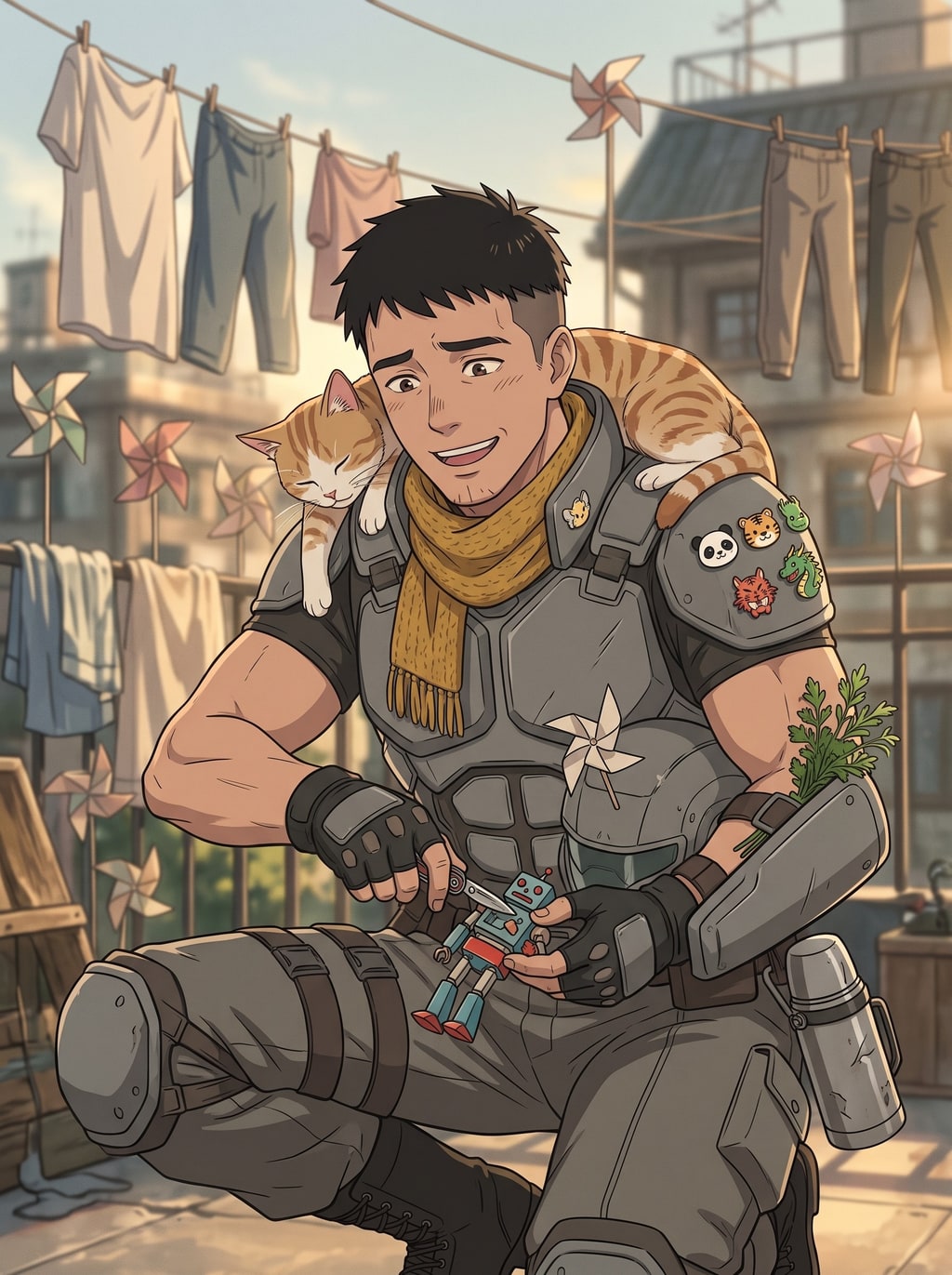
Shuikou was where Longwan put the people the sea had moved twice. Its streets were timber walkways on concrete stilts over dead spillways, and its canals carried a skin of oil from the drainage turbines three tiers down. Bo walked half a step ahead with his carbine low. He had been back on light duty for a week, his left shoulder held stiff under the field armour where the burn had healed into slick pale tissue, and he had refused the sling the surgeon gave him because, he said, it made the recruits look at him with their mouths open.
"Thirty minutes," Bo said. "Then the boat. If you fill your boots with bilge again, Gu has me repacking field kits until dawn, and I already owe two cartons of tea."
The bell started before they reached the second substation.
Someone was ringing it by hand, a heavy iron bell to the west: six strokes, a pause of four seconds, six more. did not know the code. Bo did. He stopped walking, and the easy roll went out of his shoulders.
"Structural failure," Bo said. "Where?"
's readout had broken into a staircase, stepping down and sideways and refusing to smooth. "Two hundred metres west. The building over the spillway." He tapped the glass. "Time's coming apart in there. The ground floor is running three seconds behind the roof."
"That's the Fourth Primary annex." Bo was already unclipping the anchor line from his harness. "Did the precinct clear it?"
checked the district register. "Moonveil registered a charity pass at nine-thirty. Food, warm clothes. An arts delegation."
"Singers and administrative clerks," Bo said, breaking into a jog along the wet planks. "Just what you want inside a folding floor."
The Fourth Primary Learning Annex stood twenty metres out over a dead spillway on ribbed concrete stilts with green tide lines up to their knees. Its lower windows had been patched with corrugated plastic. When followed Bo across the threshold the air thickened against his chest, warm and dense, and the slap of the canal against the stilts behind them stretched into a slow iron groan that came every five seconds instead of every two.
"Kitchen's empty," Bo called. "Soup's boiling. Bubbles aren't popping. Don't touch the brass."
stepped into what had been a reading room. A stack of exercise books had slid off a trestle table and had not reached the floor. They hung at knee height, fanned out, sinking at the speed of settling dust. Beside them hung a drop of spilled tea, amber and perfectly spherical, trembling without falling. His wrist read 0.41.
"It gets worse as you go up," he said. "Every metre higher, time runs slower. Whoever's upstairs is further behind than we are."
"Stairs," Bo said.
The stairwell was raw terrazzo lit by green emergency strips, and from somewhere above, down the hollow concrete core, a woman was singing. It was a counting rhyme, brisk and a little breathless:
"Seven boats upon the tide, six will find the other side, five to keep the lanterns lit, four to mend the timber split..."
The voice caught on a dry inhale and came back firmer.
"Three to pull the heavy oar, two to step upon the shore..."
took the stairs two at a time. On the first landing a blue stencil of a crane had been sprayed on the limewash, its beak chipped at one corner. He climbed twelve steps, turned, and the same crane was beside his shoulder with the same chip.
"Ghost loop," Bo said behind him, breathing hard. "They can't get to the roof."
"Stop climbing!" shouted up the well. "Stay where you are!"
The singing stopped. A face looked down over the banister two flights above: a young woman with black hair tied back, chalk dust across one cheek, a pale raincoat over a dark sweater. A fine gold chain at her throat carried two small gold coins.
"We can't stay," she said. Her voice was low and steady. "The fourth step from the bottom just vanished. If we stop, the wall behind us starts sounding like a river."
He climbed the last flight. As his boot touched her landing the world twitched, his left knee an instant older than his right, and he held the rail until his inner ear agreed with the rest of him.
"Dr. Neumann," he said. "Unit Nine. This is ."
"You took your time, Doctor."
Behind her, pressed against the limewash, stood twenty children. None of them looked older than eight. They wore grey smocks with red cloth badges, and their hands were linked in a single chain along the wall. Two of the smallest were crying without sound, and their tears hung on their cheeks and would not fall.
"They're terrified," said.
"They're doing very well." She said it fast and looked at him hard. "We've done six verses. They know the rhythm keeps the stairs together."
Bo reached the landing and stopped. He looked at the children, then at the woman, and his mouth opened and closed again on nothing. He looked at . did not know what the look meant and had no time to find out.
"What's your name?" he asked her.
"Kang Min-ji." She did not smile. "Can you take the little ones first? Da-Ming, at the back. His balance is going. The floor under his heels has no weight."
knelt by the nearest child, a girl with two short braids tied off in green string, and took her wrist between two fingers. Her pulse was fast and her skin was warm. Through his knee the riser buzzed, uneven.
"Each step is almost half a second out of time with the next," he said. "If the chain breaks, the loop could pinch shut between the third and fourth landings."
"Then we don't break it." She reached behind her without looking, found Da-Ming's hand, and drew him to the front. "You lead, Doctor. We'll follow your boots."
"Bo, tie a line off on the banister. It gives us a spine. If a landing starts to tear away, the line should hold it to the next one for ninety seconds."
"Working." Bo ran the copper-sheathed line off his drum and clicked the hooks into the wall plates, three snaps. "Hold steady, little ones. Uncle Bo has the rope."
stood. Under the chalk and the green light, the woman's face was drawn and pale, her lips cracked at the corners, and her eyes did not leave his.
"You're not from the district," she said.
"Montreal."
She studied him a moment longer. "The man from Xinhe."
"Yes."
"Then do what you did there." Her fingers had tightened round Da-Ming's until the boy's nails showed white. "Make it stay where it belongs."
"I can't make it stay. I can only show you where the edge is." He turned to the stairs. "Follow the line. One step every two seconds. Count with me."
They started down.
The light changed as they went, from chalky daylight to a bruised violet that clung to the iron rail, and the children stopped crying and watched 's boots and put their feet where his had been. Kang Min-ji walked behind the smallest boy with her palm flat between his shoulder blades and picked up the rhyme exactly where she had left it.
"Two to step upon the shore, one to close the iron door..."
At the end of the verse she stopped to breathe, and the stairwell lurched. It was nothing could have measured with his eyes: the rail under his glove went soft for an instant, a girl behind him stumbled, Bo's line gave a short, ugly twang. On his wrist the lag jumped a tenth of a second and fell back. Kang Min-ji had a hand on the wall and her eyes closed.
"Keep singing," said.
She opened her eyes. The man who had been talking to her about half-seconds per step was asking for a nursery rhyme, and her look said she had noticed. Then she started again from the top, seven boats, and the children's feet found the rhythm again.
On the fourth landing the floor was gone.
A metre of grey haze lay between the last tread and the next, and through it, instead of the flight below, could see the upside-down ceiling of another room forty metres away, where a battery clock ran backwards so fast its red second hand had blurred into a disc. A boy in the middle of the chain gasped and his hand slid out of his neighbour's.
"Don't look," said. He leaned across the gap, caught the boy under the arms and lifted him through. For half a second the child weighed nothing and was cold as well-water, a faint blue wake trailing from his heels, and then he landed against 's chest with real bone and a thump of wet flannel. "Next. One at a time."
Kang Min-ji took the next girl by the waist and swung her. "Jump, Xiao-Hua. Big jump."
The girl flew across and hit with a soft thump of felt coat. He set her behind him without looking and reached back. Bo caught the third on his left side and took the weight on the bad shoulder, and heard the joint click under the harness. Bo said nothing about it.
"Five more," Bo said through his teeth. "Come on, dumplings. Hop."
They passed them across like sandbags on a levee: two boys with mud on their collars, a girl who clung to Bo's vest until he peeled her fingers off one at a time, two more who jumped together holding hands. When the last child was over, Kang Min-ji stood alone on the upper edge.
The air behind her had started to fray. Hair-thin cracks of black ran through the plaster at her back. The banister under her palm had gone milky, the rebar showing through it in dark threads, and the line between the two landings shivered and sang.
"Take my hand," said.
She looked down into the gap. There was no floor in it now, only grey silt and the reflection of low clouds running backwards across a sky that was not Longwan's. For one second her calm broke. Her chin shook and her pupils opened until the brown was nearly gone, and saw a nine-year-old watching a house turn to foam.
"The water," she whispered. "It's coming up."
"It's not water. It's just geometry." He kept his hand level in the cold draught. "It doesn't have teeth. Look at me, Min-ji."
She looked at him.
"Take my hand."
Her fingers were ice cold, and her grip closed round his wrist like a cable. He hauled. For an instant the gap held on to her, her outline dragging half a second behind the rest of her like ink bleeding on wet paper, and then the line snapped taut with a clang that ran up 's arm into his shoulder and her boots struck concrete. She fell against him, breathing in short hard gasps against his collar.
"Go!" Bo was already pounding down the lower flight. "Line's losing tension. Down, down!"
They ran. The last two flights were a blur of yellow paint and shaking handrails, and they burst through the ground-floor doors as the building above them gave a long grinding shriek, and a slap of displaced air threw forward onto the granite of the quay.
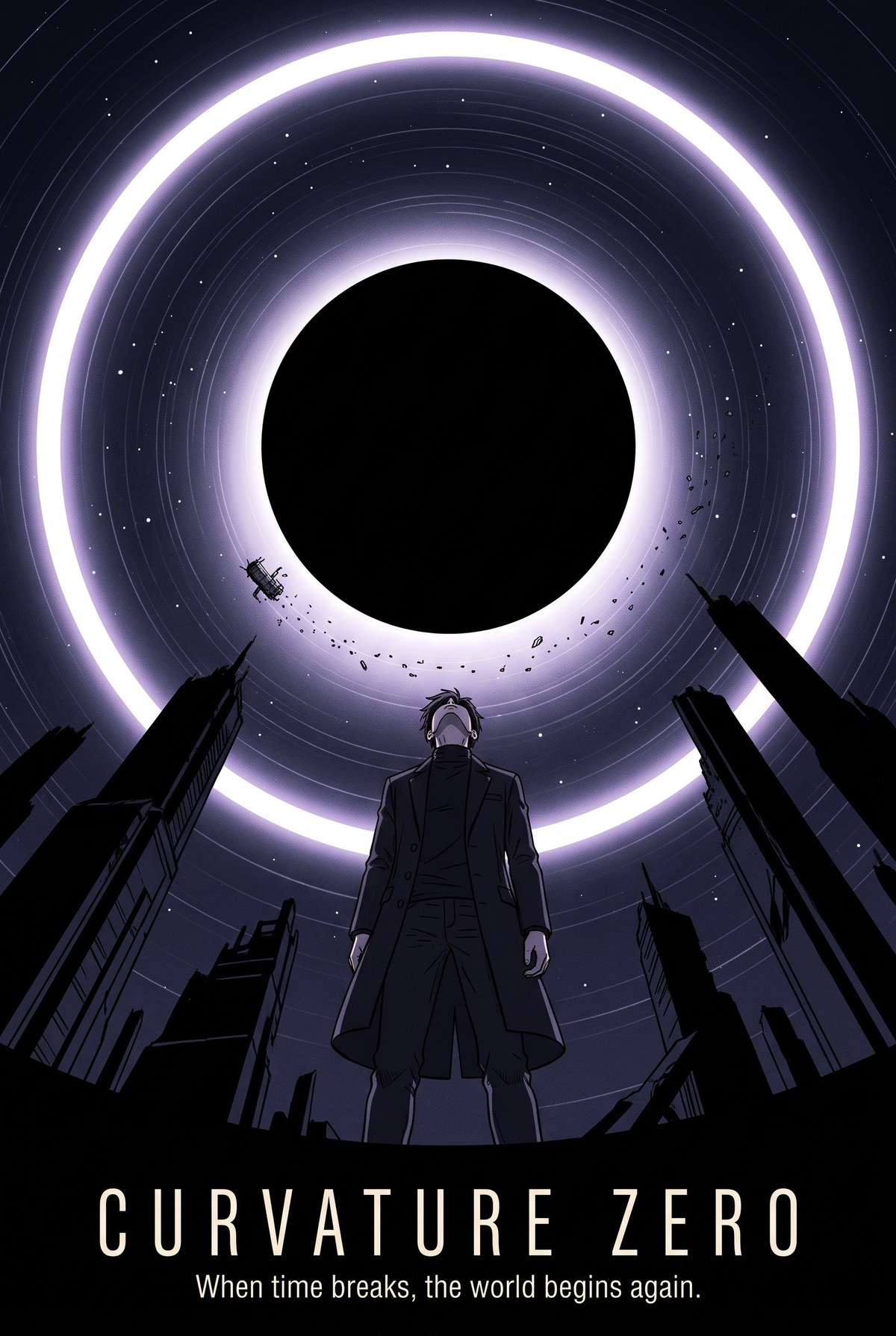
When he rolled over, the school's upper storey was gone. In its place hung a smooth, curved scoop of empty air, as if a spherical spoon had sheared through brick and timber alike. Rain fell into it, spun into a tight spiral and vanished with a dull thud like a burst tyre. Powdered lime drifted down over the canal.
The twenty children sat in a huddle on the wet stones, holding each other's smocks. Not one of them was crying.
checked his wrist out of habit. The Stability Index over the quay read 0.97 and was climbing back toward normal. MECN-7 had forecast nothing in Shuikou this week. The pump-station clocks that had brought him here were two hundred metres east, still losing their thousandths of a second.
Bo was on his knees in the mud with his right hand clamped over his left shoulder and his face grey with sweat. "Twenty out of twenty," he said. "The Colonel will give us extra rice or court-martial us both."
The guide line had taken the skin off the side of 's thumb. He sat on the cobbles until his hands stopped shaking and then went to find her.
She was kneeling beside the girl with the green-string braids, smoothing the child's wet fringe, and her own hands had finally begun to tremble. Her raincoat was torn at the right elbow, and the sweater underneath was dark with blood.
"You're hurt," said.
She glanced at the arm, mildly surprised by it. "A wire. It's nothing."
"Let me see."
"I said it's nothing, Doctor." There was no edge left in it, only the flatness that comes after fear drains out, and she let him push the wool back. The cut was shallow, four centimetres long, from the corner of a wall plate. He tore open an antiseptic pad with his teeth.
"That counting song," he said. "Where did you learn it?"
She tilted her head at him. "My mother sang it to me in Busan. When I came to the shelters here, I kept it."
"It runs at about sixty beats a minute. Close to a resting heart rate. That's why the children didn't spike. You kept their blood pressure down."
One corner of her mouth went up in disbelief. "Is that what I did?"
"Mathematically, yes." He pressed the strip down over the cut. "Keep it dry until you see a clinic."
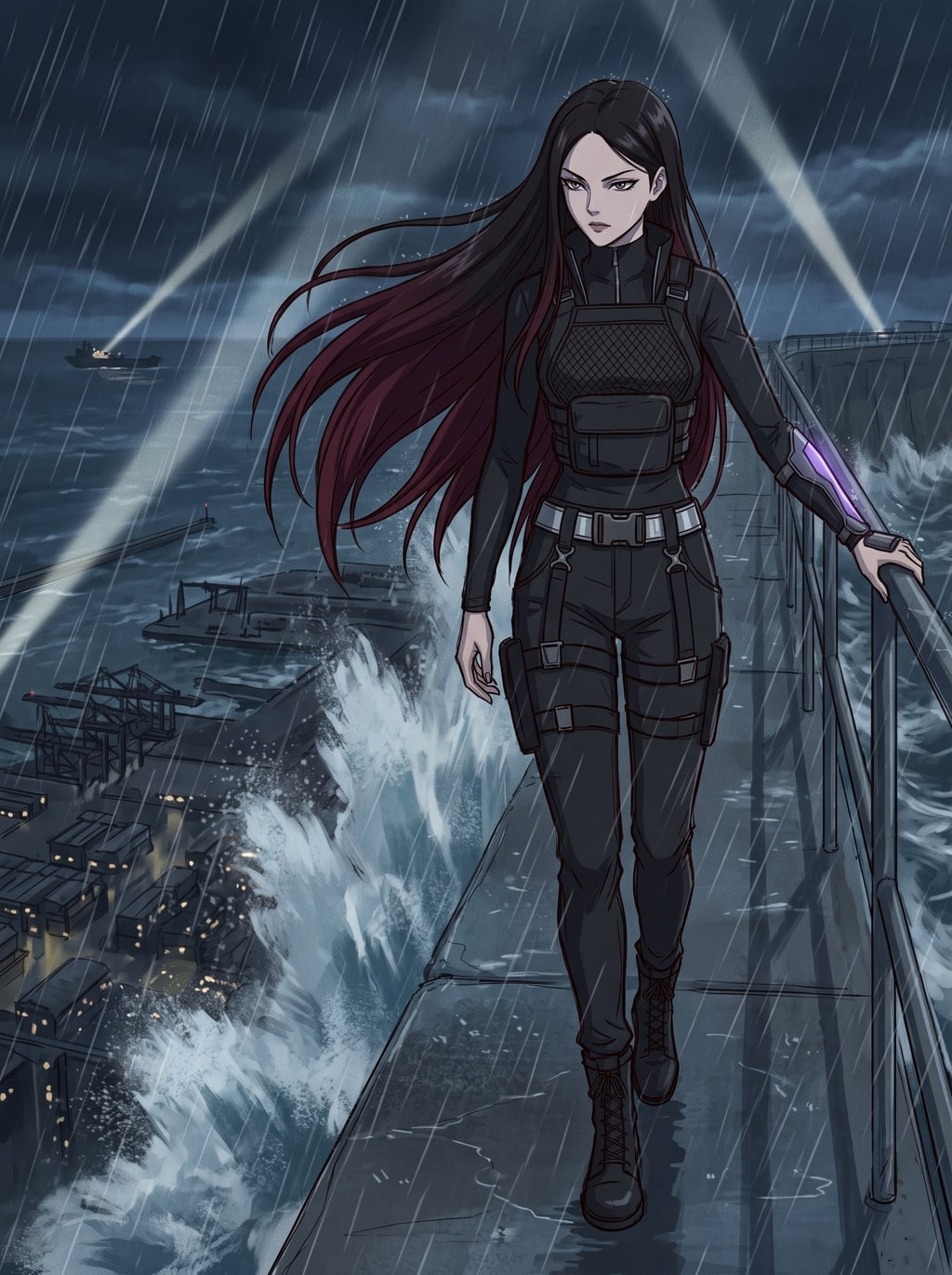
The roar of an electric turbine came round the canal bend. A black skiff with a silver crescent on its hull banked hard toward the pier, its ramp dropping before the hull touched the fenders, and a woman came off it at a run: tall, lean, in a black flight jacket, with a choppy black bob and a long fringe across one grey eye.
"!"
"Ke-Ke." Kang Min-ji stood, brushing lime from her knees. "We're fine. All of them."
The woman stopped two paces away and looked at the torn sleeve, the blood, , Bo, in that order. Her grey eyes settled on . Behind her the skiff's wake ran on across the canal toward the stilts, and for half a second the reflection of her shoulders stayed where it was while the water moved.
glanced at his wrist. The sensor had not clicked.
Not an anomaly. An echo.
"You went in," the woman said to Kang Min-ji, low and furious. "You were told the perimeter was unstable. You were supposed to wait on the boat."
"The children were on the third floor, Ke-Ke. What was I supposed to do, sing through the intercom?"
The woman turned to . "You're the Accord specialist. Neumann."
"Yes."
"You should keep your toys on a shorter leash. Shuikou isn't an experimental range."
"There was no experiment," said. "It was a vertical shear nobody predicted. The building came apart one floor at a time. If Moonveil had shared the readings from your sound trucks, we might have had six more minutes."
Something cold and bright flared behind the grey eyes. Kang Min-ji stepped between them and laid a hand on the black leather sleeve.
"He got us out, Ke. Every one."
The woman looked down at the hand on her arm, and some of the tension went out of her shoulders, though none of it left her face. "Madame is waiting at the clinic in Tier Three. She wants a full medical check before the broadcast."
"I don't need a check."
"She insists." The woman whistled, sharp, and four orderlies in Moonveil whites came down the ramp with silver blankets for the children.
Kang Min-ji did not follow at once. She looked at Bo, who gave her a stiff little nod that favoured his shoulder, and then at .
"Doctor Neumann."
"."
"." She tried the short vowel carefully. "You said you only show people where the edge is."
"That's all the maths can do."
"It was enough." She reached into the pocket of the torn raincoat and took out a heavy charcoal card, dry despite the spray, embossed in silver with a crescent cradling a skyline. "My manager usually signs these away. This one's mine."
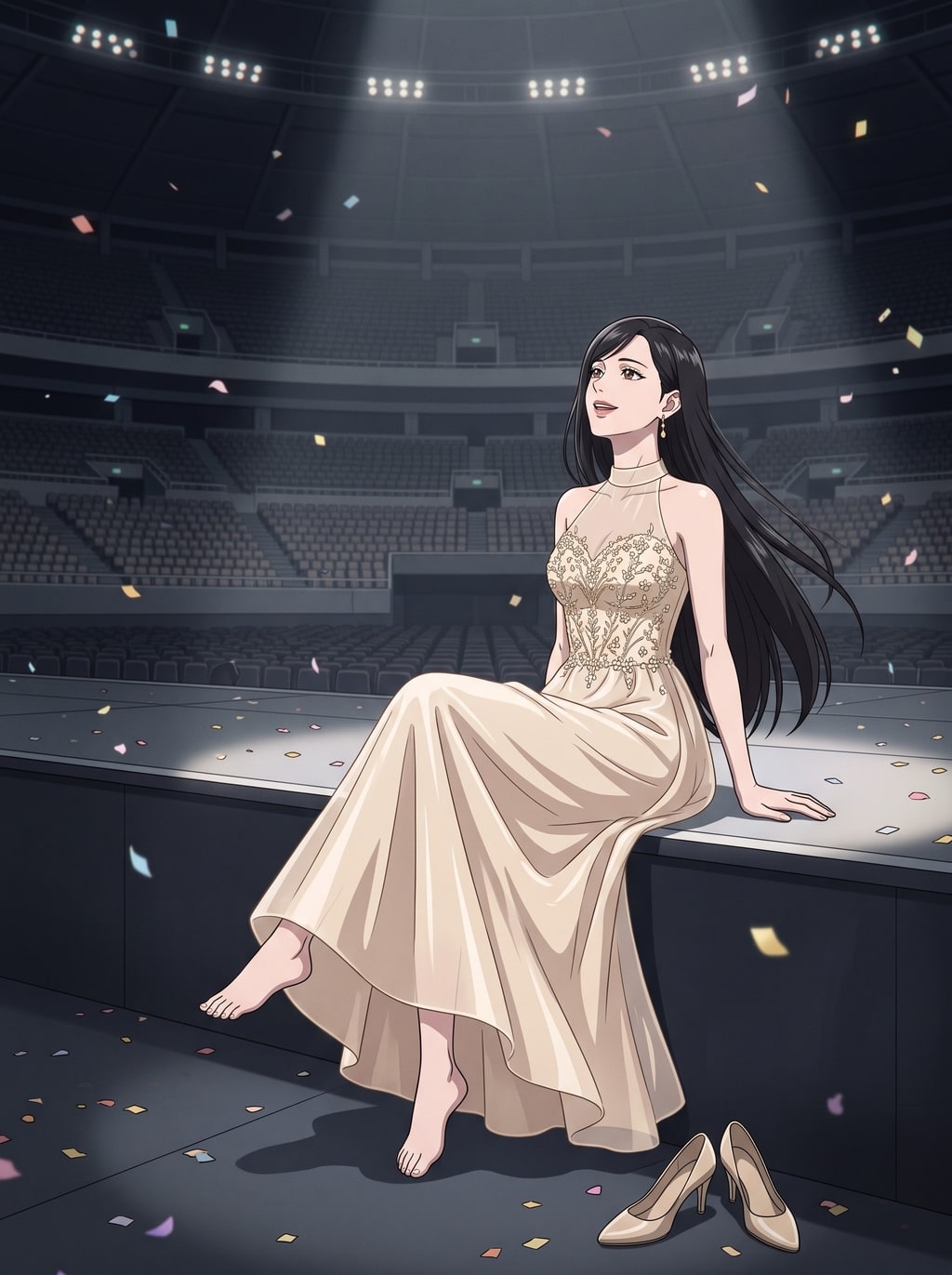
It was an invitation to the reopening concert at the Moonveil Arena, fourteen days away. In the bottom corner, in violet ink and a quicker, looser hand than the printing, someone had written: For the special guest who knows where the floor stops.
"You should come," she said. "I sing better when the room isn't folding."
"I don't really go to concerts."
"Come anyway." Her mouth tipped up at one side. "The acoustics are very stable."
She went up the ramp. The woman she called Ke-Ke followed, stopped at the top to look back at for a long, unreadable moment, and stepped inside. The skiff pulled away from the pier, its props cutting two pale braids through the floodwater.
turned the card over. The back was blank.
Beside him, Bo had started to grin, and the grin kept growing until it pulled at the small scar on his chin.
"," Bo said. "Do you truly not know who she is?"
"Kang Min-ji. From Moonveil's relief programme."
Bo's laugh bounced off the wet brick. "She's , you absolute stone! . The Voice of Longwan. She's on every projection tower from here to the sea wall."
watched the wake spread toward the stilts. He thought of the forty-metre face over the elevated expressway, lit gold, in silk, singing down over the traffic. He thought of what had told him about that face on his first night in the city: Busan, nine years old, the whole family gone, a girl who had learned to sing with the missing parts.
"She was wearing a five-credit raincoat," he said.
"And you stood on a landing and told her she had a good resting pulse." Bo wiped his eyes with the back of his good hand. "Wait until Gu hears. Wait until the whole third-deck mess hears. 'Mathematically, yes.'"
"Don't tell Gu."
"Oh, I'm telling him." Bo was already limping down the slick gangway toward their boat, holding his shoulder, still laughing. "I'm telling him first."