
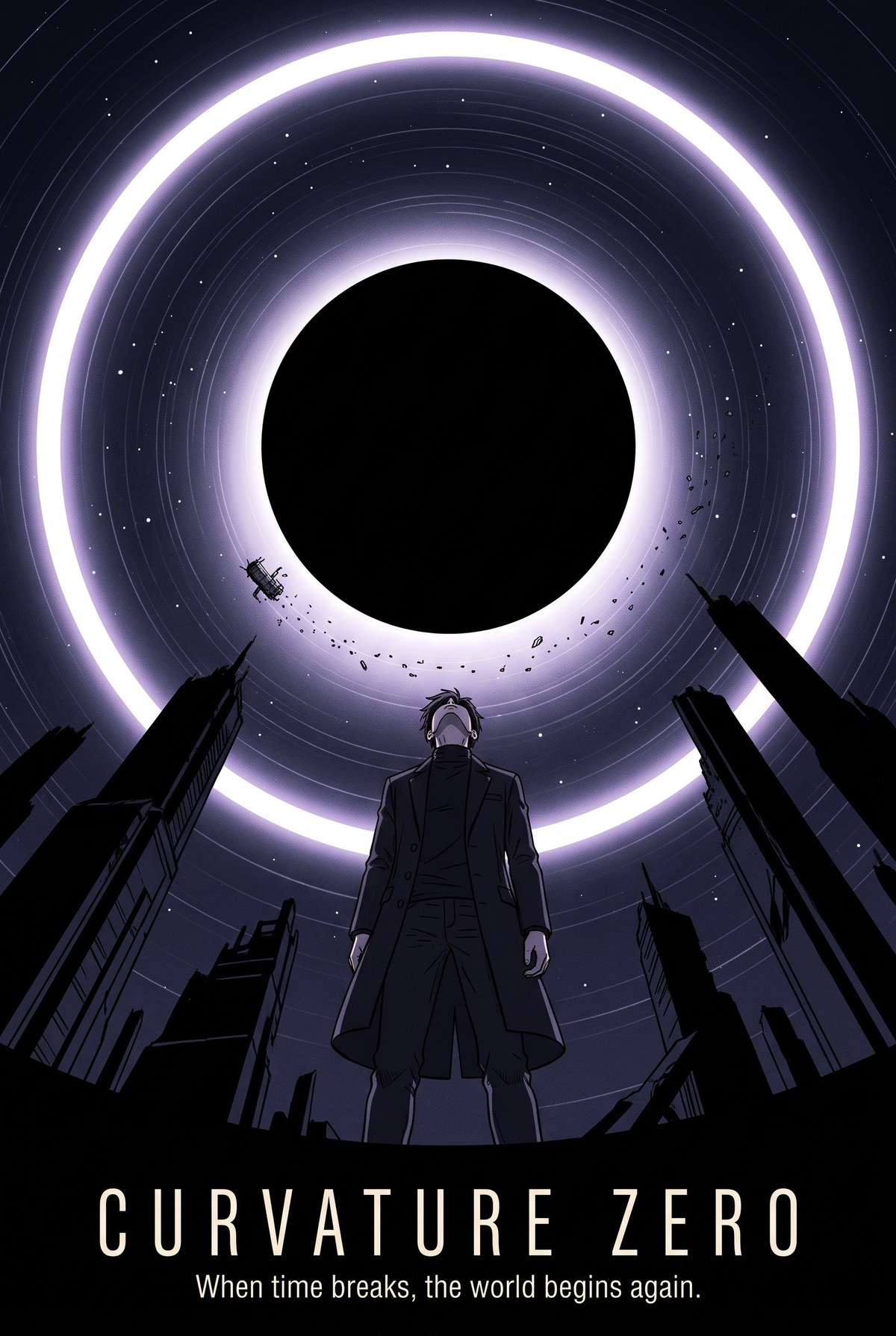



"The border between Earth and the void was once defined by air pressure: one hundred kilometres up, where lift yields to orbit. We were foolish enough to think distance was an altitude. It is merely a delay."
From Tianmen Mission Logs: Ground-to-Orbit Incident Investigations, Second Edition
It was the middle of August, thirty-two degrees on the apron at Tianmen, and the service gantry was white with frost.
The call had reached Longwan that morning: a rupture had opened in the sky over the old launch complex down the coast. Unit Nine had come at once. climbed down from the hauler into heat that hit him like an open oven, and looked up. The old launch tower stood on its headland over the South China Sea, eighty years of rust under grey primer, and frost had grown over its upper girders in pale ferns. Icicles hung from the crane rail. They pointed up. Every one of them tapered toward the sky, and above the tower, directly over it, the sky had a hole in it.
It was a circle four hundred metres across, standing on its edge above the gantry like the mouth of a well turned on its side, and inside it was night. Air as cold as deep winter poured down out of it. Stars showed through it at noon, hard and white, and the blue of the afternoon bent around its rim in thin rings. Things were falling out of it. As watched, a curled solar-panel spar came out of the dark, tumbled lazily down the face of the tower and clattered off an empty fuel tank. A clump of melted relays hit the asphalt and stuck. Thirty metres from the hauler a black stone the size of a fist struck the concrete and lay there hissing, and when the breeze came off it, it smelled of nothing at all, the flat dead smell of something that had never had air on it.
"Perimeter at three hundred metres," Gu said on the radio. "Three crane men were on the tower when it opened. One came back down twenty minutes ago. Hoshino has him. Two unaccounted."
Someone was shouting from the gantry.
found her on the fourth-level catwalk, a small figure in a flight jacket far too big for her, leaning out over the rail with one arm pointed straight up at the hole. A long black ponytail tied with a red ribbon stood out sideways in the downdraught. She was shouting numbers. Nobody on the ground was answering her.
"Who is that?" said.
"Flight dynamics," said the Coalition sergeant at the cordon tape. "She's been up there since it opened. The director told her to come down."
The girl saw the Unit Nine insignia on the hauler and came down the open stairs three at a time, skidding on the frost, and crossed the apron at a run. She stopped in front of with her chest heaving. She was perhaps twenty-four. The jacket was covered in sewn-on patches from launch programmes that had been cancelled before she was born, and her eyes were red from staring into screens.
"You're late," she said. "The descent tracks aren't parabolic. They're negative-eccentricity hyperbolas. That's not a fall. That's an orbital drain."
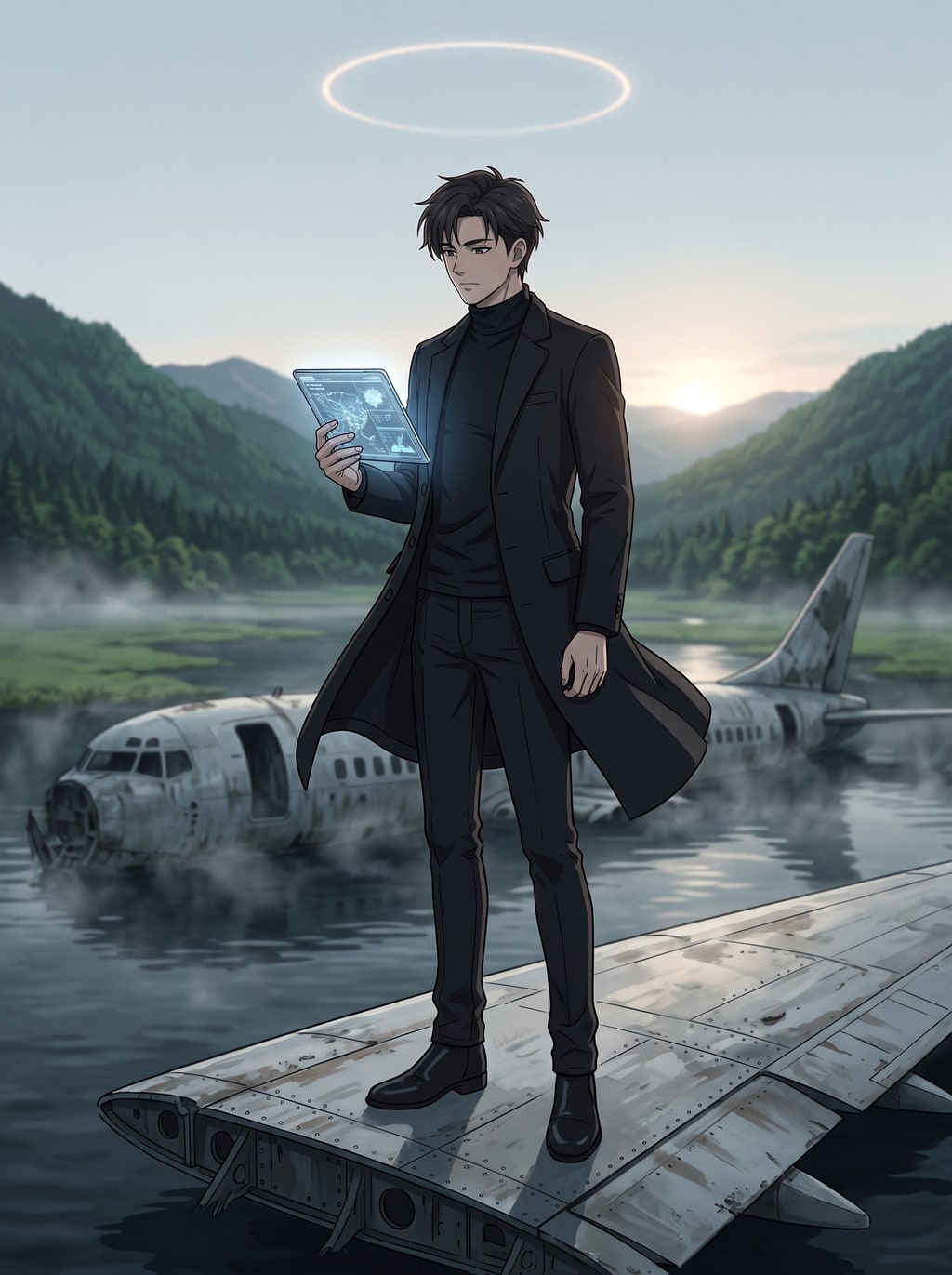
Her face went scarlet the moment she had said it. read the stencil on her chest: . Flight Dynamics. He also understood her. The junk was not dropping the way junk drops. Space was pouring it down on them from high above the air, the way a sink pours water down a drain.
"You think the hole is tied to something up there," he said.
"Because it is." She pulled her cuffs down over her hands. "Sir. The tracking office told me it was radio noise and to clear my screen. But the debris isn't random. Everything's coming down at an angle of fifty-one point six degrees. That's the old international station corridor, the path the International Space Station once flew. Nothing falls out of fifty-one point six unless someone put it there ninety years ago."
had come up behind them. Su saw the Colonel's insignia and went rigid, but she did not step back.
"Is she right?" said.
plugged his terminal into the battered deck Su had under her arm. MECN-7's gold lines came up across her rough plots and lay down on them almost exactly. "She's right."
"What's your name?" said.
", Colonel. Junior dynamics officer."
"," said into his collar. "The man who came down."
was on the step of the medical trailer with her sleeves rolled to the elbow. "Freeze burns over sixty percent of him. Decompression sickness, textbook. His blood was fizzing while the air boiled off him at minus forty. The winter coverall kept enough seal to save his lungs. Core temperature twenty-eight when they peeled him off the apron." She looked up at the hole and back at . "He was up there for six minutes, . Low orbit. Bare sleeves."
"And the other two?" said.
"One of them is gone," Su said. She had her hands back inside her cuffs. "If he went through the hole faster than seven metres a second, he's circling the Earth now, above the air. He won't re-enter until orbital decay brings the perigee down." She swallowed. "In about three hundred years."
"The third?"
"I don't know. I lost him in the glare."
The ground kicked under their feet.
The shock had been a fragment the size of a door. It had come down twenty paces from the radio van and buried itself half a metre in the tarmac, and its edges were glowing dull red and dripping molten metal into the salt grass by the drain. was already on one knee five metres back with a heat gauge, and was standing over it with a mesh dish under his arm, swearing in Polish.
"Do not step inside the arc, ," said. "Space is pulling hard enough around it to unglue your boot soles."
slowed to a walk as the heat reached him, and then the smell did, and he stopped.
Hydrazine, scorched nylon netting, and the sour sealant they had used on the inner hull seams. He had breathed that air every day of the mission. Under the blistered paint, across the plate, ran a line of blue sans-serif letters in the Accord Exploration Registry's stencil, burned through in the middle:
...EP-L...
was at his shoulder. She took his upper arm in her hand, and held it.
"Neumann. Speak."
"Service module," he said. His voice sounded scraped. "The right side, where the steering jets were."
looked from the plate to 's face. "The Kepler? , that's the Moon. That's three hundred and eighty thousand kilometres."
"The Halo isn't a place you fall out of," said. "It's an edge. Whatever crosses it stays on the edge until something opens underneath." He looked up at the black circle over the tower. "This opened underneath."
The dish under 's arm made a thin, regular chirp.
went down on his knees on the hot concrete and spun the dial. "That's not ours. Four-oh-six point oh-two-five megahertz. That's the old civil search-and-rescue band, nobody's used it since the war except the Accord registry." The chirp came again, every eight-tenths of a second. "Strong signal. Steady. It's forty metres above the gantry and coming down at nine metres a second." He looked up, and the colour had gone out of his face under the beard. "It's an Accord distress locator."
High on the tower, something came out of the circle.
It did not tumble like the scrap. It came down steadily, trailing a strip of orange drogue cloth that could not fill in the freezing air pouring out of the hole, and it struck the top catwalk with a clang that came down to them a second late, bounced twice and wedged itself in the yellow catch-netting twelve metres above the lower deck.
was running before he knew he had decided to. He knew what an Accord locator on that band could mean.
The gantry stairs were glazed with ice. At nine metres up the air had gone dry and bitter and his breath came out in white streamers that froze on the brim of his cap. He heard behind him, closer than she should have been, making no noise at all on the treads. At the top he went down on his stomach on the catwalk under the netting. The orange cylinder hung a metre out over the drop, jammed in the cordage, a whip antenna trembling at its base.
He put his chest against the rail and reached. A metre was more than he had. He reached further, and felt the rail take his weight, and then a hand closed on the harness ring at the back of his belt and settled her weight against the column behind him, and he stopped needing the rail.
His fingers caught the antenna collar. He dragged the cylinder in through the bars and fell back with it on the grating.
It was so cold it burned through his gloves. It was an Accord spacesuit locator, an old AER-four, scuffed down to bare titanium, its little solar skin crazed with impacts. Riveted to the battery hatch was a copper plate, and on it someone had scratched two letters with a tungsten scribe, deep enough to last.
L.S.
A clear plastic pouch was strapped to the casing with silver tape. Inside it, folded flat, was a blue canvas notebook with a split spine.
The little status light behind its window was green.
"The power cells on an AER-four last seventy-two hours," said. "From the moment the pressure switch trips."
crouched beside him. She did not touch it. ". That was eight years ago."
"." He found his collar mic. "Patch the audio off the dish into this line. Now."
White noise first, shrill, full of the hiss of an open edge. Under it, a dry, regular rasp: a suit's air scrubber working far past its limit. Then a voice he had not heard for eight years, as level as a radio check.
"...Kepler distress relay, mark zero-two... , if this transponder reaches an Accord ground array, the module separation fired clean. The latch didn't fail. I pulled the staging lever myself, from outside the hatch. Do not let Karim take the blame for the burn, and don't go looking for the bridge. There is nothing left forward of frame six. The boundary... , it is not an event horizon. It's a manifold. It is folded like linen. I can see the lights along the Chinese coast through the inner ring, but my clock is losing twelve minutes every second..."
A dull knock on the suit mic. A breath caught on something broken.
"...Air is at nine percent. When you get home, don't let them call it random. Do you hear me? Don't let them call it random. It's geometry. It's all just geometry, and it's looking for..."
It stopped. A clean high tone took its place, and after it the dry synthetic voice of the locator's own clock: Metric coordinate burst received. Local epoch: minus four minutes, twelve seconds.
"Minus four minutes," said on the radio. His voice was not steady. ". That clock wasn't started eight years ago. It was started four minutes before it hit the netting. Wherever she is, she let go of that canister ten minutes ago, our time."
stood up. The wind off the sea pulled at the braid at her neck. She was looking at the circle above the tower.
"She is alive."
"No," said. He had his thumb on the scratched letters on the copper plate. "Not alive. Not dead. She is in the fold. From inside, eight years could be nothing. If the gate stays open..."
"It won't!" Su's voice cracked across the radio, high and breathless, from the hauler below. "Dr. Neumann, look at the readings! The hole is narrowing. It will close in about four minutes, and when it snaps shut its edge will cut the tower in half like a blade. And look at the counterweight track. Look up!"
looked up.
Forty metres above them, on the crane's counterweight track, a man in a yellow high-altitude suit hung between two girders. He was alive. A puff of vapour came from the valve of his hood every three seconds. His boots had come off the steel, and he was held by a single nylon lanyard that was sawing against the sheared lip of an anchor plate, and every time the downdraught gusted, he rose a little further toward the stars.
"The platform can't reach him," Gu said. "Hydraulics freeze the moment the arm goes into the hole."
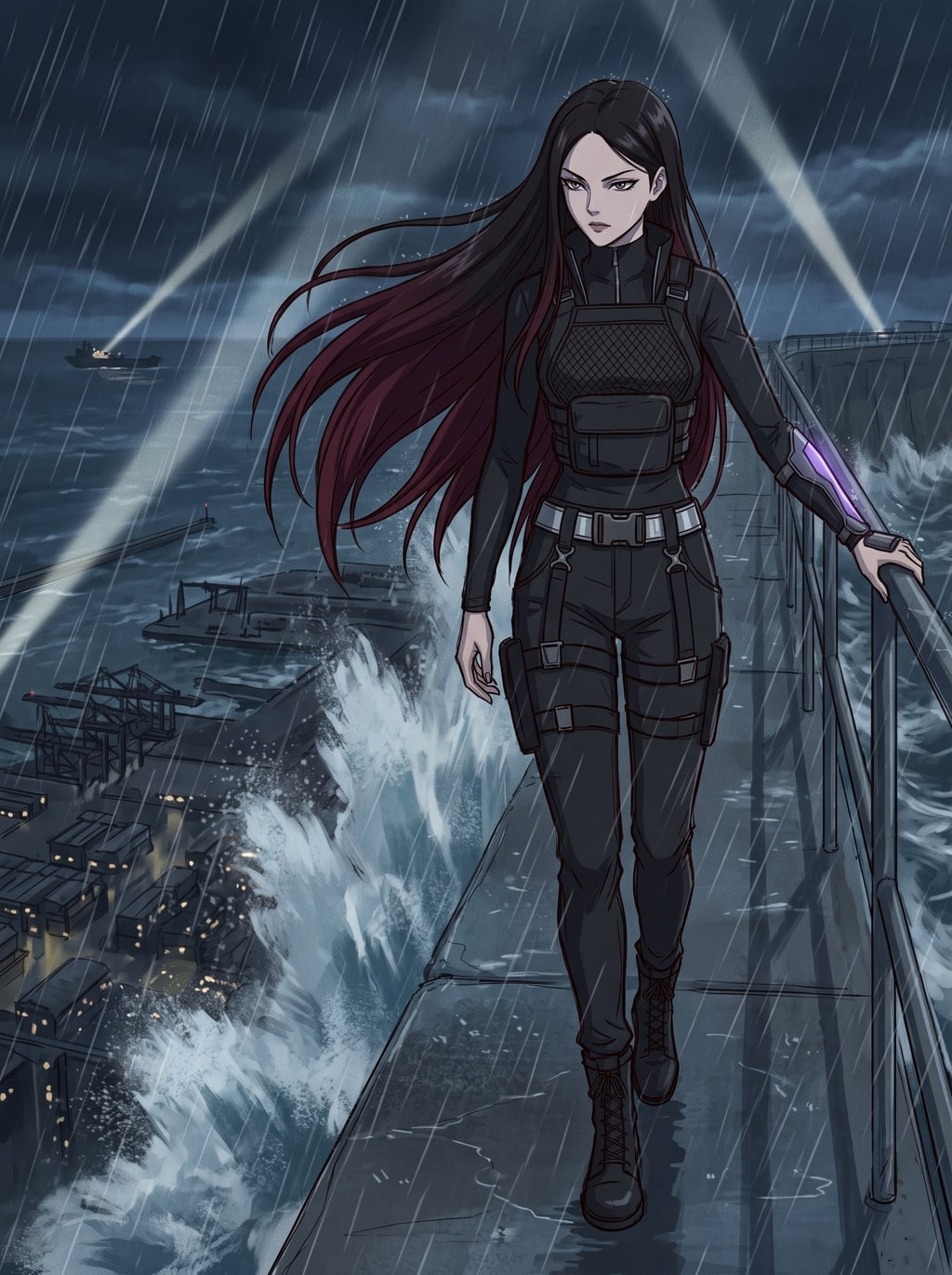
"Then no hydraulics," said. She unclipped the anchor driver from her harness, a pneumatic harpoon gun as long as her arm, and the clip came away with a heavy click.
"Colonel, wait!" Su again, words tumbling over each other. "If you fire a line into that hole at the wrong moment, it snaps on impact. The far side of the gate is up in space, and up there everything is going east at nearly eight kilometres a second!"
did not move. She looked at and waited for him to tell her when.
He went down the stairs with the locator in his arms, three treads at a time, and hit the apron running. At the hauler he pushed the orange cylinder into 's hands. "Keep it shaded. Don't let it warm up too fast."
wrapped it in a thermal blanket without a word, the pouch and all, and held it against her chest.
Inside, Su's console was buried in fan-folded printouts covered in blue pencil. On the screen MECN-7's plot was fighting a live radar trace that looped and buckled like a bent wire.
"Show me when she can fire," said.
"The mouth isn't standing still. It wobbles, once every eight seconds, because the Moon is dragging on it." Her fingers were moving while she talked. "At the top of each wobble it stops moving against the ground for one hundred and forty milliseconds. That's when she fires."
He leaned over her shoulder. He knew the shape. It was a pattern out of his McGill notebooks, turned into radar returns and girders.
"One hundred and forty milliseconds," said. "That is four frames."
" does not need four," said from the awning.
looked out of the hauler door. Up on the level-four rail had braced herself with the driver on her shoulder and was completely still.
He put his hand on the shoulder of Su's jacket. "Wanxing. Count her down."
Su swallowed. Her eyes went from the clock to the trace and back. When she spoke again her voice had dropped and slowed and found a beat. "Wobble coming round. Four. Three. Speed matching. Two. One. Now!"
The crack of the driver came across the apron like a rifle shot. The harpoon went up trailing a graphene line that flashed silver in the sun, and struck the flange of the girder sixty centimetres above the man's harness, and its flukes bit into the iron in a spray of orange sparks.
"Anchored," said.
The line went taut and began to sing. A moment later the frayed lanyard parted, and the man in the yellow suit swung out into the empty air over a three-hundred-metre drop, spinning, held by 's line alone. On the catwalk had the winch clutch in both hands and her boots braced against the stanchion, and the drum was shuddering in its mounts.
"Haul him in!" Gu shouted.
"Hold the drum!" said. ", don't haul yet. Something's changing."
On Su's screen the hole's trace kinked hard to the west. The Stability Index under the tower dropped from 0.4 to 0.12 in one wobble.
"Something else is coming through," Su said. "Four hundred kilograms. Twelve kilometres a second. It's coming straight down the old road from the Moon!"
"Identify," said. Through the open door saw the crane shudder, and 's boots slide five centimetres on the frost.
He put his face close to the glass. The new trace did not tumble. It was the clean, steady curve of an engine burning, an old one, and he had studied that curve until dawn in Montreal.
"It's not debris," he said. "It's an engine."
Through the black circle it came: a booster stage, thirty years dead, charred black, the Accord roundel on its flank burned to a shadow, tumbling end over end in a skin of freezing vapour and trailing loose wire. It was falling down the gate's corridor straight at the crane cab.
"Clear the platform!" Gu said. "Yuelan, step off!"
"The worker is on the line," said. She did not let go of the clutch. ". Give me a release time."
"If she lets go, he falls three hundred metres," Su said, very quietly. "If she holds, the wind behind the booster cuts the cable and takes her with it."
turned. ". How many lanterns are cleared for flight?"
already had her hand flat on the yellow release panel on the crate beside her. "Sixteen. On standby."
"Dump all their spare power into their fields. Put them under the booster's nose. We don't need to stop it. We only need to tip it three degrees, and then the Earth turning under it will carry it past the tower."
"It will burn out every one of them."
"Burn them."
hit the key with the heel of her hand.
Sixteen gold lanterns came off the crate together with a scream of fans and went up almost straight, climbing into a cone under the falling stage, and their noses lit amber, so bright had to look away. The air between them bent the afternoon light into a slick, sideways ripple.
The booster hit the amber three hundred metres up. There was no fire. There was a long iron groan that came down out of the sky and through 's chest, and on Su's screen the red curve bent outward, toward the marsh.
The stage went past the crane twelve metres from 's catwalk. Its wake tore away the safety netting and stripped the frost off the girders in one white sheet, and the graphene line sang and held. Three kilometres out it went into the salt marsh, and the sound came through the ground before it came through the air: a deep thump, and a column of black mud and steam that went up a hundred and fifty metres.
On the catwalk threw the winch lever to its stop. The drum shrieked, and the yellow suit came down out of the frost, hand over hand, thirty centimetres ahead of the closing edge.
"It's closing!" Su threw her arm over her eyes. "Three, two, one!"
The black circle shut all at once, there and then gone, with a crack like a dropped steel plate that blew in every window along the row of command trailers and threw off his feet into the leg of a bench. The air came slamming back into the place where the hole had been. Then everything was quiet.
The heat closed over the apron. The upside-down icicles on the gantry all let go at once and came down in fat warm drops that ticked on the concrete.
got up, spitting grit. High on the rail, was kneeling over the man in the yellow suit. She pulled off one glove and held up two fingers to the people below.
Half an hour later was sitting on an upturned cable spool, staring at his hands. They were shaking too hard to put his stylus back in its pocket, and after the third try he gave up and let them hang between his knees. At the deployment rack stood over sixteen dead controller housings that were leaking thin white smoke.
"One million six hundred thousand yuan of government hardware," she said. Her voice was flat; her ears were still ringing. "They held the curvature for four seconds, . Four entire seconds."
had not moved from her chair. On her screen the red curve had flattened to a level green line. Through the broken window behind her the sky was a clean, blank summer blue all the way to the sea. She had bitten through her lower lip and there was a small dry smear of blood at the corner of her mouth, and her knuckles were white on the edge of the console.
"You had the inclination wrong," said.
Her chin came up like a cornered animal's. "The debris came down at fifty-one point six..."
"Fifty-one point six four. The Kepler's locator came down a hair off your line. You allowed for the air slowing it, but you forgot the fuel still left in the service module. About eighty kilograms of it. That shifts the balance point forward."
She looked down at the sheets under her forearm, the cramped pencil sums and crossed-out working, and her mouth opened a little.
"You calculated the rest by hand," said. He sat on the clear corner of her console. "No big computer. With a live rupture sixty metres over the gantry."
She pulled her fingers back into her cuffs. "They were going to clear the queue," she said. "The launch director called it ghost echoes. He said if I reported one more thing in the sky that radar couldn't confirm, he'd send me to the fuel depot at Haikou to log drum pressures."
"He won't," said from the door.
She came down the three steel steps with half her braid undone and the orange locator in her left hand, the thermal blanket still round it, and set it on the table on top of Su's charts.
"."
Su stood so fast her chair screeched. "Colonel!"
"How old are you?"
"Twenty-four, ma'am."
"Who taught you to track ruptures?"
"Myself, ma'am. The academy library reels. Dr. Neumann's papers from McGill." Her eyes went to for half a second, in pure terror, and back. "The 2123 ones. On quartz drift near rupture edges."
looked at her for three seconds, then four. Out in the salt grass beyond the fence the cicadas started up again, one answering another.
"Boundary Operations has a desk open in Longwan," said. "Flight dynamics, intercept division. The pay is inadequate, the hours are offensive, and people drop things on your head from orbit."
Su opened her mouth and nothing came out of it for two heartbeats. "Ma'am?"
"Pack your kit. You have twenty minutes." was already turning for the steps. "If you're late, you can walk back to Haikou and log drum pressures."
"Yes, Colonel!" Su's voice broke on the second word. The salute she threw landed somewhere above her right eyebrow. did not turn round, but her shoulders came down a centimetre on her way out.
pulled the blanket off the locator.
The frost was going. Water ran off the pitted casing in thin lines through the old grease, and the little status light still pulsed green. He peeled back the silver tape and slid the pouch free and held the notebook in its plastic without opening it. The canvas was faded nearly grey along the spine where her hand had held it, and one edge was scorched brown where the pouch had cooked against the casing. On the cover, in black marker, in her round, impatient hand, it said: L. SERRANO. KEPLER. IF YOU ARE READING THIS YOU ARE READING SOMEONE ELSE'S NOTEBOOK.
He put it inside his jacket, against his ribs, and zipped the jacket over it.
"Dr. Neumann?"
Su was at the bottom of the trailer steps with an olive canvas kit bag on her shoulder, its broken zip mended with copper wire, and a field terminal under her arm with its corners taped. It had taken her eight minutes. She looked very small against the hauler.
"Wanxing."
"Your 2123 paper." The words came out fast, before anyone could take her clearance away. "In the fourth appendix. Your sums for the Lunar Fracture, the break that made the Halo."
"Yes?"
"You left a remainder." She looked straight at him now, the fear gone, pushed aside by something hungrier. "Seven point six percent of everything the Fracture swallowed. You wrote it off as lost while the rupture formed. But by your own numbers, none of it ever left. You didn't lose that mass, Dr. Neumann. It didn't disperse."
He felt the cold still coming off the locator on the table beside him, cold from the edge of the Halo, where it had taken eight years to cross fifty metres of air.
"No," he said. "We didn't lose it."
"Then where did it go?"
looked out past the gantry, past the steaming marsh and the perimeter towers, to where the daylight Moon hung faint and white over the sea, thin as a fingernail pressed into the blue.
"It stayed there," said. "Waiting for us to build a door."