



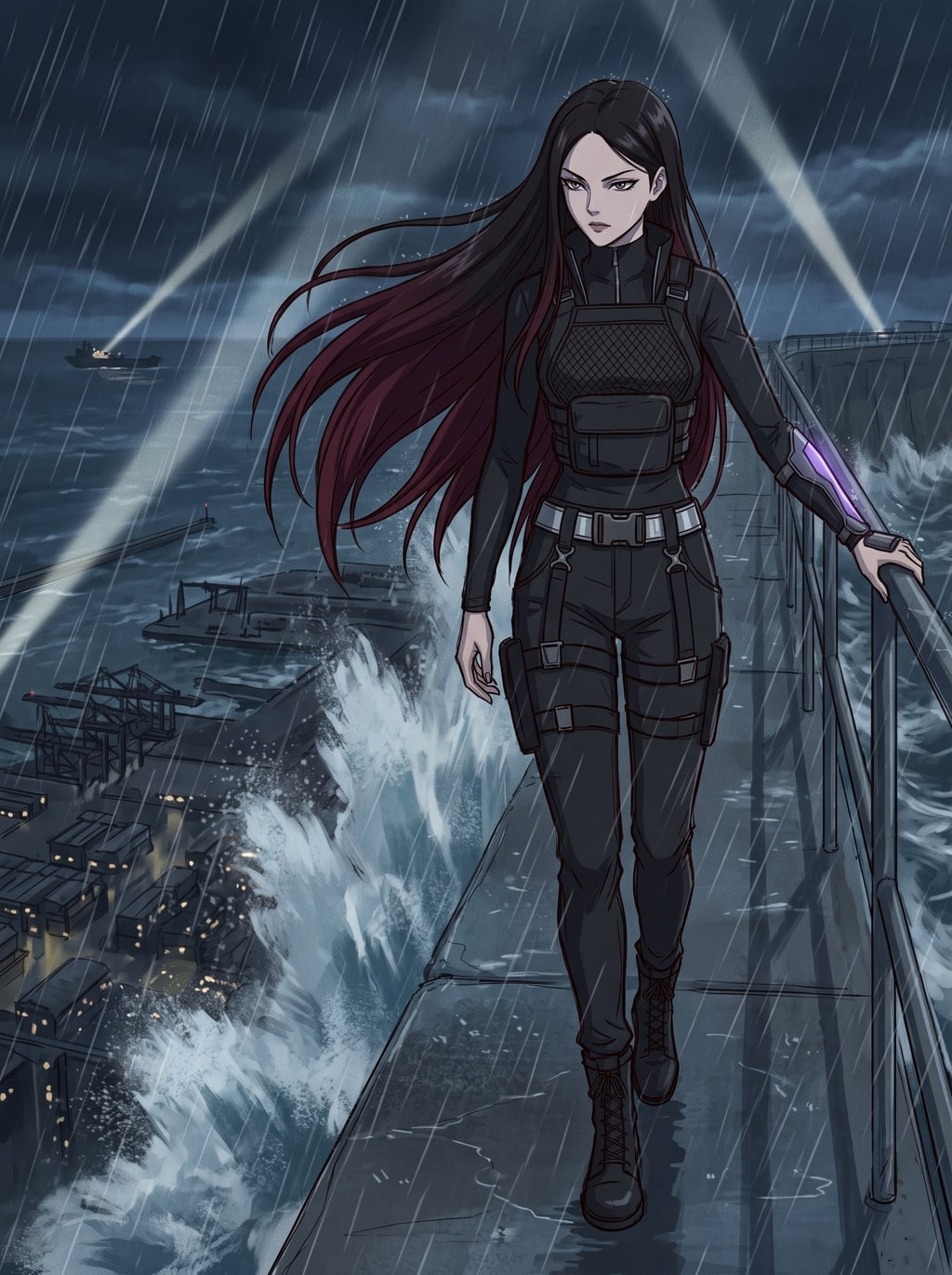
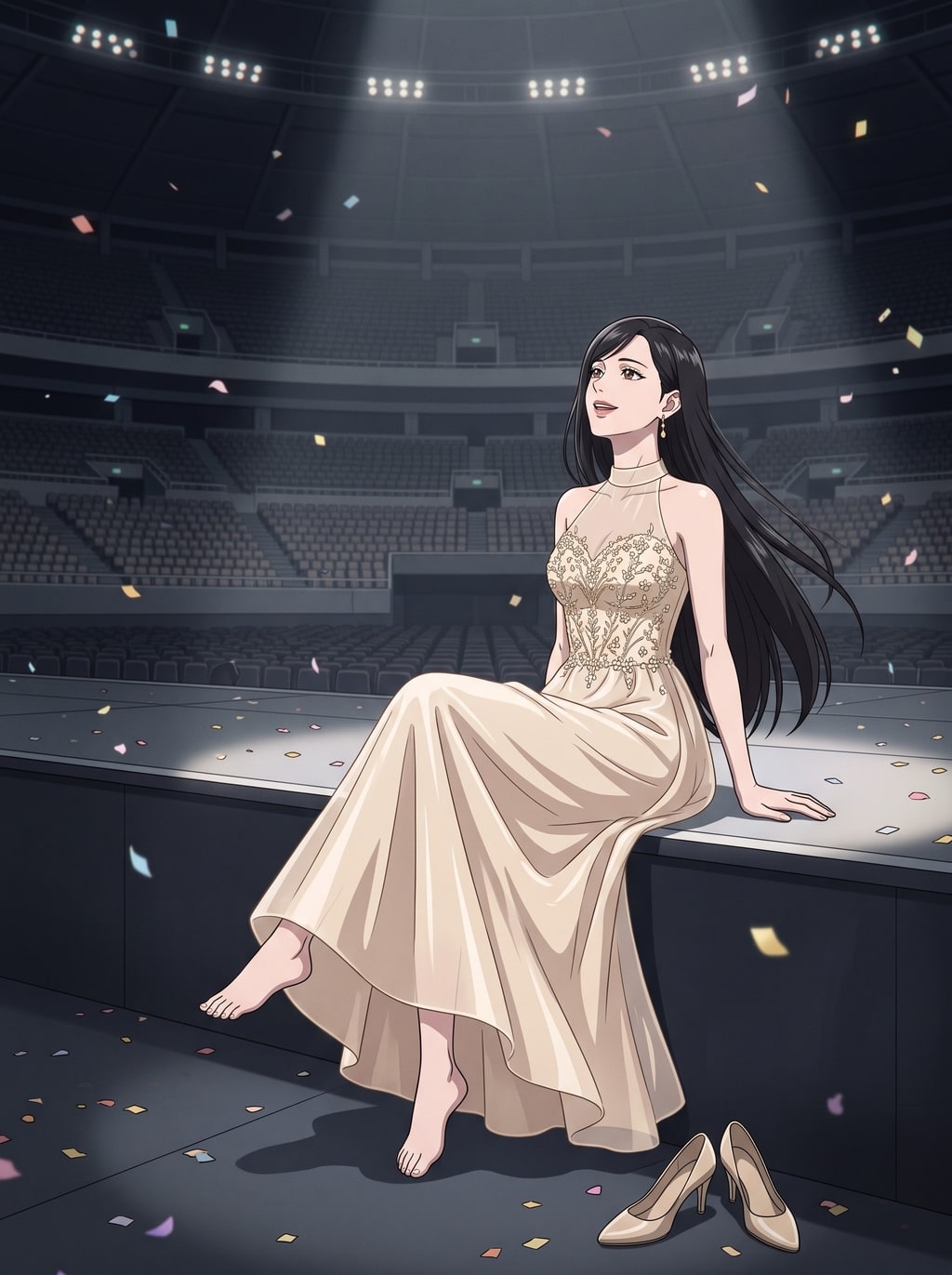

"A court does not mend torn cloth; it only measures the rent."
From Precedents of the Longwan High Court, 2131
"You are shaking the bench, ," said.
"I am not shaking. Your knee is."
It was 's knee. She pressed both palms on it until the linen of her borrowed trousers bit into the skin, and , who had known her since their first winter in the shelter dormitory, when they were two girls sharing one blanket, let the lie stand.
The witness bench of the High Court of Longwan ran along the east wall beneath a row of tall arched windows, and the light that fell through them in long dusty shafts was the grey of a day that had not decided whether to rain. Outside, behind the cordons on the canal embankment, two hundred thousand people were standing in the drizzle. could not see them. She could feel them. Every few minutes the crowd shifted its weight, and the shift came up through the floorboards into her heels, the same slow tremor she remembered from the dormitory floors after Busan, when the sirens wound down and a thousand people moved at once to find out whether their street was still there.
wore a black tunic the clerk's office had found for her, buttoned to the chin over the dampener. had strapped it across her collarbone the morning after the Parade: a band of grey titanium two fingers wide, four hundred grams, which touched whenever she thought nobody was looking. It had pulled her lag in to almost nothing. When she tucked her hair behind her ear, the air beside her cheek still held the shape of her fingers for a moment after they had gone.
wore the plain grey suit the prosecutor's office had lent her, and on its lapel, because Article Nine of her Moonveil contract required it at every public appearance and the contract had eleven months left to run, the pin: a small silver crescent moon folded over on itself, the one every Moonveil artist had worn on every stage for nine years. She had fastened it this morning the way she brushed her teeth. She had noticed it in the lift and left it where it was.
In the corridor before the doors opened, a lawyer for the receivers now running Moonveil had walked beside her for twenty metres with his umbrella still dripping. He was a pleasant man with a soft voice. If Miss Kang testified that she had known nothing, he said, which was surely the truth, the catalogue would stay in her name and the royalties would keep going to the shelter fund, as they always had. If she said anything that put the foundation's intent in question, the catalogue would be an asset of an indicted company, and assets were frozen. He had pressed a card into her hand. It was still in her jacket pocket, folded in half.
Across the well of the court, behind a wall of blast glass, sat in the dock. They had let her keep the crane coat, and the long braid over her shoulder was still strung with its tiny silver bells. The bells had never made a sound. had asked her about it once, at fourteen, and Madame had said some things are made to be seen keeping quiet. She was looking at now with the small, patient tilt of the head that had once made a nine-year-old on a shelter cot believe the world could be stitched back together with enough clean thread. looked at her own thumbs.
At the prosecution table turned a page. She wore an ivory suit, the only pale thing in a room of black robes and wet wool, and one hand rested flat on a manila folder tied with red tape. She had not opened it all morning.
"The People call ."
came down from the press tier with one slate and no notes. She sat, gave her name and her network, and waited for the question with her hands folded, a woman who had testified before and expected to be lied about afterwards.
"Ms. Whitlock. Who paid for the Helix Trust?"
"Three governments." touched the slate and the air above the well filled with amber lines, money moving between cities in thin threads of light. "The Trust has been a clearinghouse for thirty-one years. I can confirm three sources. The Atlantic Federation's Advanced Defense Logistics Agency. The Northern Accord's Reconstruction Science Bureau. The Coalition's Ministry of Heavy Infrastructure."
The gallery made a sound like gravel shifting. The bailiffs brought their staves down on the boards.
"To be clear," said, "all three powers paid to develop weapons that tear space itself."
"In the last eighteen months of the war. I have the transfers, and two of the engineers on the record. The programmes were closed on paper when the Halo opened. The Trust kept the people and the equipment."
"And Moonveil Media?"
"Moonveil was how they found the children." did not look at the witness bench, and understood that this was a courtesy. "Touring shows, shelter concerts, free clinics. The foundation kept a register of children who came out of ruptures with what their doctors called unusual stability: their bodies held together where other people's came apart. I count twenty-four thousand names over twenty-two years. The register is exhibit four."
Twenty-four thousand. had sung in sixty-eight cities before her nineteenth winter. In every one of them, after the show, Madame had walked the hospital wards beside her, a cool hand on a hot forehead here, a name written there in a small black calfskin notebook. In an unheated green room in Hankou, she had smoothed 's hair back from her face with both hands and said, We are simply finding the ones who can hear the pitch, Min-ji.
had thought it was a thing people said about singers.
"The People call ."
He came from the escort bench between two officers, walking carefully, keeping his left side still under his coat. His silver-lilac hair was tied back with the black ribbon, and without the stage lights his face looked younger and very tired. He stood in the witness box in a shaft of window light and put his hand on the reader. had sung forty duets with him. Before every one he had made a joke in the wings, usually about his own cheekbones. Today he said only his name.
"Mr. Kirishima. You sat on the inner council of the Meridian Circle."
"I did."
The defence counsel rose. "Objection. The witness is an actor whose contract was terminated in receivership. He has traded on drama for five years. He is not competent to speak to foundation logistics."
"Overruled. The witness will answer."
looked through the blast glass at Qiao. She gave him the look knew, the one that forgave you in advance.
"I sat on the Circle," said. "I went with Madame to the private wards in Sector Four, Sector Nine and the cellars under the Old Port grain elevators. I signed the transfer chits for twenty-eight children under the line for cultural bursaries."
"Why did you sign them?"
"Because I believed her." He laid his hands on the rail. "She showed us how fast the Halo was growing, and the date it would reach the top of our sky. She said we were choosing who would carry people through. I gave her my face. I gave her my voice. I moved fourteen million credits out of Moonveil syndication to buy vacuum pumps for the clinic cellars."
The defence counsel was on his feet again. "Isn't it true your bookings fell forty percent after the Pearl River season, and this remorse is a bid to stay relevant?"
"My career drowned when the floodgates opened on the North Canal," said. "The screens are dark, Counselor. I do not care if they ever light up again. I stood three paces from the hatch in Sector Four while three girls from the dock camps were strapped into a cradle that bent the space around them, and Madame told their mothers in the corridor that they had passed the entrance examination for the conservatory. If you think I invented that, you may cross-check the refrigeration logs under exhibit seven."
Nobody in the gallery moved. Behind the glass, Qiao folded her gloved hands on her knee.
stepped down. On his way past the press rail one of the camera operators swung a lens to follow him, and said, quietly enough that only the front benches heard, "Left side, please. It photographs better." put her hand over her mouth. snorted, then looked furious with herself.
"The People call ."
came down from the technical row in a borrowed Coalition tunic that was too broad in the chest. He did not look for her as he passed, and she was glad, because she did not know what her face would do. Behind him in the second row Yuelan sat very straight with her left forearm bandaged from wrist to elbow, watching the exits instead of the dock.
"Dr. Neumann," said. "You examined the machinery recovered from the North Canal pumping vaults."
"I did. It could not open a rupture on its own. It made one easier to start, under a chosen crowd, at a chosen hour." He paused, and saw his hands find the edge of the box and stay there. "Its pattern matches the strain recorded on the Kepler's hull near the Moon, before we lost her."
The breath went out of the gallery. "You still think of it as an accident, Dr. Neumann," Qiao said.
The Chief Magistrate struck the block. "The defendant will remain silent."
Qiao did not look at the bench. Her voice came through the brass grille in the glass as unhurried as it had ever been at a dinner table. "You fell home from it for twenty-two days in a capsule the size of a wardrobe. You have had eight years to listen. And you still believe the universe is a broken pipe, because a wrench is the only thing you know how to hold."
"A pipe that drowns people is broken, Madame ," said. "The intent of the water does not interest the person who cannot breathe."
"Counsel will control the defendant."
went back to his seat. He sat down beside , and , without turning her head, moved her boot two centimetres so it touched his.
"The People call ."
's whole body went still. caught the cuff of her tunic.
"Take your time."
slipped her wrist free, gently, the way she slipped out of a partner's hold in rehearsal. "Time is the one thing I do not have in the right order, ," she said, and stood.
She walked down the centre aisle with her chin up and her shoulders loose, a dancer crossing to her mark. On the parquet in front of the bench her right heel came down, and a moment later a second heel, pale and faintly violet, came down in the same place and faded into the varnish. On the screen above the doors, the one that showed the court what was going out to the plaza, it happened again in slow motion. Through the floorboards felt the crowd outside take it in, a long movement under her feet like a wave going up a beach.
"State your name and occupation."
". Principal dancer, Moonveil Arts Ensemble." She tilted her head back. knew the angle. It was the one she used on junior chorus girls who had missed their marks. "Formerly."
"Ms. ," said. "What was done to you in the winter of twenty-one sixteen?"
"I was sixteen. I had grey lung from the shelter dust, and I coughed blood on the floor of the Old Harbour pavilion in the middle of a run-through. Madame took me to her foundation clinic in Sector Four. There were twelve other girls in the basement. All from the northern relief camps." 's voice was flat and quick. She was frightened, thought, and when was frightened the jokes stopped and the facts came out in a straight line. "They did not give us medicine. They put us under a bronze vacuum ring and held a fold open over the table, and they put spinal needles into us while it was open. Seven of the girls did not wake up after the first session. In three days their bodies had gone to grey water. Three more lost their minds. They are in the cistern under the concert hall. They sit in thirty centimetres of runoff and sing the same three notes. If you go down there, you can hear them."
Somebody in the gallery began to cry and was hushed.
"And you?"
"I held." She raised her left hand and spread the fingers, and the lamplight broke along her thumb into an oily violet edge. "I am what Madame calls a Firstborn. My body is partly somewhere the clocks do not agree. When I jump, the stage does not know exactly when I will land, so I stay up a little longer than anyone else. Audiences threw gardenias. Madame said it was the next shape of the human form." She lowered the hand. "Touching people hurts. It feels like the second before a shock. I do it anyway, for one person."
She did not look at the witness bench.
"You were dying of grey lung, little bird," Qiao said through the grille. "I gave you thirty years. I gave you wings."
"You made me a ghost," said. "And you sold balcony seats so the ministries could watch me float."
let the silence sit for five slow beats.
"Thank you, Ms. . The People call Kang Min-ji."
stood. Her knees felt like dry pine, but her boots made no sound on the runner. The court went quiet in a different way, the quiet of people who already knew her face and were waiting to see what it would do. For seven years her recorded voice had played from the yellow sirens on the river at dawn, telling two million people the tide was down and the bridges were open.
She took the box. She put her hand on the reader and said her name, both of them, and the clerk wrote down the one she gave first.
"You were under exclusive contract to Moonveil Media for nine years," said.
"Yes."
"Did you know what the machines under the stage floors were?"
"No. Madame told me they were dampening grids. She said they kept the bass from cracking the shelter walls."
"Did you go with Madame on her visits to the flood wards?"
High in the south gallery three girls from the district youth choir sat together in faded volunteer tunics, their badges pinned crooked. had taught one of them to breathe from the stomach. She looked at them while she answered.
"I helped her."
The cameras on the dollies turned their red lights toward her.
"I did not know what the lists were. I thought we were finding beds. When the children came up to the stage steps to sing with me, Madame would hold their wrists. She would tell them their breath had a colour. Then she wrote their shelter numbers in the little black book she carried in her coat. I smiled at their mothers. I told them Madame was the woman who took me out of the mud after the sea walls fell in Busan. I told them she was safe."
She turned from the cameras to the glass.
Qiao looked back at her with the calm of a gardener walking an orchard after a late frost, counting what had lived.
"Madame ," said, quietly, under the microphones. "Did my mother have a colour, too?"
Qiao did not blink. "Your mother pressed shirts in a laundry above the harbour at Yeongdo, Min-ji. She had no colour at all. She stayed in the old world because her body belonged to it. You lay under four metres of wet concrete for a night and a day, and you sang the alphabet song until the rescue dogs found you, and your balance never tore." The bells on her braid lay still against the black silk. "I did not invent your frequency, child. I only built you a hall large enough to hold it."
's hands found the rail of the box. The wood had been scrubbed with phenol, and the grain was scored where other people had gripped it.
"You knew that if I announced a concert at the Citizen's Hall, four thousand people from the lower wards would come, because they thought my songs were safe," she said. "You used me as an anchor point for your machine."
"The world must go through the door, ," Qiao said. "The three governments will spend fifty years building walls and dying behind them. The ruptures are the next weather. If we do not teach our children to breathe in it, it will take them anyway. Is it a crime to build the bridge before the flood?"
"You didn't build a bridge," said. "You set the fire so you could sell the ashes."
She heard her own voice and did not recognise it. It had lost the roundness Moonveil's coaches had spent nine years putting into it, and what was left was a girl from the Busan docks who had slept in wet boots for ten winters.
She turned to the nearest camera. "My contract with Moonveil Media is ended. Whatever rights Madame holds over my recordings, my image or my name, I dissolve under Coalition Emergency Code Eighty-Four. The foundation holds thirty-two million credits in trust for me. I give all of it to the Relief Directorate, for the families from the Citizen's Hall."
The Chief Magistrate lifted his gavel and held it there. He did not bring it down.
"I will not sing your hymns anymore, Madame ."
Her fingers went to her lapel. The clasp of the pin was stiff, and it took her two tries, and she was aware of every lens in the room watching her fail at it. Then it came free. She stepped down from the box, crossed to the prosecution table, and laid the silver crescent face up on the open ledger in front of . It made a small click on the paper.
"The children you took will have someone to speak for them," she said, "who does not need your stage."
She did not wait to be excused. She walked past the guard post to the second row of the technical benches and sat down beside , because it was the nearest seat and because it was his. Her ribs ached from breathing too shallowly.
He did not look at the cameras and he did not take her hand. He reached under the bench, brought up a paper cup of tap water he had fetched twenty minutes earlier, and set it on the boards by her knee. There was pencil graphite on his fingers. It was the way you passed someone a bolt across a workbench because the next weld was cooling. She drank the whole cup. Then she took the lawyer's card out of her pocket, still folded in half, and dropped it in.
untied the red tape.
"Madame . In twenty ninety-six, during the Second Northern Offensive, you were chief administrator of the Coalition's Second Military Hospital in Jiangnan."
For the first time that day something moved in Qiao's face. "That was thirty years ago. Before the water rose."
"On the fourteenth of August that year an Atlantic Federation shell built to tear space exploded four kilometres from the hospital. The tear went through the maternity wing. Sixty-two infants and four nurses were listed as missing, presumed consumed."
"I remember the day," Qiao said. "The sky went violet. The clocks in the delivery rooms ran backward."
"Among the missing was a three-day-old girl. Jing. Your daughter."
Qiao's gloved hand closed on her own knee.
"Do not speak her name in this ditch."
laid a sheet on the reading glass, and the projector threw it up above the dock: a grainy infrared scan of a baby wrapped in Coalition green wool, lying inside a heavy cradle with a lead hood and an analogue clock set into its side.
"The child was not consumed. Your late husband, Director Heng, placed her in an experimental displacement cradle. It was an Accord prototype, built to push a child six hours out of step with the world until the danger passed."
Qiao was on her feet. Her palms hit the glass. "Heng told me the cradle failed. He told me she was lost in the drift."
"The cradle did not fail. It drifted for four years. A reclamation unit found it in a salt marsh outside the drowned ruins of Suzhou in twenty-one hundred. The child inside was alive. The foundation had already declared her family dead, so she entered the Coalition ward system under a registry number." set down a third sheet with a blue maritime stamp. "Registry Nine-Nine-Four-Beta. Adopted in twenty-one-oh-four, at four years old, by Jae-hyun, clerk of the Maritime Court. Renamed ."
could hear the dolly motors overhead. She could not hear the crowd at all.
Qiao stood with both hands against the glass. Her eyes went over the prosecutor's face, slowly, the way you search a crowd at a station, and stopped on the small mole beneath 's left eye. Her breath made a round patch of fog on the pane.
"Jing-er," she said.
did not look up from the table. Her fingertips were white where they pinned the sheet, and the sheet did not move.
"The defendant founded the Meridian Circle," she said, "in the belief that by tearing the ground under Longwan she could reach back into the fracture of twenty ninety-six and recover what it took. You spent thirty years and four hundred million credits, and twenty-four thousand children, to reverse an error that had already resolved itself."
She closed the folder and looked up at last, through the fog on the glass, at the woman behind it. "The prosecution rests."
The magistrate adjourned for deliberation in a voice that came out thin. Two guards in black plate came for Qiao, and she let them take her elbows without a word. At the door she turned her head once, looked at , who was squaring the edges of her papers, and then at . She looked lost. had never seen her look lost. Then the door shut.
let out a long breath, the sound of water going down a drain, and reached blindly along the bench. Her hand found 's. The touch came in two parts, a prickle of static on 's knuckles and then, a moment later, the weight of real fingers, cold and thin. held on until the shaking stopped. She could not tell whose it had been.
came down the aisle toward the magistrates' corridor with her briefcase in her left hand. Her sleeve brushed 's shoulder.
"Prosecutor ."
She stopped and turned only her head.
spoke in Korean, low, so the reporters along the rail would get nothing. "You knew. Before today."
answered in Korean. "I knew three weeks ago. When Dr. Neumann gave us the keys to the Helix archive."
"You could have recused yourself."
"If I had, another prosecutor would have offered her an insanity defence. Displacement trauma. She would have spent the rest of her life in an Accord sanatorium with a garden, three attendants and a grand piano." Her eyes went to the ledger on her own table, where the silver pin still lay on the open page. "My father was a clerk of the Maritime Court. He died of lung rot because the Coalition could not afford filters for the lower docks. He taught me that the law is not a mother. It is only the place where we record the cost."
She went through the oak door, and the latch struck its plate.
At the south end of the hall four bailiffs leaned on the iron bars of the main doors and walked them back. The leaves swung out. Grey afternoon came in across the threshold, wet stone and canal water, and with it the sound of the plaza: two hundred thousand people standing in the rain, neither cheering nor shouting, waiting to see who would come out first.
pulled at her sleeve. ". They're waiting for the singer."
looked down at her borrowed cuffs, at her bare lapel with two small holes in the wool where the pin had been.
"There is no singer," she said. She took 's hand again and felt it arrive in its two parts. "Come on. Let's go tell them what the rain is made of."
They went out together onto the top step. The rain was fine and cold and it was in her hair at once. Below her the plaza was a field of umbrellas and bare heads all the way to the canal, and for a moment nobody made a sound.
Then, somewhere near the bottom of the steps, a woman began to sing, off-key and too slow.
The snow still falls upon the stones,
A few voices took it up, and then a few hundred, and then it went back across the plaza in a long ragged wave until the whole embankment was singing it.
The fire is low, the kettle cold.
did not sing. She stood on the top step with 's hand stinging in hers and listened to them. They had the third line wrong, the way the shelter children had always had it wrong, and none of them stopped.