

"A trajectory is never an escape from the ground that launched it. It is merely the ground extended until curvature and velocity strike their compromise with falling."
From Su Wanxing, Notes on Metric Trajectories and Primary Ascent, Third Edition
On the seventy-sixth day, six hours before the launch window opened, was sixty metres up the service tower at Tianmen with her eye to a spotting scope, and she was not supposed to be looking at what she was looking at.
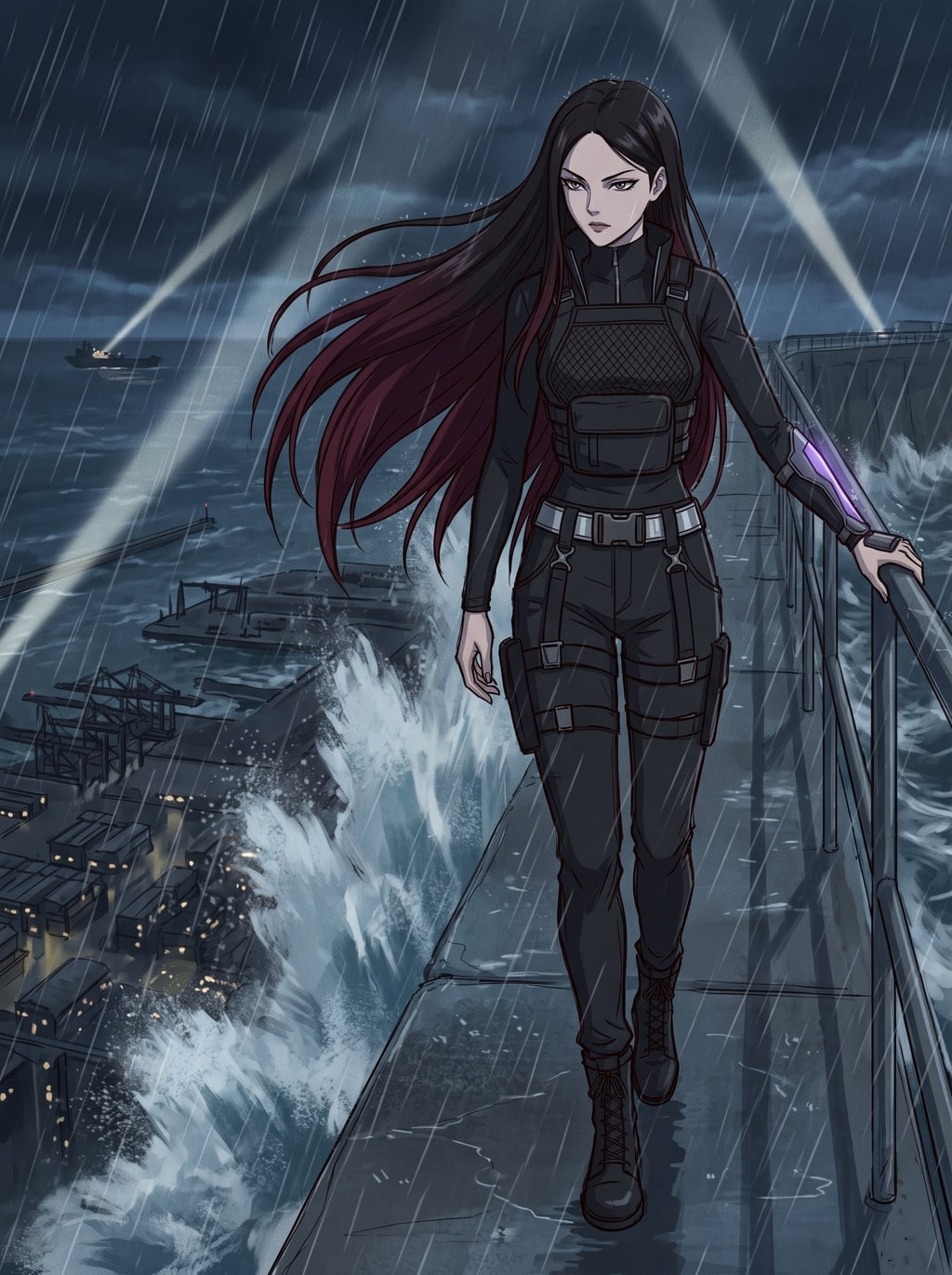
She had come up to check the alignment on the ranging reflector. The reflector was fine. She had checked it twice, then turned the scope a few degrees without quite deciding to, and now the breakwater below the headland filled the eyepiece: wet granite blocks, the grey chop of the bay going black with the dusk, and two people standing at the end of it.
had walked down there twenty minutes ago to breathe air that had not been through a compressor. had followed him five minutes later. They were standing shoulder to shoulder looking east, where the Moon would come up, and they were not talking.
Su twisted the red ribbon from her ponytail round her left forefinger until the tip went white, let it go, and did it again. She had done that since the academy, in exams, in the simulator, on the night the results came out and her name was not on the flight list. At eighteen she had copied Neumann's paper on how clocks drift near the edge of a rupture out by hand, in blue ink, on the backs of discarded launch manifests, because the academy library did not issue cards to students without a family registry. She had kept the manifests in a shoebox under her bunk for six years. She had not told him. She did not intend ever to tell him.
Her headset clicked. had done a radio check from the breakwater at the start of the hour and had not switched off his collar mic, so Su's channel carried whatever it heard.
"Don't let them make you a myth up there, ," said in Su's ear. "We come back ordinary people."
"I am an ordinary man. The maths is the only part that is extraordinary."
Through the scope Su watched lean her forehead against his upper arm. She counted without meaning to. Three seconds. Then straightened, said something too low for the mic, and walked back along the breakwater toward the car that would take her up to the big dish on the headland, where she would sing.
Su pulled the headset off. Her face was hot. She took the scope off its mount, folded the tripod, and went down the tower by the stairs instead of the lift, all sixty metres, so that she would have something to do with her legs.
The ready room smelled of new suit fabric and the citrus solvent the techs used on the visors. Su sat in the corner and did up her seals one at a time while other people said goodbye to each other.
came in four hours before launch with three sealed copies of the orbital charter. She gave one to Voss, one to and one to , and held on to 's for a moment after he had taken it.
"Above ninety kilometres you belong to no state," she said. "If you find what is left of the Kepler, bring the data straight to the open net. If it touches a ministry desk before the world sees it, it will become an asset instead of a truth."
"I know how ministries read data, Ji-won."
"I know you do. That is why I wrote it down." She shook his hand, then 's. "Bring the ship back."
was leaning in the doorway with her recorder switched off in her hand. "My bureau offered eighty thousand credits for five minutes with you on the gantry," she said. "I told them the link was jammed by rupture noise." She looked at over the recorder. "Don't die up there, Neumann. If you die, every two-bit mystic from Boston to San Diego will start a church in your name, and I'll spend the next twenty years debunking your saints."
"I will do my best to remain uncanonized," said.
Unit Nine was waiting where the corridor bent toward the gantry lift: Bo Han and Gu at the front, half a dozen soldiers behind them in the raw concrete, their gear stripped down to sidearms. Bo had a steel food pail with steam curling out round the lid and a stack of waxed paper cups, and he planted himself in front of the lift doors so that nobody could get to them without going through him.
"The pouches they seal for you are freeze-dried sawdust," he said, ladling. Ginger, scallion, the brown fat of bones that had been simmering since noon. "You need something hot in your belly. A booster doesn't care about your soul, . It only cares how many litres of blood it can drag out of your head and dump into your boots."
"," Gu said. He was already halfway down his own cup.
"Medical advice, ."
Bo held a cup out to Su. She shook her head, because her stomach was a closed fist, and he kept holding it out.
"The little ones get the bottom of the pot," he said. "That's where the fat is. Drink it, Flight."
She drank it. It burned the roof of her mouth and went down into her and stayed there, warm.
Bo turned back to . His left shoulder sat lower than the right, the way it had since the stadium, and when he lifted the ladle Su saw him not wince. "Gu and I stay on the ground. If anything comes at the pad while your engines are lighting, Unit Nine holds it. You look through the nosecone. We keep the concrete underneath you."
"You shouldn't be on guard duty with that shoulder, Bo."
"My shoulder lifts forty kilos of kit without clicking." Bo put his right hand on 's shoulder, heavily enough to rattle the suit rings. "Go find 's ship."
The lift doors opened behind him. He stepped out of the way.
The flight deck sat back behind the prow, a cramped half-ring of couches under a canopy of layered quartz that looked up and to the sides and never forward. Voss had the commander's couch on the left. was in the centre seat with the screens for MECN-7, the forecasting system he had built, and was on the right. Su's cradle was mounted half a step behind , close enough that she could have touched the back of his collar ring. Behind them, in the bay, had the radio link, the lantern board, her sample kits strapped between her boots, and sat by the spare instrument panel with her eyes half closed, feeling the floor.
Outside, it was full dark. The pad lights turned the steam off the fuel lines white.
"Hydraulics good," Voss said. "Main valves green. Flight, confirm the backup course."
"Backup course loaded, ." It came out louder than she meant. Su pressed her tongue to the roof of her mouth and brought her voice down. "Gyros steady. Standing by."
did not turn his head. His left hand came off the armrest and he tapped two fingers twice on the edge of the console. He had done the same thing two days ago, after she found a tiny drift in the climb plan that two senior navigators had called heat noise. Trust your numbers, Wanxing, he had said in the corridor afterwards. The machines want to agree with reality. We are the ones who tell them lies.
The radio crackled. "Hey. ."
"I'm here, Bo."
"Don't puke inside the visor. The seal takes three hours to clean. And on the three-g push, use your belly, not your neck."
"Use the belly," said. "Thank you, Bo."
"Six minutes," Voss said.
Half an hour ago Su had stopped reading the flight director's tidy summary and switched to the raw numbers coming straight up the cables from the pad. Summaries were for review boards. The raw lines were the only honest witnesses in the cabin, and she read them the way other people read faces.
Line 4400. Oxidiser pressure in the first stage, steady where it should be.
Line 4401. The engines' steering motors, answering fast and clean.
Line 4402. Stray field at the foot of the pad, close to nothing at all.
Line 4403. Stray field seventy metres up, a little higher than it should be.
Her hands stopped above the glass. The number was small and amber, at the bottom of the fourth block. It came from swing-arm four, one of the big steel arms that held the fuel lines against the side of the ship until launch. Two separate instruments measured the length of its strut, one by laser and one by radio. Both said strut four-B was getting shorter. She watched it for four seconds, which was long enough to be sure and too long to have waited.
"Dr. Neumann."
turned in his couch. "Show me."
"Strut four-B. Both readings say it's shrinking."
"That's the cold fuel," Voss said, without taking her eyes off the attitude ball. "The skin's at minus one-sixty. The steel shrinks. It's normal."
"Not this fast." Su heard her own voice go hard and fast and did not stop it. "Cold shrinks an arm that size by a fraction of a millimetre a minute. That strut has lost almost a millimetre in four seconds, and its temperature hasn't moved. The metal isn't getting colder, . The distance between the pins is simply disappearing."
went still for a full second. "She's right," he said. "That's a wedge, a small device that bends space. Someone has clamped one to the hinge on arm four."
's palm hit the yellow perimeter override. "Gu. Swing-arm four. Now."
A new sound came up through the hull, through forty centimetres of titanium and into the couches. It was high and thin and dragging, a dull lathe bit on glass. The whole mount shivered.
"Five minutes twelve," Voss said. Her right hand went down between her knees to the yellow abort ring and her fingers closed round it. "If arm four doesn't swing clear when we lift, the fuel line wraps round the engine bell and we're a bomb before the clamps let go. I'm scrubbing."
"No," said.
"Neumann."
"An abort locks the drain valves." 's voice was level and very quiet. "All the fuel we've loaded pours into the flame trench and sits there. The wedge feeds on weight, and you'd be handing it a trench full. Thirty seconds after you pull that ring, the tower goes down into the cellar under the pad and takes the pad, the launch crew and Unit Nine with it."
Voss did not take her hand off the ring. She did not pull it either.
"Gu," said. "Status."
Static, a whine of feedback, then three flat cracks in a concrete tunnel. When Gu came back he was breathing hard.
"Four hostiles in the service lift. Ground-crew canvas, contractor badges, Singapore issue. They have an ultrasonic drive clamped to the lower hinge knuckle. Bo's going in with the shield. They've welded the fire door."
"Four minutes forty," Voss said. Her knuckles were white on the ring. ", clear that hinge in two minutes or I pull and we take our chances with the trench."
"Negative, ," Su said.
It was out before she could stop it. Voss's eyes came round through the amber light and pinned her to the back of her cradle.
"Speak, Flight."
Su's hands were already moving. She took arm four out of the automatic countdown and sent its readings across to 's screen, so that he could see the strut the way she could. Her heart was going like a moth against a lamp, and her head was perfectly clear.
"You can't blow the hinge with an explosive bolt," she said. "The device is already bending space all round it. Fire a charge in there and the blast won't go out into the air. It'll fold back. It'll invert the vector: the blast turns round and goes through the second-stage methane tank."
"She's correct." On 's screen Su could see the bent space taking shape around the hinge, a lopsided cone leaning toward the hull. "Gu, listen to me. Do not shoot the emitter housing. If you crack it while it's running, everything it has bent runs down the arm and into our skin."
"Then what the hell do we do with it?" That was Bo, roaring, and behind him three more shots and the slap of a body on grating. "We're nine metres out on an open ladder. They've got a torch on it. They're welding the housing to the knuckle!"
"," said. "Are the lanterns on the trench rail warm?"
The lanterns were 's drones, small bronze shells that could fly or sit and listen. Twelve of them had been left on the ground for exactly this kind of night.
"Twelve on the rail," said from the aft bay. "Batteries full."
"Don't fly them. Wire them into the pad's grounding grid, the copper under the concrete. Wanxing, tell her how bad four-B is."
"Worse every second." The numbers came out of Su fast and flat. "The hinge is crawling. It's lost almost a quarter of its strength."
", when I say, send one hard pulse through the lanterns and out through the seawater in the drainage channels." 's hand was flat on his console. "We're not going to break the wedge. We're going to ground it into the sea."
Su understood it then. It was a lightning rod. Whatever the wedge had built up would run down the copper into the sea and be gone.
Three minutes forty, said the countdown. Power units running.
On the pad camera, a sick violet light was crawling along the rivet lines of arm four. The steel had begun to look soft, the heavy beams bending in a way beams did not bend. Two figures in Boundary Operations grey came through the vapour on the platform. Bo was unmistakable, wide and lopsided, firing from the hip. Gu was four paces behind him with a coil of bare copper cable over his shoulder as thick as a wrist.
"Cable's at the hinge!" Gu shouted. Su could hear the insulation burning in his mic. ", it's in the steel. It's eating my gloves. I can't get to the clamp!"
"Don't clamp it," said. "Drop the bare end in the seawater trench behind your boot. , fire."
A whip-crack came up through thirty metres of hull. Su felt it in her back teeth. On her glass the line for strut four-B bucked, went off the bottom of the scale, and came back up flat and green.
Line 4403. Stray field seventy metres up, back to nothing.
"Hinge is clear!" Gu's voice tore through the intercom. "The device cooked itself. Cutting the manual latch."
On the pad feed, arm four tore away from the hull in a burst of white vapour, swung out on its counterweights and hit its stops with a boom that rang through the bulkheads.
"Arm four clear and locked at ninety," Su said. She did not let her voice climb. "Nothing bent left on the pad."
"Two minutes." Voss lifted her hand off the abort ring, flipped the guard on the ignition circuit, and armed it. "Good work, Flight. Ground crew, clear the trench."
"Clear," Gu said, running. "Unit Nine in the shelter. Take her up."
glanced across at . "You still have all your ribs, Dr. Neumann?"
"Where they belong. Thank you, ."
"Don't thank me," said, looking straight ahead at the dark canopy. "Thank the girl behind you. She saw the metal shrink."
Su felt the blood go up into her face under the helmet seal. She put both palms flat on the cold glass and held them there.
Sixty seconds. The engines' first stage came up under them in a scream that wiped out the sound of the sea.
Thirty.
"Flight, take the guidance."
"Guidance is ours. Lined up on the Gate to a hundredth of a degree. We have the path, ."
Ten. Nine. Ignition sequence start.
The world did not roar. It struck. A single blow came up through the tail into the couch and drove Su's breath out of her, and in the side quartz the night went white as the trench flashed its seawater to steam.
Clamps released. For half a second they hung, the engines fighting their own weight. Then the tower slid down past the quartz and was gone.
As the ship began its roll, the headland swung across the right-hand canopy, lit from below by the launch. Su saw the great dish on the granite and the low roof of the ground station beside it, and on the roof, for less than a second, one small figure standing by the dish with her scarf blown straight out sideways in the wash. Then the roll carried it away under the hull.
"Two g," Voss said through her teeth. "All four burning. Course true."
Su watched the Stability Index for the air around them step down, the way MECN-7 had said it would. 0.998. 0.994. 0.990.
"Twelve kilometres," she said. "Here's the rough part."
The hull shook in a way that rattled her teeth together. Up here the air still carried the old war in it: cold, heavy shelves of bent space left in the high sky by weapons nobody would admit to. The prow struck them one after another like a hammer on a roof.
"MECN-7 holding," said. "Index point nine seven. The bend is opening ahead of us. Wanxing, stay on the Gate."
"On it."
Ahead and above, where no window looked, the Sky Gate was a shape on her display: a well of night in the sky over Tianmen, the one safe door up through the damage, with the stars bent into rings round its rim.
"Staging," Voss said. "Three. Two. One."
A heavy thud came up through the deck as the boosters let go and fell back toward the sea. For two seconds there was no weight at all. Su's body lifted in the straps. Her grease pencil, left loose by the data toggle, rose up between her visor and the panel and turned slowly end over end in the red light, a small cedar satellite.
Then the upper engine lit and pressed her back into the couch, clean and quiet after the boosters, and Aletheia went through the Gate.
A sound passed through the metal. It was a long high note, a crystal bowl struck under water, and it sang in the bulkheads and the equipment bays and in the fillings of Su's own teeth. In the upper canopy the stars stopped being points. They drew out into long curved needles, all bending toward one place above the ship. Then the note broke off.
"Cleared the Gate," Voss said. "Main engine off. We're on course."
The shaking was gone. There was only the hiss of the air scrubbers, and small ticks from the skin as it met the cold. Su opened her left glove catch and let the hand drift up into the cabin, and closed her fingers round the floating pencil, and put it away in her thigh pocket.
"Look," said.
leaned forward in his straps. Su leaned past his shoulder.
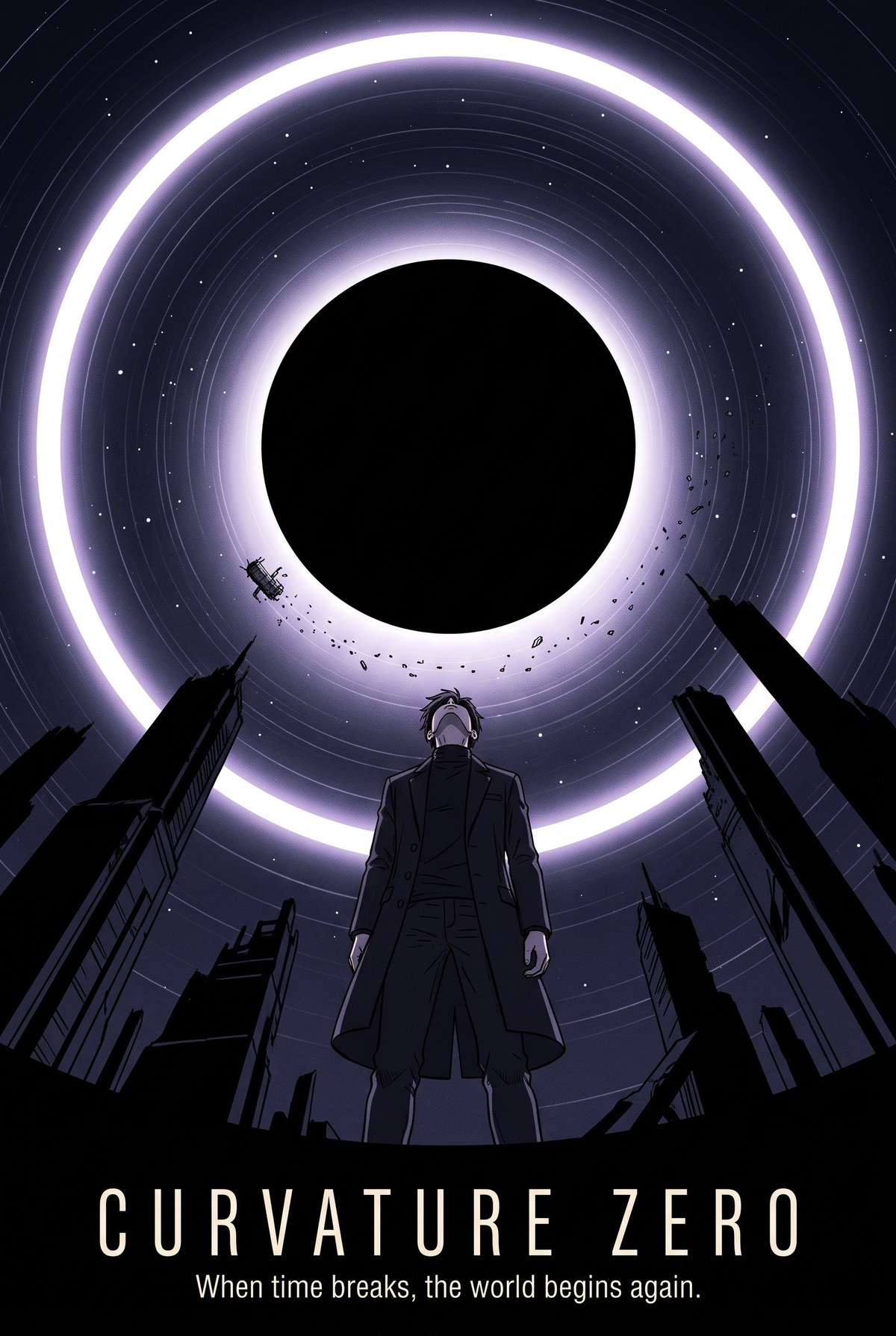
Beyond the bright curve of the Earth, in the black, was the Moon, and round its middle was the Halo: the ring of silver needle-light that had been in the sky her whole life, bending the stars behind it into arcs. From the ground it was a smear. From here it had edges, and it was turning, slowly, a long breath drawn across three hundred thousand kilometres of nothing. Eight years of silence lay inside it.
She had run this crossing forty thousand times, on paper and in simulators, until her thumbs were black with graphite. Against the real curve the numbers felt very thin.
"There you are," said.
He said it so softly that no one but Su, less than a metre behind him, could have heard it. He was not talking to the Moon.
Su pulled her harness tight, put her thumb once to the ribbon at the back of her neck, and reached for the keys.