

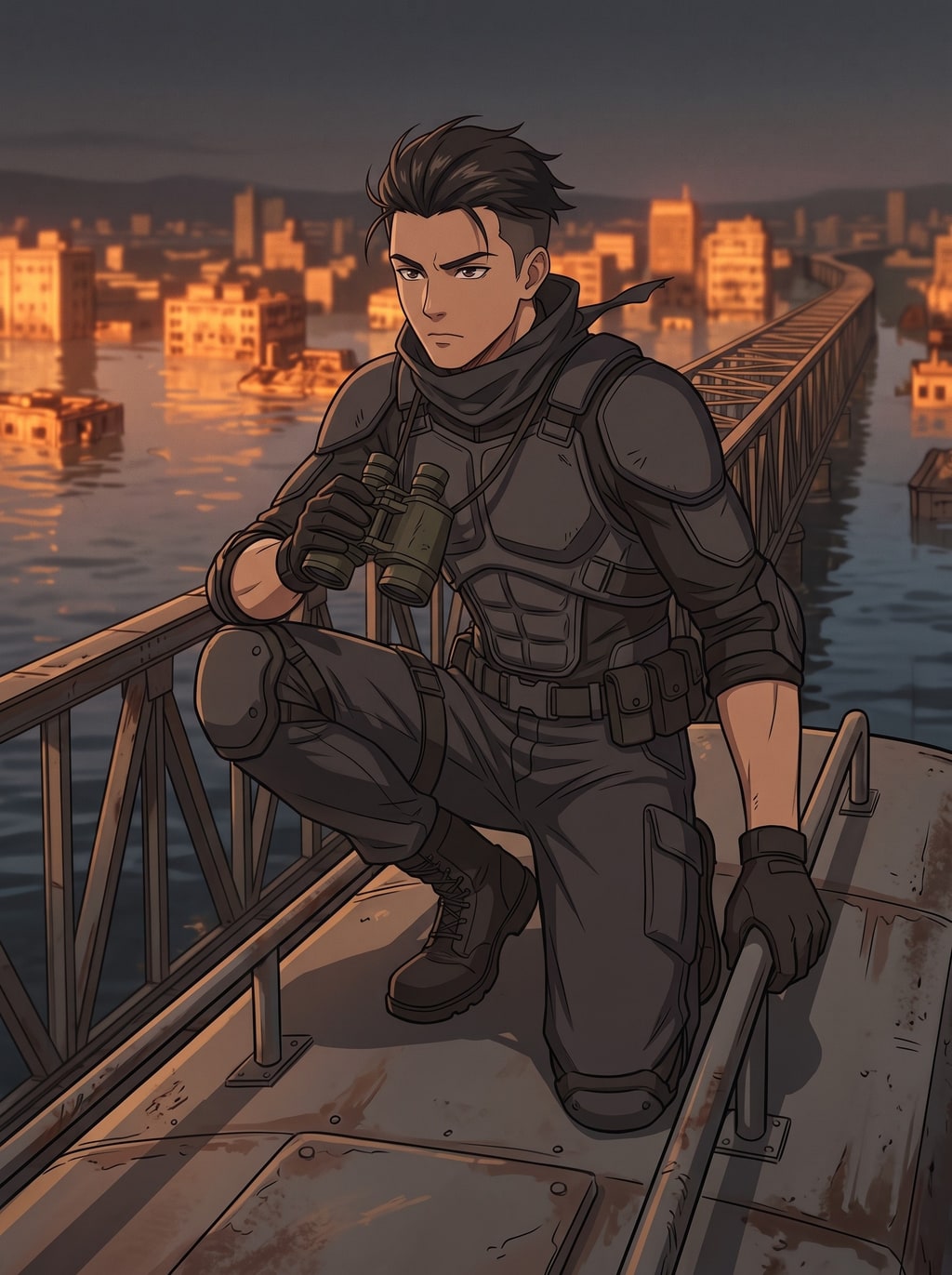
"A city is an agreement among four million clocks. Dissolve the agreement, and the stones will remember that they were never obliged to stay together."
From Lectures on Coordinate Integrity, Boundary Operations Command Staff College, 2124
The red lanterns along the canal did not fall. They ceased to occupy only one moment at a time.
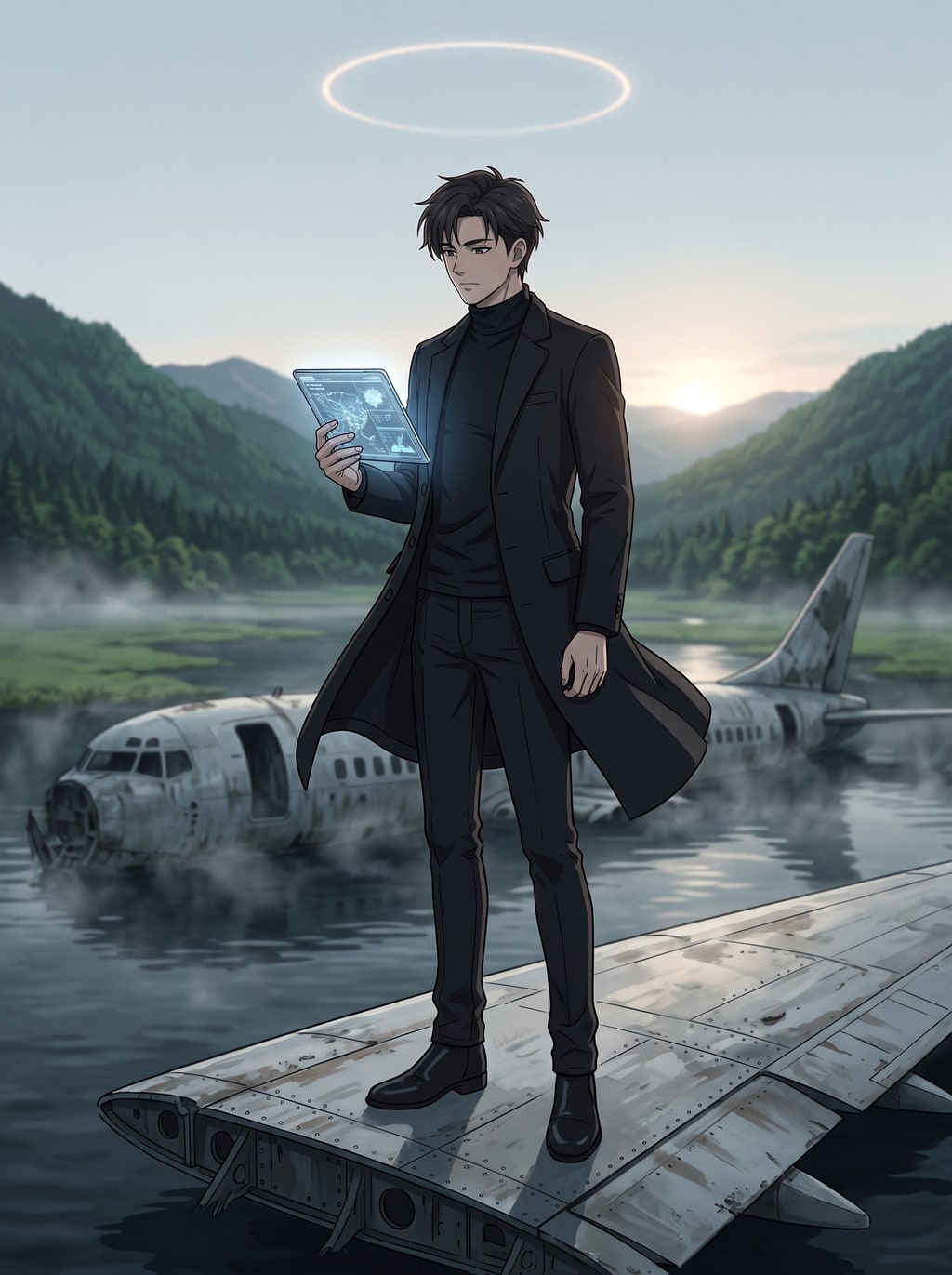
saw it from the roof of the old Nanhe pumping house, twenty metres above the water. Along the far promenade hung a string of paper globes, and each one now hung in two places a hand's width apart, the second a shade dimmer than the first, both of them swinging. It was the fifteenth night of the first month, the Lantern Festival, and forty thousand people were out on the stone embankments below in their good coats, eating sweet sesame dumplings out of paper cups and drinking ginger syrup so hot it steamed in the cold. A child on her father's shoulders reached for one of the doubled lanterns, caught the dimmer of the two, and closed her fist on air.
In 's left ear, MECN-7's warning began to click, dry and fast, faster than it could count.
had spent six days trying to have 's concert cancelled. Six magistrates had refused her. Moonveil's lawyers had called it a festival, a charity, a civic tradition. The city's Stability Index stood at a healthy 0.97, and no court in the Coalition would close the Citizen's Hall on the forecast of a man who had lost his crew. So was on her stage three kilometres south, Unit Nine was spread across the old city in squads of four, and was on a roof with his tablet and a hundred lanterns waiting in their racks behind him.
"Ground's going soft in sector four," said in his ear. "No. Four, nine and twelve. , the water in the lower basin just dropped five millimetres. It isn't draining away. The riverbed is getting wider."
"Space is stretching sideways," said. "Check the Moonveil clinics."
There was a pause full of static, the sound 's radios made when they were thinking. "They dropped. All seven. The machines that keep the ground steady under them all switched off together at twenty-fifteen. That's no tripped breaker, that's a commanded scram. Someone pressed a button."
On the Fourth Pier, a woman made a short, choked sound, the noise of a foot finding a stair that is no longer there. A man carrying two paper globes on a pole pitched forward and went into the paving up to his shins. The granite closed round his calves like suet and set hard again. It held him there upright, his mouth open and his arms going round, the globes bobbing on their pole above him.
Then the service doors of the Moonveil clinic on the embankment opened, and the patients came out.
At first, through the steam off the food stalls, took them for exactly that: people in pale hospital gowns turned out into the cold by a fire alarm. Then the orange streetlight reached them. One walked on four legs that grew from a single twisted pelvis, the shins crossing and uncrossing like shears. One was the height of a child, with a body a metre long that filled and emptied with a wet sigh at every step. Their faces were smooth. Where their bare feet touched the wet asphalt, it frosted white. One of them came to the brick wall of the promenade and walked into it. For three paces the red brick went the colour of skim milk and let it through, then closed behind its heels without a crack.
"." It was Bo Han, down at the head of the canal with his squad, shouting over the noise of forty thousand people discovering that the ground had stopped agreeing with them. "Tell me you see this. We have half-people coming out of the brick."
"Metric Chimeras," said. "Their bodies aren't quite where you see them. You'll miss nine times out of ten. Do not fire blind."
"Tell that to the four-legged one chewing on an iron bollard."
"Bo, pop boundary flares," said on the command channel. "Blue only. Guide the crowd toward the civic park, not the high-rises. Gu, seal the west locks. If they pack onto the footbridges, the bridges go."
"Moving," said Gu.
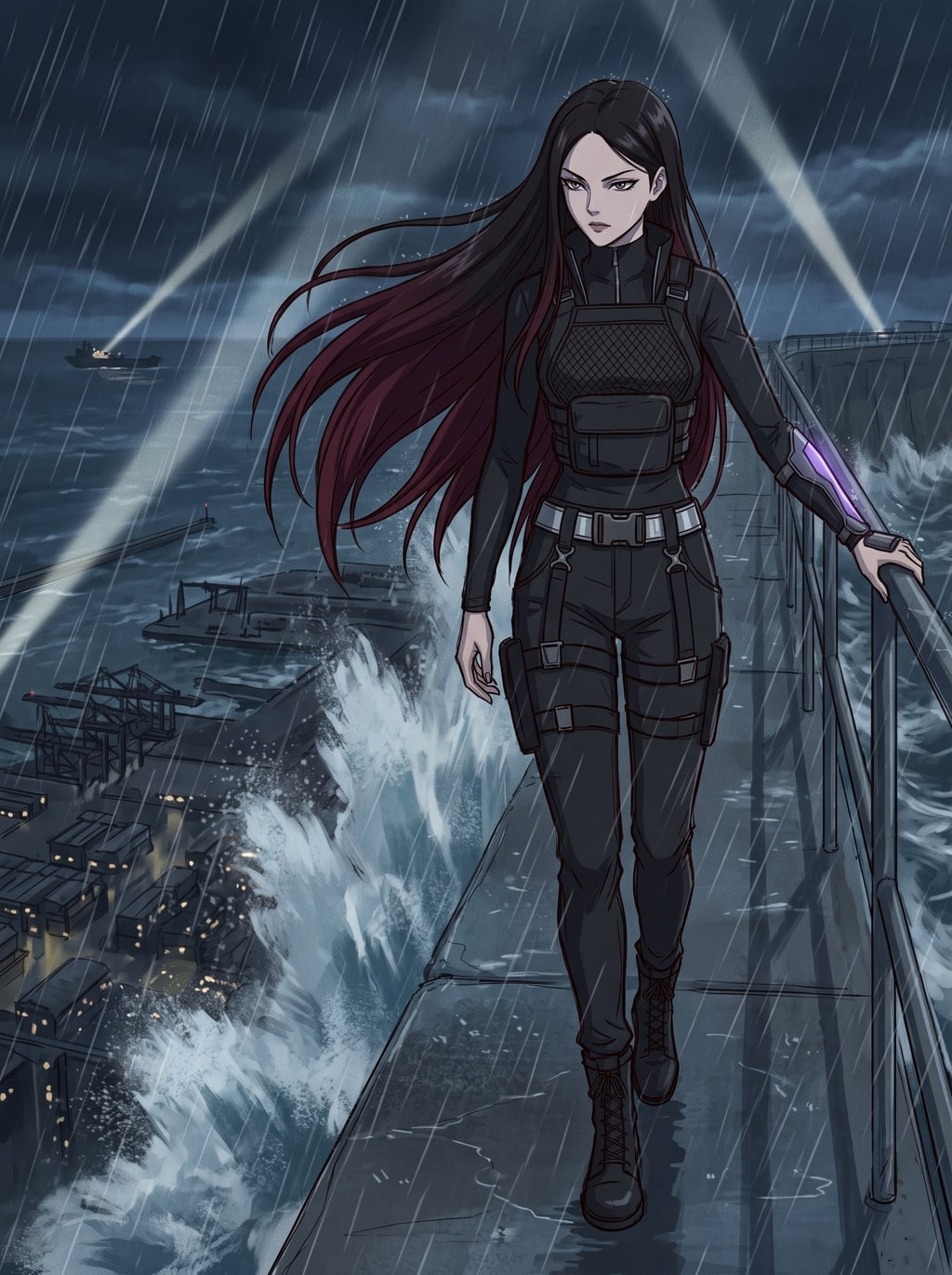
was on the pumping-house roof beside , crouched at the low wall in her Horizon harness, with a carbine slung across her back and her braid tucked into her collar. She did not watch the chimeras. She watched the streets: where the crowd was moving, and where it would jam. Below them, blue flares went up one after another along the canal, and the river of people bent and began, raggedly, to flow north.
marked the chimeras on his tablet and drew out the direction each one was heading. "They aren't wandering," he said. "They're walking the old survey radials. The straight lines the first surveyors drew out from the old centre: the third ditch, the foundation ring of Old Shenzhen, the main water pipes."
"Toward what?"
"Toward each other." He ran the pattern forward. "Every one of them carries a piece of rupture in its bones. She didn't make weapons, . She made nodes. Fixed points. Stand forty of them on the right crossroads, and six hundred metres of city slides halfway into the other side, without anything opening at all."
looked at the tablet for a long second. "She is laying a synthetic floor over the city."
On the square below, a chimera with two profiles, one set a little behind the other like a head carved twice, walked through a fruit seller's cart. The wood did not splinter. Every melon in the cart turned inside out, and the black seeds hung in the air in a little cloud before they fell into the slush.
"The public are calling it the Night Parade," said. "It's on every channel already. The hundred demons. People are throwing salt at them, . Table salt. Out of the noodle stalls."
The sound reached before anything else did: a bell, rung forty fathoms down under black water, so deep that it was less a note than a pressure inside her skull.
She was on her knees on the floor of her dressing room under the Citizen's Hall. She did not remember getting there. Through her left eye, the room was still the room: the rail of scarlet costumes, the mirror ringed with bare bulbs, a saucer of candied hawthorn shedding sugar on the counter. Through her right eye, the far wall had gone. In its place a grey corridor ran down through the bedrock under the amphitheatre, between pillars that were sliding apart into brine. She could see both. She could not stop seeing both.
In the mirror, her reflection was still sitting on the stool, watching her, half a second behind.
"No," said, and her nails scored white lines in the varnish.
Under the skin of her forearms, something was moving: rows of small hard ridges, shifting the way gravel shifts under a wave going out. She knew what they were. She had felt them once before, in the clinic, at sixteen, and Madame had held her hand until they settled.
Something clicked at the base of her skull, behind her right ear, where the node sat: the implant the size of a rice grain that linked her to Madame. Madame always touched the pearl pin on her collar before she spoke into it.
"My firstborn." The voice did not come through the air. It came up through the bone behind her ear, warm and close and unhurried, the voice that had read to her when she could not sleep. "Do not fight the alignment. You were the first to cross and remain whole. You know the peace of it. Look at them, Ke. They are not frightened. They simply return to where they were always meant to stand."
And could feel them. All of them, out in the districts: the Firstborn, the rough drafts, the ones who had never had names. They were walking out of seven clinics along the lines Madame had drawn, quiet in their lungs, heavy in their bones, going where the mathematics pulled. She could feel the bedrock under the amphitheatre, thin as a drumskin. She could feel the place in the city where all the lines met, and it was here. It was above her head. It was the stage.
"Listen to the floor, child. It is waking."
She put her forehead down on the boards. And through the boards, above the thunder of four thousand people on the stone steps of the amphitheatre, she heard someone singing.
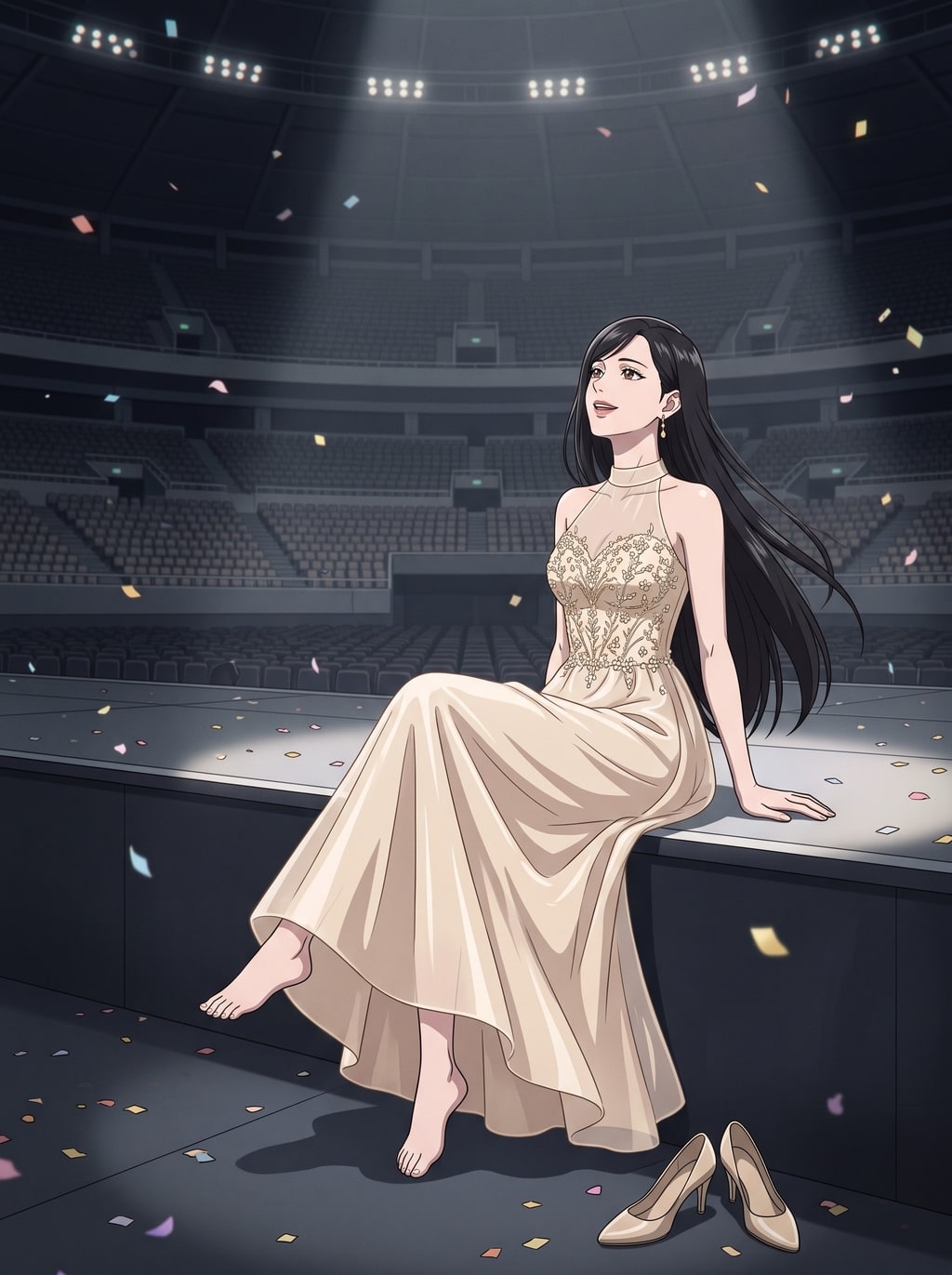
It was . There was no microphone, because the power had gone in the hall. There was just 's own voice, thin and clear against the wind, singing the counting song from the shelters in Korean. Her mother had sung it to her in Busan. had sung it in the shelter dormitory to forty frightened children in the dark, their first winter, and had been one of the forty. Seven boats upon the tide. sang it slowly, at the speed of a resting heart, so that four thousand people on a staircase that had started to soften would stop shoving and climb in time.
lifted her head.
"You don't own where I walk," she said to the empty room.
She reached up behind her ear and took the node between finger and thumb. It had been part of her for eleven years. She pulled. The skin tore with a dry little pop, and a bead of blood came out and did not fall. It hung in the air beside her cheek, dark and round, and then faded to nothing, like breath on glass.
In the mirror, her reflection was two seconds behind now, still kneeling, its mouth still open. She did not look at it. She stood, put her shoulder to the wall beside the stage door, and leaned. The plywood took her the way water takes a hand. She let go of her own weight and stepped into the fold.
Gu Yichen had six hundred and twelve people in the pedestrian tunnel under East Third Street, by the turnstile count, and a water main above them that was coming apart.
"If the water pressure drops any lower, the flood barriers come down by themselves," he said into the radio, "and that tunnel fills to the roof in four minutes. Where are the city engineers?"
"Gone," said .
She sat at the desk of the coordination van with two screens open, one to the Provincial Emergency Directorate and one to the court archive. She had not raised her voice once in the forty minutes since the clinics dropped. There was canal mud on her shoes and none anywhere else.
"Their depots are empty, . Under Emergency Order 44-B, civil authority in the four southern districts is suspended. I have just signed a warrant handing the flood gates to your command." She touched a key. "There. It is lawful for you to override them."
"A seal doesn't turn a valve."
"No. But it stops the automatic system locking you out when you cut the hydraulics." She opened a third window without looking up. "Mr. Vale. The water authority's central server. Gu's team needs the override codes for sectors seven to twelve."
"Got them," said. "Prosecutor, I feel I should mention you just committed seven counts of unauthorised network seizure under Coalition law. I've been counting."
"Record them," Ji-won said. "I will sign my own arrest warrant tomorrow morning. , the tunnel locks are released."
Gu keyed his mic. "Bo. Blow the east grates. Get them up onto the open bridge, not into the next tunnel. Count them out."
"Counting," said Bo, under the crack of flares. "There's three chimeras on the stairs. They're not doing anything, they're just standing there, but people are trampling each other to get past. I'm shoving them back into the alcoves with pulse charges. The chimeras, not the people."
Gu watched the turnstile counter on his screen. Six hundred and twelve. Five-ninety. Five-forty. Then a grey dot sliding down the transit board caught the corner of his eye. It was the South Gate line: a seven-car monorail on automatic, still running its timetable from the depot, heading into a sector where the rails had gone soft.
"The monorail," he said.
"I see it." Ji-won dragged a red lockout box across the district's power board. "If that train reaches South Gate at speed while the track is soft, its wheels will sink through the rail and it will come down on the promenade."
"Kill the power to it."
"Killed." On the board, the grey dot slowed, and slowed, and stopped two hundred metres short of the soft section. Four-ninety in the tunnel. Four-sixty. Ji-won had already turned to the forward monitor, where the map of Longwan was going from blue to a spreading bruise of violet. Gu saw her hands, which had not stopped all night, go still.
"," she said. "Look at the Citizen's Hall."
On the pumping-house roof, saw it at the same moment. The violet on his tablet was not spreading evenly. Every line from every clinic was bending at its far end, curving back, and drawing tight in rings round one point three kilometres south.
"."
She leaned over the tablet. The rings tightened as they watched.
"That isn't a breakout," said. "They are building a resonant cavity. A metric lens."
"On her," said. He could hear his own voice going flat and quick, the way it did when the numbers were ahead of him. "In Busan, was four metres from the edge of the rupture. Her scar is a wound in space that never closed. That's what the scans were for, every three months for sixteen years. If they close the ring round her stage, everything they've built focuses through her, the way a lens focuses sunlight." He looked up at the bruised sky, where low cloud hid the Moon. " Qiao is pulling the Moon down to Earth."
did not answer him. She was already on the command channel. "Bo, leave two teams on the grates and bring the rest to the north colonnade of the Hall. Gu, move the command post to the gatehouse. , get into the frame."
Atlas-0 stood on its transport sled in the yard below, under work lights. was already up on the gantry beside it, pulling the covers off its joints. The suit was smaller than people expected, a little over two metres of grey composite with gold seams and Unit Nine's crossed halberds stencilled on the breastplate. had built it for himself, and the cockpit was cut to his size. He went down the fire stairs three at a time.
"I've taken the safety limits off the cracked hip like you asked," said as he climbed in. "You get fifteen percent more strength. If space bends harder than that crack can take, the hip welds itself solid, and you're four hundred kilos of statue in the middle of a street."
"Fifteen percent is plenty."
"Nobody ever says that about anything that turns out to be plenty."
The harness closed on him: thigh clamps, chest plate, the gauntlets round his forearms. The visor lit, and the festival vanished. In its place he saw the city the way the lanterns would see it: the bend of space rolling over the streets in coloured bands, like oil on dark water, and the Stability Index falling as he watched. 0.684. 0.641. 0.598.
"Lanterns up," said, and slapped the release.
The racks on the roof opened. A hundred small six-sided drones rose into the sleet, each one glowing a warm, steady gold, and wheeled into a ring thirty metres overhead. Their signals came into his visor one after another, a column of green ticks: ninety-nine anchor pings, one dead node.
"Atlas-0 operational," he said. Through the suit's speaker his voice came out heavy and strange.
"Move," said .
She did not wait for him. She took three running steps across the pumping-house roof and jumped the gap to the temple next door, nine metres of air over the alley. She landed crouched on the curved ridge of its roof, among the carved fish and the glazed tiles. For a moment she stayed there, a black shape against the lanterns and the burning sky, the gauntlet on her left forearm lit to a hard violet star. Then she dropped off the far side into the dark.
hit the street. Four hundred kilograms of suit came down on the kerb and broke it, and the balance system screamed and caught him, and he leaned forward and ran. Each stride cut a crescent in the road. Above and ahead of him, the Hundred Lanterns streamed south in a long gold ribbon, faster than he could follow, testing the air as it went bad.
The lanterns reached the Citizen's Hall forty seconds before did. Through their microphones he heard it all as he ran, small and clear.
The amphitheatre was a bowl of limestone tiers round a sunken pool, and the stage floated on the pool: a lotus of sixteen teak petals, with the city's bronze seal set into its heart. The four thousand were gone from the tiers. 's song had walked them up the stairs and out into the park before the steps went soft. had stayed, because someone had to sing the last of them out. She was still on the stage, alone, in a pale coat over her stage dress, with her boots on the bronze seal.
Fifty chimeras stood round the granite edge of the pool, shoulder to shoulder, perfectly silent, facing her.
The water in the pool had stopped moving. It was a flat black sheet with no reflection in it. As watched through the lanterns' eyes, it began to rise: one centimetre, then ten, peeling off the floor of the pool in a single slab and lifting toward the edge of the stage. stepped back from the edge of the petals. He saw her look at the water, and he saw her face, and he remembered her on the stair in Shuikou saying it's coming up.
The air four metres above the stage cracked like green bamboo, three times, and fell out of it.
She hit the teak on her shoulder and slid. Her right arm, from the elbow down, was not quite an arm any more. It was a smear of pale light in the shape of one, trailing a quarter-second behind the rest of her. She got her left hand into the hem of 's coat and held on.
"I have you," said. There was blood on her teeth. "I have you. Min-ji, don't look down."
went down on her knees and took hold of her with both hands. Her fingers closed on the light where 's forearm should have been, and she did not let go of it. , two hundred metres out and running, watched her understand.
"You're one of them," said, and her voice broke on it. "Ke-ke, what did she do to you?"
"She didn't do it," said. "She just refused to let me finish dying." She dragged 's face round to hers. "Listen to me. It's a lens. The whole thing is a lens and you're standing in the middle of it. She's pulling the Moon through your scar."
The fifty chimeras raised their arms together.
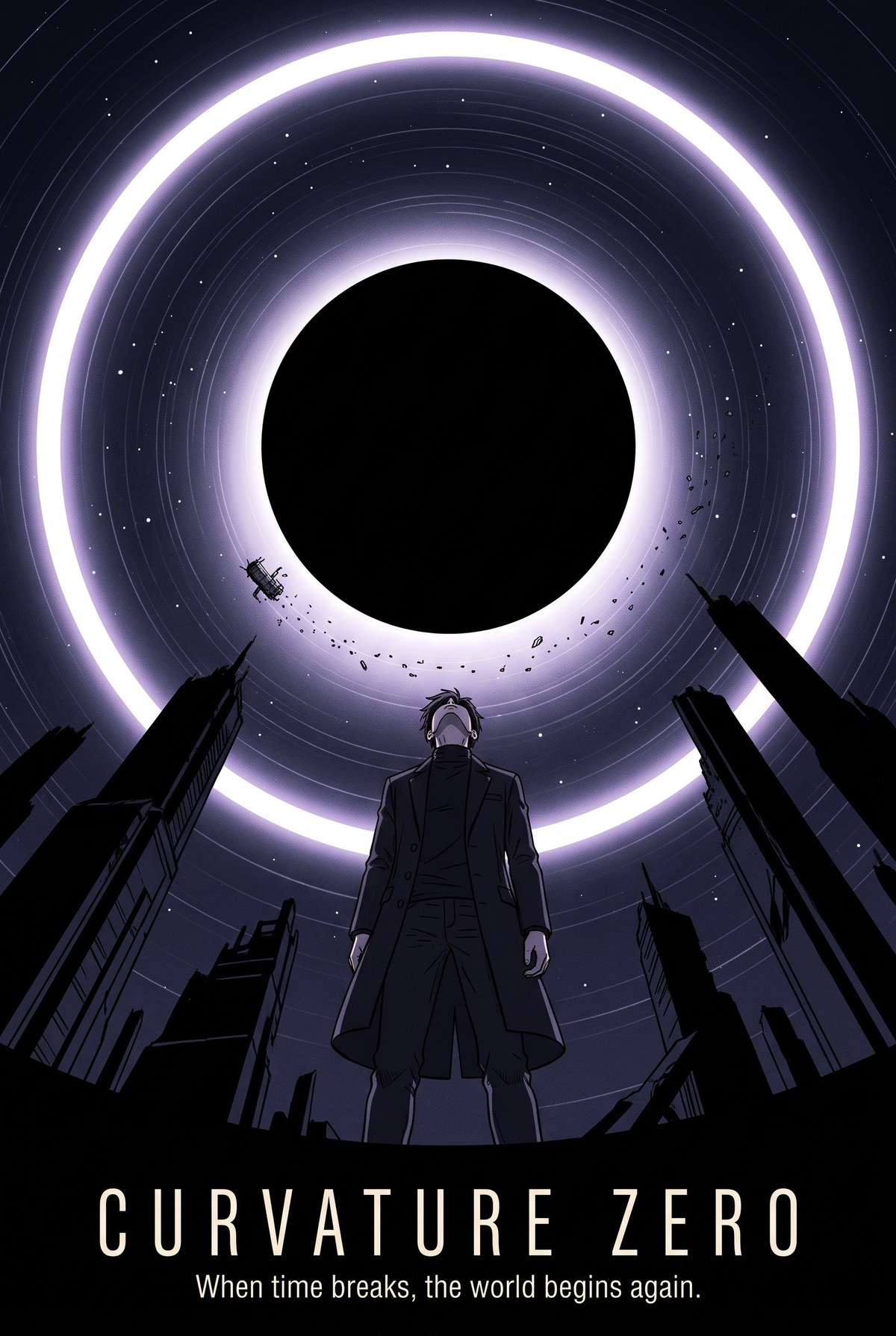
A column of violet light came up out of the black water and went straight through the cloud. There was no thunder, only a vast muffled stroke, a bell rung under the sea, and the force of it knocked every person left in the park flat on the wet grass. Above the Hall, the clouds twisted round into a drain. In the eye of it, the Halo looked down on the city through the torn cloud, crooked and immense, with the grey rim of the Moon at its centre.
The numbers in 's visor went 0.312, 0.248, 0.180.
"The edge is collapsing," said. "The whole pool is the edge."
Atlas-0 took the ornamental gates without slowing. The iron railings snapped on the breastplate, and fired the jets on the suit's back and went over the ruined flowerbeds in one long jump, mud and gravel flying behind him.
", the Anchor Relay."
"It won't lock." was four kilometres off, and his voice was fading. "You're on plain radio. Text and readings, , nothing else fits through the tear."
"Anchor pins."
hit the release on his hip covers. Four steel pins, each two metres long, fired down on explosive bolts into the four corners of the pool and drove into the granite with four flat thuds he felt in his teeth.
"Lanterns, perimeter."
The ribbon of gold above him folded its rotors and fell. The hundred lanterns dropped into a ring round the pool and spun there at full power, throwing a net of gold light of their own down over the stones. Inside the ring, the chimeras lifted their smooth faces to the gold light. Their mouths opened on a chord heard through the plates of the suit.
came over the stone railing on foot. She fired her carbine three times from the hip, and three chimeras on the south side of the pool went sideways across the azaleas like skimmed stones, knocked loose from whatever held them, out of the ring. The violet column shuddered and faded a shade toward grey.
", move," said, landing on the outer petals.
"She can't!" shouted.
brought the suit to a halt at the rim of the stage. The bronze seal had gone. Where it had been there was a hole two metres across, and through it he could see neither water nor rock, only depth: a well of cold starlight going down and down, past where down should have stopped.
was in it to the waist.
Gravity had nothing to do with it. She was sinking down a slope only she could feel, drawn in through the scar at the base of her throat. She had both hands round 's good wrist. had her other arm, the arm of light, hooked round a steel lighting frame bolted to the deck, and it was coming apart at the elbow.
"," said. Every bit of the Voice of Longwan had gone out of her voice. She sounded nine years old. ", help us."
He hit the emergency release. Atlas-0 dropped to its knees, and the breastplate unlocked and swung open.
"Neumann, stay inside," said. She fired twice past him into the ring. "That pull will take you apart."
"The suit weighs four hundred kilograms. On that deck it'll punch the whole platform into the pool." He was pulling his arms out of the gauntlets. ", put the anchor loop on my sleeve."
"There's nothing at the rim, ! The reading's zero. There's nothing for the loop to hold on to!"
"Send it."
The small screen on his sleeve lit green. He climbed out of the open suit and dropped onto the teak.
The cold went into his teeth. It was the cold of 2120, the cold behind the Kepler's glass. His first step landed on wood as heavy as iron, and his second went into it like sand. He went down on his knees and crawled the last metres, splinters through his trousers, while the deck tilted under him toward the hole.
", hold her."
turned her head. Half her face was flushed and human and streaked with tears. The other half had gone see-through, lit from inside, running a beat behind her breath. "I can't," she said. "She's not falling, Doctor. The city's grounded through her."
"Min-ji," said. "Reach."
She let go of with one hand and reached, and he caught her wrist.
The touch closed a circuit. The stage and the smoke and the sound of 's carbine went away, and for an instant there was only what was on the other side of the hole. It was looking up.
He had felt it once before, and spent eight years telling no one but . It was the same: no face, no eyes, no malice, only attention so large that his whole life fitted in a corner of it. It was reading the city. It felt the seven clinics, and the fifty bodies round the pool, and the scar in the woman whose wrist he held. Then it felt him, and it stopped.
You came back, the stillness said.
The deck round the hole burst into white sparks. 's wrist turned in his grip, and her skin slid across his palm. He closed his hand on her fingers, then on her fingertips, then on nothing.
"Min-ji!"
let go of the frame. She did it on purpose; he saw her choose it. She turned her body over and went down into the hole after , caught her under the arms, and put her chin into the hollow of 's shoulder, the way you hold a child on a stair.
"I have you," said, in her own voice. "I'm with you."
They went down into the light together: two shapes, then two ribbons of violet twisted once round each other, then nothing.
The seal cracked and fell in. Where the heart of the lotus had been, there was a clean round shaft three metres across, cut into the black bedrock, its walls polished and perfectly cold.
The column went out.
lay on his face on the wet teak with his hands spread on the grain. He could not make them close. The silence after the column was louder than the gunfire had been. Through it he could hear the lanterns coming down all round the pool, their batteries drained, dropping one by one into the grass with soft papery thumps.
Above the Hall, the cloud was closing again over the Halo, rolling back across the crooked ring until there was only a sick violet stain behind the fog, and then not even that.
Boots crossed the broken footlights and stopped at the rim of the shaft. stood there with her carbine hanging on its sling. She looked down into it for three seconds, judging its depth by the deadness of the sound, and then she looked at him.
"Neumann."
He did not lift his head. "They're gone," he said. ". They're gone."
"No," said. "They were taken. There is a difference."
The city was coming back. He could hear it: car alarms, people shouting each other's names across the park, the bells of the river taxis on the main canal. The chimeras round the pool had not been shot. When the lens tore loose, they had lost their hold and come apart, and there were little heaps of grey ash along the stones where fifty of them had stood. Five districts were under brackish water, and the streets were full of crushed paper lanterns and lost shoes and salt, but the pavement had stopped moving. The ground had set.
Gu Yichen came up the stage stairs three at a time, mud to the knees, with behind him carrying her case.
"Tunnel's clear," Gu said. "Six hundred and twelve in, six hundred and twelve out. The bridges held. Two dead on the Fourth Pier that I know of. Forty-one injured." He stopped at the edge of the shaft. "Where is she?"
did not answer him. She stepped over to , took him by the collar, hauled him to his feet, and held him there until his knees agreed to it.
Ji-won stood an arm's length from the hole and looked down into it for a long time, the way she read a document: twice.
"Madame has left the Moonveil Tower," she said. "An unregistered tilt-rotor took off from the ninety-fourth-floor pad ten minutes ago. City tracking lost it over the dykes, heading south-east." She looked up. "Toward the old Grand Arena."
wiped his mouth with the back of his hand. The numbers were already there behind his eyes, cold and in order, and he hated them for it.
"She doesn't want them dead," he said. "She needs them. 's scar to tune it, and to hold it steady. They didn't fall out of the world. They fell into the lattice core, the heart of the whole machine. It's under the Grand Arena, three hundred metres down, where all the survey lines meet."
turned and looked south-east, where the mist lay orange over the industrial dykes.
"Then we go down," she said.