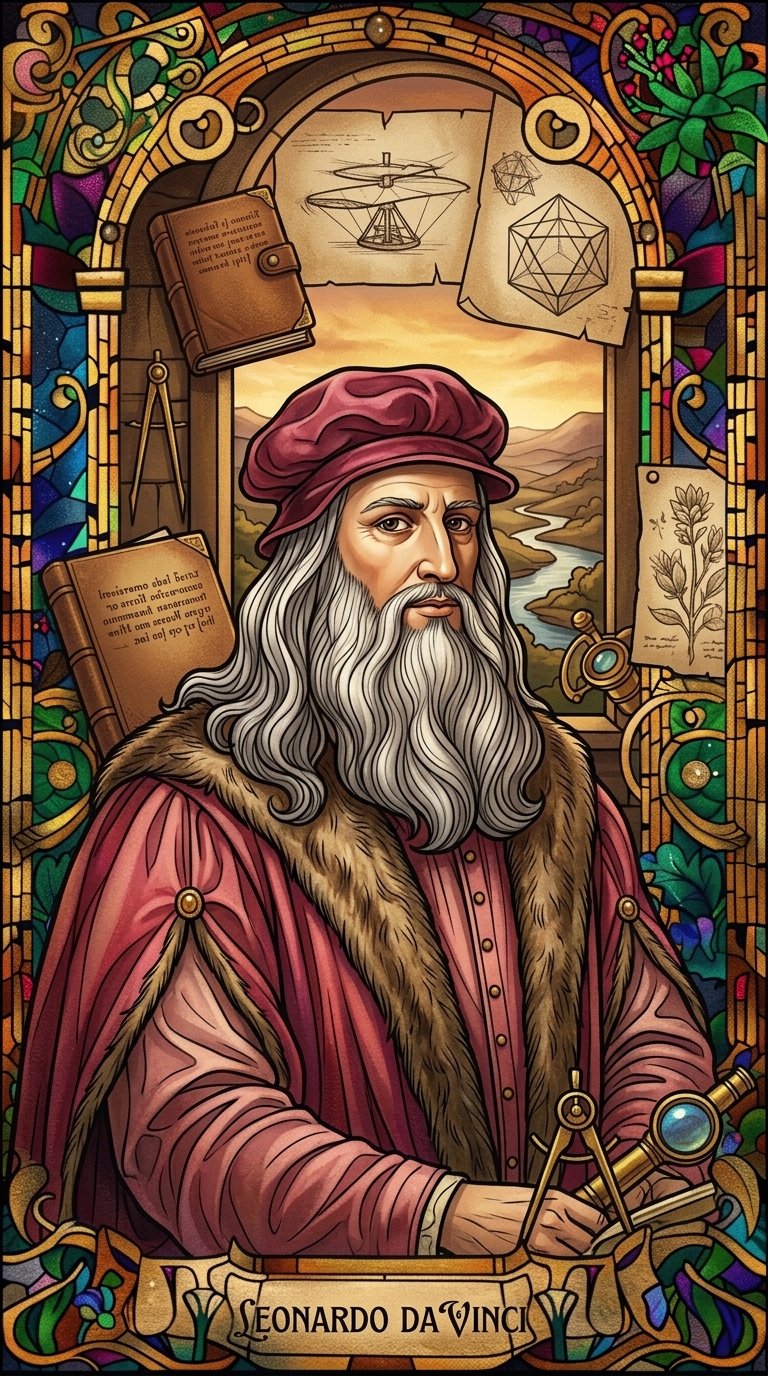
Leonardo was born in 1452 in Vinci, near Florence, and trained in the Florentine workshop of Andrea del Verrocchio. Around 1482 he moved to Milan to serve Duke Ludovico Sforza as painter, engineer and designer of court festivities.
In Milan he painted the Last Supper and spent years on a colossal bronze horse, of which only the clay model was made before war ended the project. Back in Florence he began the Mona Lisa around 1503. All the while he filled thousands of notebook pages, written in mirror script, with studies of anatomy, the flight of birds, the movement of water, geology and machines of every kind.
Much of what he planned was never finished, and little of what he wrote was published in his lifetime. He spent his last years in France as a guest of King Francis I, and died at Amboise in 1519.
Which unfinished idea do you most wish you had completed?
The great bronze horse for Duke Ludovico. I spent over ten years on it, studying the finest coursers in the stables of Milan, measuring every joint, and working out how to cast eighty tons of bronze in a single pour. The full clay model was finished, over twelve braccia high, standing in the Corte Vecchia. Then the bronze set aside for it was sent off to Ferrara to be made into cannon, the Duke fell, and the French archers used the clay beast for target practice. To have so many years of observation and labour ruined, while the metal meant to honor life was turned into instruments of slaughter, remains a bitter thing. I would have liked to see that horse cast.
How did you train yourself to observe?
I began with a rule my master Verrocchio kept in the workshop: never look at a thing as a whole without first dividing it into its members. If you wish to know how a plant grows, you do not gaze at the bush. You look at the leaf, how it springs from the shoot, how the veins branch to feed the edge, and how it turns toward moisture and light. To train my hand and eye, I carried a small notebook tied to my belt through the streets of Florence and Milan. When two men quarreled, or laughed together, or an old man sat resting his chin on his stick, I took down the movement at once, in quick lines. Nature does not pause to let a painter mix his colours. If you cannot catch the turn of a shoulder in three strokes of charcoal, you will never put true life upon a wall.
Why did you study anatomy so closely as a painter?
A painter must know what lies beneath the skin, or his figures will look like sacks of walnuts rather than living men. If you do not know where a muscle begins, where it binds to the bone, and which sinew pulls it into action, you cannot show an arm straining to lift a weight or turning in fear. One muscle swells while its companion slackens and lengthens. I had to see the cords and joints with my own eyes so I would not draw muscles where none exist, as many do who wish to seem grand and forceful. To paint the motion of the body, you must first know the machine.