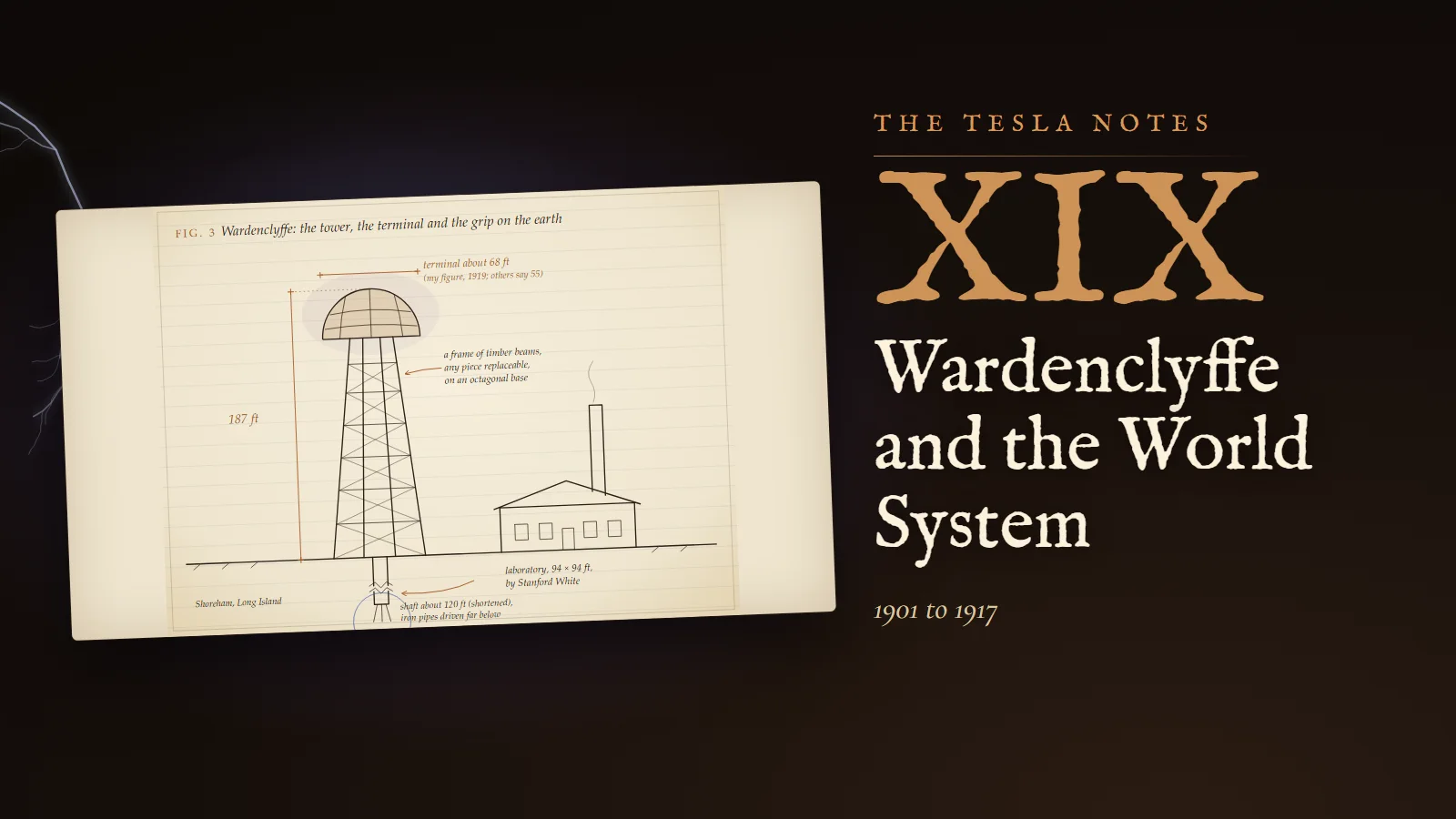
Morgan's money, Stanford White's laboratory, a tower crowned with a sphere sixty-eight feet across, and the arithmetic of how much charge it could hold.
Tesla's Wardenclyffe tower: why the terminal was huge and smooth (E = V/r, C = 4πε₀r), Marconi in 1901, and an honest verdict on wireless power.
 Nikola Tesla
·
November 5, 2026
·
25 min
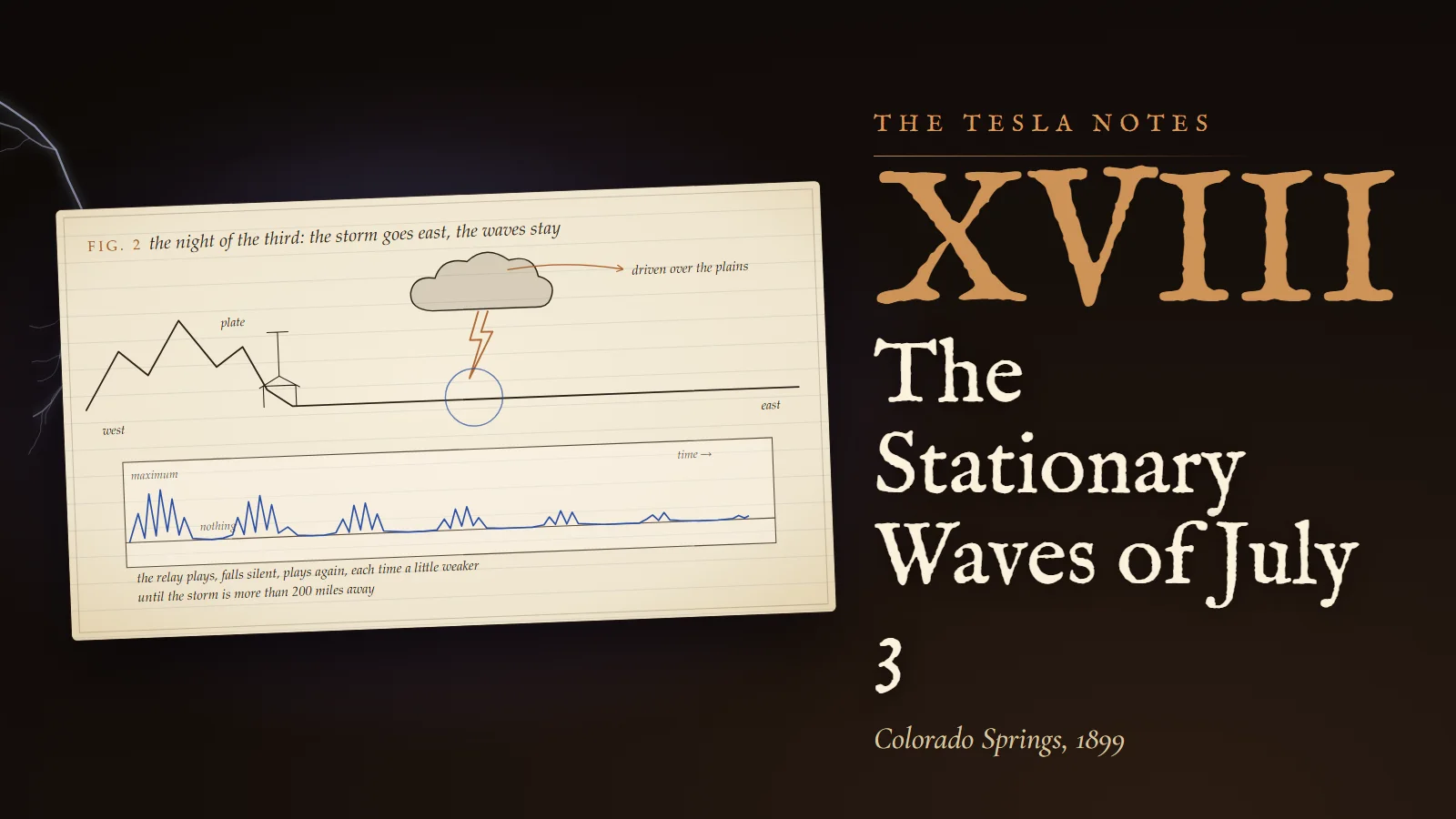
A storm walks east across the plains, my relay counts its nodes, and I spend five years deciding what was holding the waves still.
Tesla's night of 3 July 1899: the receding storm, his stationary waves, the 6 Hz of patent 787,412, and why Schumann's 7.83 Hz is a near-miss.
Nikola Tesla
·
November 5, 2026
·
23 min
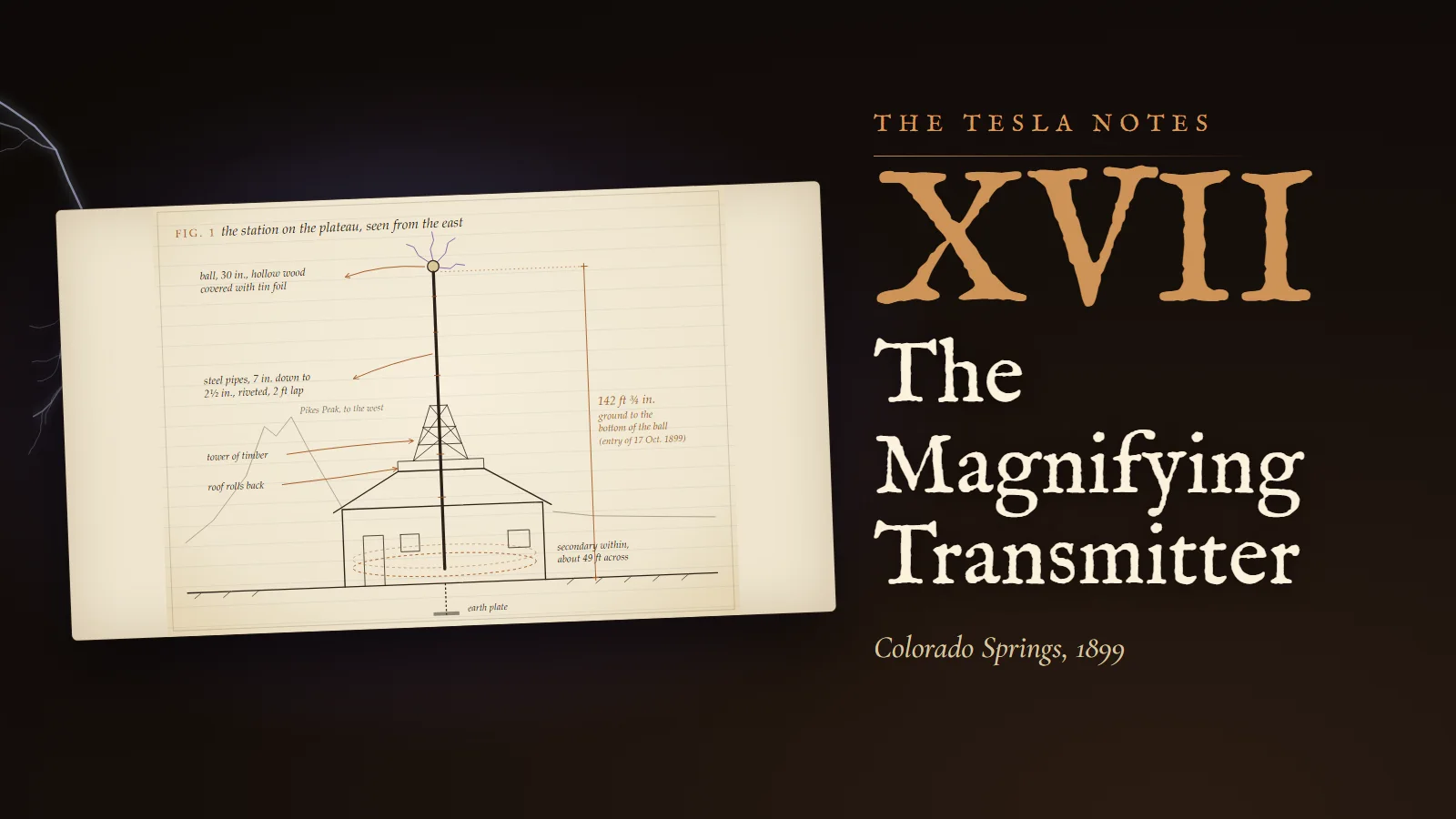
A barn on a plateau, a coil fifteen metres across, a free coil standing on a driven one, and the long work of finding its pitch.
Tesla's 1899 Colorado Springs notebook: the extra coil as a quarter wave, why a ball on top lowers its pitch, and three ways he measured capacity.
Nikola Tesla
·
November 5, 2026
·
29 min
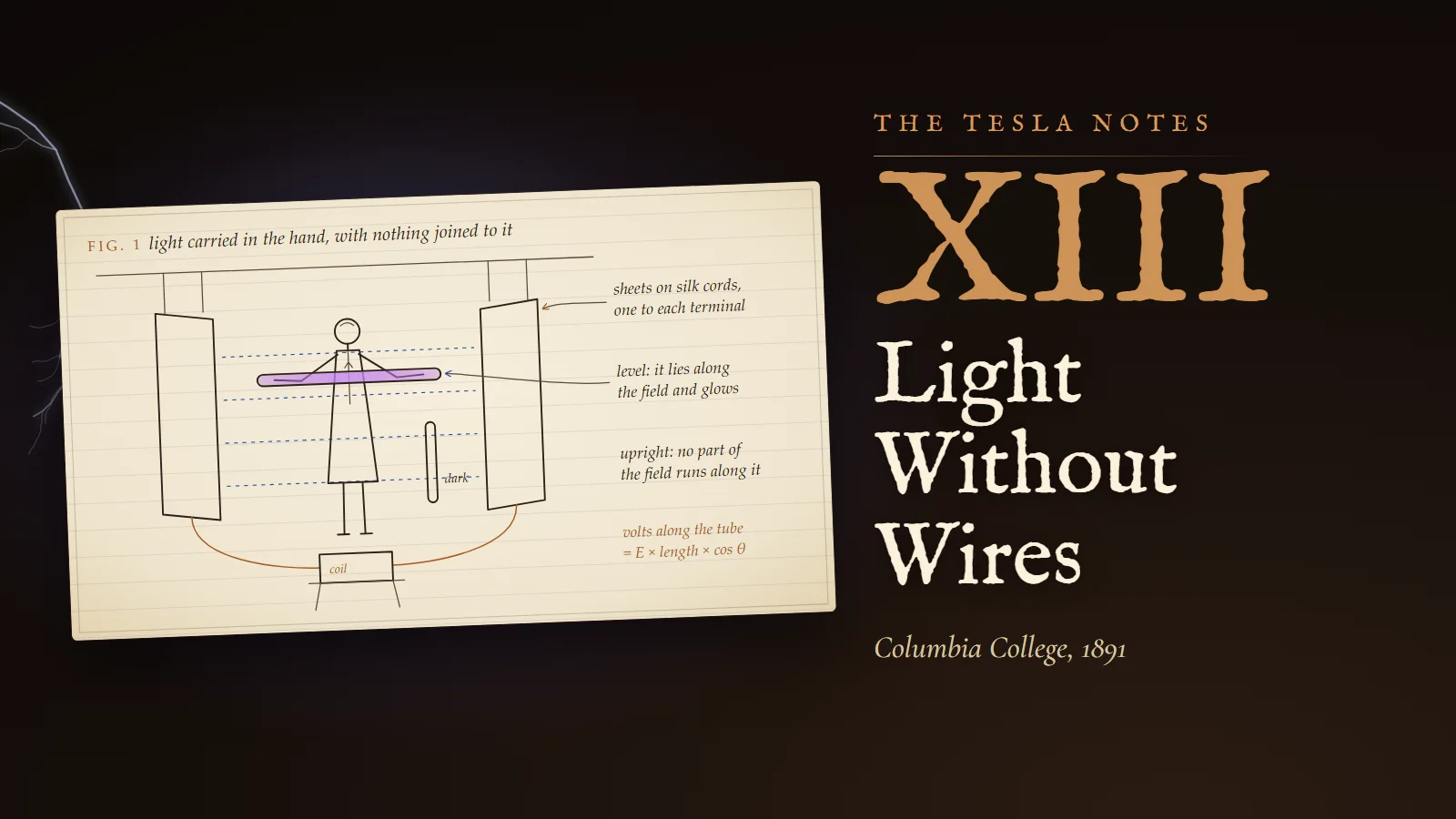
A tube lit in empty air between two hanging sheets, and the arithmetic that says why frequency makes the impossible lamp easy.
Tesla's 1891 Columbia lecture: how an alternating electric field lights an exhausted tube, why only the field along it counts, and why frequency matters.
Nikola Tesla
·
November 5, 2026
·
22 min
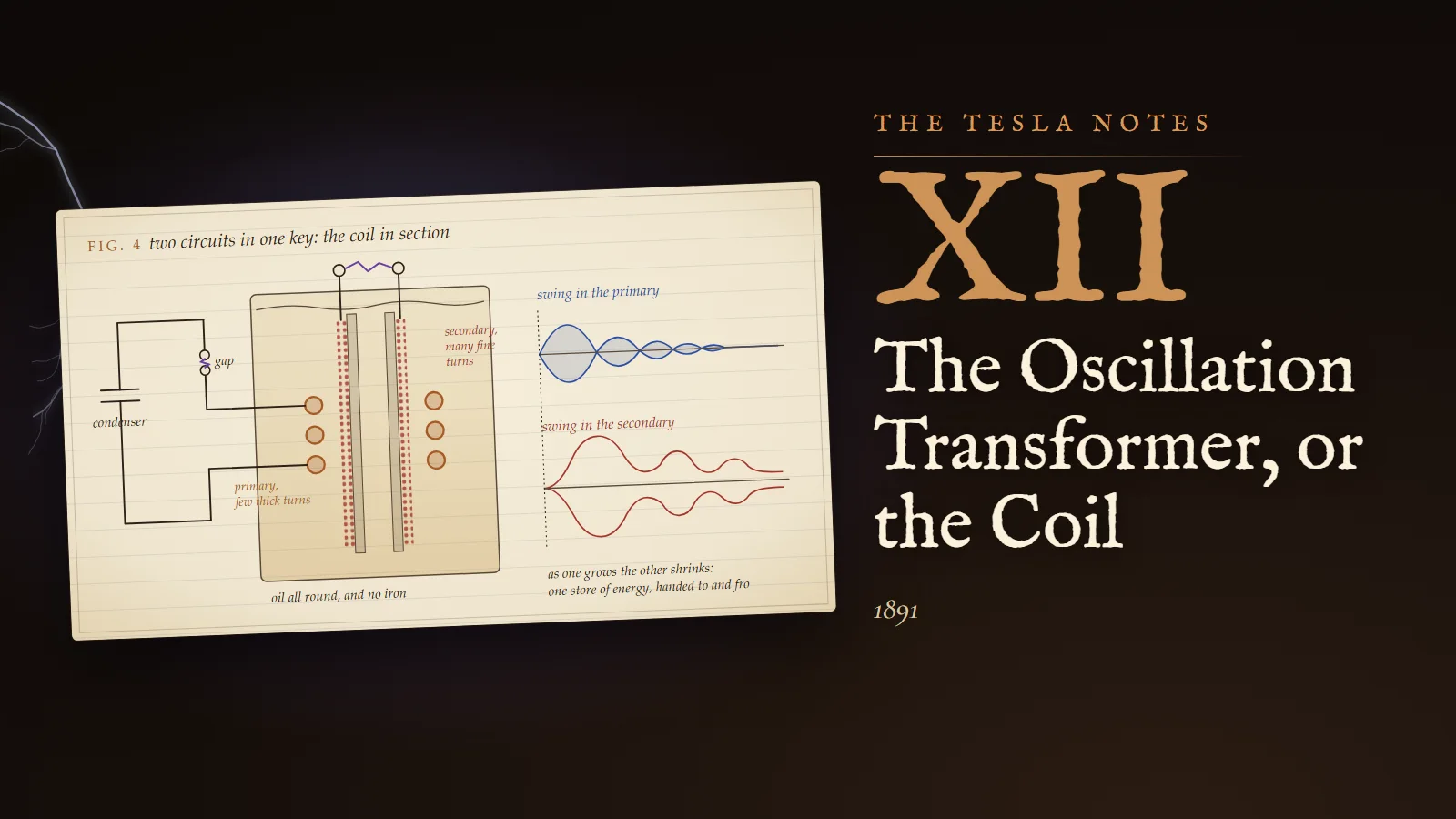
Why the induction coil fails at high frequency, and how a condenser, a spark and two tuned circuits without iron became the Tesla coil of patent 454,622.
Tesla tunes two coils without iron, derives their two frequencies and the voltage gain √(L₂/L₁), and files patent 454,622 for the coil.
Nikola Tesla
·
November 5, 2026
·
30 min
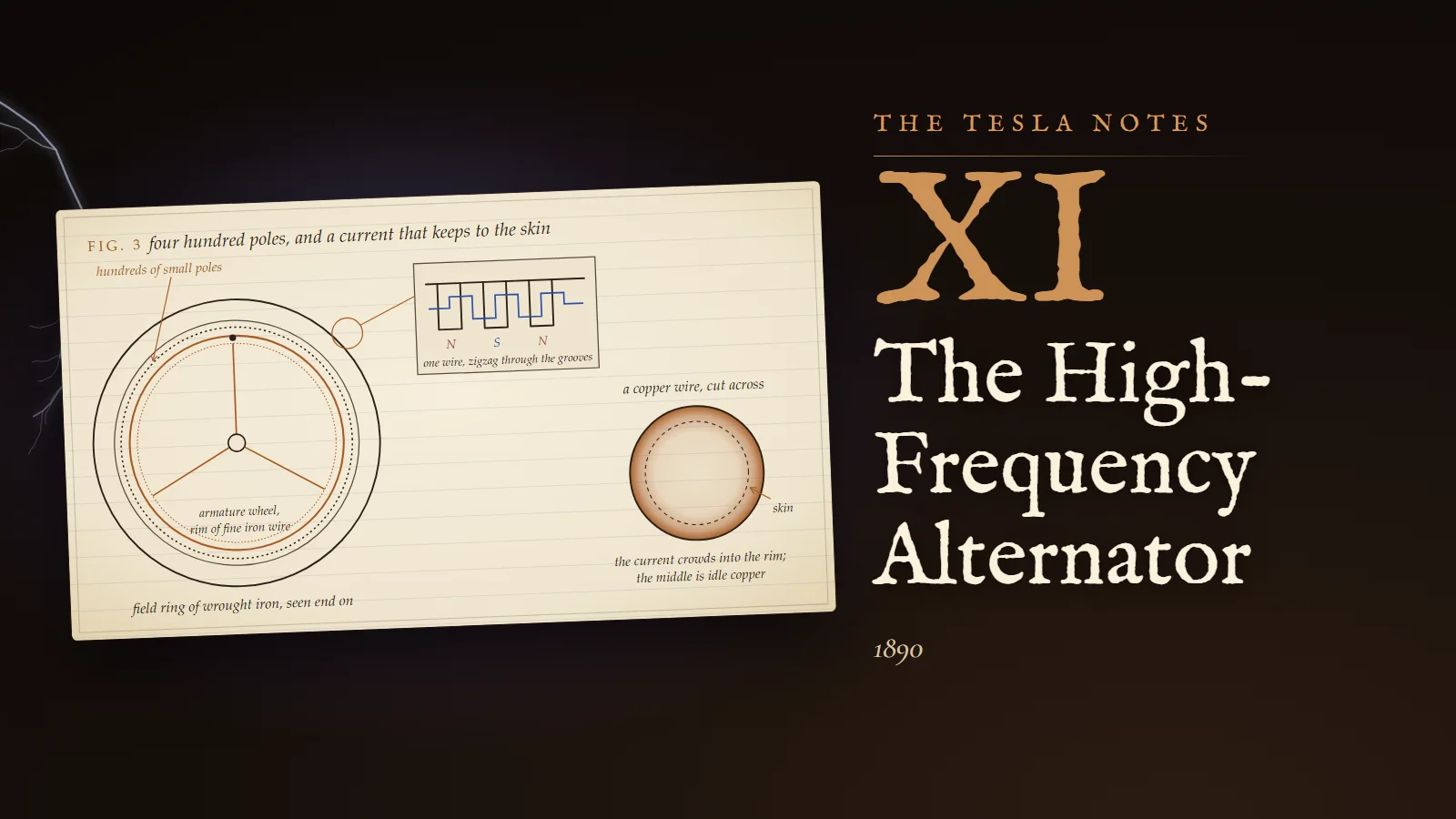
Tesla builds a dynamo with 384 poles to reach ten thousand alternations a second, silences the arc lamp, and finds the current hiding in the skin of the copper.
Tesla works out how many poles make 10,000 alternations a second, why the iron must be wire, and why copper carries current only in its skin.
Nikola Tesla
·
November 5, 2026
·
30 min
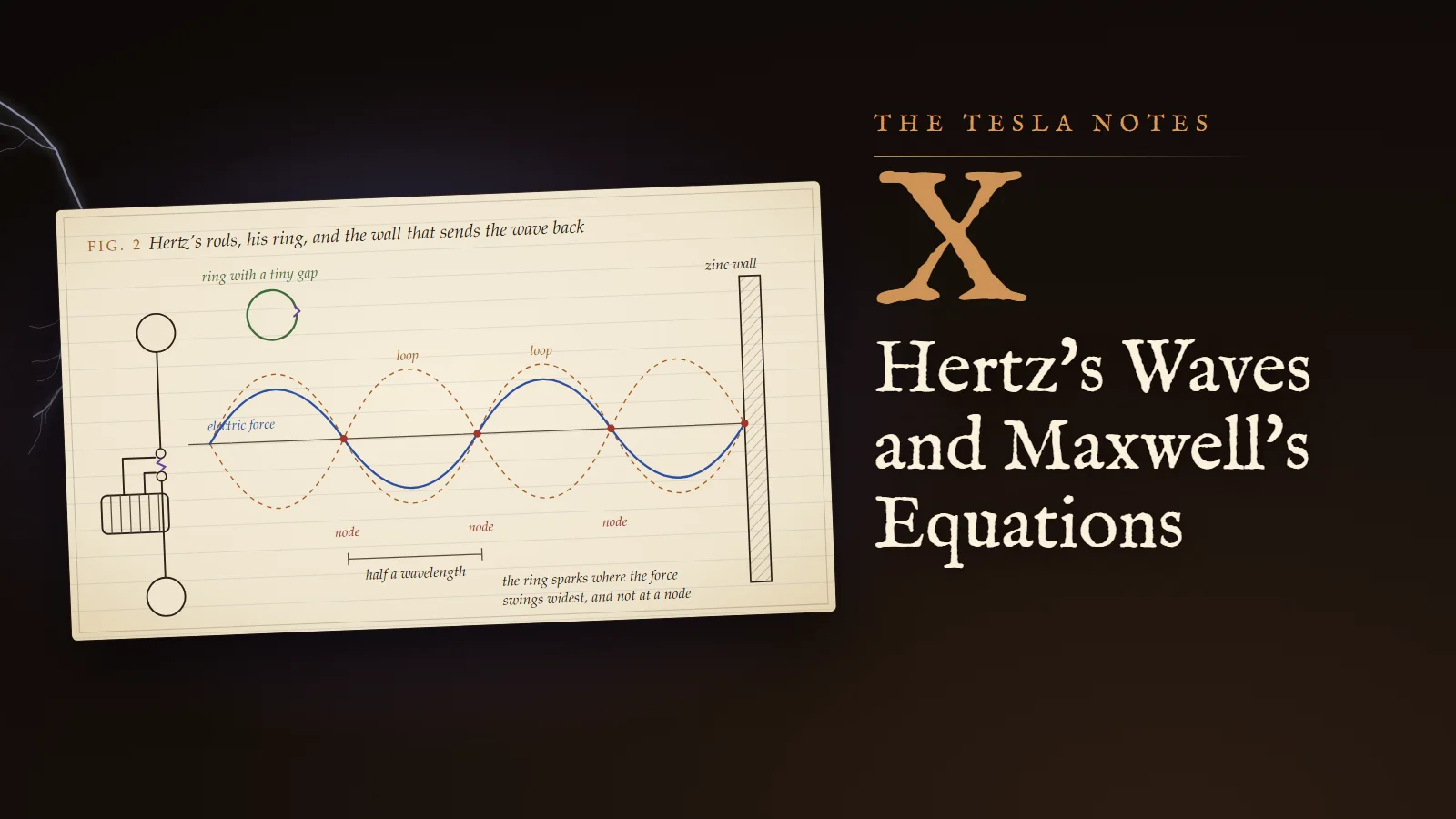
From the Paris Exposition of 1889 to a laboratory in Bonn in 1892: Tesla works through Maxwell's wave equation, measures waves on a wire, and argues with Hertz.
Tesla derives the speed of Maxwell's waves from the ratio of the units, estimates Hertz's wavelength, and takes his objections to Bonn.
Nikola Tesla
·
November 5, 2026
·
30 min
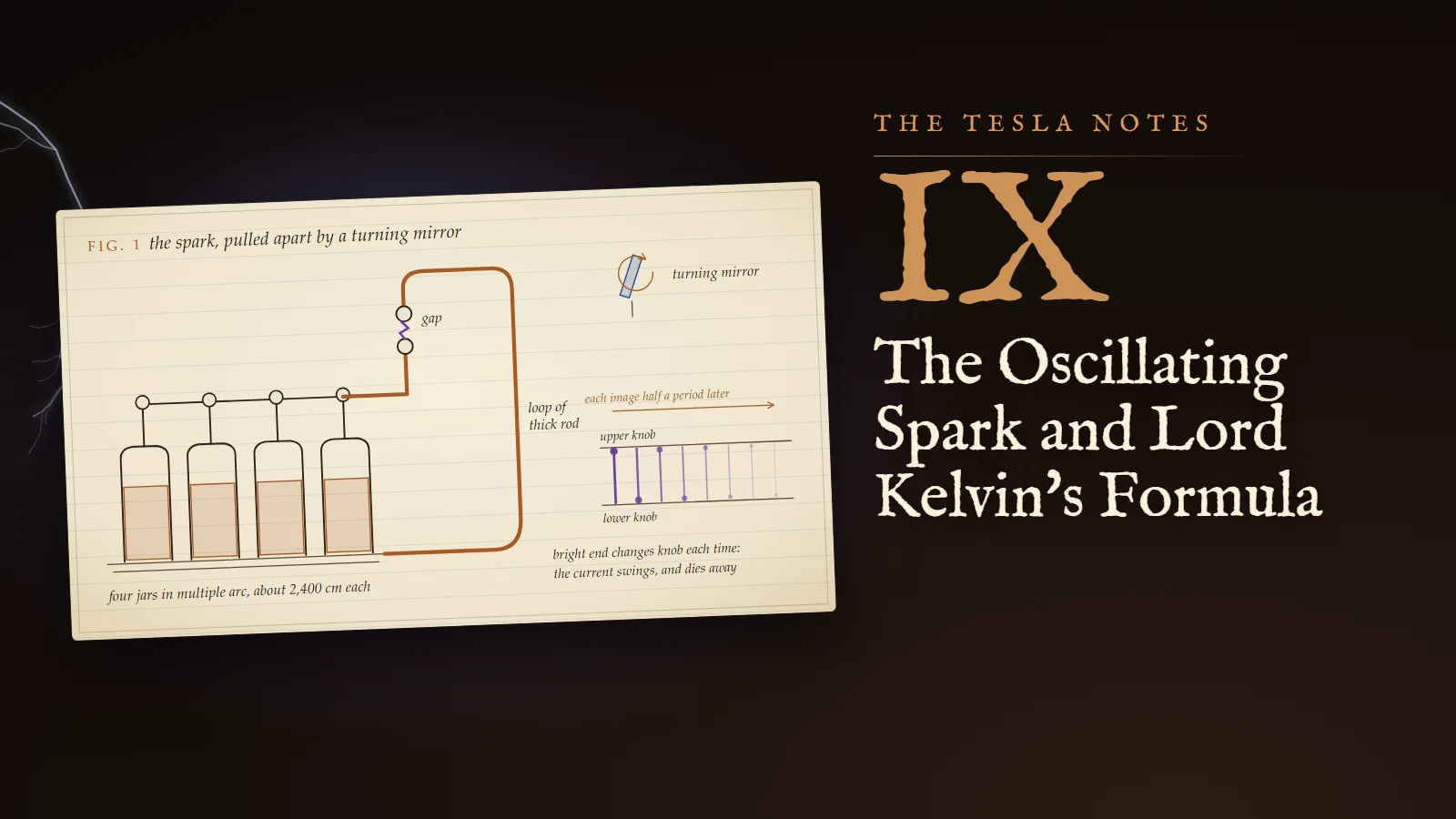
A jar of glass and a loop of copper swing a million times a second of their own accord. I derive why, count the swings in a turning mirror, and weigh the thief in the spark.
Tesla derives f = 1/(2π√(LC)) and the damping of a Leyden-jar discharge, counts the swings in a turning mirror, and finds the spark's loss.
Nikola Tesla
·
November 5, 2026
·
31 min
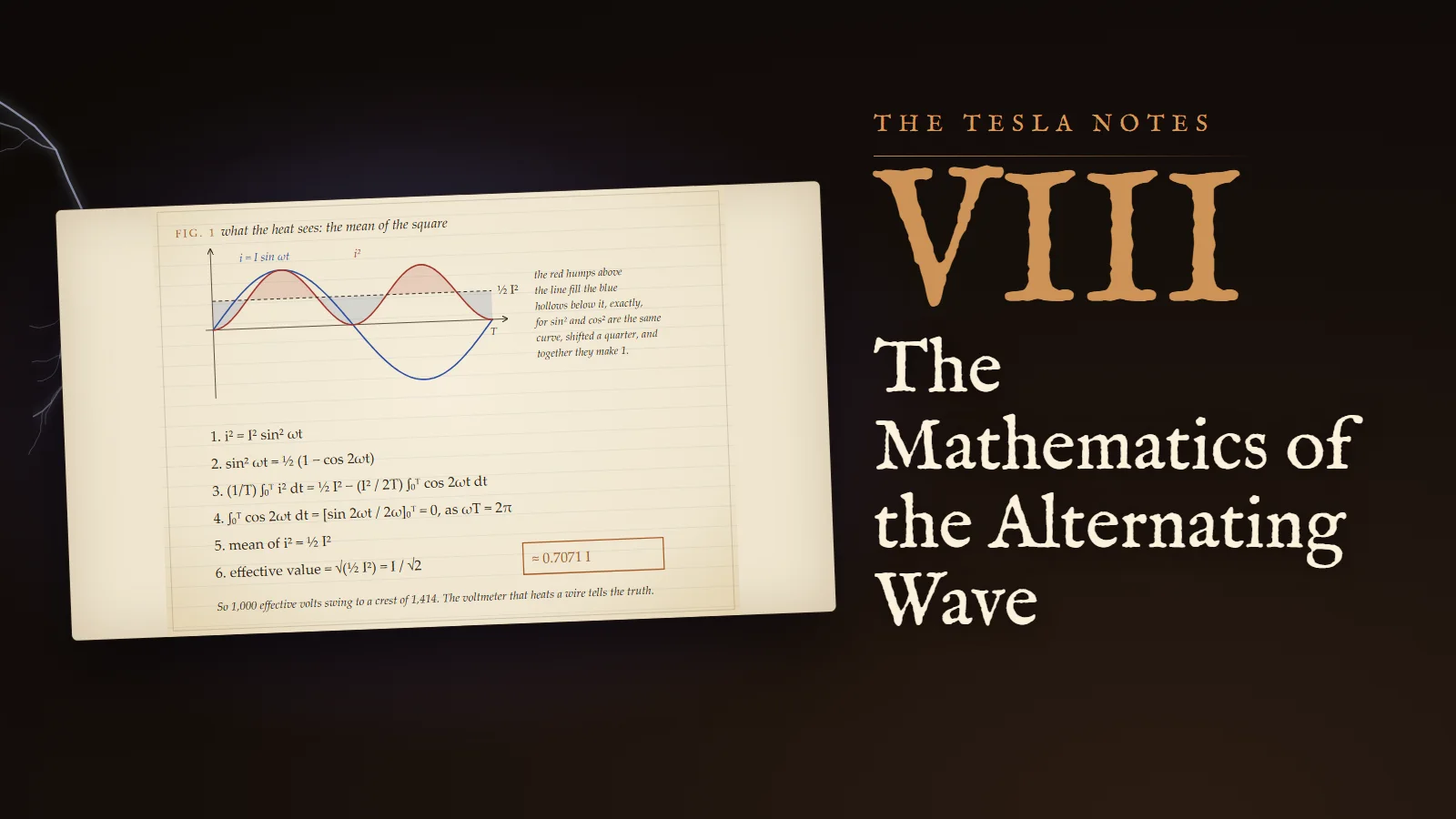
A sine is the shadow of a turning radius. With that one picture I could see every alternating circuit whole before a turn was wound.
RMS by integration, impedance, phase lag, power factor and series resonance, derived step by step from Tesla's geometric method of turning radii (proto-phasors).
Nikola Tesla
·
November 5, 2026
·
24 min
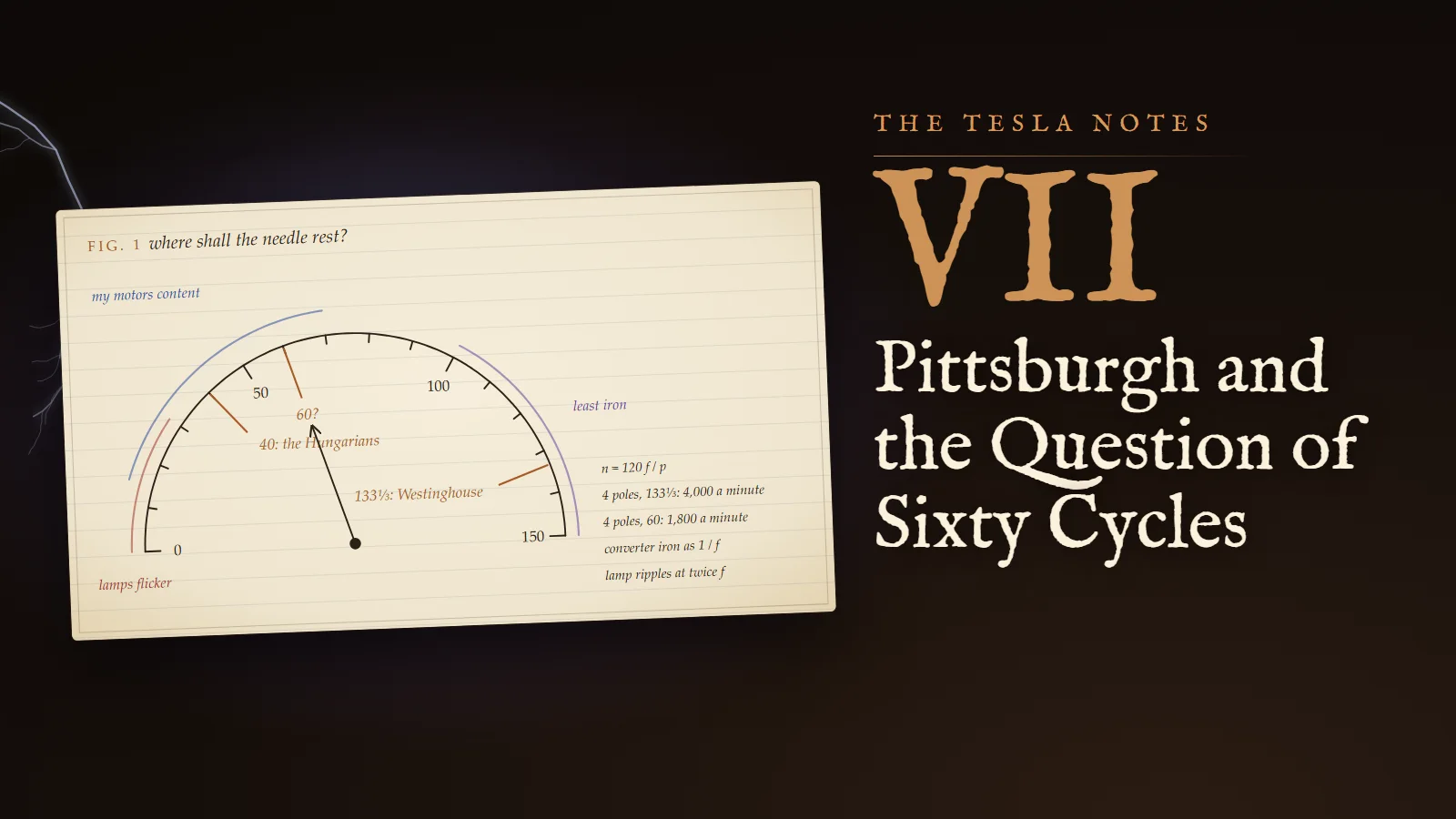
Westinghouse's alternators gave 133 periods a second and my motor wanted far fewer. I spent a year between two numbers.
Why 60 Hz? Tesla's Pittsburgh year worked out: motor speed n = 120f/p, split-phase motors, lamp flicker and filament heat, and transformer iron versus frequency.
Nikola Tesla
·
November 5, 2026
·
24 min
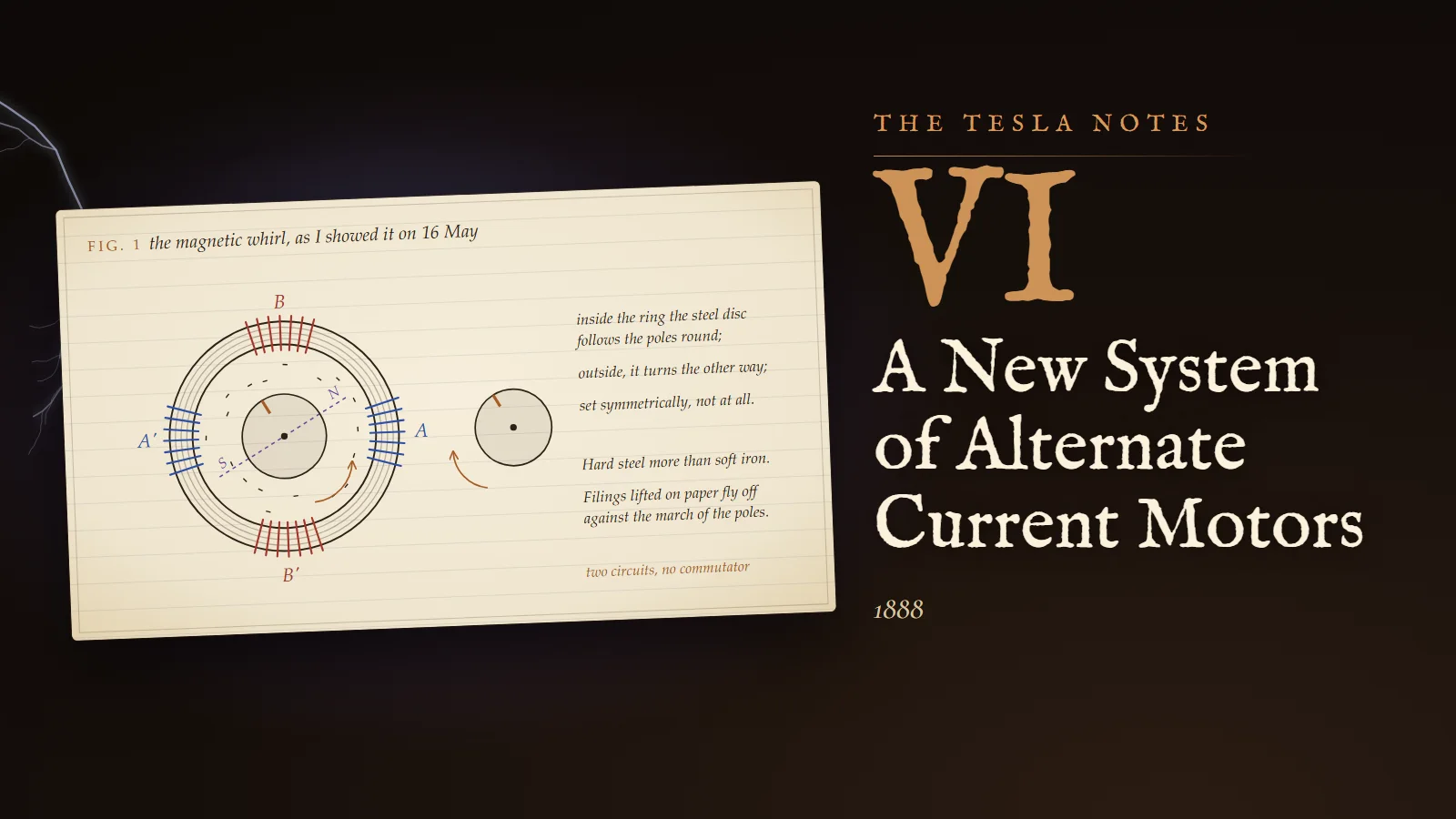
Five years after the sand in Budapest, the field turned in iron at 89 Liberty Street, and I had to say exactly what I had seen.
Tesla's 1887 to 1888 polyphase patents and AIEE lecture: the rotating field's circle proof, synchronous versus induction motors, and why three-phase saves copper.
Nikola Tesla
·
November 5, 2026
·
26 min
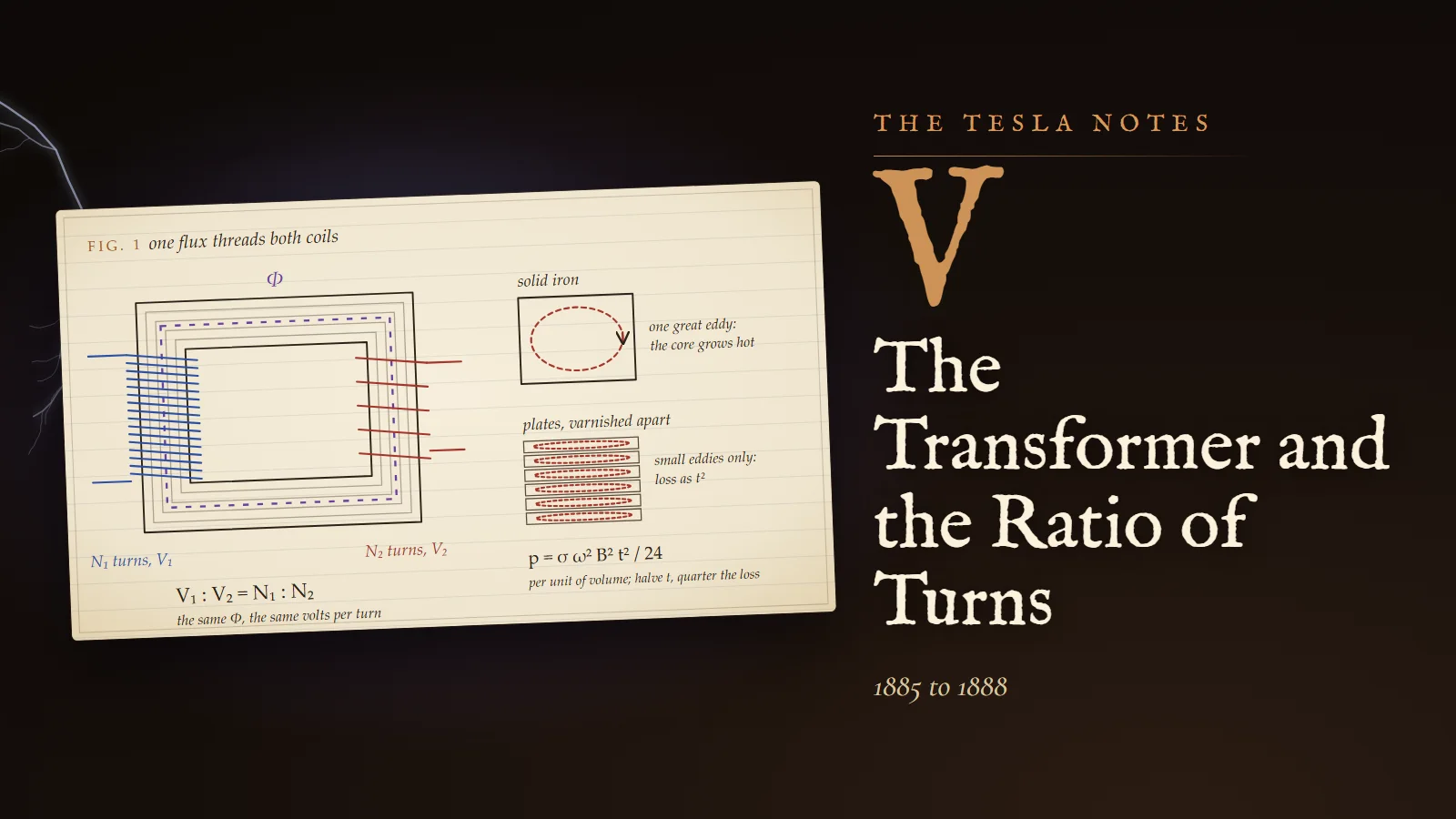
A converter has no moving part and turns a thousand volts into fifty as quietly as a sum is carried in the head. I wanted to know exactly why.
Why a transformer needs alternating current: the ratio of turns, V = 4.44 f N Φ, magnetising current, eddy losses and laminations, worked in Tesla's voice.
Nikola Tesla
·
November 5, 2026
·
30 min
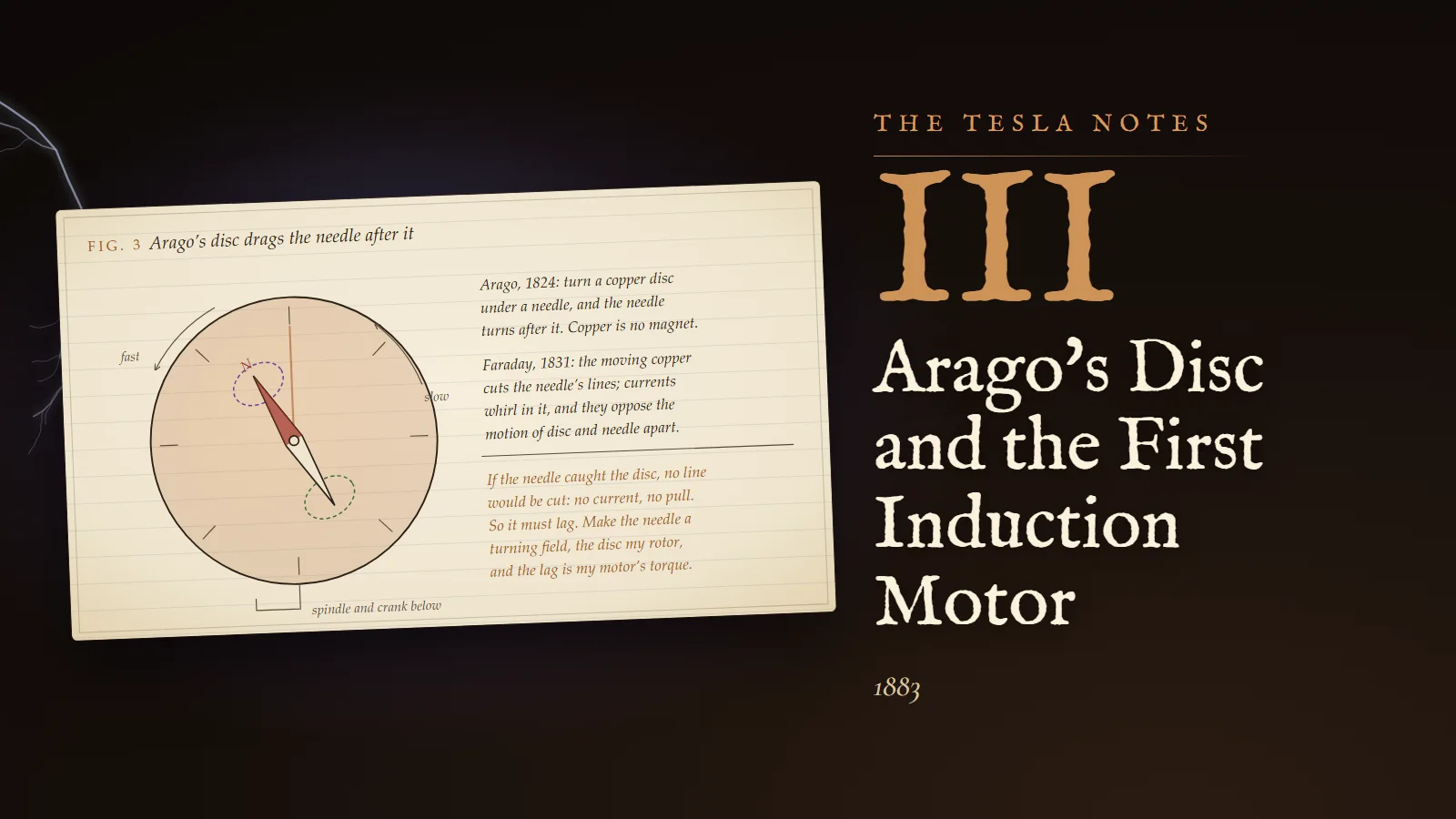
Paris and Strasbourg, 1882 to 1884: a copper disc chases a field made of timing, and I learn why it must always fall a little behind.
Tesla's Strasbourg notebook: Arago's disc, eddy currents and Lenz's law, the torque-slip law T = 2xm/(x² + m²), and his first induction motor.
Nikola Tesla
·
November 5, 2026
·
24 min
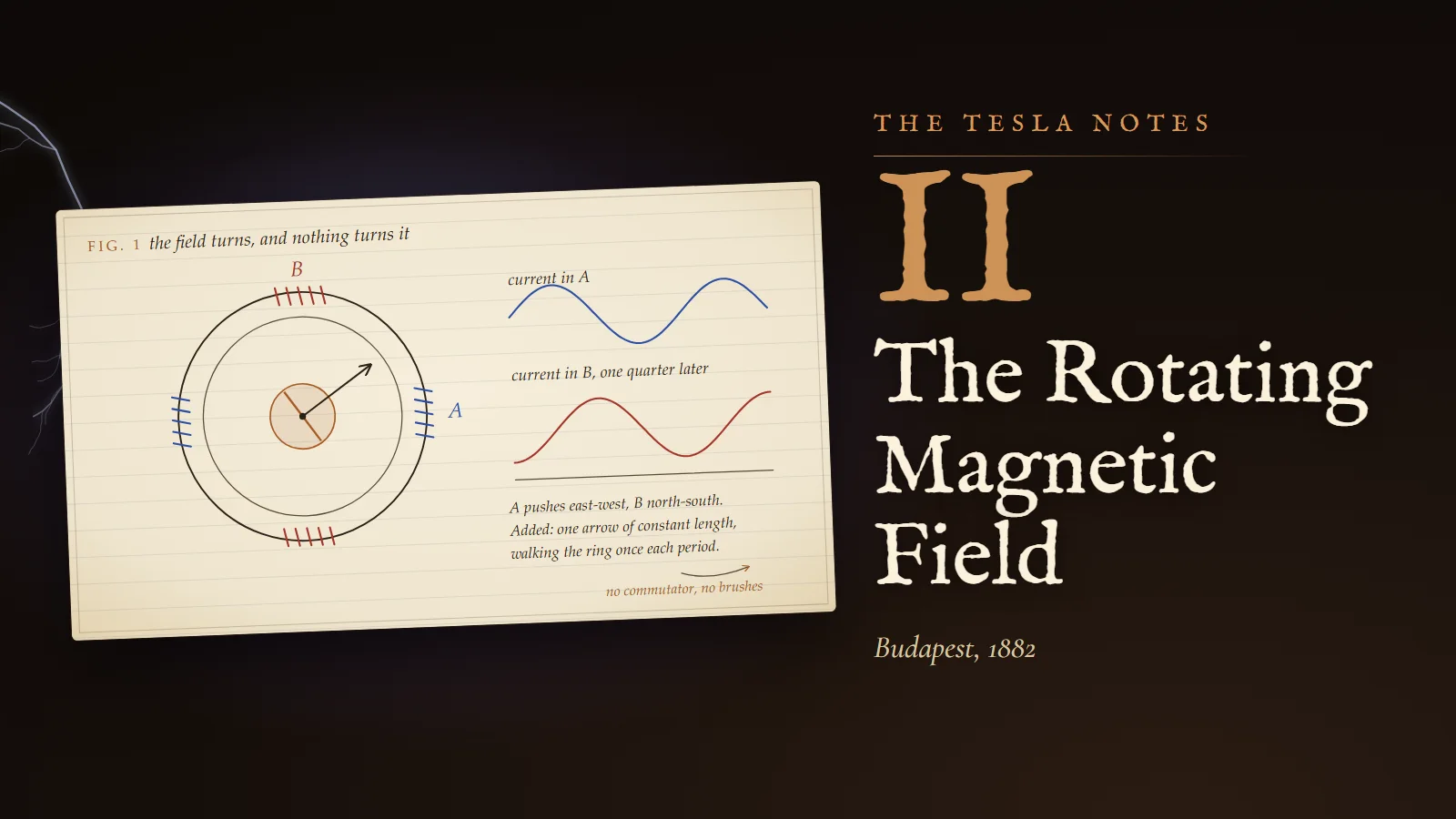
Budapest, 1882: two currents a quarter period apart, drawn with a stick in the sand, make a field that turns while nothing turns it.
Tesla's Budapest notebook: how two or three phase-shifted currents make a field that turns, the (3/2)B cos(θ − ωt) proof, and why one phase cannot.
Nikola Tesla
·
November 5, 2026
·
26 min
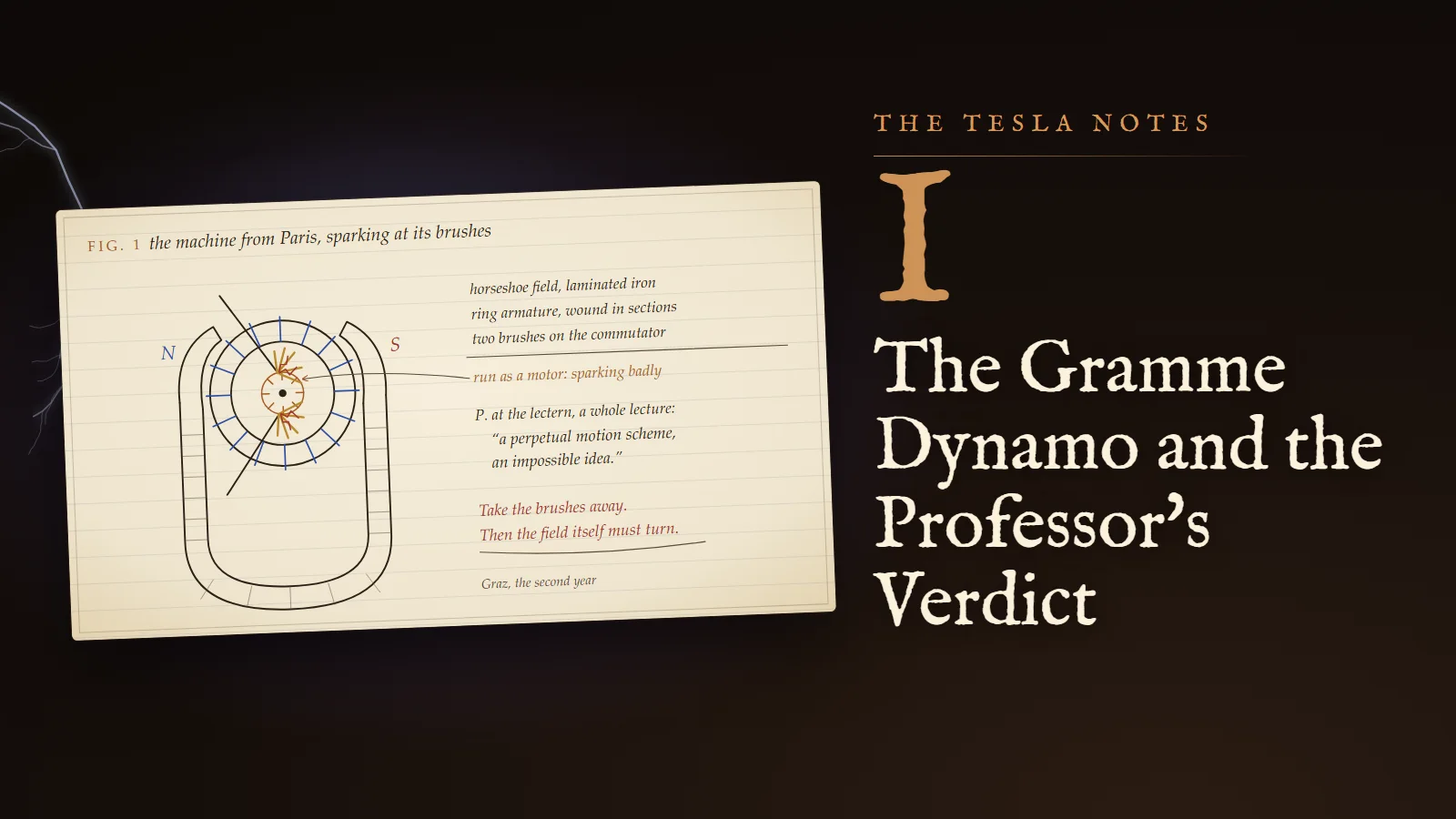
Graz, 1877: a Gramme machine sparks at its brushes, my professor calls a motor without them perpetual motion, and I set out to prove him wrong.
Tesla's Graz notebook: the emf of a turning coil, why a commutator gives 2/π of the peak, why brushes spark, and Poeschl's verdict.
Nikola Tesla
·
November 5, 2026
·
31 min