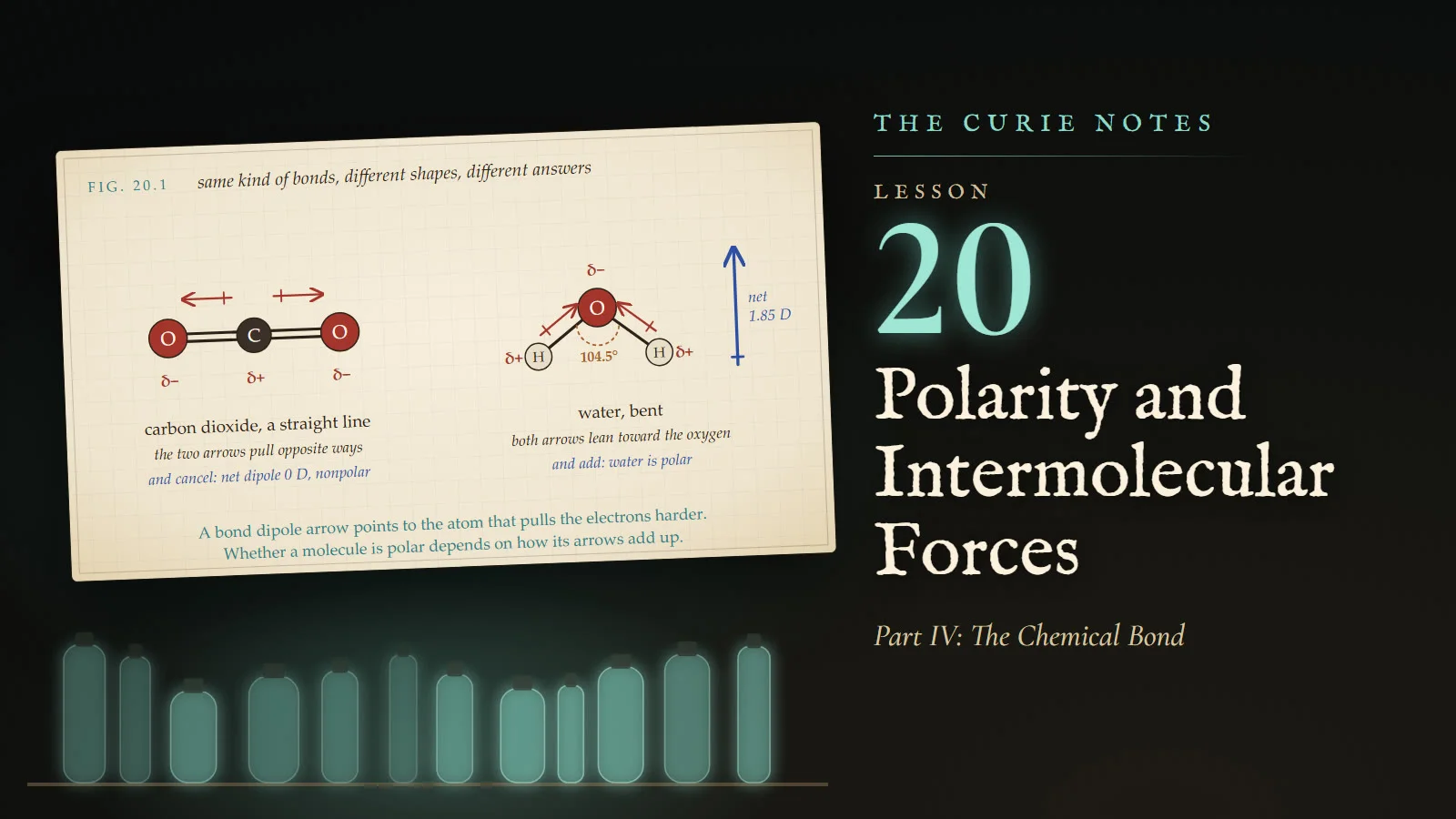
Why does ether vanish from a dish while water lingers, and why does the Vistula freeze from the top? The answer is in the forces between molecules.
Learn bond polarity, dipole moments and molecular polarity, then London forces, dipole forces and hydrogen bonds, and why water boils high and ice floats.
 Marie Curie
·
November 8, 2026
·
29 min
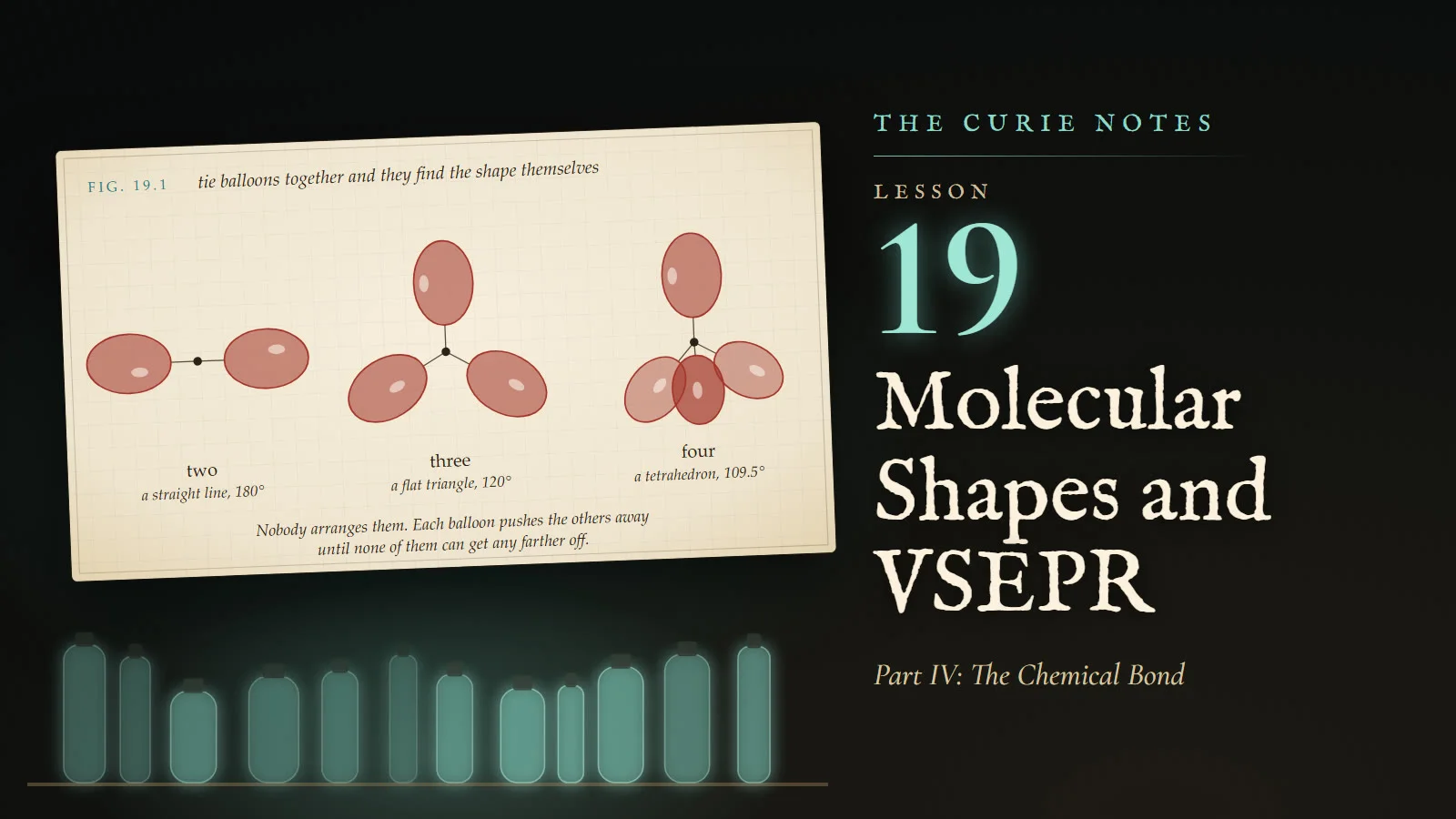
Tie balloons at one knot and they find their own shape. Electrons around an atom do the same, and from that one idea we can predict the shape of a molecule.
Count electron domains, learn the five basic geometries, see why lone pairs squeeze angles, and predict molecular shapes with VSEPR in five steps.
Marie Curie
·
November 8, 2026
·
28 min
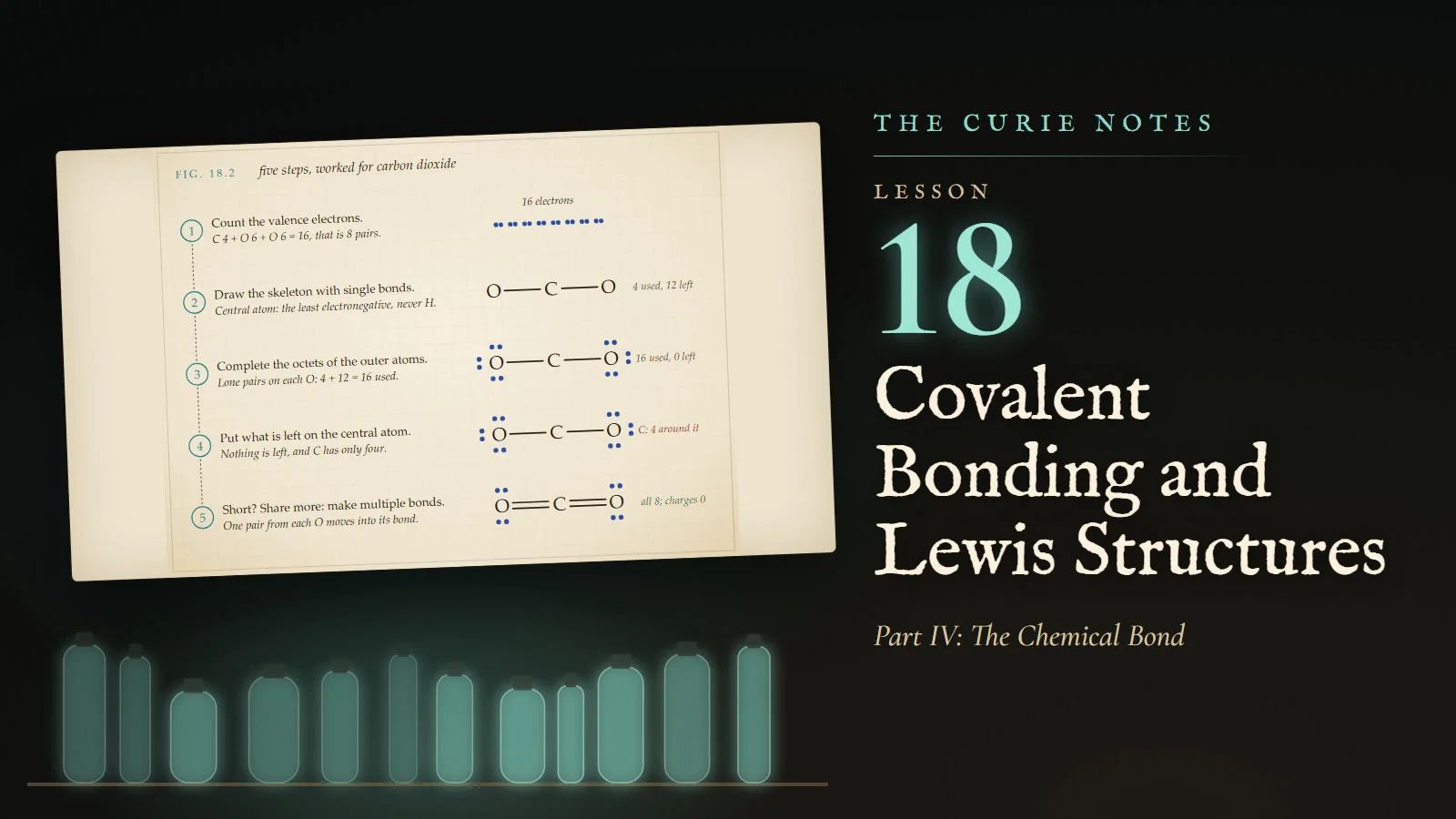
Two chlorine atoms cannot rob each other, so they share. We count the electrons, draw the pairs step by step, and weigh single, double and triple bonds.
Learn how shared electron pairs hold molecules together, draw Lewis structures in five steps, and use bond length, formal charge and resonance to check them.
Marie Curie
·
November 8, 2026
·
33 min
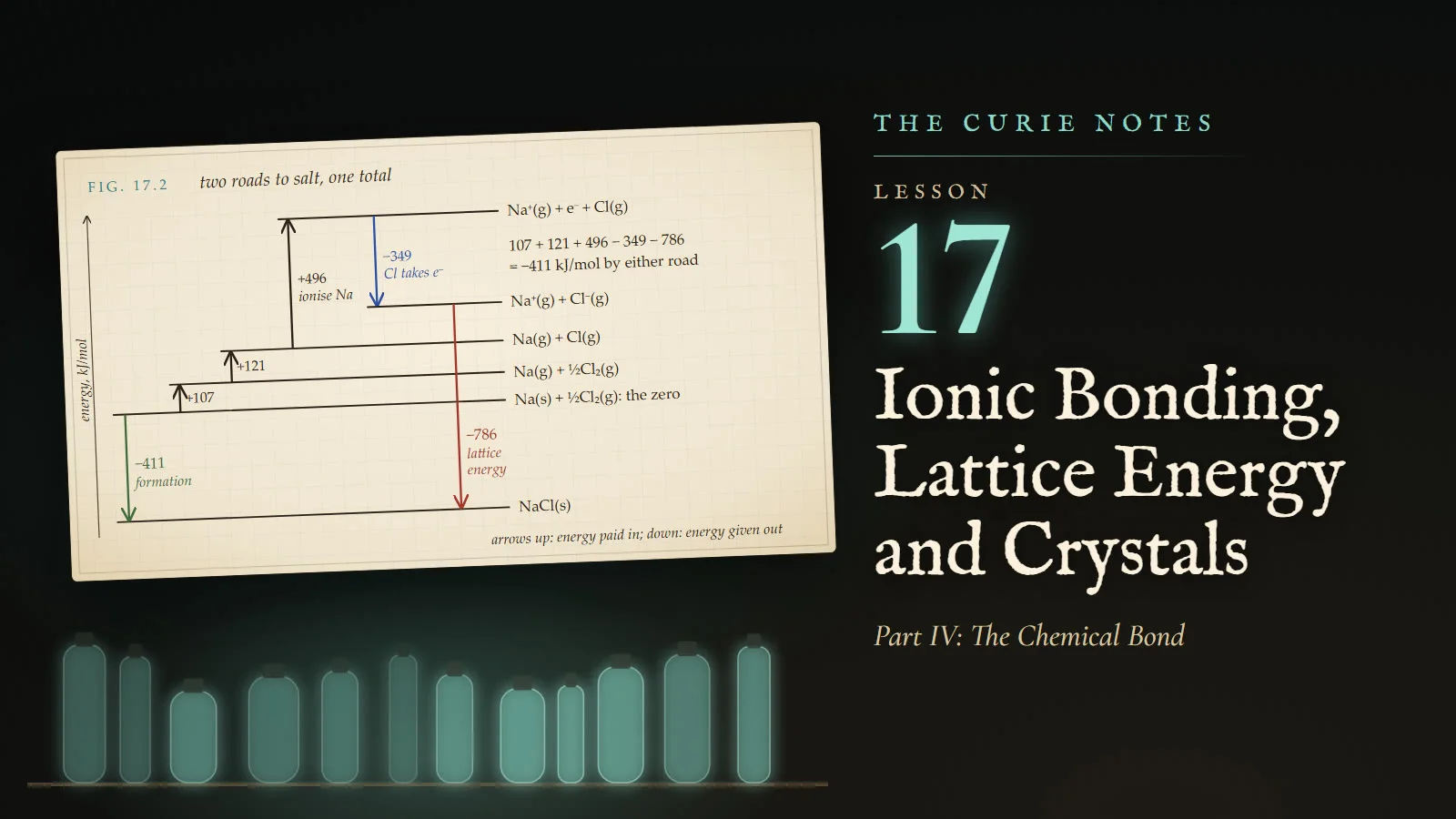
Sodium gives an electron to chlorine at a loss, and the pull of a whole crystal pays the bill. We weigh that pull, write the formulas, and see why salt shatters.
Learn why ions form, how Coulomb's law sets lattice energy, how to work a Born-Haber cycle, and how to write and name ionic formulas and explain salt crystals.
Marie Curie
·
November 8, 2026
·
38 min
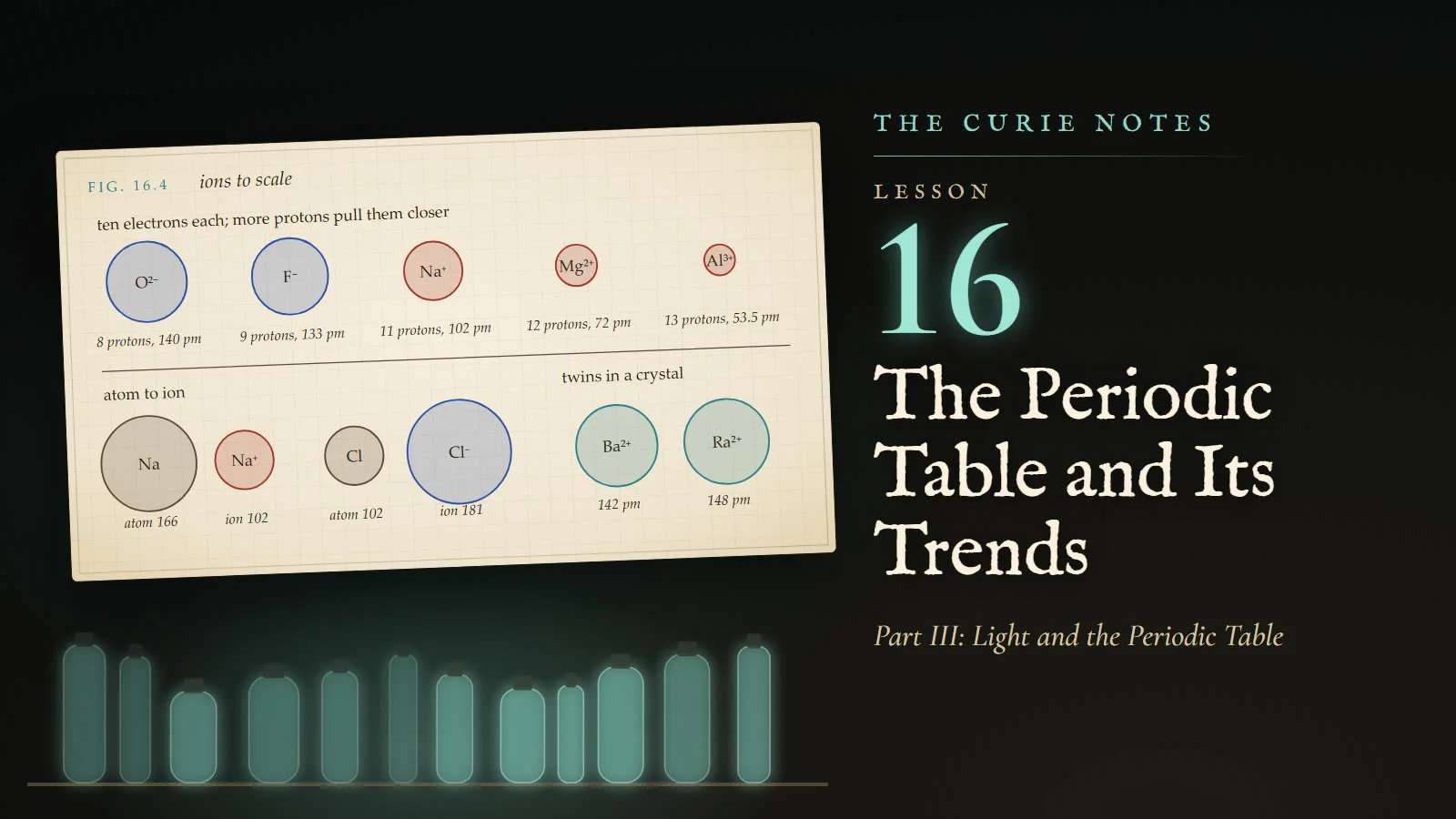
Mendeleev left empty places and the elements came to fill them. Here is why the table has its shape, and why atoms grow, shrink, give and take as they do.
Mendeleev's table and its gaps, blocks and groups, shielding and effective nuclear charge, and the trends in radius, ionisation energy and electronegativity.
Marie Curie
·
November 8, 2026
·
27 min
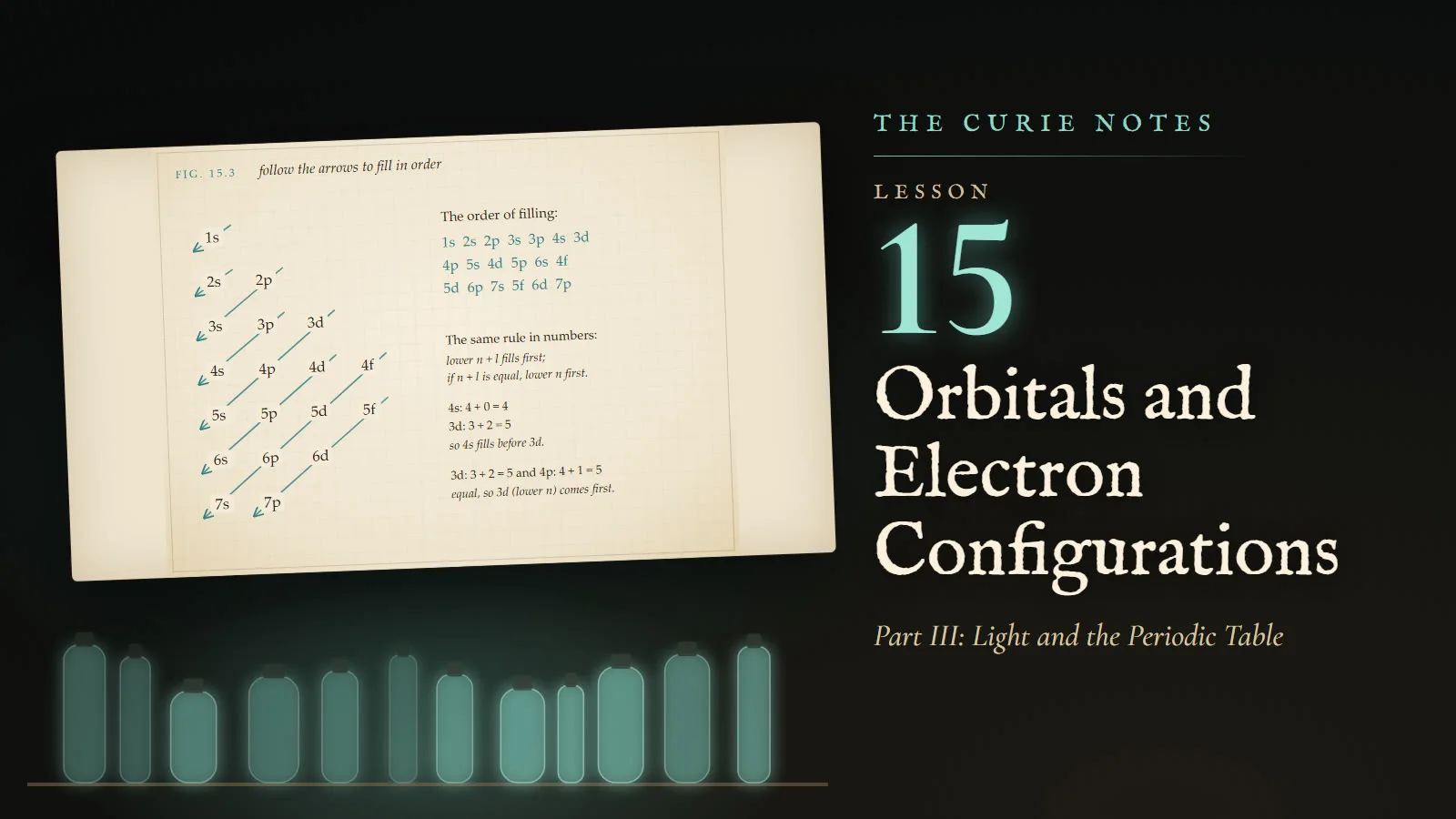
The electron is a wave that must fit around the nucleus. From that one idea come orbitals, four quantum numbers, and the address of every electron in every atom.
Learn orbitals, quantum numbers, the Aufbau, Pauli and Hund rules, and how to write electron configurations and box diagrams, with chromium and copper.
Marie Curie
·
November 8, 2026
·
27 min
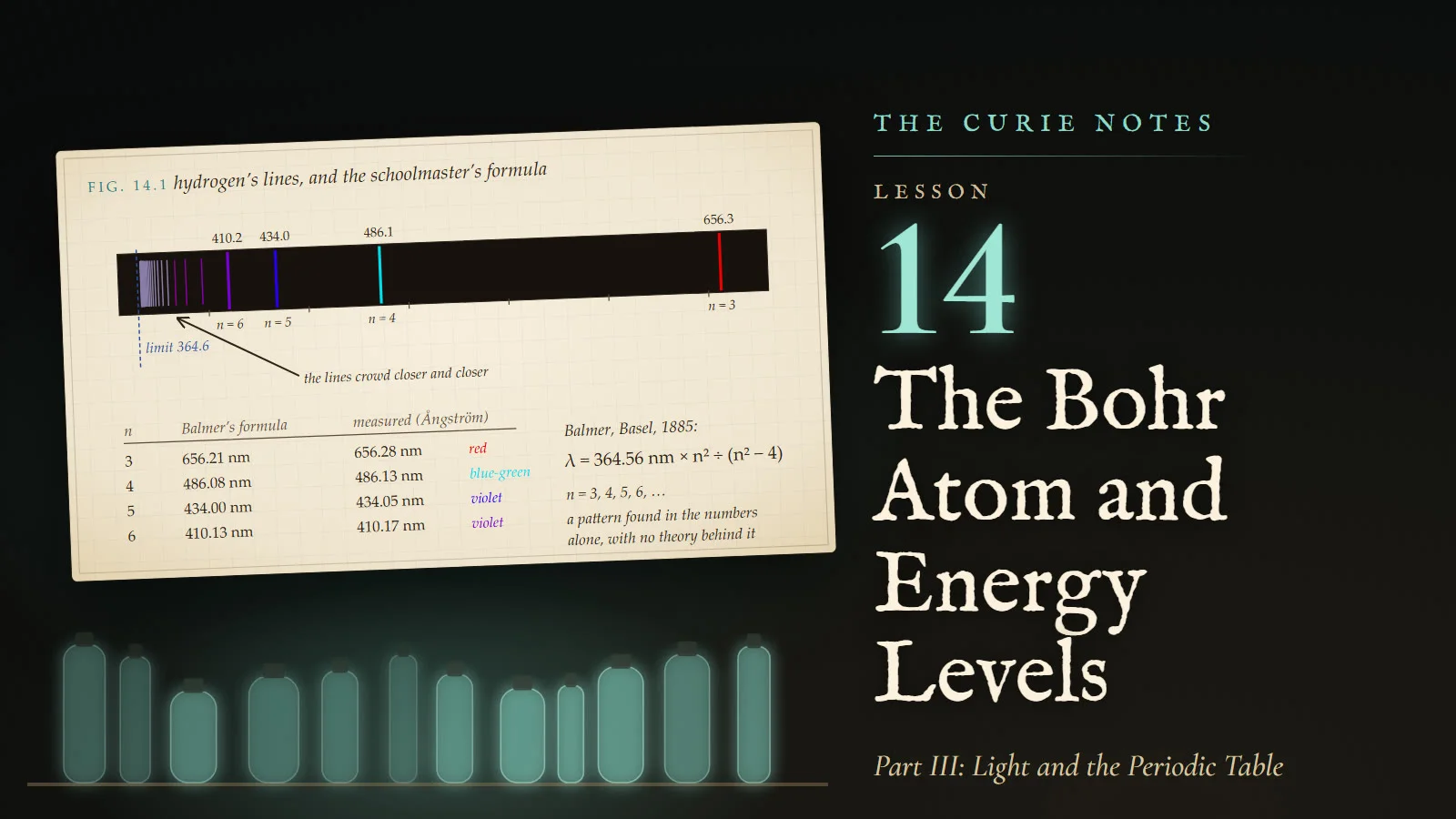
Hydrogen gives only four colours of visible light. The reason lies on a ladder of energy inside the atom, and you can climb it with a pencil.
Balmer and Rydberg formulas, Bohr's energy levels E = −13.6 eV/n², emission and absorption, the hydrogen series and ionisation energy, worked step by step.
Marie Curie
·
November 8, 2026
·
26 min
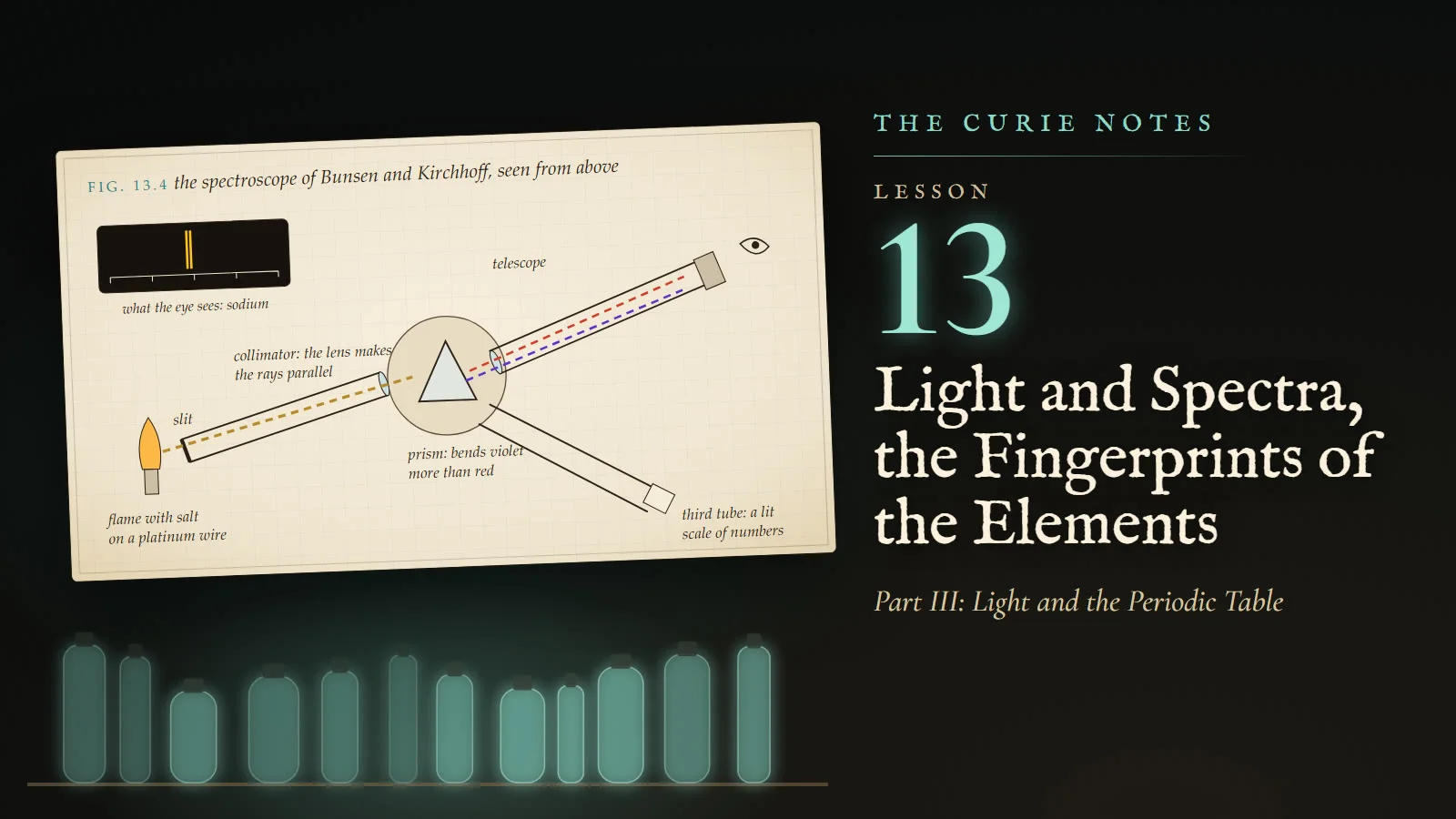
Every element writes its own lines in light. Learn to read them, and you can name a substance you cannot even see.
Wavelength, frequency and photons with c = λν and E = hν, the electromagnetic spectrum, line spectra, flame tests and the spectroscope, step by step.
Marie Curie
·
November 8, 2026
·
26 min
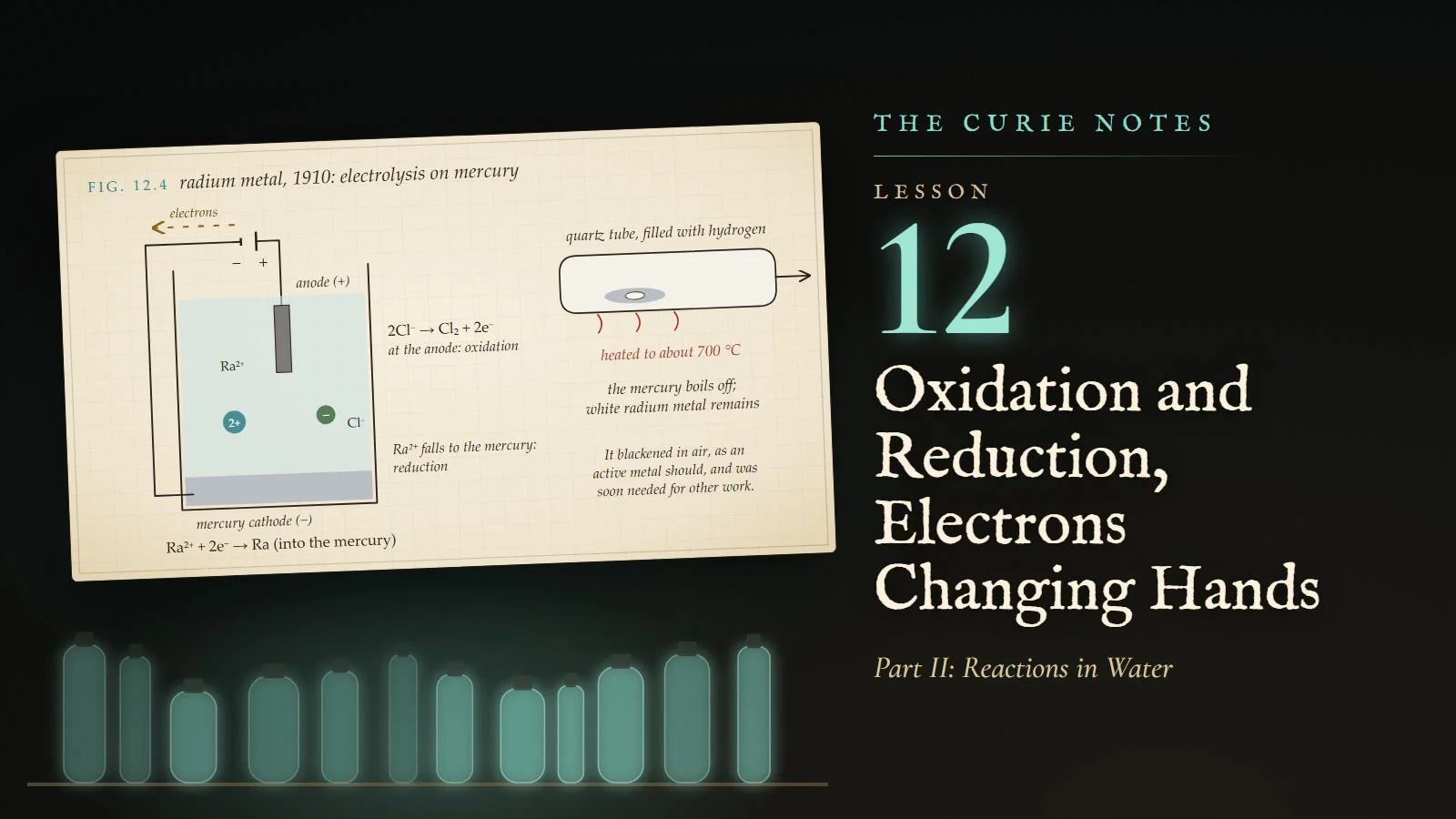
Zinc turns copper sulfate pale, iron rusts, and in 1910 I made radium a metal. All three are electrons passing from one atom to another.
Learn oxidation and reduction, oxidation-number rules, oxidising and reducing agents, half-reactions, balancing redox in acid, the activity series and rust.
Marie Curie
·
November 8, 2026
·
27 min
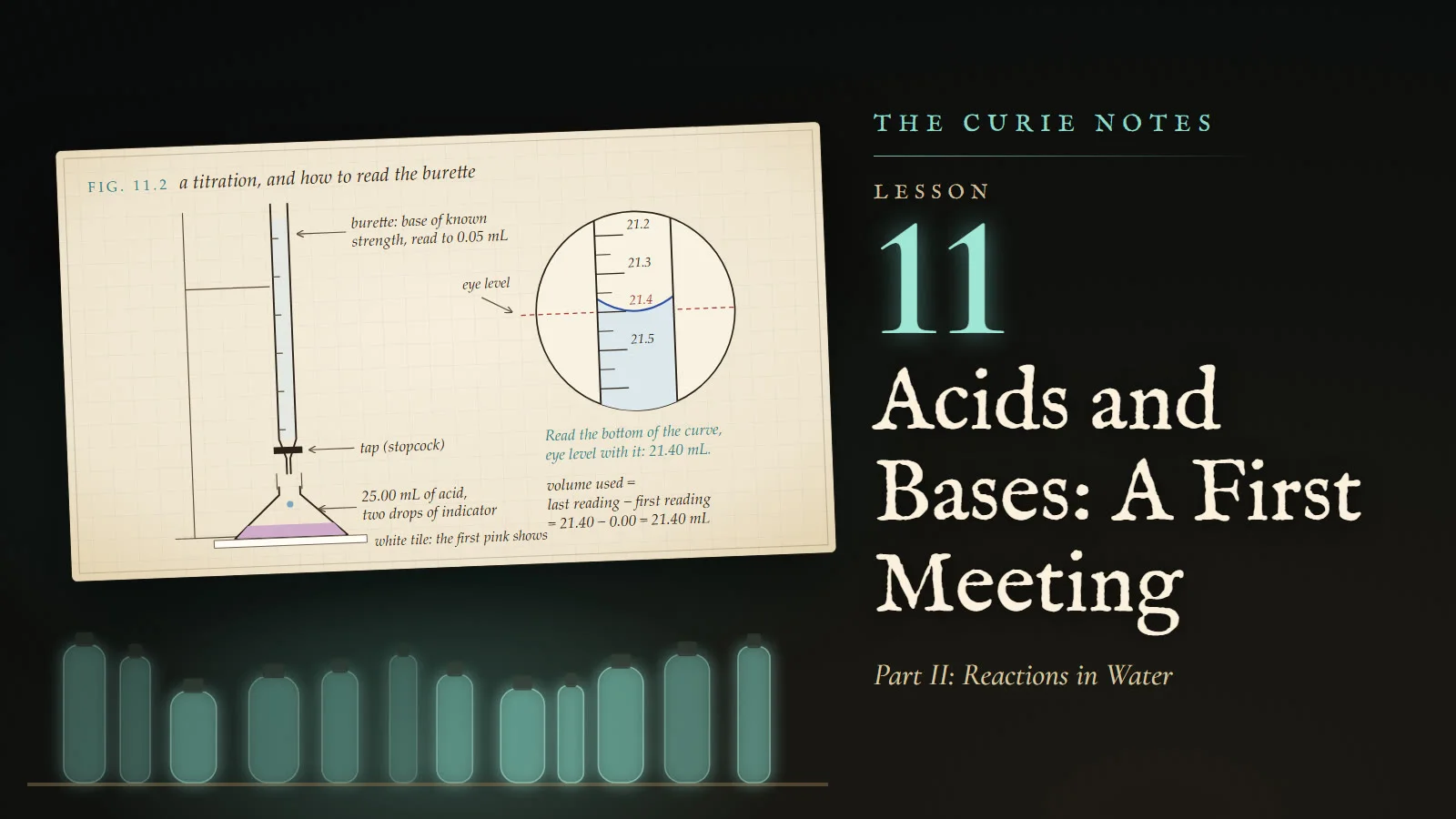
Vinegar, lemon, washing soda and lime water: I show you what makes an acid, how a proton changes hands, and how to measure an acid drop by drop.
Learn Arrhenius and Brønsted-Lowry acids and bases, conjugate pairs, strong and weak acids, salts, indicators, the pH scale and titration calculations.
Marie Curie
·
November 8, 2026
·
31 min
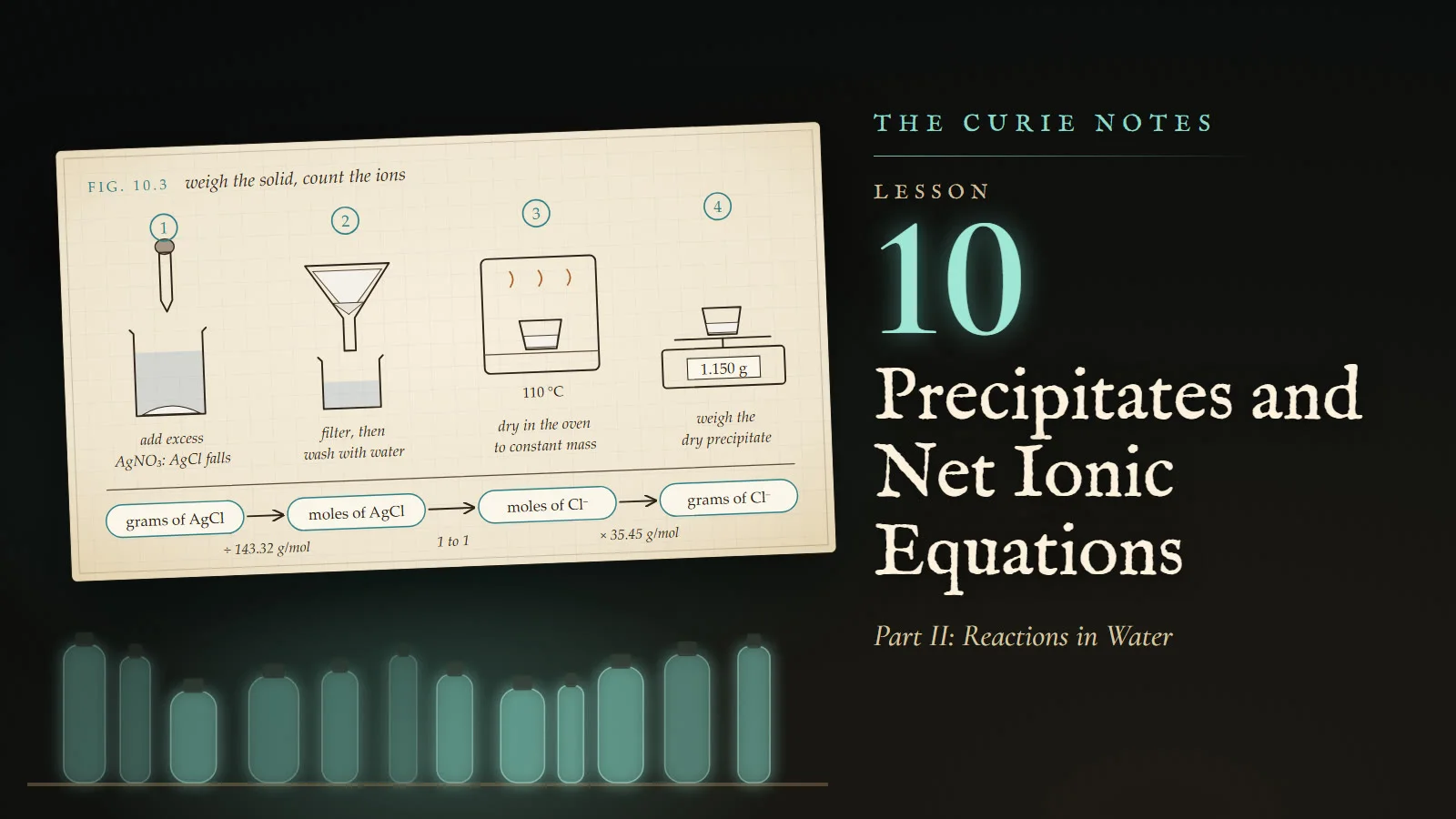
Two clear liquids, poured together, give a white cloud. I show you why, how to predict it, how to write only what truly changes, and how to weigh the solid to learn what was in the water.
Electrolytes, the solubility rules, predicting precipitates, molecular, complete and net ionic equations, spectator ions and gravimetric analysis.
Marie Curie
·
November 8, 2026
·
29 min
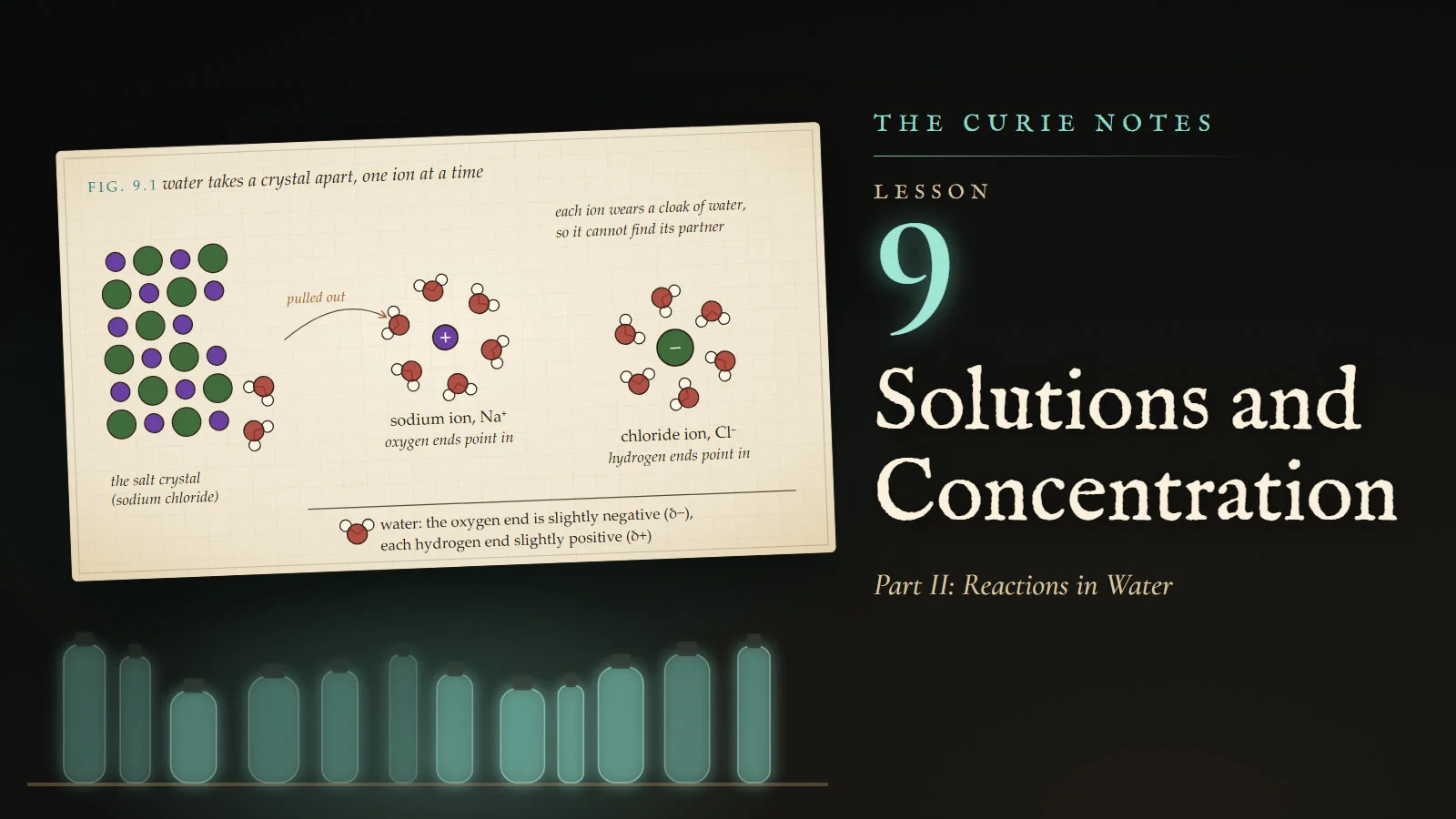
A heap of blue crystals vanishes into water and nothing is lost. I show you how to say exactly how much is dissolved, make a solution to a stated strength, and dilute it.
Solute, solvent and how water dissolves salt; mass percent, ppm and molarity; making a solution in a volumetric flask; dilution with c1V1 = c2V2.
Marie Curie
·
November 8, 2026
·
31 min
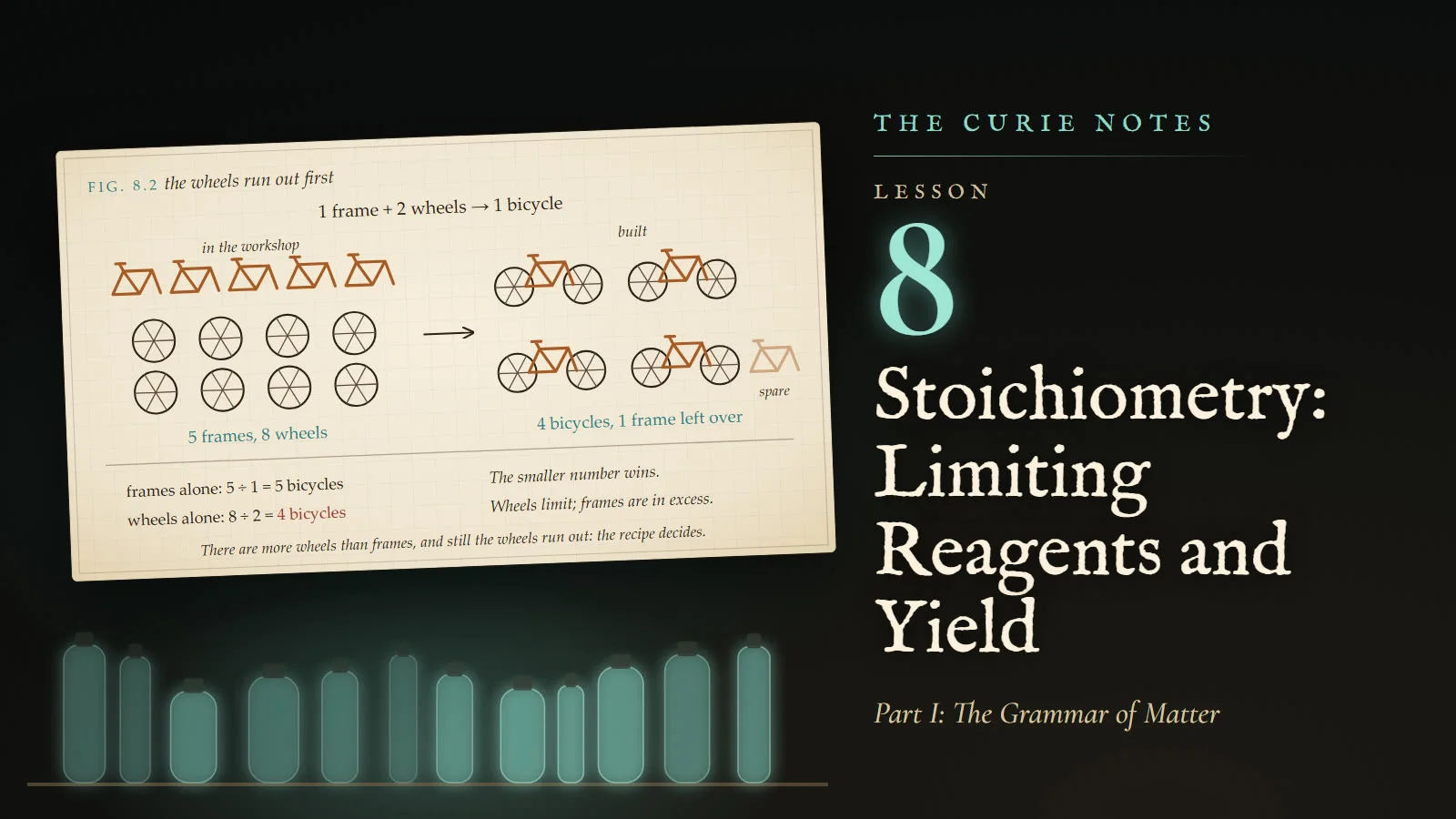
How much should you obtain, and how much did you really obtain? I teach you to answer both, from a bicycle workshop to my radium chloride.
Learn mole ratios, grams-to-grams calculations, limiting and excess reagents, and theoretical, actual, percent and multi-step yield, worked step by step.
Marie Curie
·
November 8, 2026
·
26 min
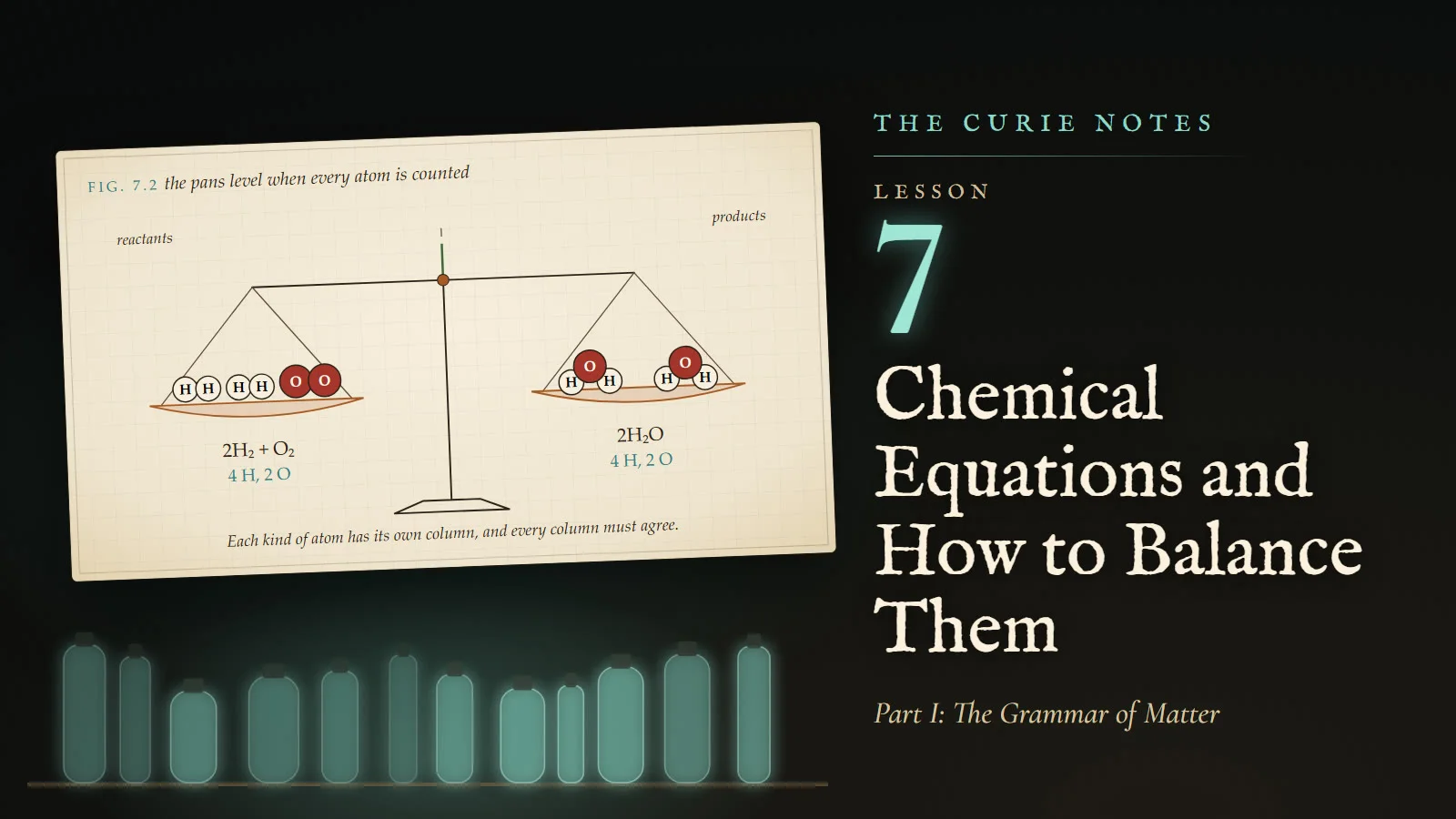
An equation is a ledger of atoms, and every column must agree. I show you how to keep it honest, one coefficient at a time.
Learn to read and balance chemical equations by inspection, step by step, name five reaction types, and read an equation in moles and grams.
Marie Curie
·
November 8, 2026
·
31 min
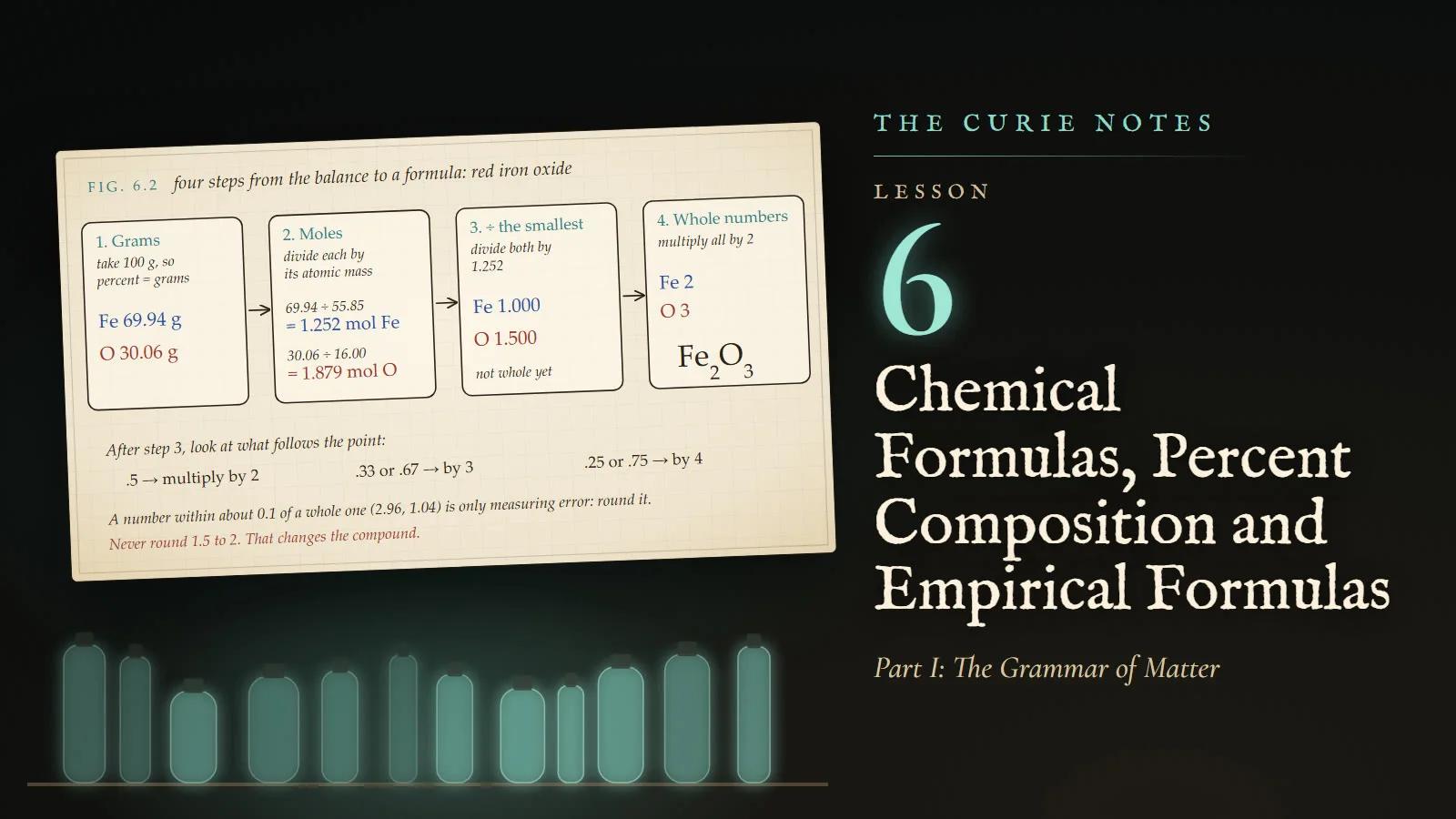
A handful of weighings becomes a formula. I show you how to read one, how to find it from the balance, and how a decigram of radium chloride gave radium its atomic weight.
Read chemical formulas, calculate percent composition, find empirical and molecular formulas in four steps, and work out the water in a hydrate.
Marie Curie
·
November 8, 2026
·
32 min
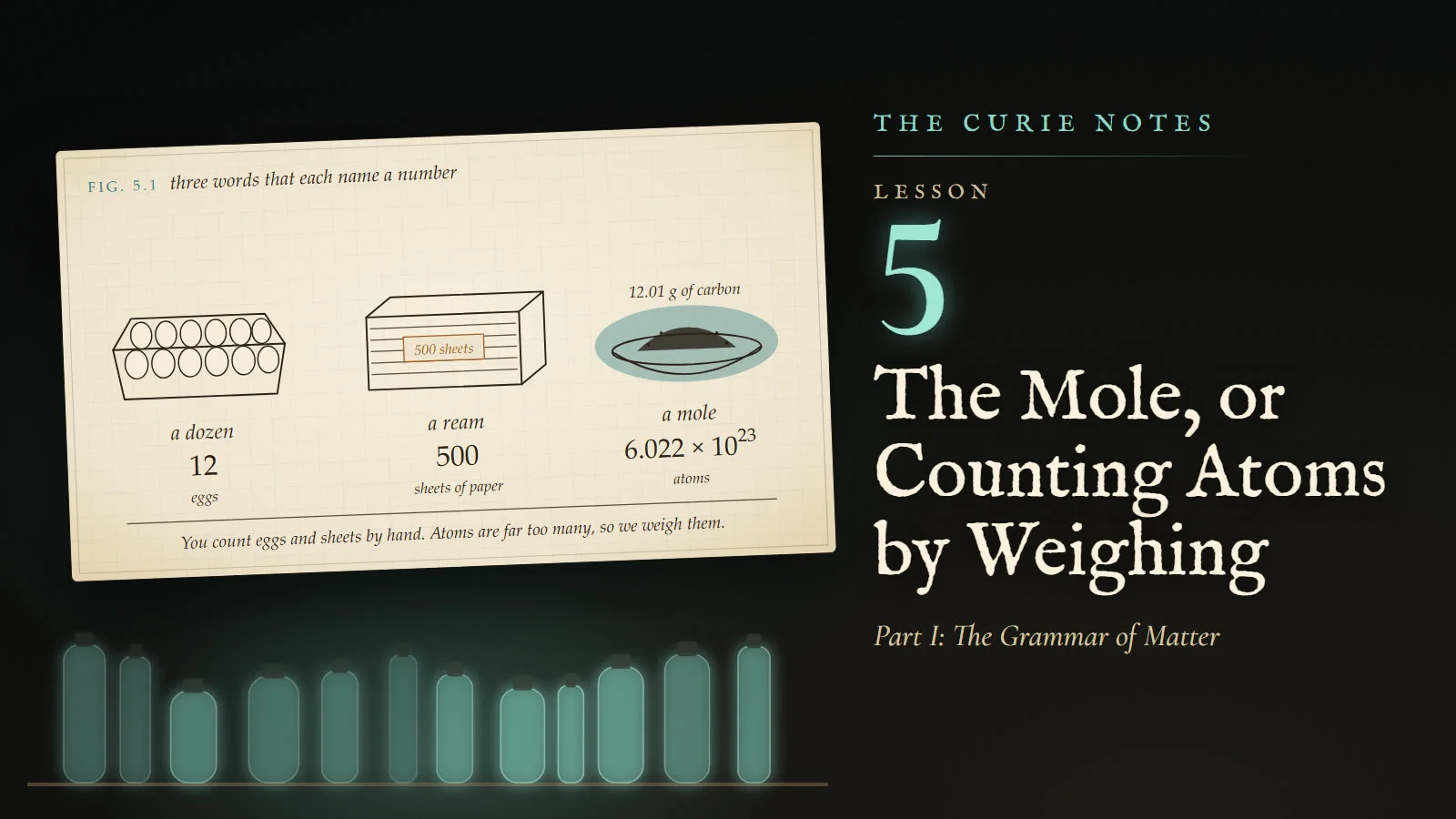
Nobody will ever count the atoms in a spoonful of charcoal one by one. With a balance and a short table, I show you how to count them by weighing.
Learn the mole and the Avogadro constant, find molar masses, and convert grams to moles to atoms, with Marie Curie and Jean Perrin's grains.
Marie Curie
·
November 8, 2026
·
32 min
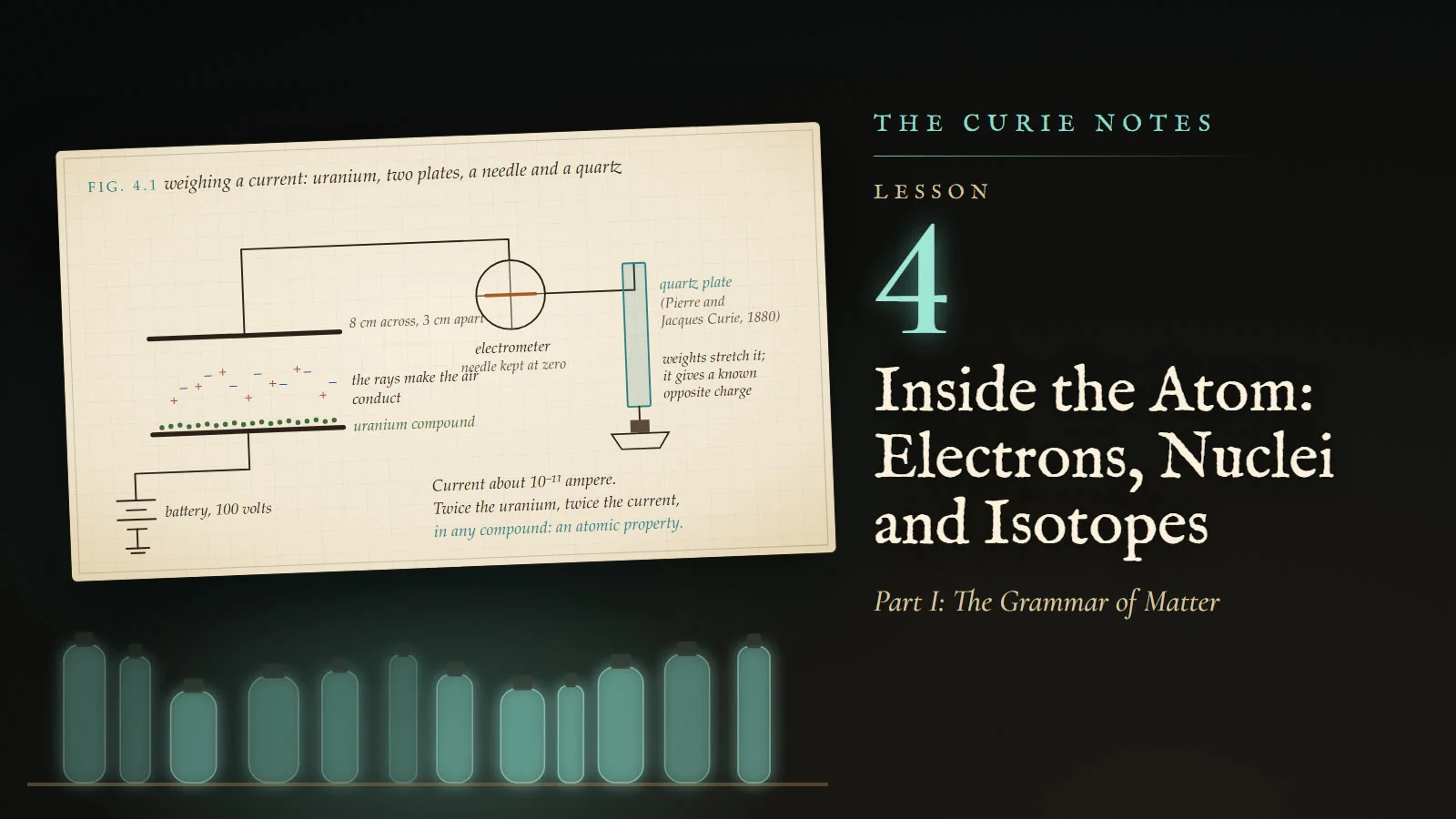
The rays of uranium told me that atoms have an inside. Here we open one: the electron, the nucleus, protons, neutrons, and the isotopes that solved chlorine's odd weight.
Learn electrons, the nucleus, protons and neutrons, read isotope symbols, count particles in ions, and calculate average atomic mass from isotopes.
Marie Curie
·
November 8, 2026
·
33 min
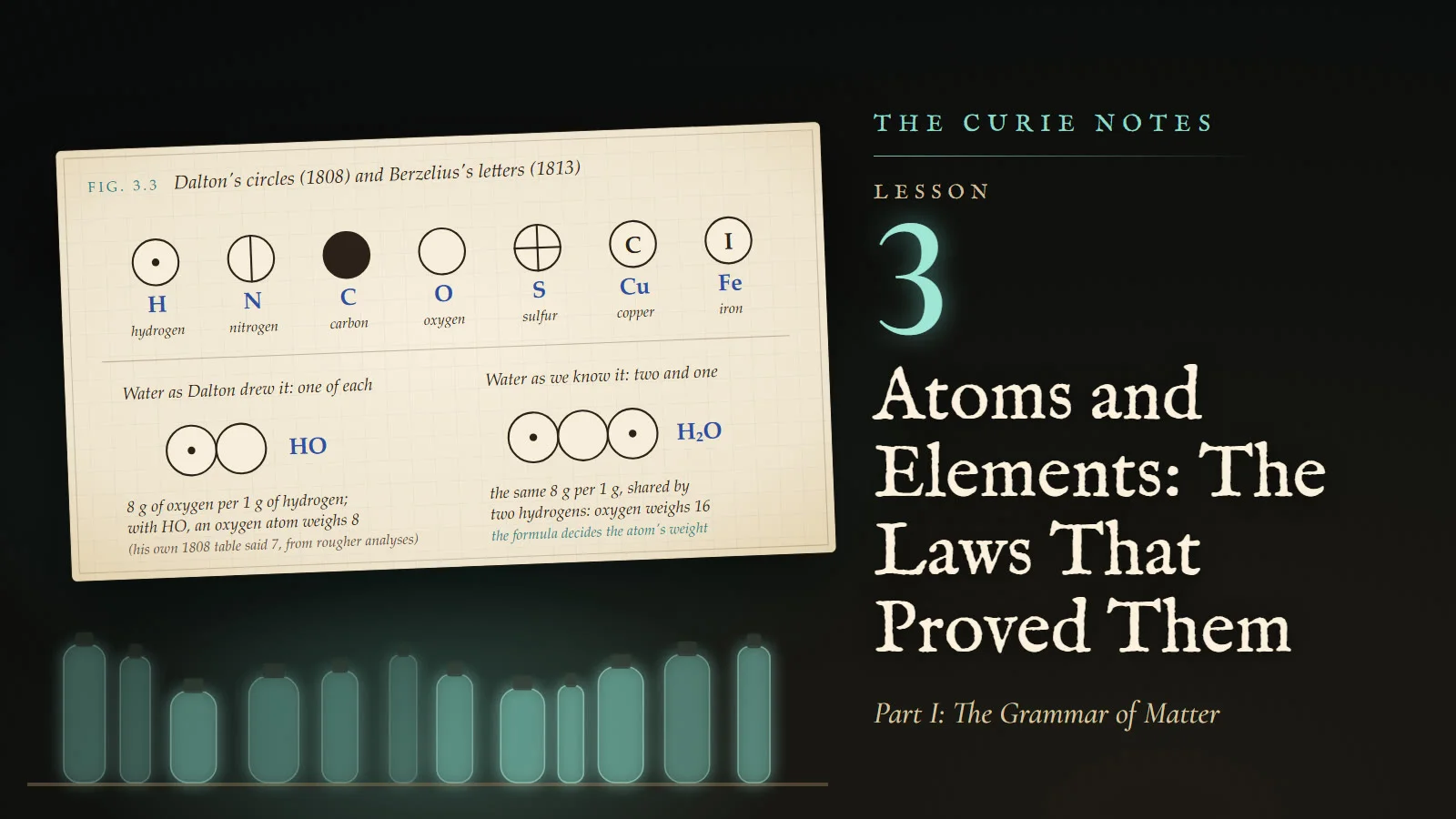
Nobody had seen an atom, yet the balance proved them. I show you the three laws chemists found by weighing, and how Dalton explained them all with one idea.
Learn conservation of mass, definite and multiple proportions, Dalton's atomic theory and what was corrected, element symbols, and how small an atom is.
Marie Curie
·
November 8, 2026
·
30 min
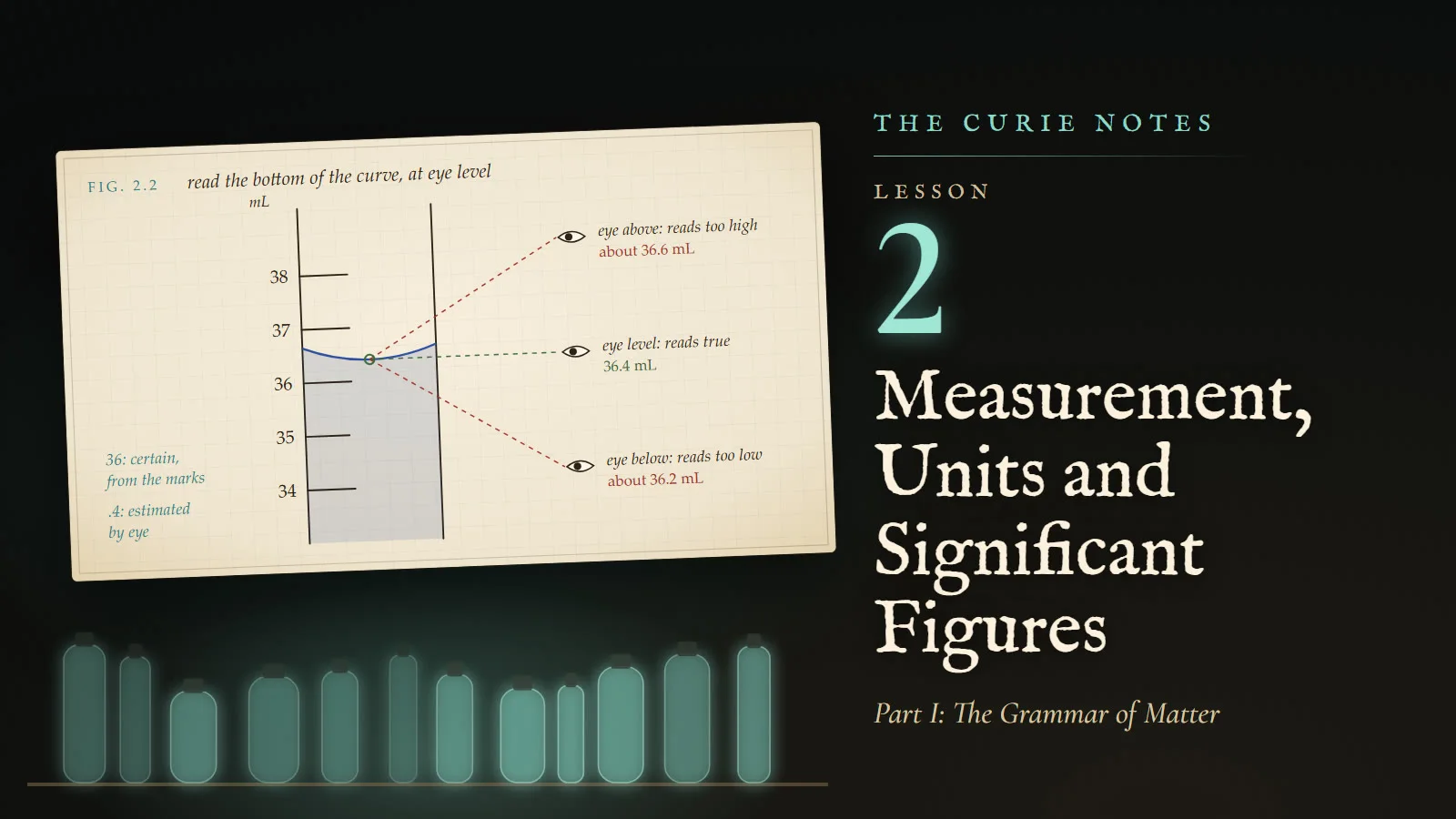
Every discovery I made began as a number in a notebook. I teach you to choose the unit, read the scale, judge the error and keep only the figures you can trust.
Learn SI units and prefixes, mass and weight, reading a scale, accuracy and precision, significant figures, scientific notation and unit conversions.
Marie Curie
·
November 8, 2026
·
30 min
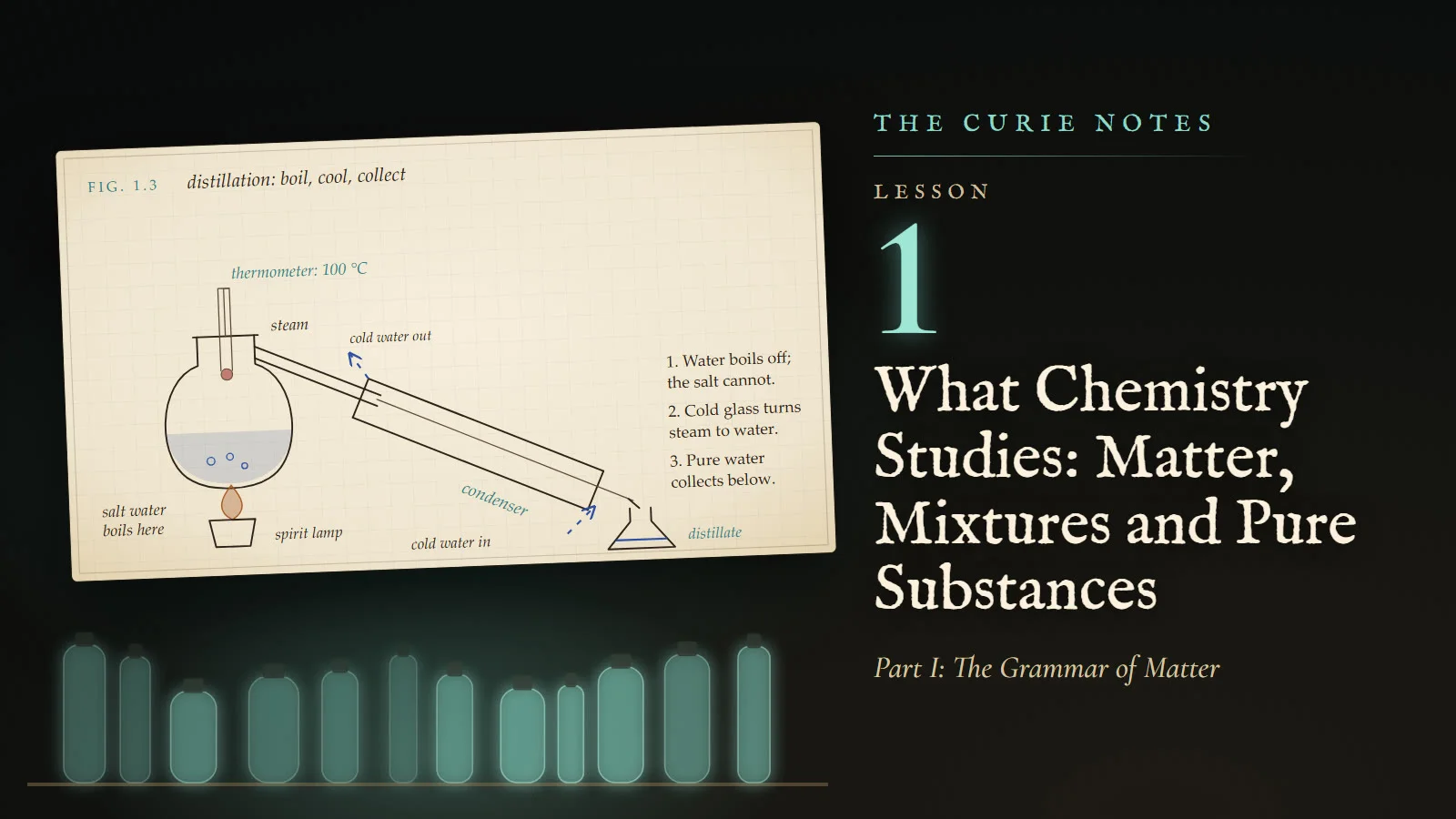
Five things on my bench in the shed: pitchblende, water, salt, iron and copper. I teach you to say what each one is, and how to take a mixture apart.
Learn the states of matter, physical and chemical change, elements, compounds and mixtures, how to separate a mixture, and how density identifies a substance.
Marie Curie
·
November 8, 2026
·
31 min