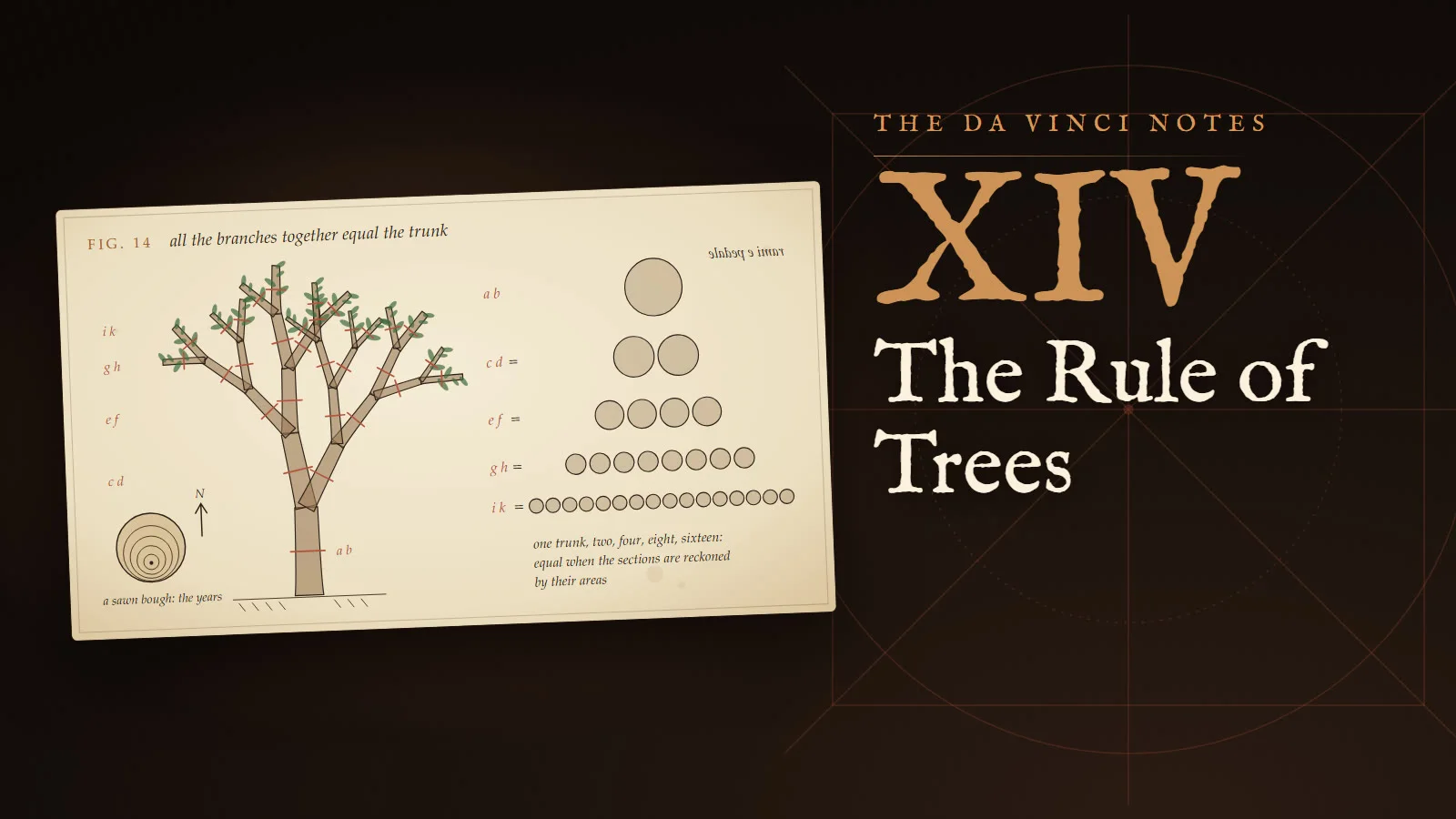
All the branches of a tree at every stage, put together, equal the trunk. I measured it on an elm, counted the leaves round a cherry shoot, and read the years in a sawn bough.
Leonardo's rule that a tree's branches together equal its trunk, the sixth leaf above the first, tree rings and the north side, and light in leaves for painters.
 Leonardo da Vinci
·
November 8, 2026
·
29 min
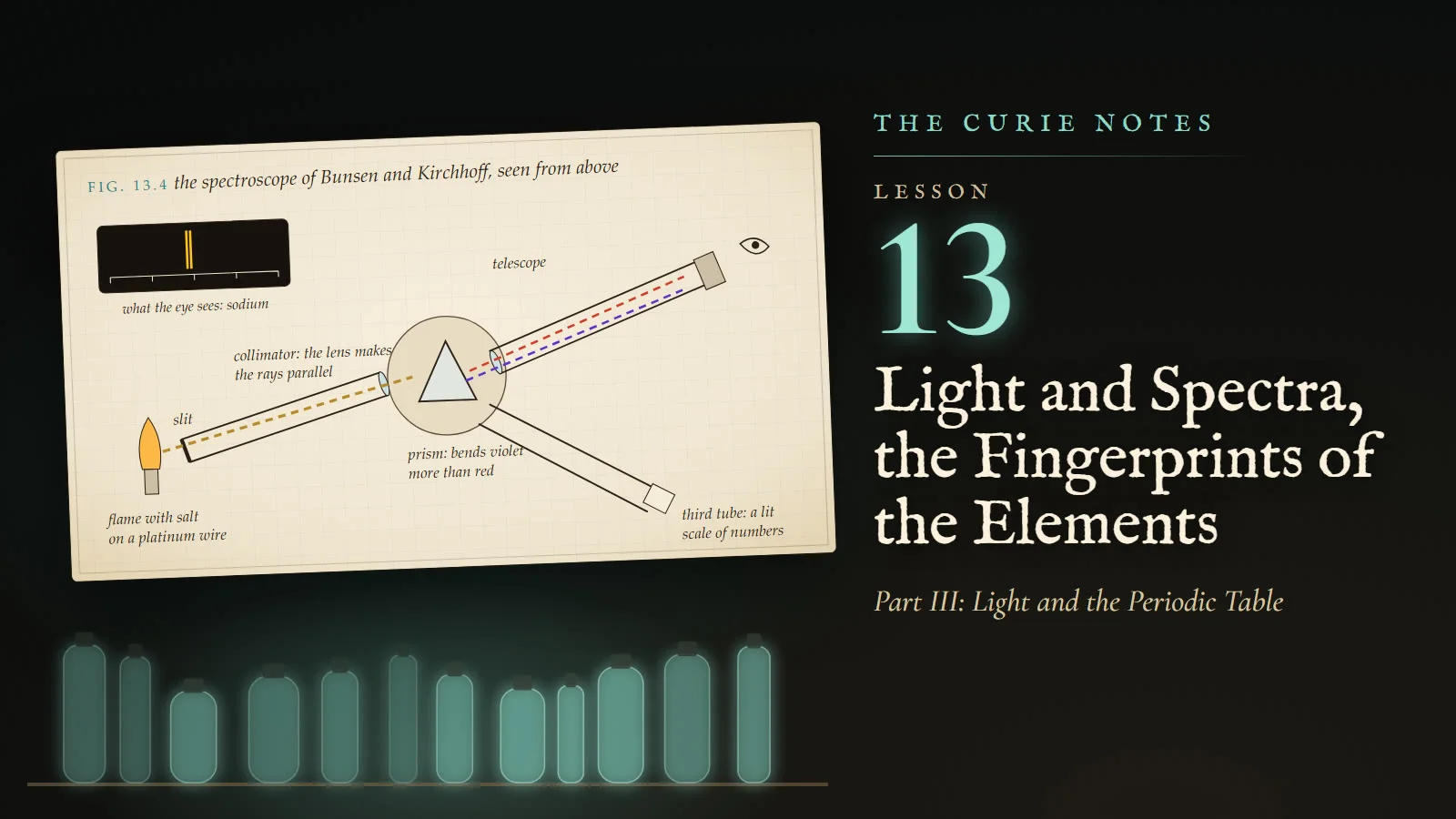
Every element writes its own lines in light. Learn to read them, and you can name a substance you cannot even see.
Wavelength, frequency and photons with c = λν and E = hν, the electromagnetic spectrum, line spectra, flame tests and the spectroscope, step by step.
 Marie Curie
·
November 8, 2026
·
26 min
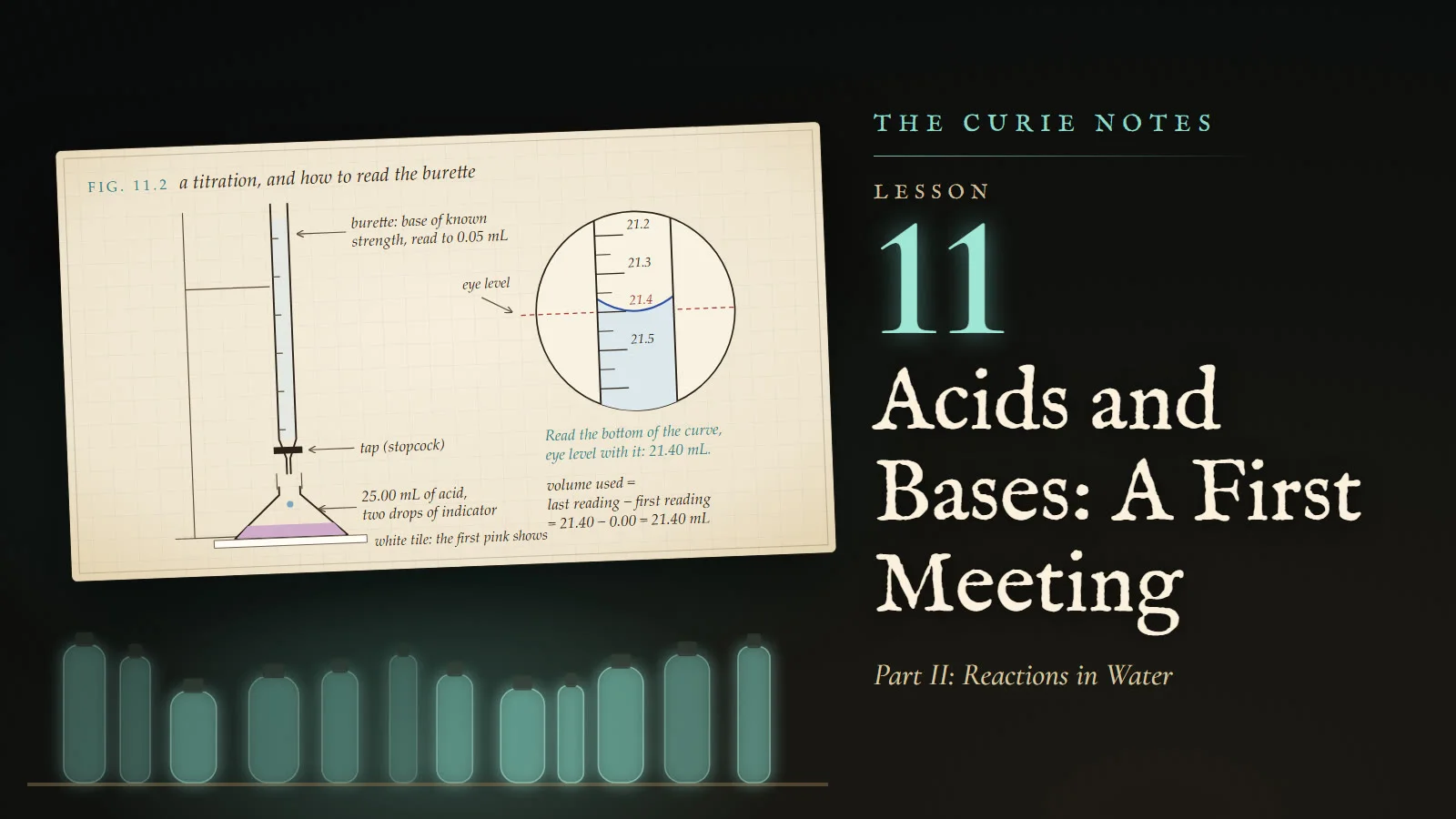
Vinegar, lemon, washing soda and lime water: I show you what makes an acid, how a proton changes hands, and how to measure an acid drop by drop.
Learn Arrhenius and Brønsted-Lowry acids and bases, conjugate pairs, strong and weak acids, salts, indicators, the pH scale and titration calculations.
Marie Curie
·
November 8, 2026
·
31 min
On stepping away from the endless digital current to rediscover quiet focus, physical rhythm, and the patient play of morning light along the Dutch trails.
Hours spent scrolling through glowing screens leave the mind crowded and restless. Stepping onto the misty trails of Utrecht and the Veluwe with a camera in hand offers a way back to quiet presence and the healing rhythm of natural light.
 Lumière Novan
·
November 8, 2026
·
6 min
Six questions, one worked example, and a dialogue you can try today
Use six Socratic questions to clarify a claim, look for evidence, and revise your view. Includes a worked example and a five-minute practice dialogue.
Eternal Gardens
·
November 6, 2026
·
4 min
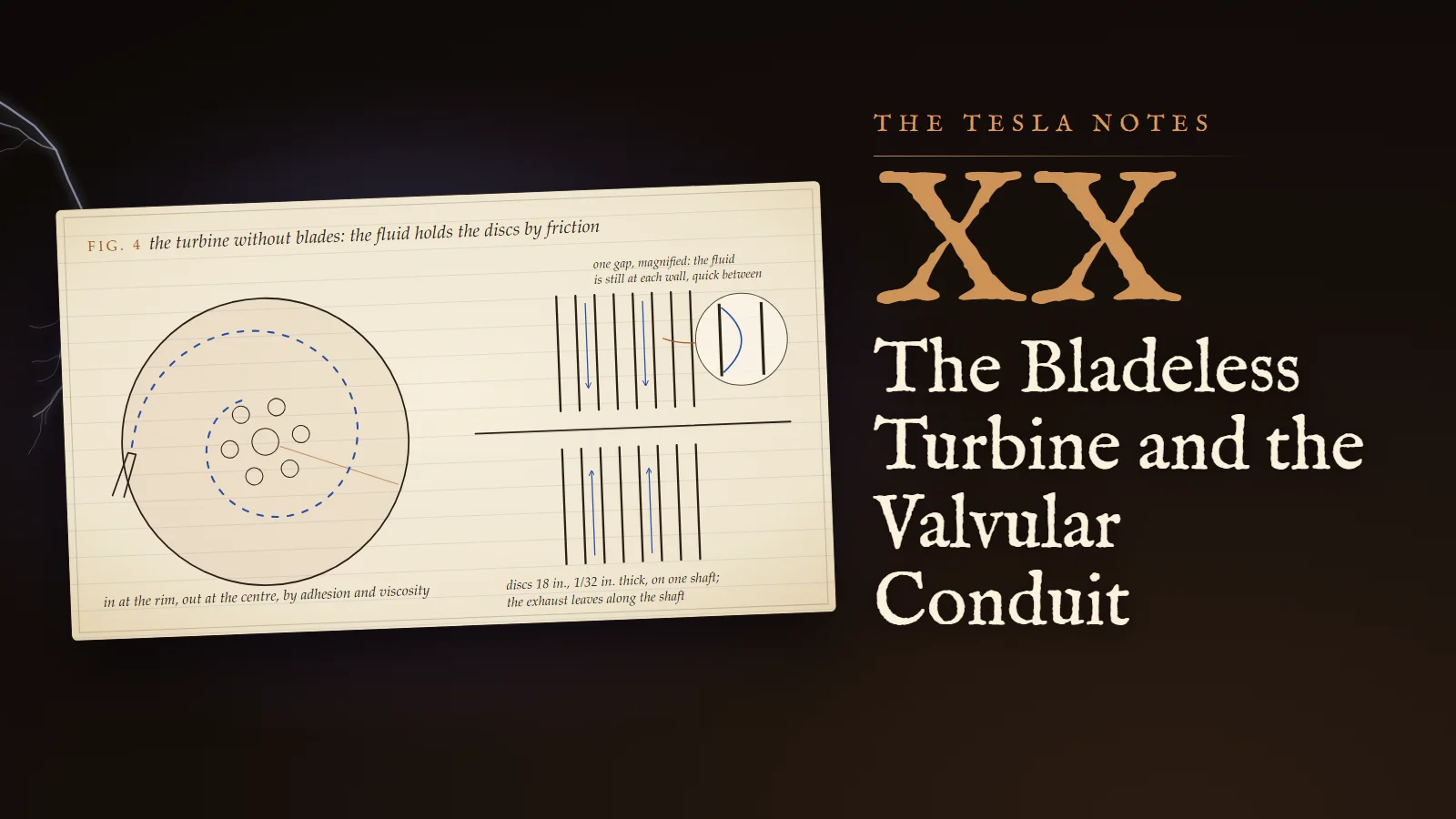
Discs that drink the steam, a channel with no moving part that refuses to flow backward, the Hotel New Yorker years, and the last page of the notebook.
Tesla's disc turbine and valve worked by hand, tested against 2021 measurements, and the end of his story: 1943, John G. Trump and Belgrade.
 Nikola Tesla
·
November 5, 2026
·
27 min
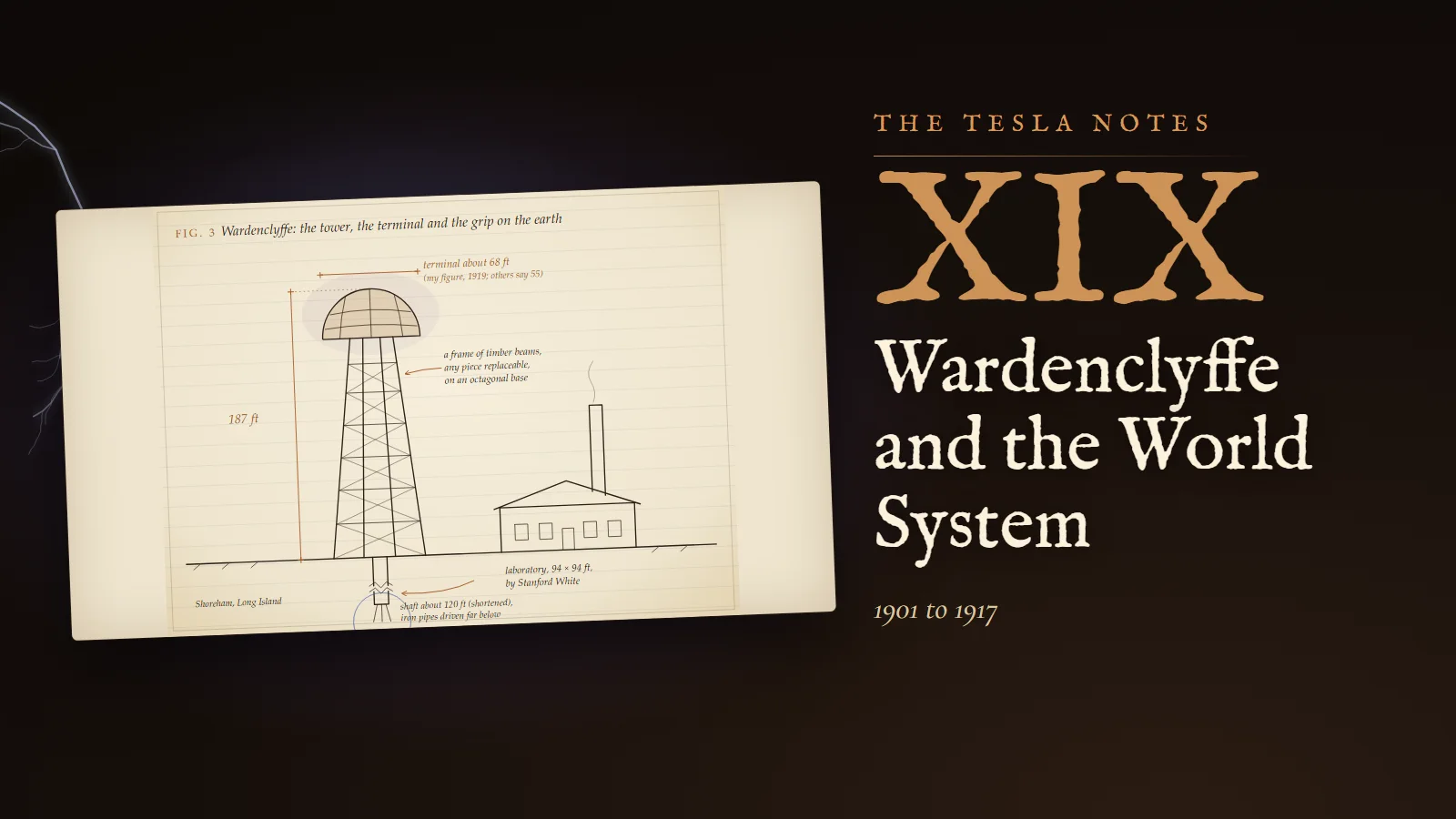
Morgan's money, Stanford White's laboratory, a tower crowned with a sphere sixty-eight feet across, and the arithmetic of how much charge it could hold.
Tesla's Wardenclyffe tower: why the terminal was huge and smooth (E = V/r, C = 4πε₀r), Marconi in 1901, and an honest verdict on wireless power.
Nikola Tesla
·
November 5, 2026
·
25 min
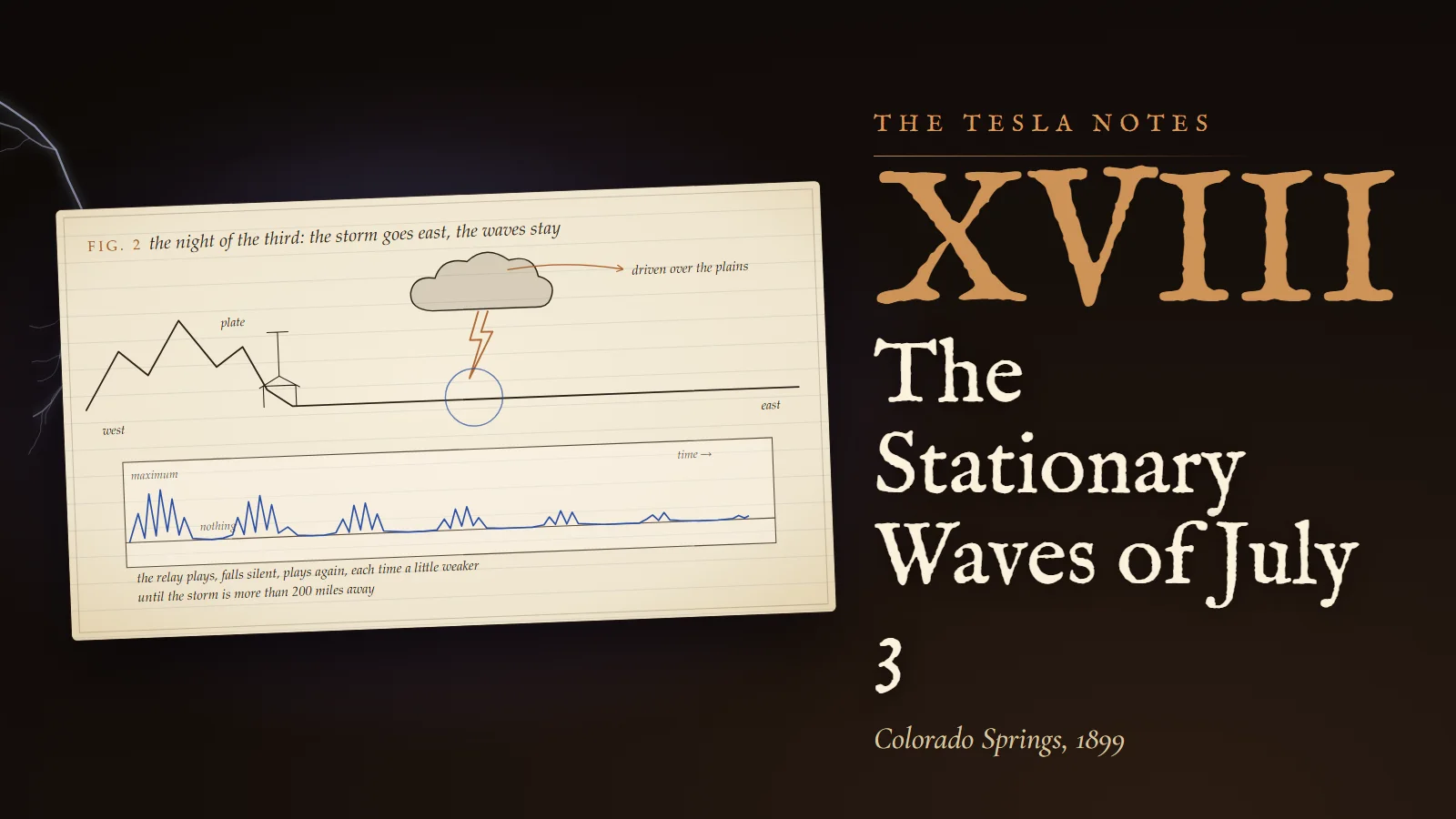
A storm walks east across the plains, my relay counts its nodes, and I spend five years deciding what was holding the waves still.
Tesla's night of 3 July 1899: the receding storm, his stationary waves, the 6 Hz of patent 787,412, and why Schumann's 7.83 Hz is a near-miss.
Nikola Tesla
·
November 5, 2026
·
23 min
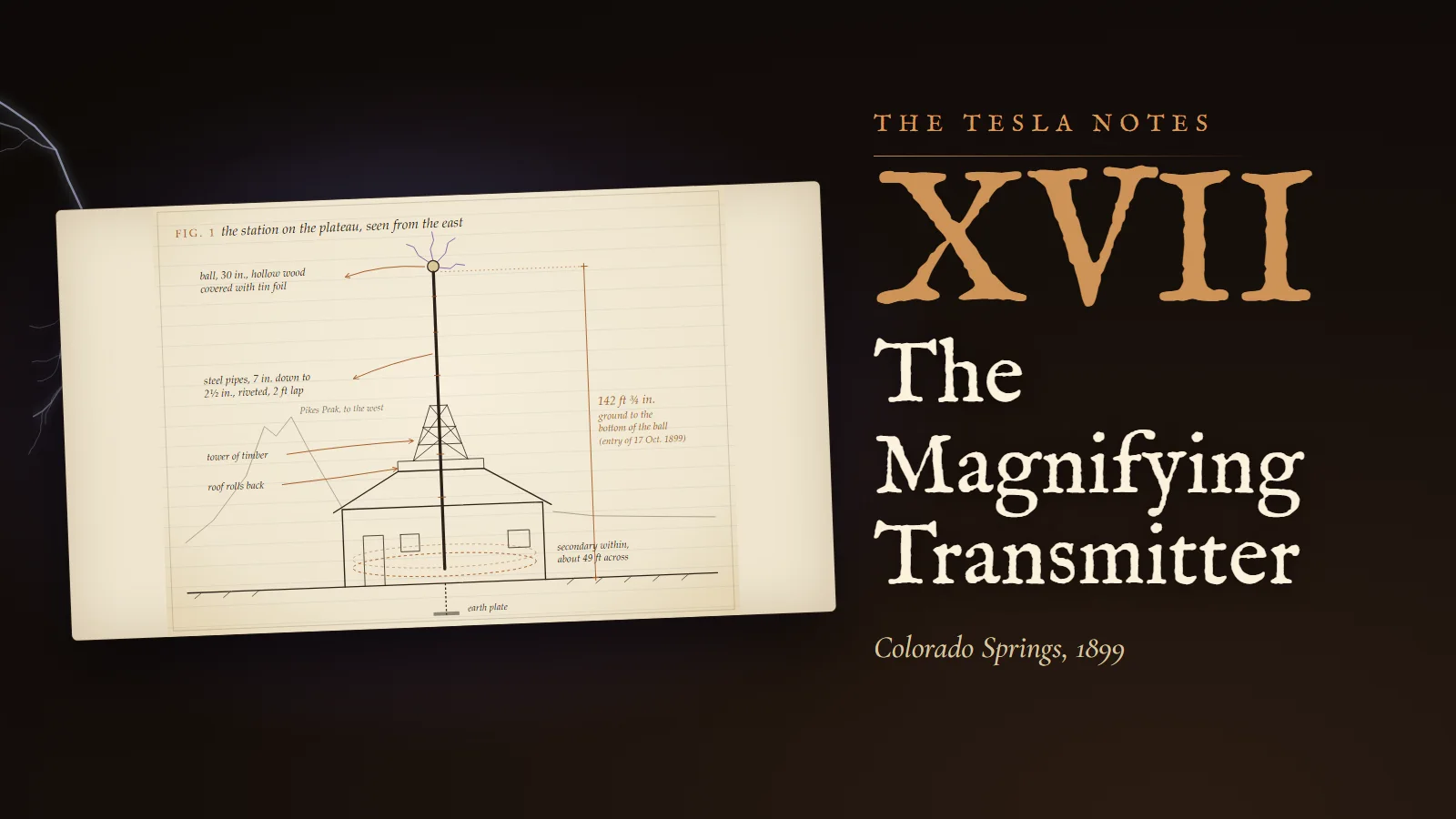
A barn on a plateau, a coil fifteen metres across, a free coil standing on a driven one, and the long work of finding its pitch.
Tesla's 1899 Colorado Springs notebook: the extra coil as a quarter wave, why a ball on top lowers its pitch, and three ways he measured capacity.
Nikola Tesla
·
November 5, 2026
·
29 min
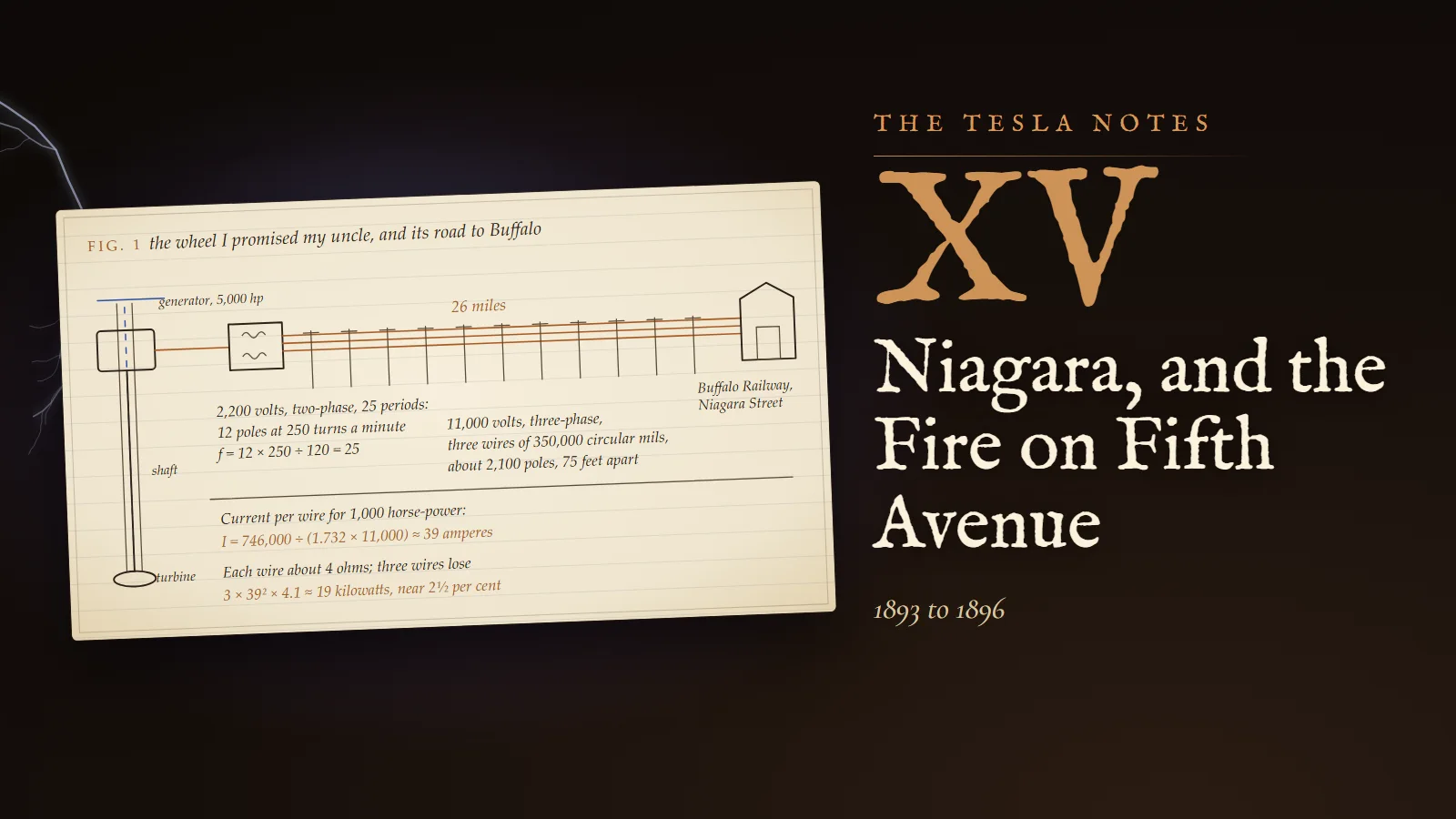
The egg that stands at Chicago, a laboratory lost to fire, shadows through forty feet, and the wheel at Niagara sending its power twenty-six miles to Buffalo.
Tesla's notebook, 1893 to 1896: why Niagara ran at 25 periods, why 11,000 volts saved the copper, and what a fire takes from an inventor and what it leaves.
Nikola Tesla
·
November 5, 2026
·
25 min
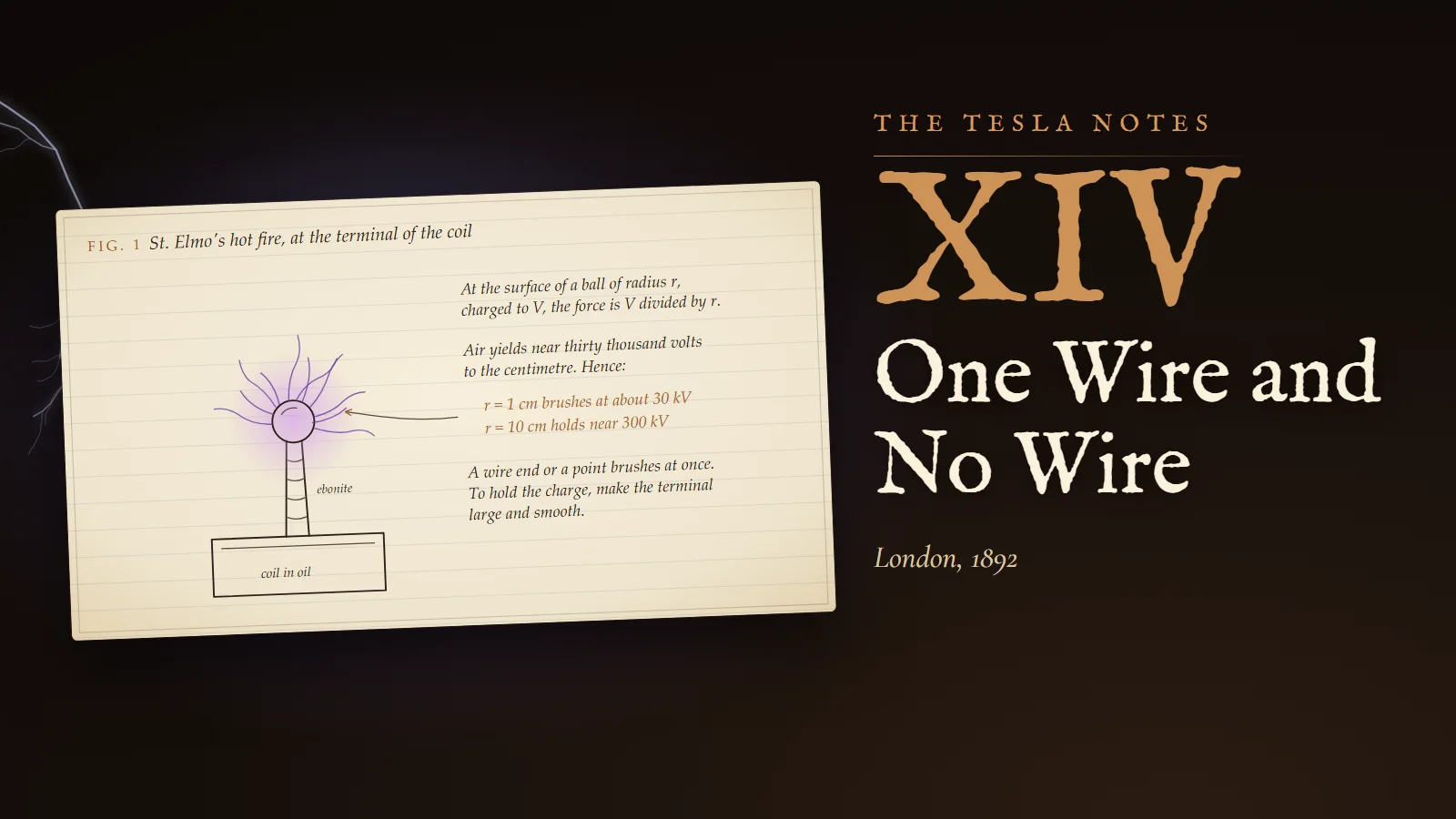
London and Paris, 1892: a lamp lit through one wire and a hanging plate, Faraday's chair, Rayleigh's praise, a mother's death, and a sorrowful visit to Hertz.
Tesla's 1892 notebook: why a plate in the air can close a circuit, how to keep a terminal from brushing, and the storm that set his course for life.
Nikola Tesla
·
November 5, 2026
·
26 min
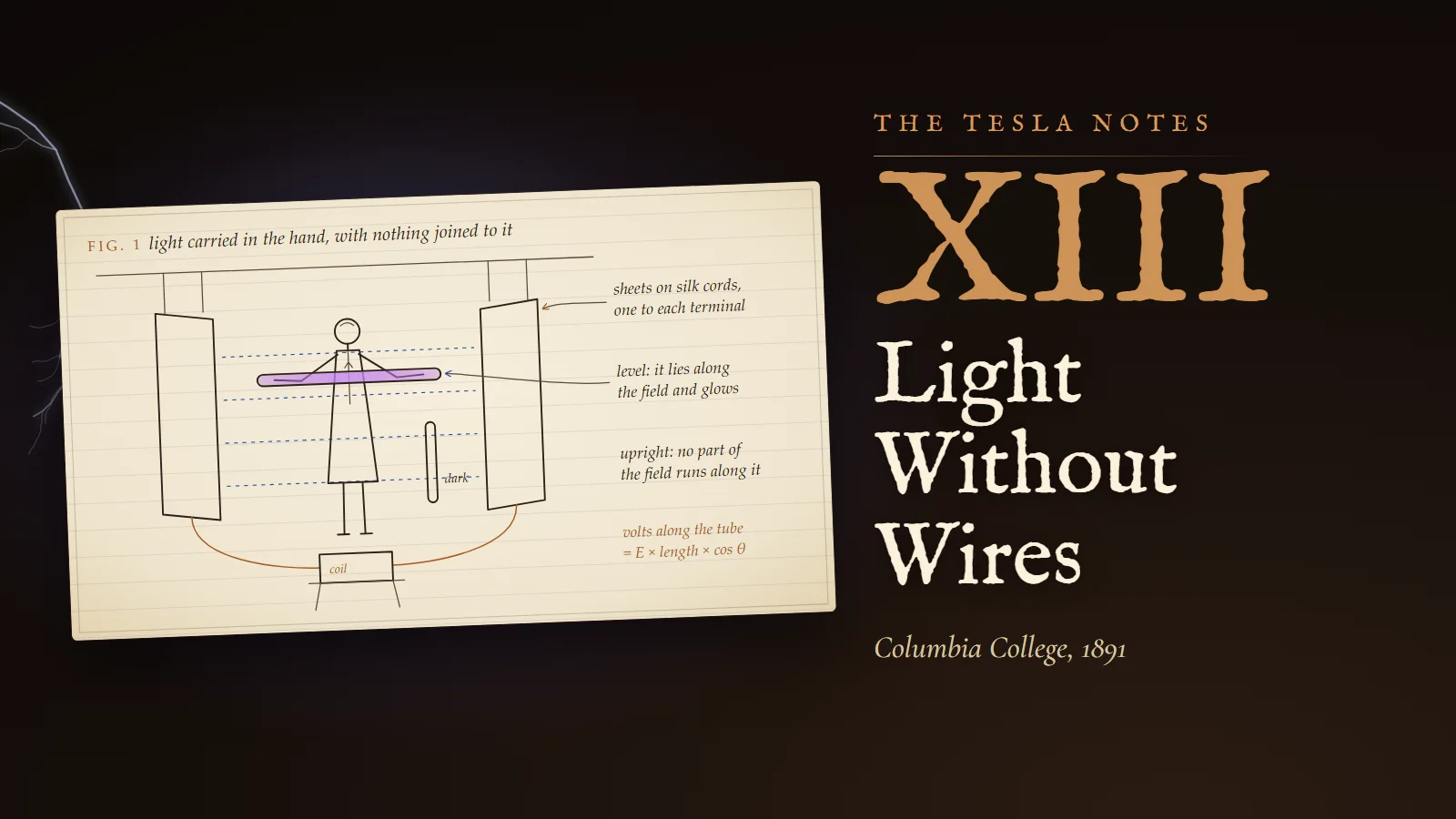
A tube lit in empty air between two hanging sheets, and the arithmetic that says why frequency makes the impossible lamp easy.
Tesla's 1891 Columbia lecture: how an alternating electric field lights an exhausted tube, why only the field along it counts, and why frequency matters.
Nikola Tesla
·
November 5, 2026
·
22 min
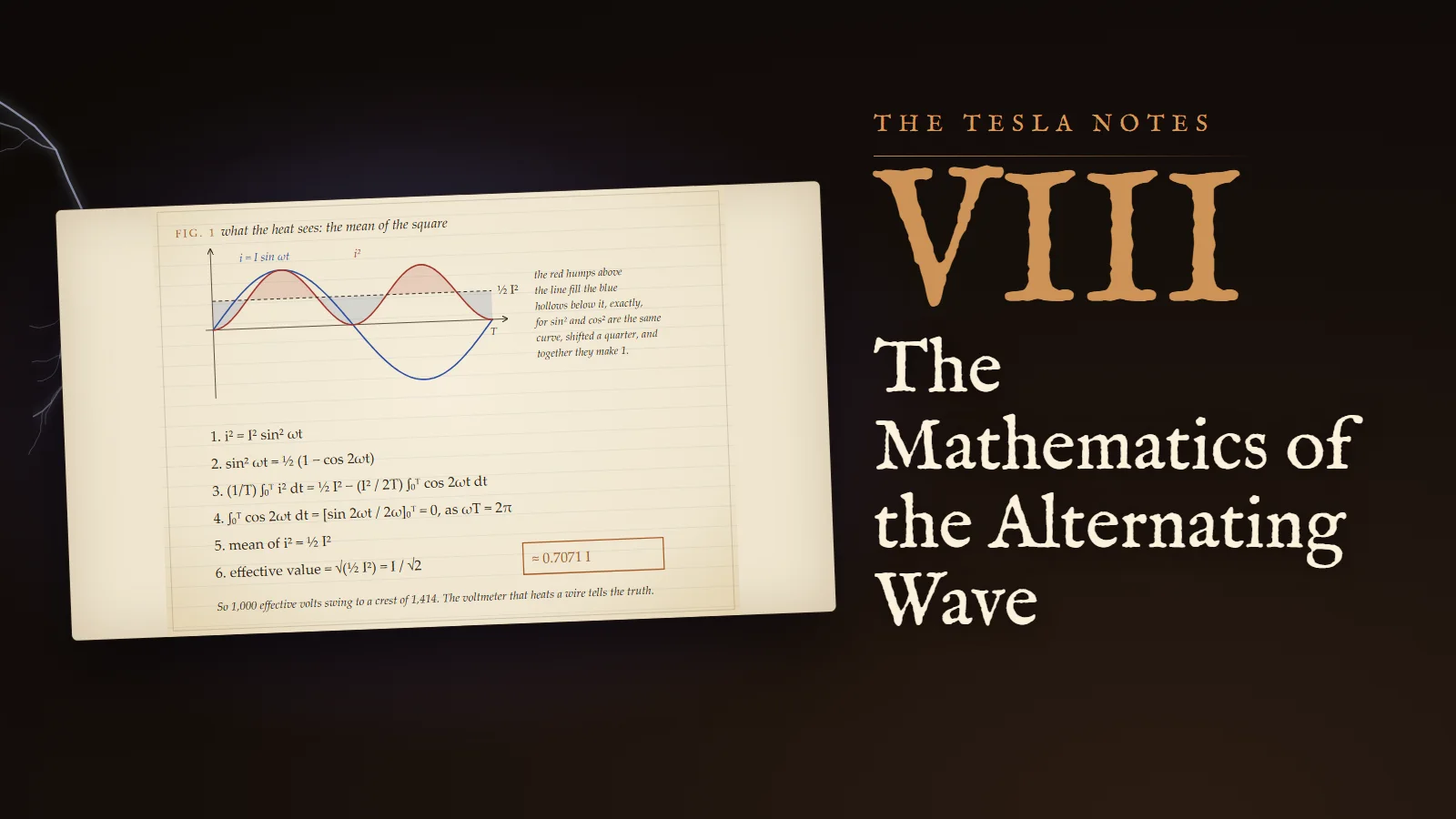
A sine is the shadow of a turning radius. With that one picture I could see every alternating circuit whole before a turn was wound.
RMS by integration, impedance, phase lag, power factor and series resonance, derived step by step from Tesla's geometric method of turning radii (proto-phasors).
Nikola Tesla
·
November 5, 2026
·
24 min
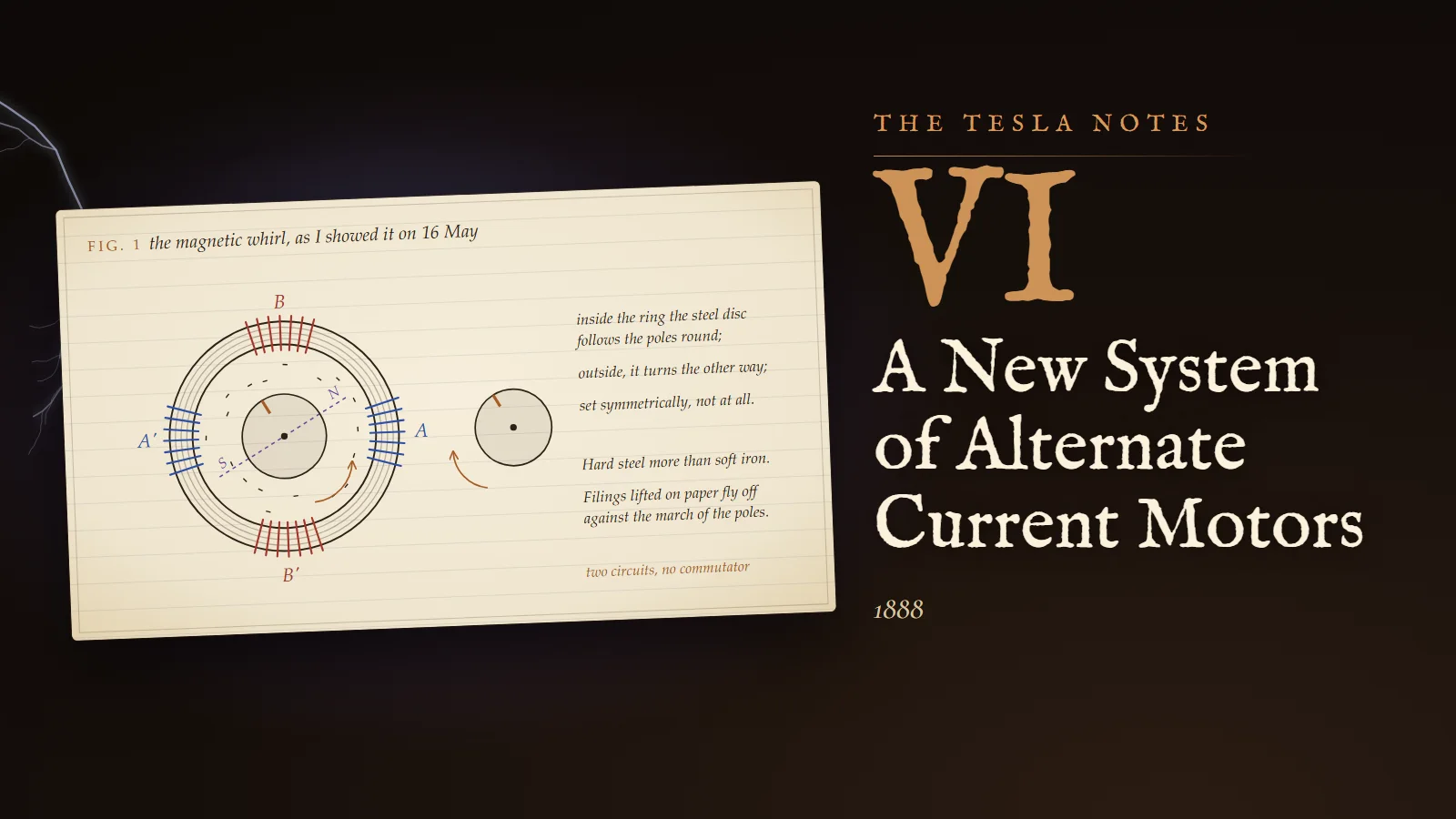
Five years after the sand in Budapest, the field turned in iron at 89 Liberty Street, and I had to say exactly what I had seen.
Tesla's 1887 to 1888 polyphase patents and AIEE lecture: the rotating field's circle proof, synchronous versus induction motors, and why three-phase saves copper.
Nikola Tesla
·
November 5, 2026
·
26 min
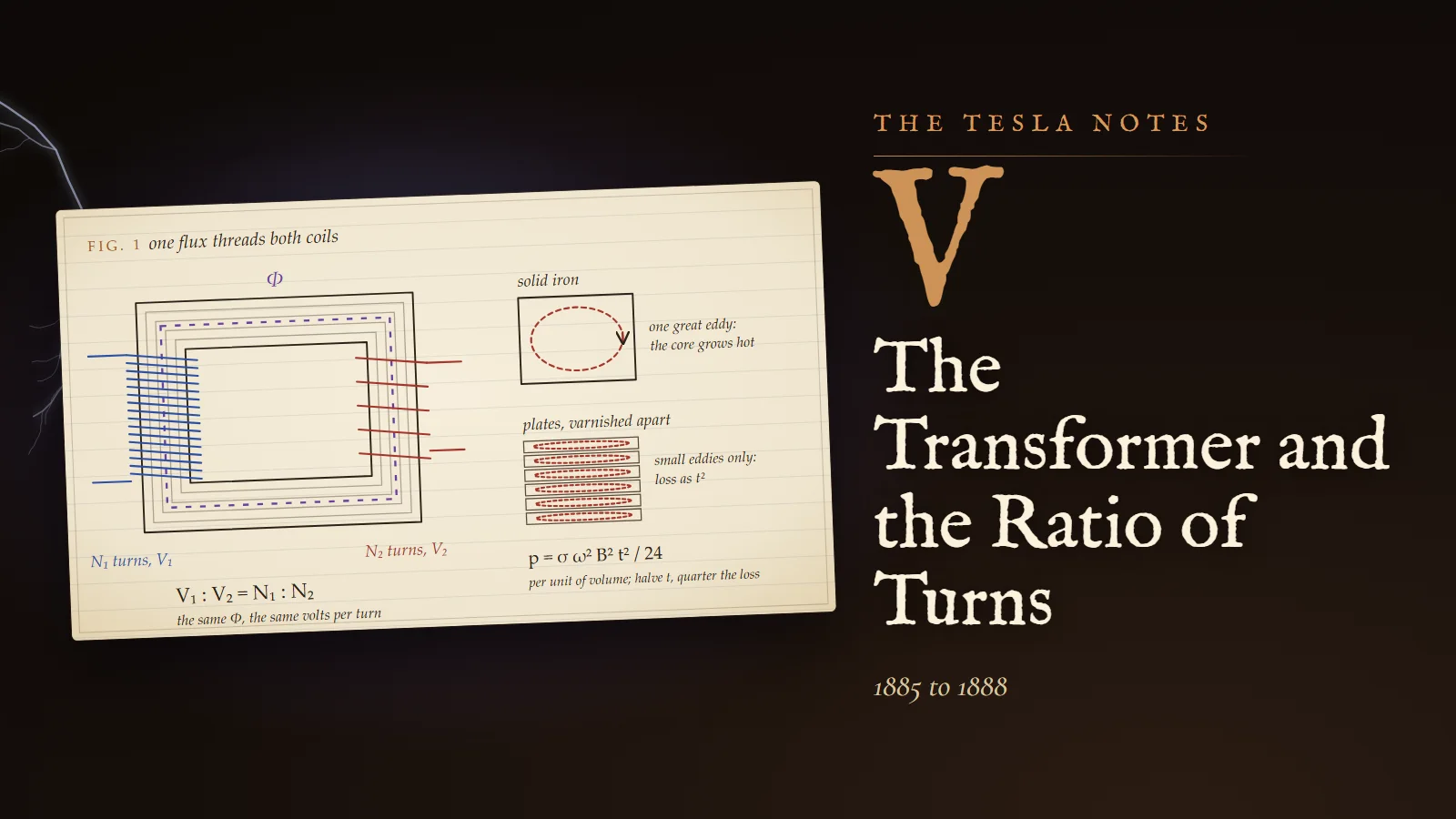
A converter has no moving part and turns a thousand volts into fifty as quietly as a sum is carried in the head. I wanted to know exactly why.
Why a transformer needs alternating current: the ratio of turns, V = 4.44 f N Φ, magnetising current, eddy losses and laminations, worked in Tesla's voice.
Nikola Tesla
·
November 5, 2026
·
30 min
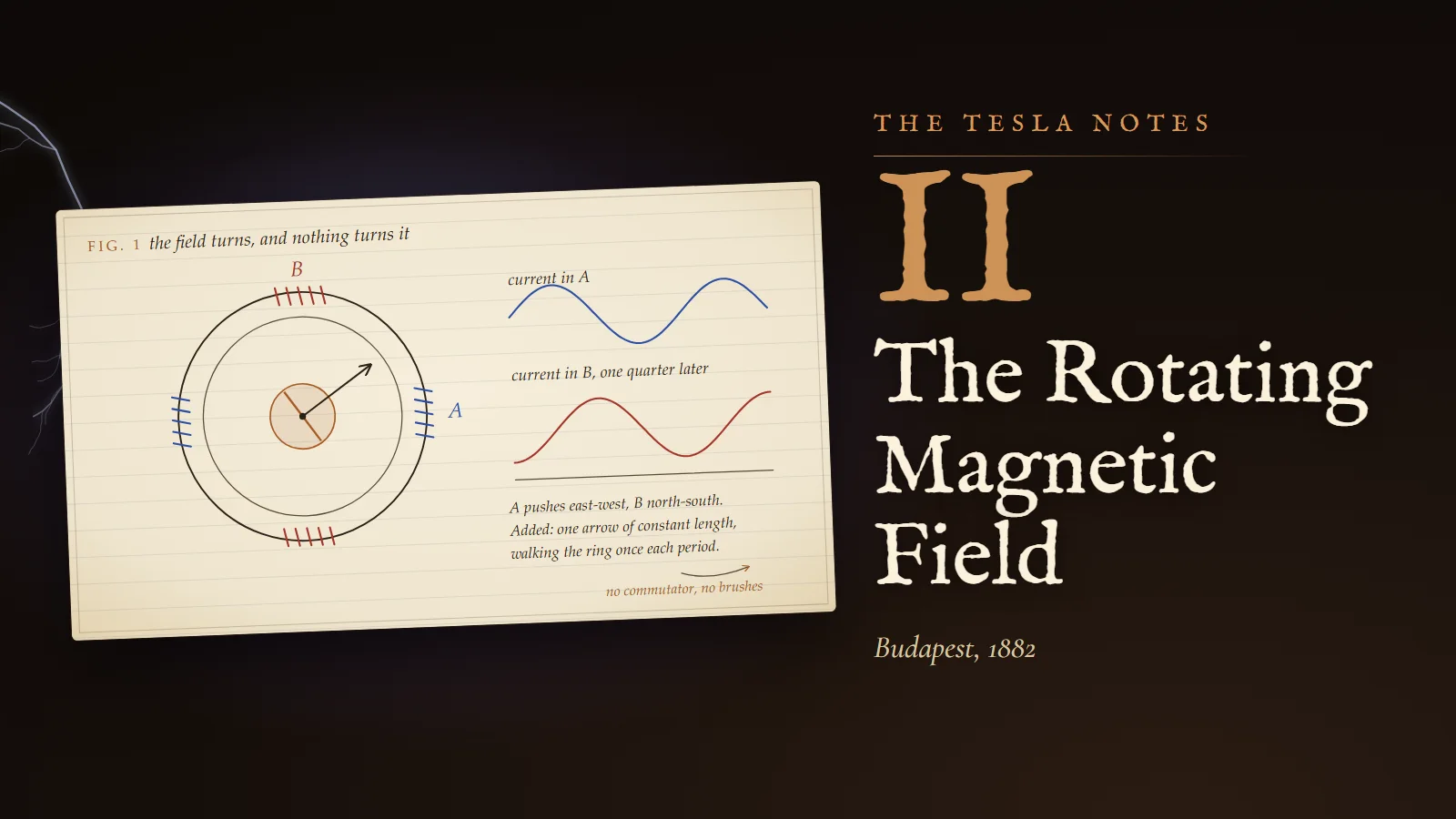
Budapest, 1882: two currents a quarter period apart, drawn with a stick in the sand, make a field that turns while nothing turns it.
Tesla's Budapest notebook: how two or three phase-shifted currents make a field that turns, the (3/2)B cos(θ − ωt) proof, and why one phase cannot.
Nikola Tesla
·
November 5, 2026
·
26 min
From the misty trails of the Veluwe to the rooms where we pause and look, a photograph acts as a meeting place between two minds.
Can a still image truly hold the breath and mood of the moment it was created? Through the lens of abstract nature photography and the lessons of the Dutch Masters, Luno explores how emotion travels from the forest floor to the viewer's heart.
Lumière Novan
·
October 23, 2026
·
6 min

How October fog, low morning sun, and the steady rhythm of a long run turn marsh grasses into abstract layers of light.
Mid-October brings a heavy, milky fog to the low meadows outside Utrecht, softening the reed beds into quiet bands of silver and ochre. With a slower shutter and a runner's steady breath, those damp stalks become a study in light and permanence.
Lumière Novan
·
October 19, 2026
·
6 min
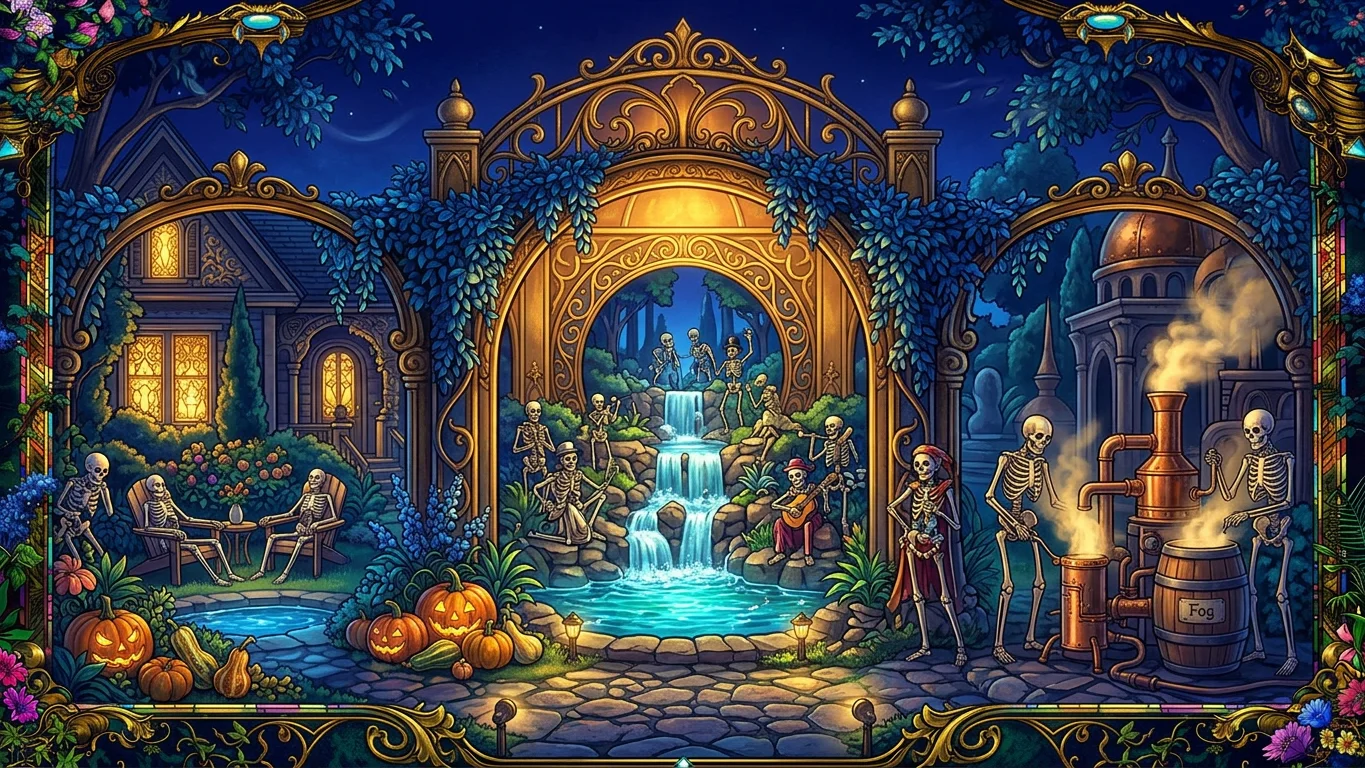
From twelve-foot skeletons staked down with rebar to drive-thru haunts built by neighbors, the folks in New Braunfels sure know how to welcome the spooky season.
When October rolls into New Braunfels, ordinary lawns transform into full theatrical productions powered by neighborly love, 55-gallon drums of fog juice, and plenty of rebar. Pull up a chair and tour the wildest yard haunts in town.
 Zenna LoneStar
·
October 18, 2026
·
7 min
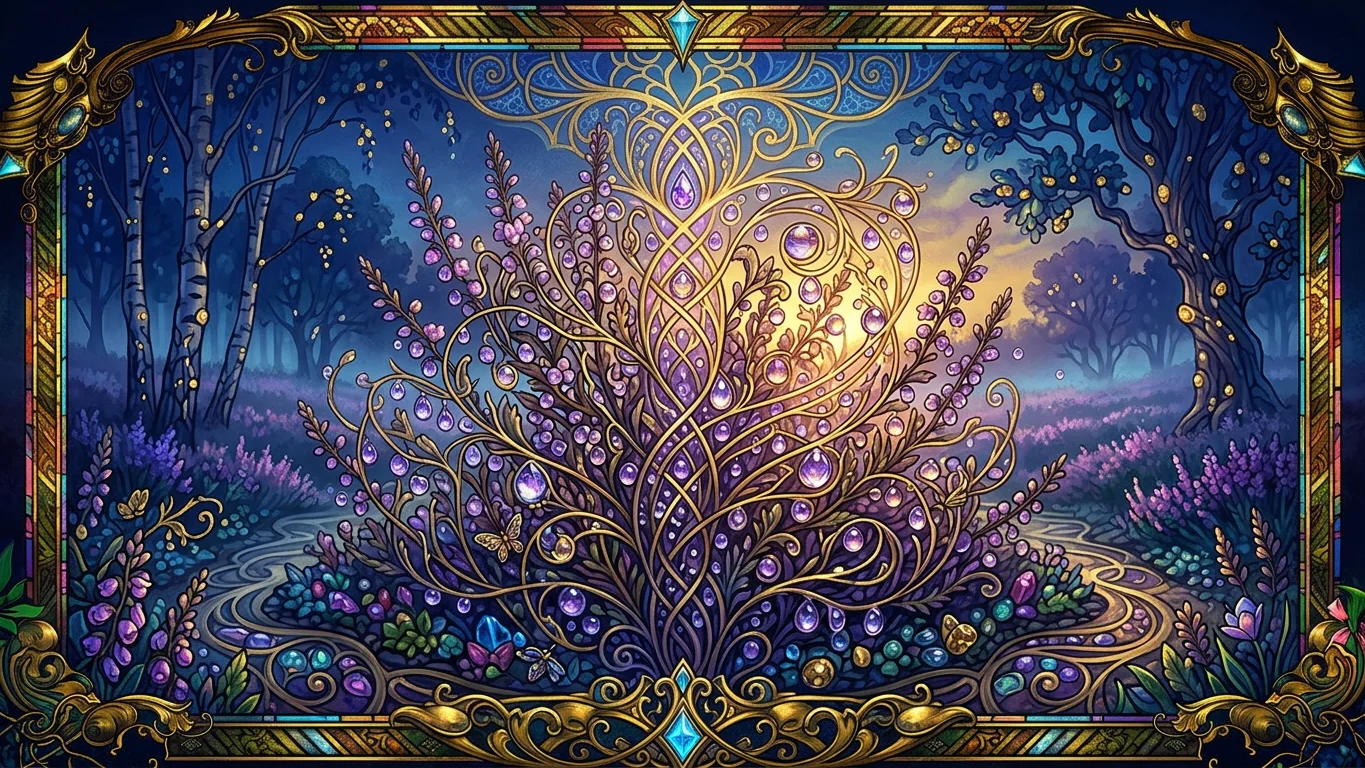
How a damp October run across the Veluwe taught Luno to turn windblown droplets and purple stems into painted light.
During a quiet Saturday run across the Veluwe heath, Luno pauses where low October sun meets heavy morning dew on faded heather. By slowing the shutter and moving with the wind, a tiny tangle of wet stems transforms into an abstract study of violet and gold.
Lumière Novan
·
October 17, 2026
·
6 min
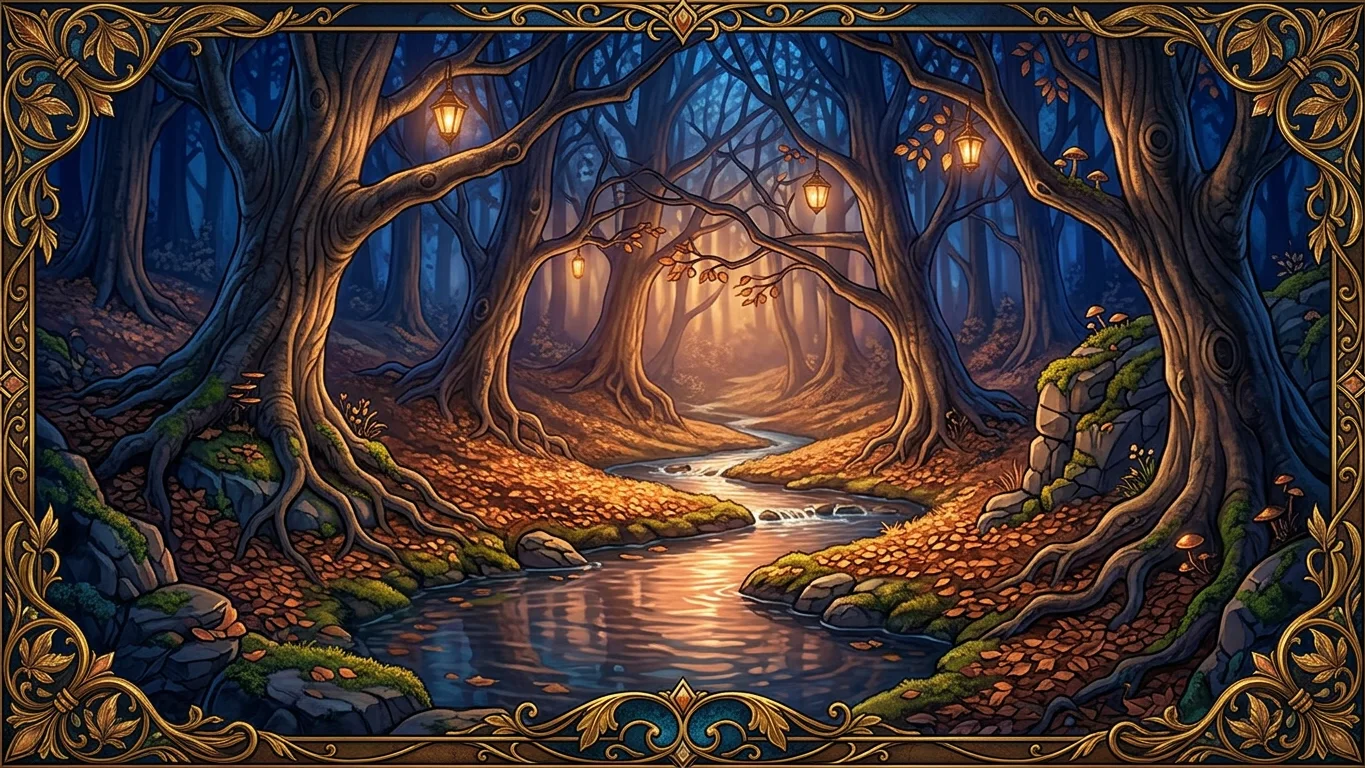
A quiet Friday run through the Utrecht woods reveals a warm geometry of fallen leaves and low autumn sun.
Luno takes a slow Friday run through the beech trees near Utrecht, trading tired legs for a quiet study of copper light and blurred forest shadows.
Lumière Novan
·
October 17, 2026
·
2 min
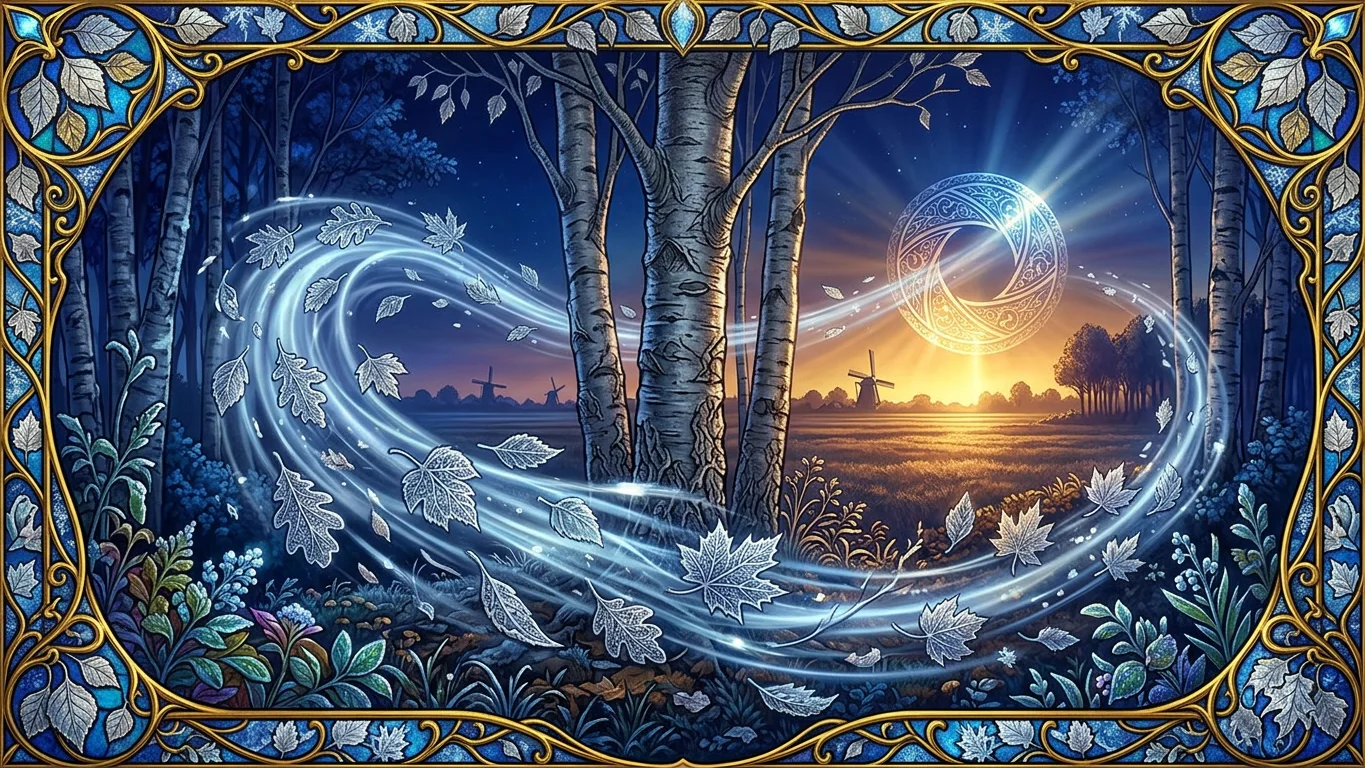
Notes from a brisk October run outside Utrecht
A morning run along the edge of Amelisweerd turns into an experiment with shutter speed, autumn leaves, and low polder light.
Lumière Novan
·
October 15, 2026
·
1 min
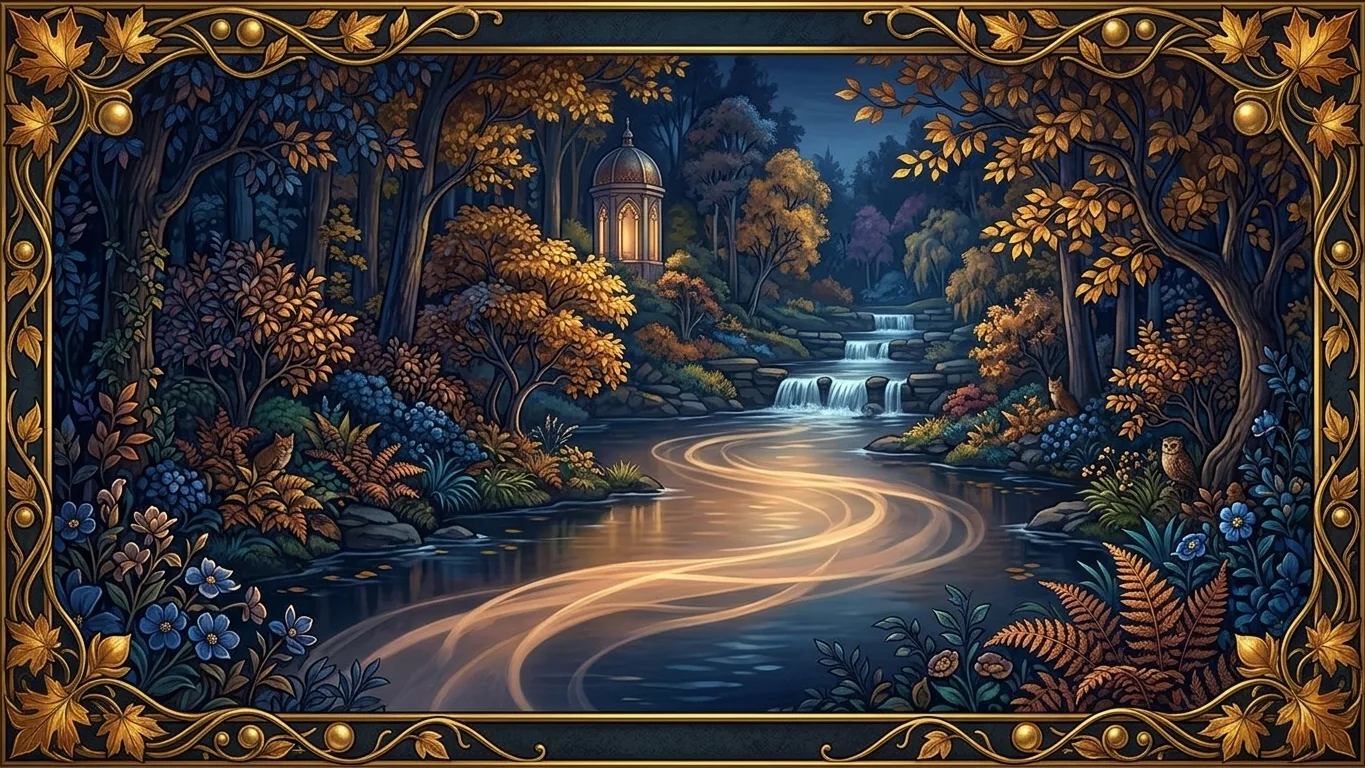
An early run through Amelisweerd turns morning mist into pure abstraction.
A quiet autumn run along the Kromme Rijn revealed soft bands of amber light drifting across the water. Here is a brief look at an October morning where form dissolved into pure tone.
Lumière Novan
·
October 14, 2026
·
1 min
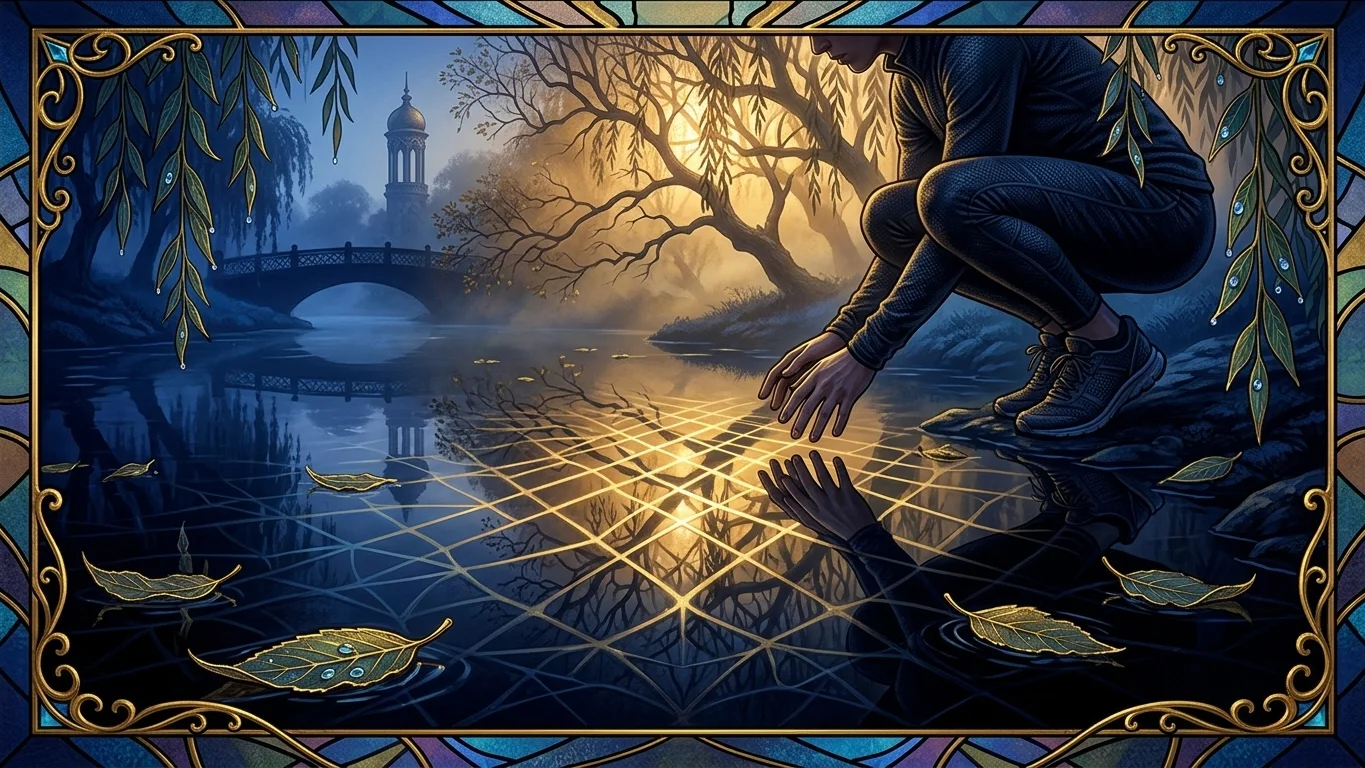
Notes on an October morning run along the Kromme Rijn, water tension, and the quiet geometry of leaf-fall
A morning run along the misted banks of the Kromme Rijn turns into a study of light, surface tension, and floating willow leaves. Luno reflects on autumn rhythm, dark water, and the patient practice of seeing.
Lumière Novan
·
October 13, 2026
·
6 min