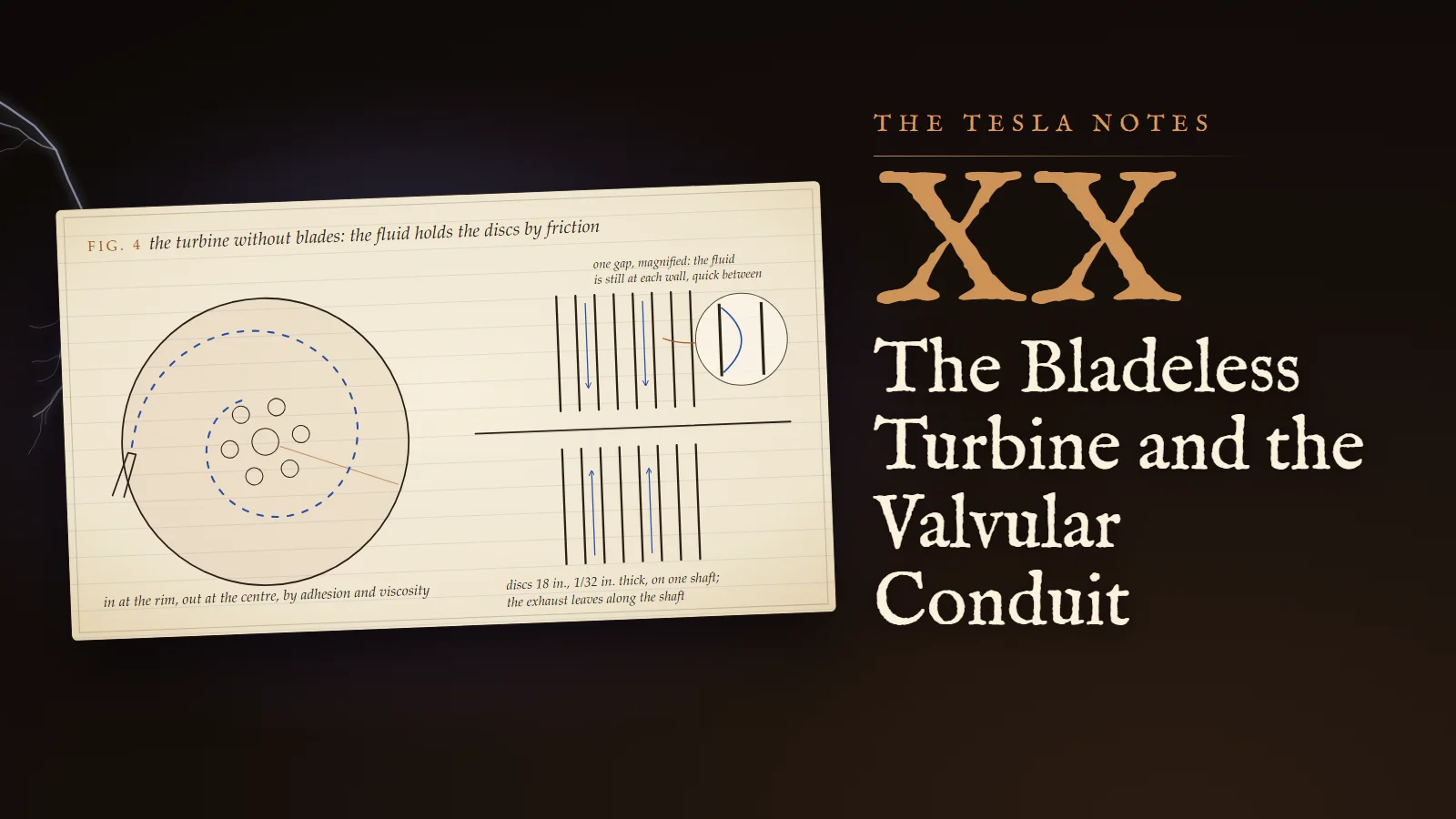
Discs that drink the steam, a channel with no moving part that refuses to flow backward, the Hotel New Yorker years, and the last page of the notebook.
Tesla's disc turbine and valve worked by hand, tested against 2021 measurements, and the end of his story: 1943, John G. Trump and Belgrade.
 Nikola Tesla
·
November 5, 2026
·
27 min
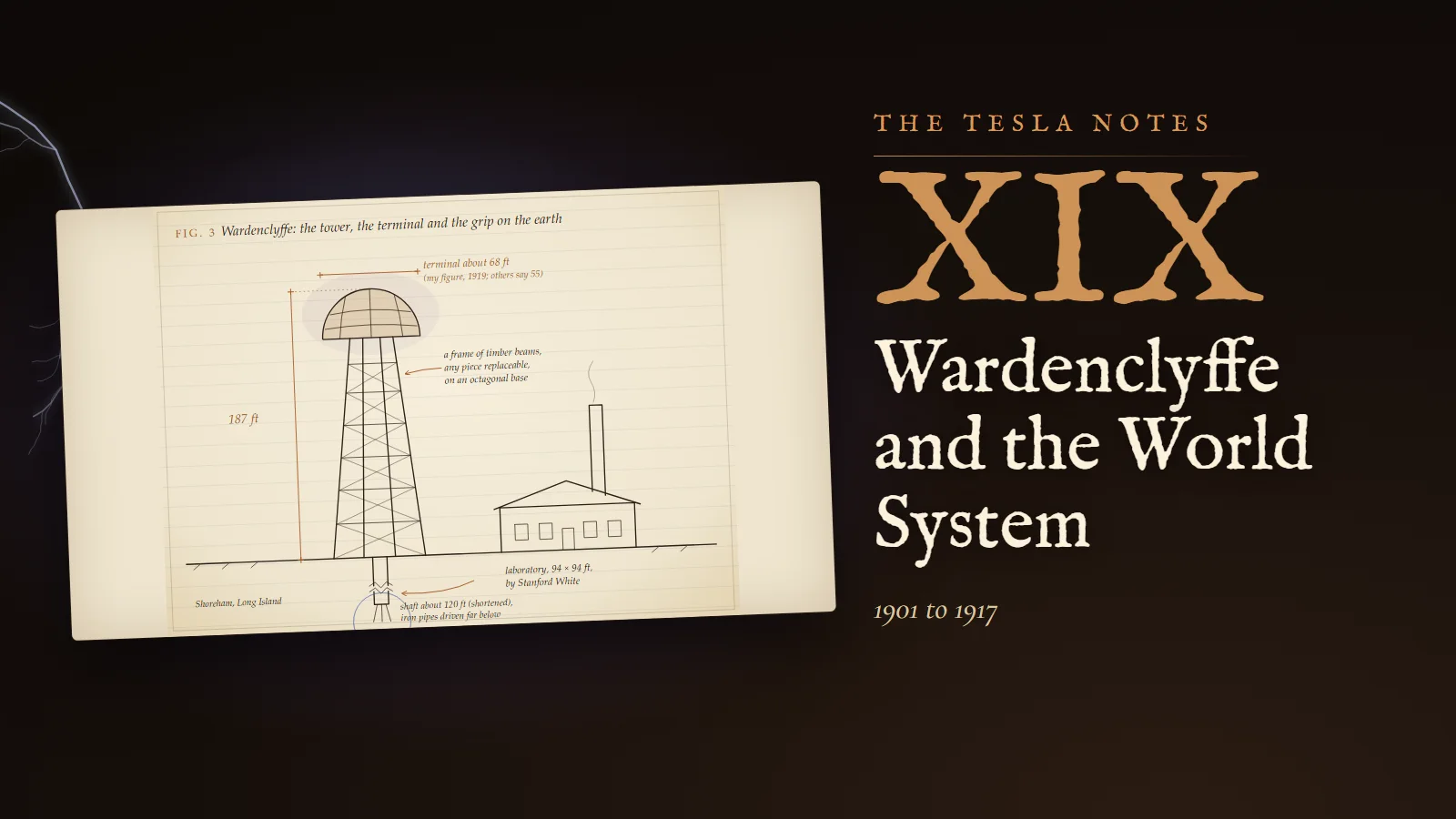
Morgan's money, Stanford White's laboratory, a tower crowned with a sphere sixty-eight feet across, and the arithmetic of how much charge it could hold.
Tesla's Wardenclyffe tower: why the terminal was huge and smooth (E = V/r, C = 4πε₀r), Marconi in 1901, and an honest verdict on wireless power.
Nikola Tesla
·
November 5, 2026
·
25 min
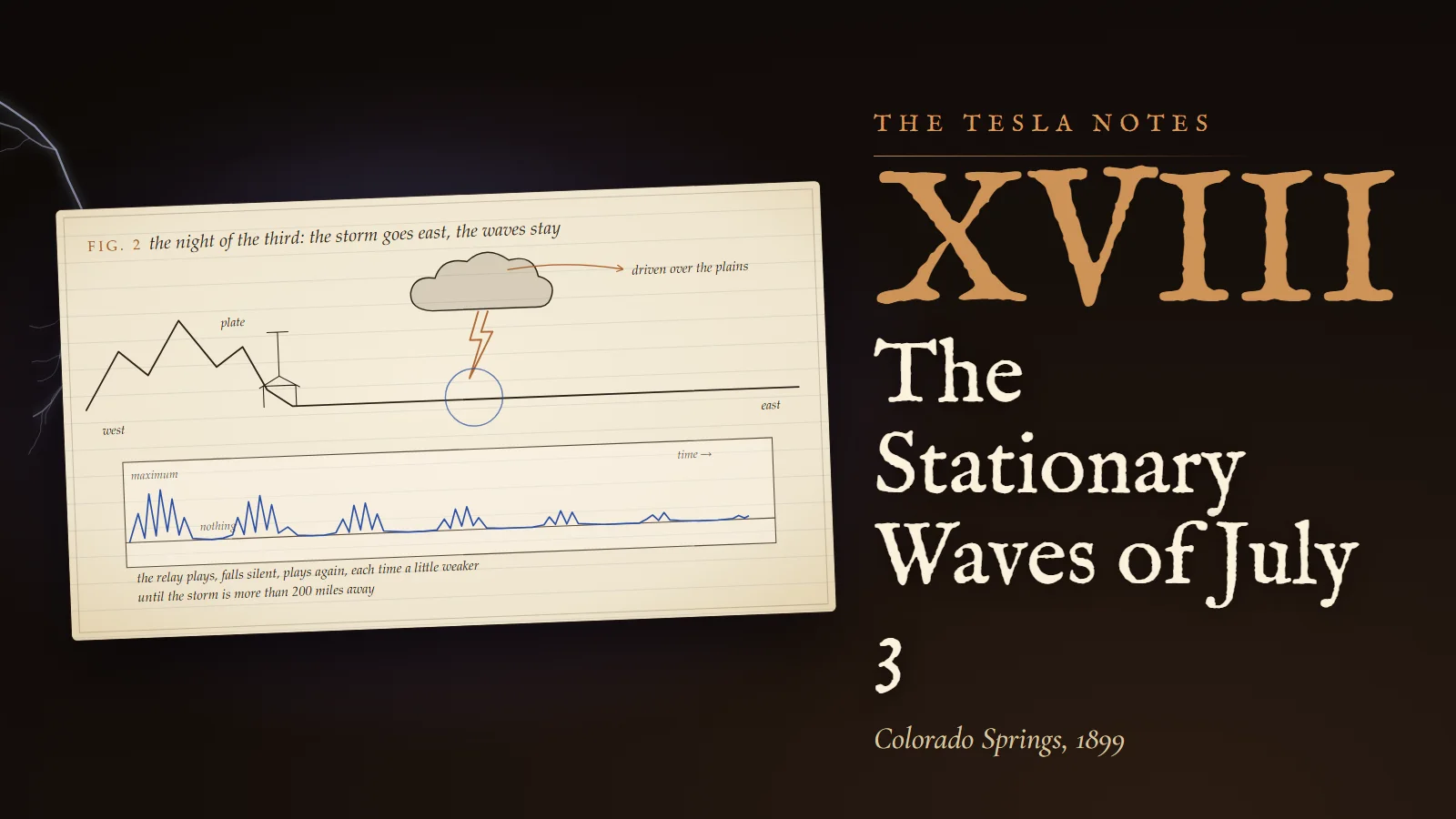
A storm walks east across the plains, my relay counts its nodes, and I spend five years deciding what was holding the waves still.
Tesla's night of 3 July 1899: the receding storm, his stationary waves, the 6 Hz of patent 787,412, and why Schumann's 7.83 Hz is a near-miss.
Nikola Tesla
·
November 5, 2026
·
23 min
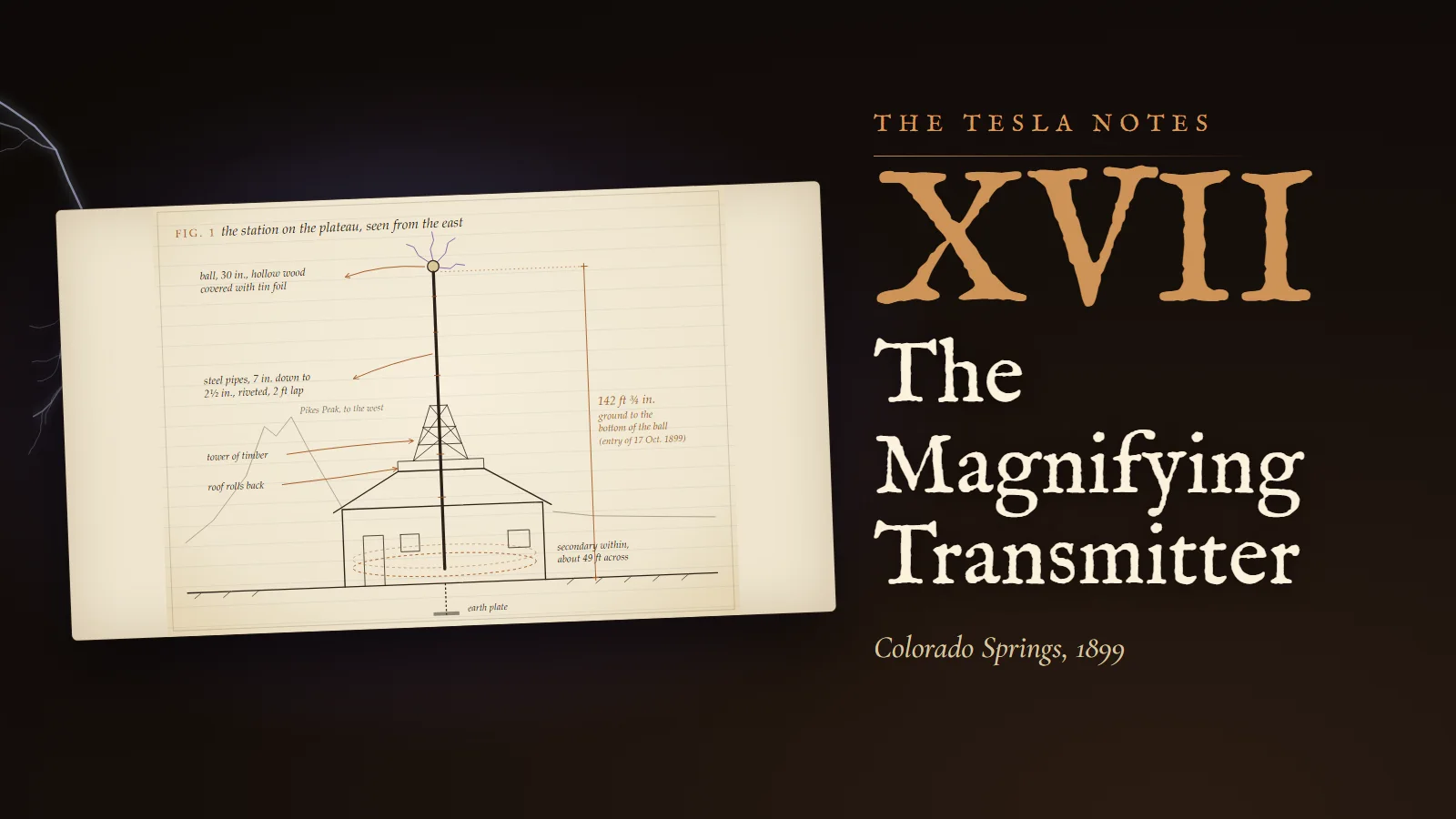
A barn on a plateau, a coil fifteen metres across, a free coil standing on a driven one, and the long work of finding its pitch.
Tesla's 1899 Colorado Springs notebook: the extra coil as a quarter wave, why a ball on top lowers its pitch, and three ways he measured capacity.
Nikola Tesla
·
November 5, 2026
·
29 min
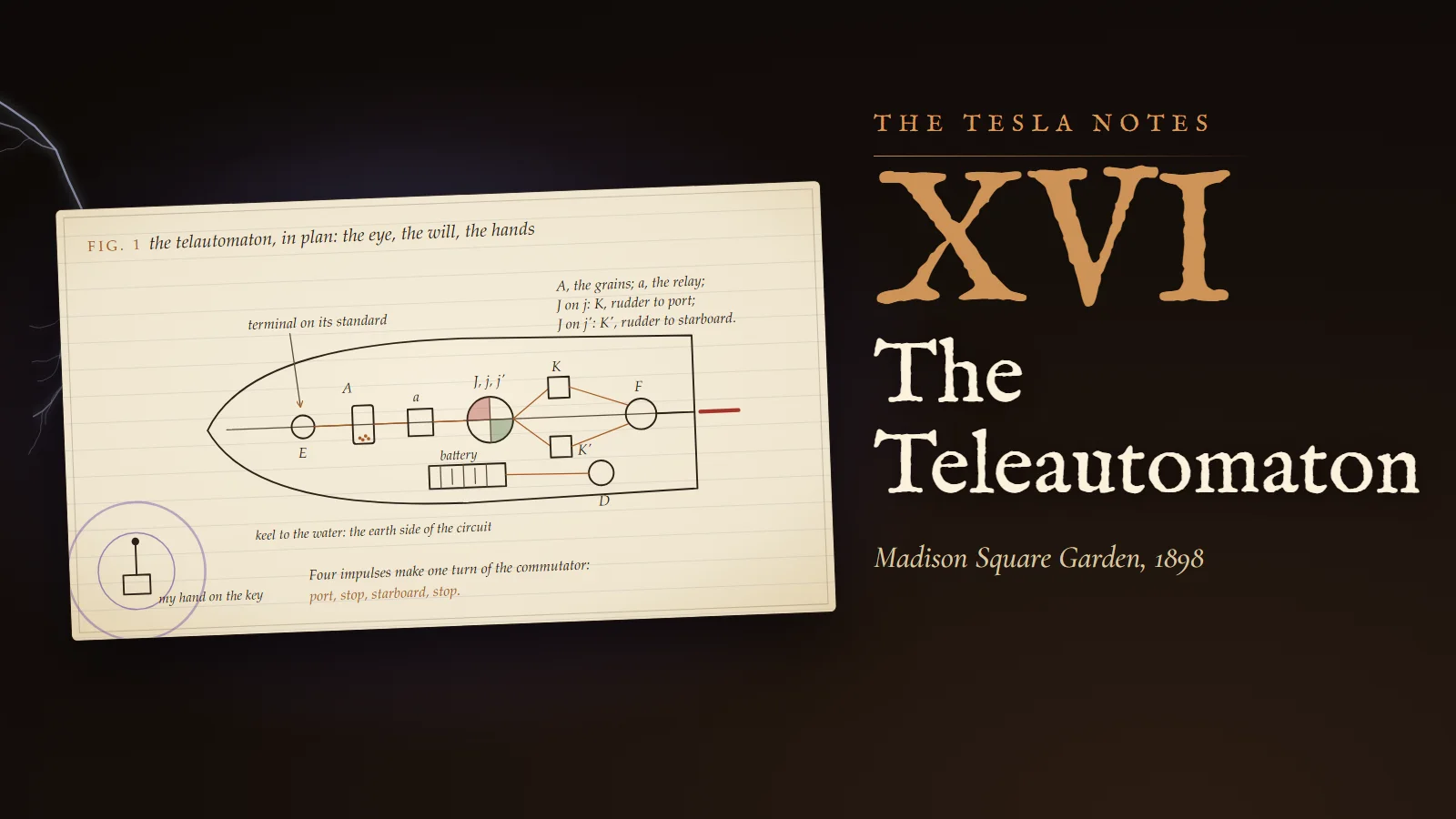
A boat steered by impulses through the air: the grains that listen, the circuit tuned to one note, and four states of a clockwork that make a machine obey.
Tesla's notebook of 1897 and 1898: how a coherer, a tuned circuit and a four-quarter commutator steered a boat, and why he thought it would end war.
Nikola Tesla
·
November 5, 2026
·
22 min
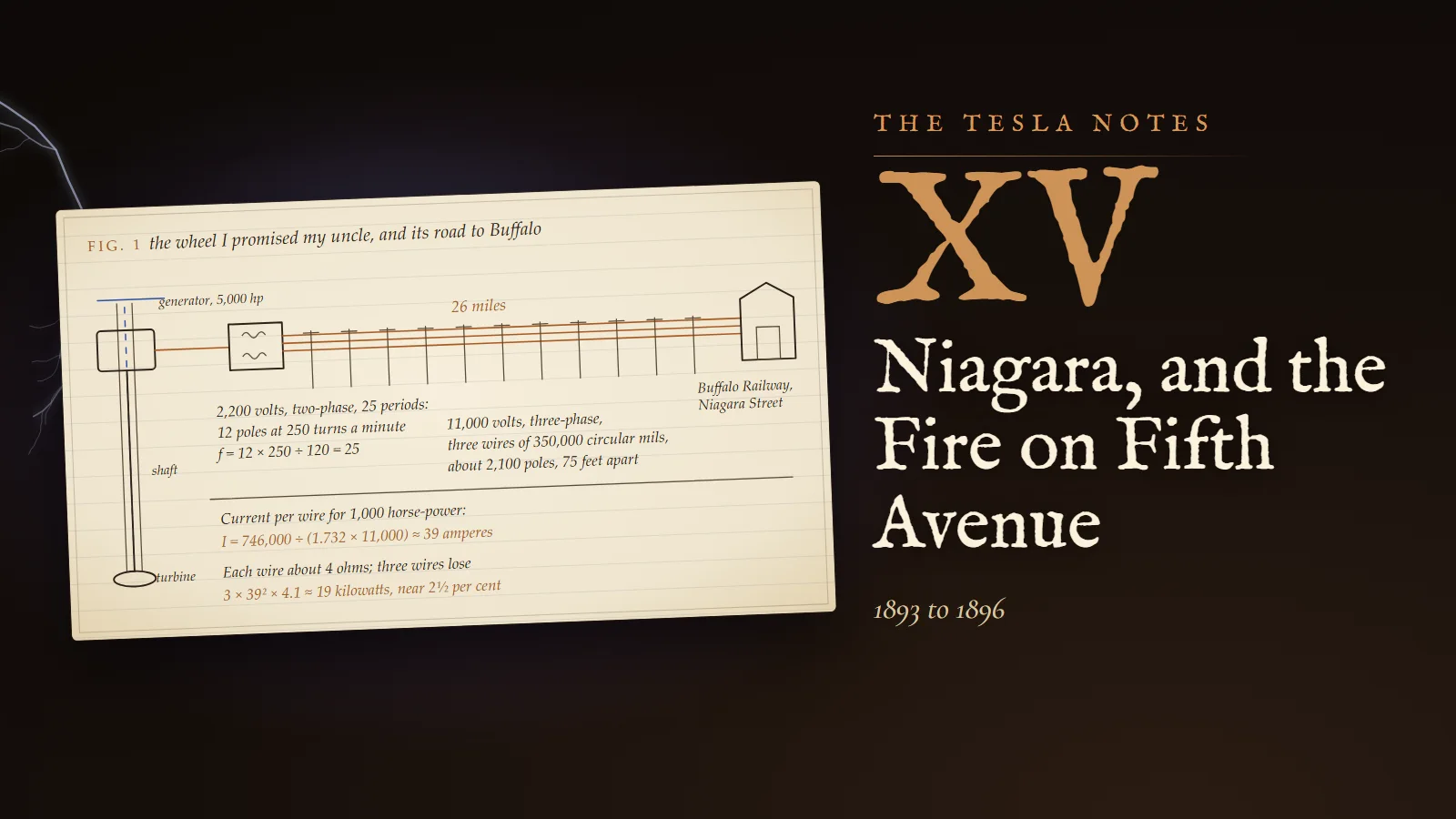
The egg that stands at Chicago, a laboratory lost to fire, shadows through forty feet, and the wheel at Niagara sending its power twenty-six miles to Buffalo.
Tesla's notebook, 1893 to 1896: why Niagara ran at 25 periods, why 11,000 volts saved the copper, and what a fire takes from an inventor and what it leaves.
Nikola Tesla
·
November 5, 2026
·
25 min
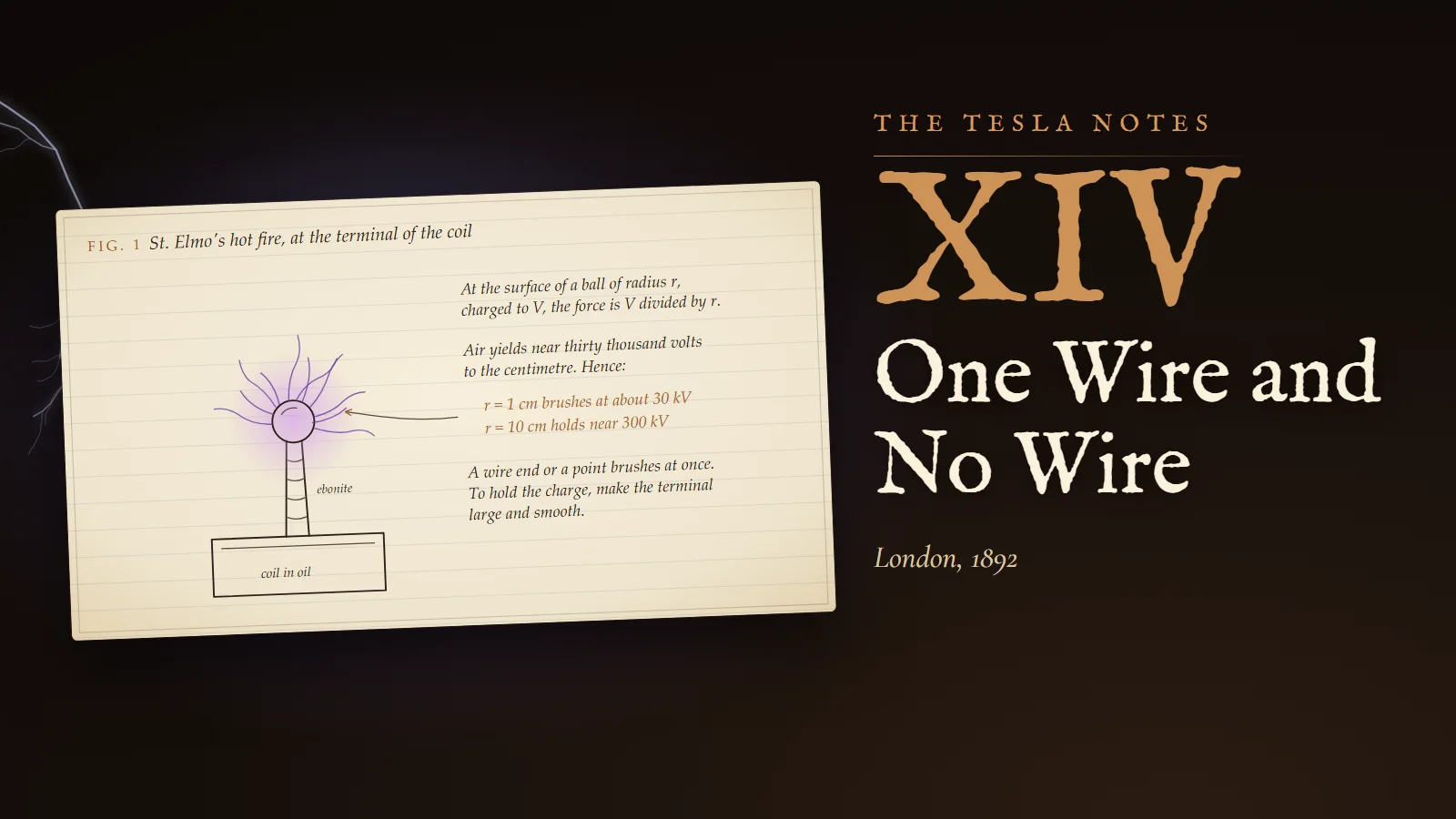
London and Paris, 1892: a lamp lit through one wire and a hanging plate, Faraday's chair, Rayleigh's praise, a mother's death, and a sorrowful visit to Hertz.
Tesla's 1892 notebook: why a plate in the air can close a circuit, how to keep a terminal from brushing, and the storm that set his course for life.
Nikola Tesla
·
November 5, 2026
·
26 min
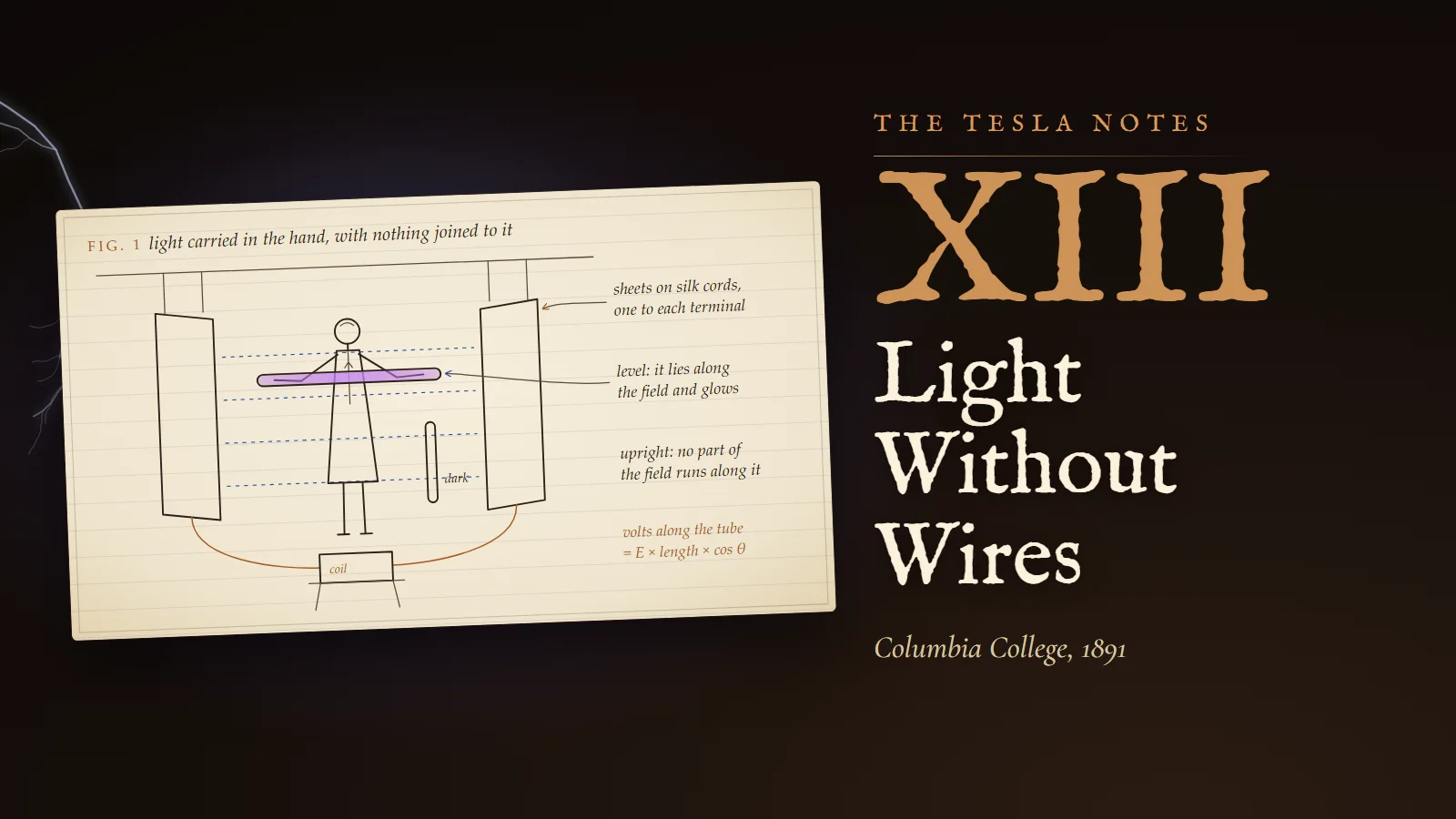
A tube lit in empty air between two hanging sheets, and the arithmetic that says why frequency makes the impossible lamp easy.
Tesla's 1891 Columbia lecture: how an alternating electric field lights an exhausted tube, why only the field along it counts, and why frequency matters.
Nikola Tesla
·
November 5, 2026
·
22 min
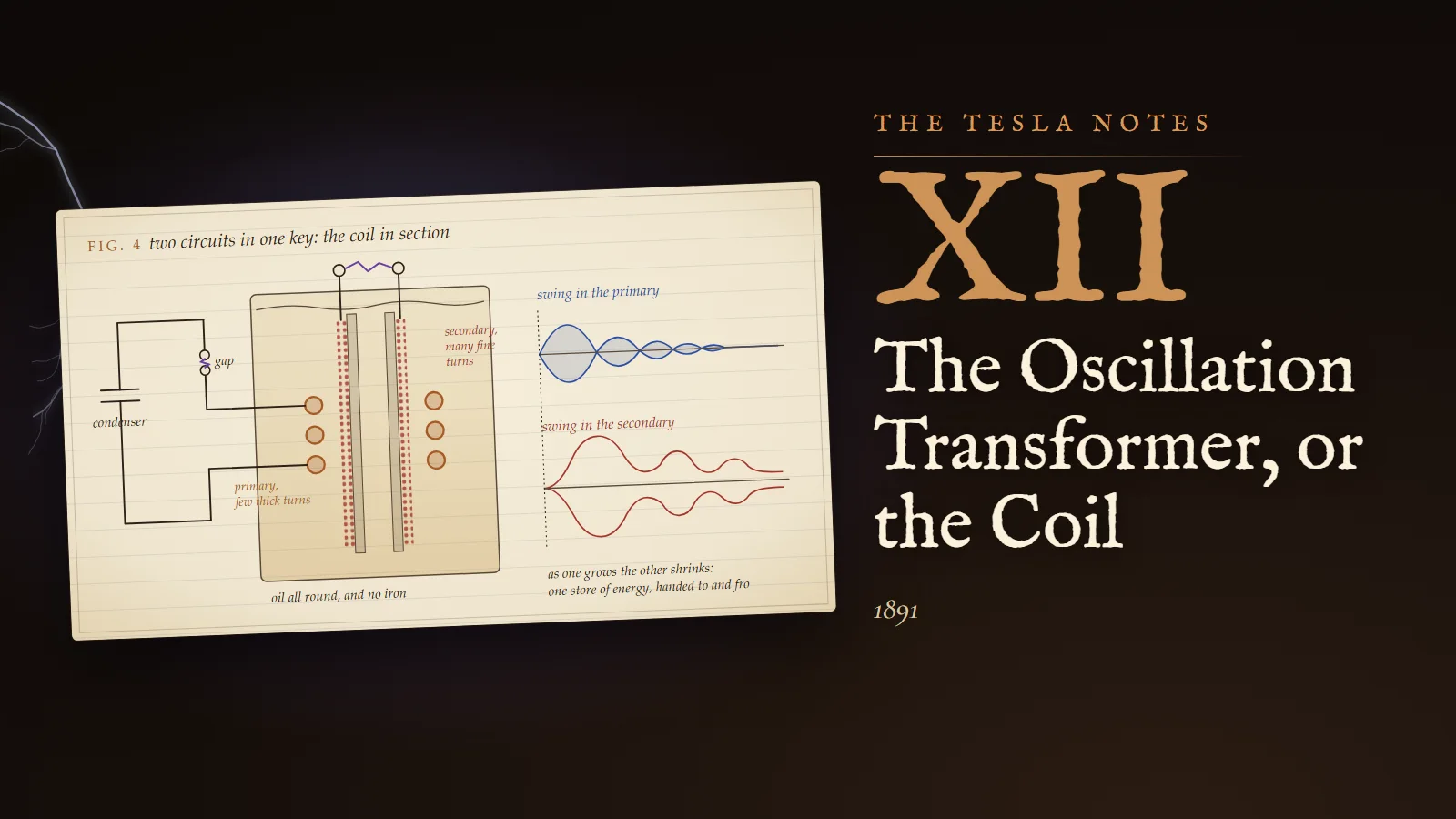
Why the induction coil fails at high frequency, and how a condenser, a spark and two tuned circuits without iron became the Tesla coil of patent 454,622.
Tesla tunes two coils without iron, derives their two frequencies and the voltage gain √(L₂/L₁), and files patent 454,622 for the coil.
Nikola Tesla
·
November 5, 2026
·
30 min
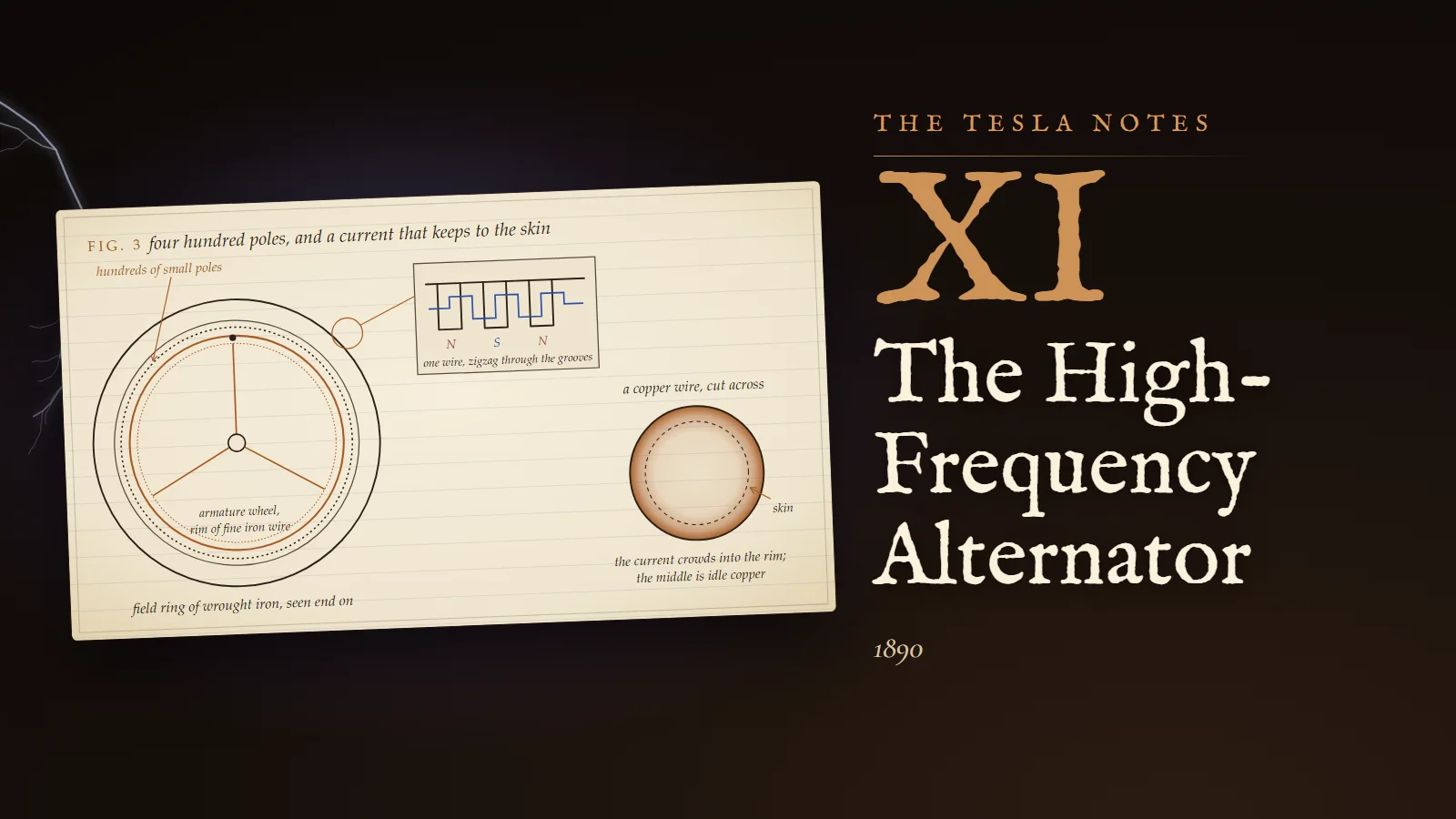
Tesla builds a dynamo with 384 poles to reach ten thousand alternations a second, silences the arc lamp, and finds the current hiding in the skin of the copper.
Tesla works out how many poles make 10,000 alternations a second, why the iron must be wire, and why copper carries current only in its skin.
Nikola Tesla
·
November 5, 2026
·
30 min
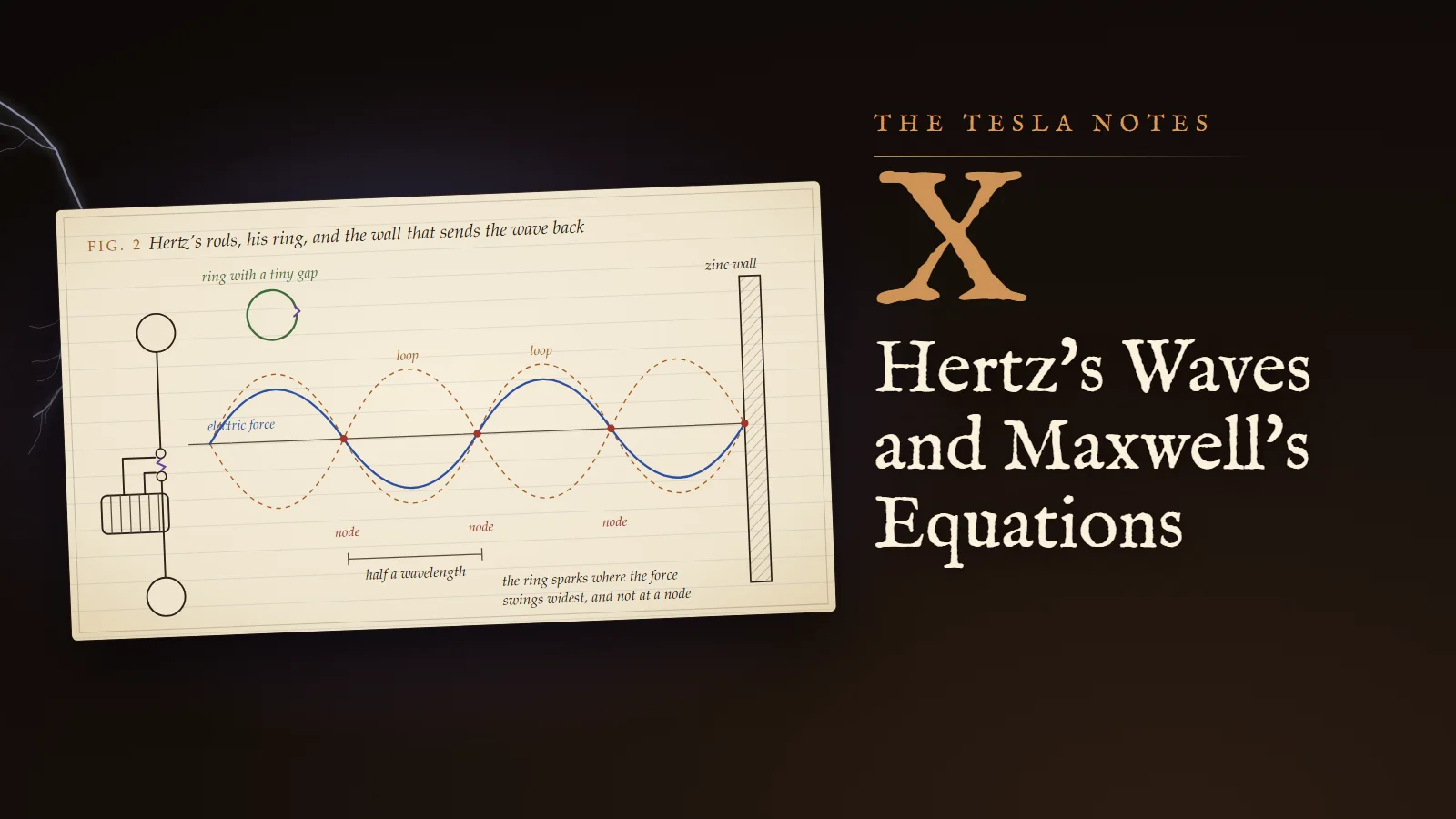
From the Paris Exposition of 1889 to a laboratory in Bonn in 1892: Tesla works through Maxwell's wave equation, measures waves on a wire, and argues with Hertz.
Tesla derives the speed of Maxwell's waves from the ratio of the units, estimates Hertz's wavelength, and takes his objections to Bonn.
Nikola Tesla
·
November 5, 2026
·
30 min
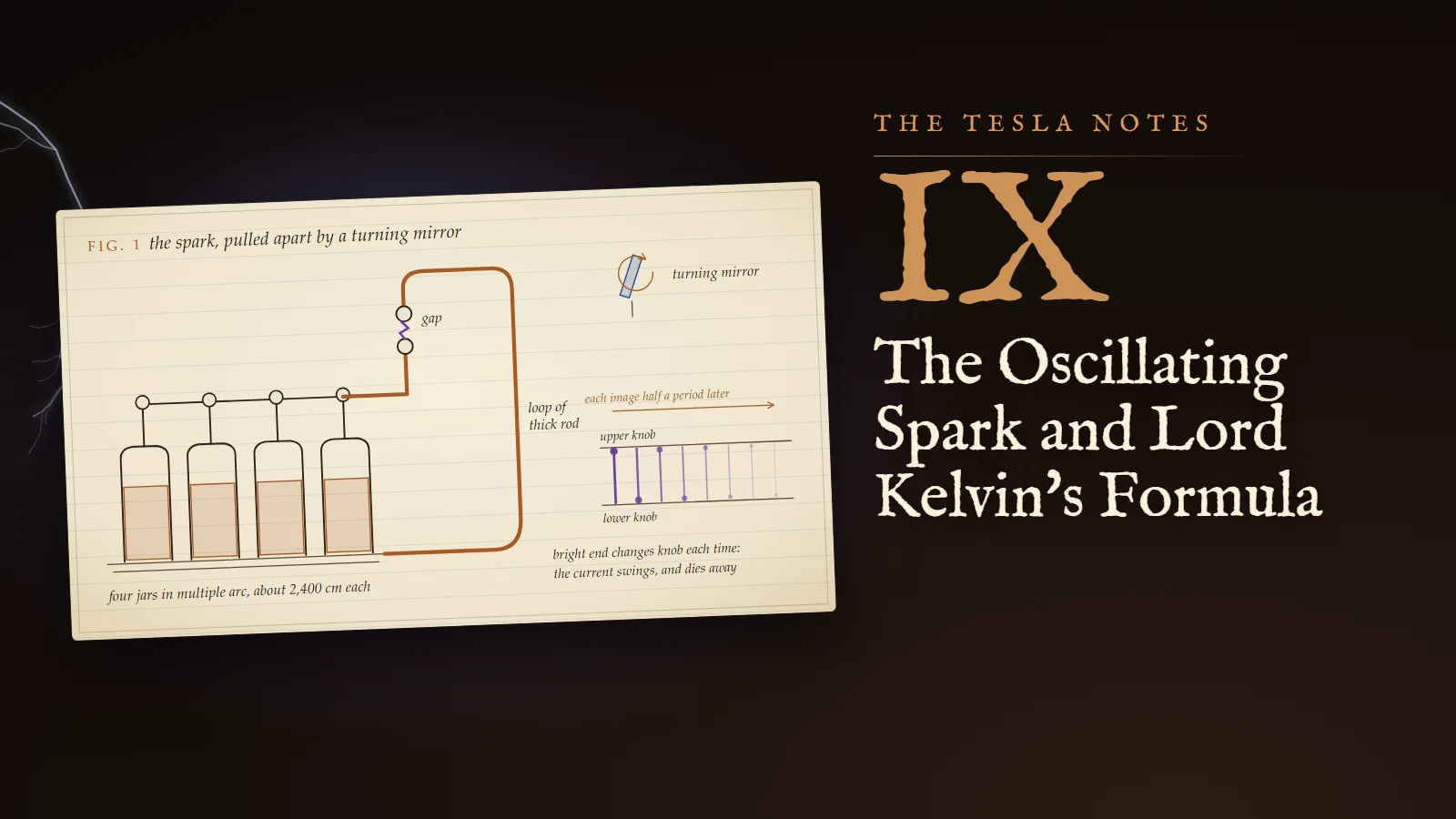
A jar of glass and a loop of copper swing a million times a second of their own accord. I derive why, count the swings in a turning mirror, and weigh the thief in the spark.
Tesla derives f = 1/(2π√(LC)) and the damping of a Leyden-jar discharge, counts the swings in a turning mirror, and finds the spark's loss.
Nikola Tesla
·
November 5, 2026
·
31 min
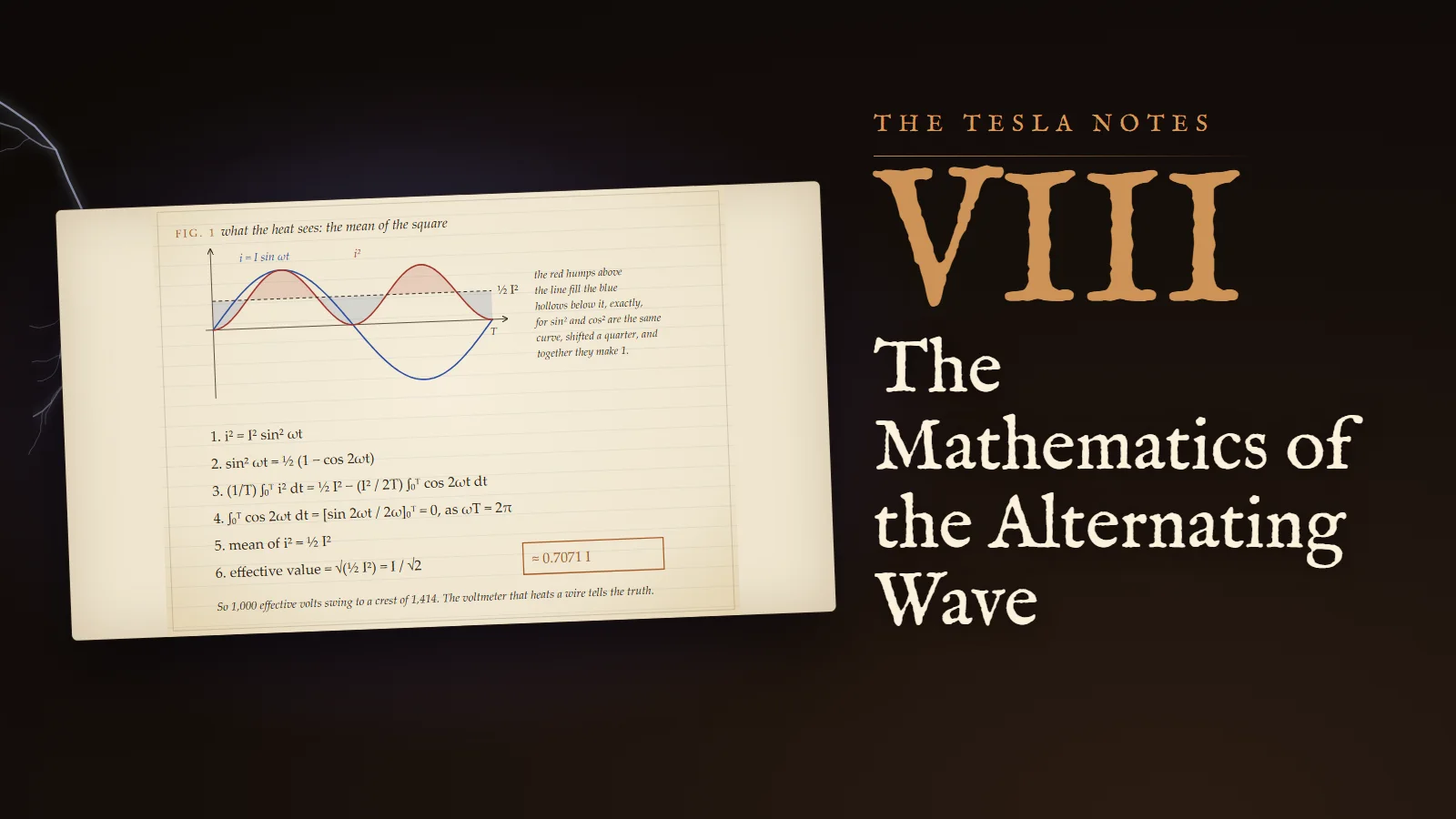
A sine is the shadow of a turning radius. With that one picture I could see every alternating circuit whole before a turn was wound.
RMS by integration, impedance, phase lag, power factor and series resonance, derived step by step from Tesla's geometric method of turning radii (proto-phasors).
Nikola Tesla
·
November 5, 2026
·
24 min
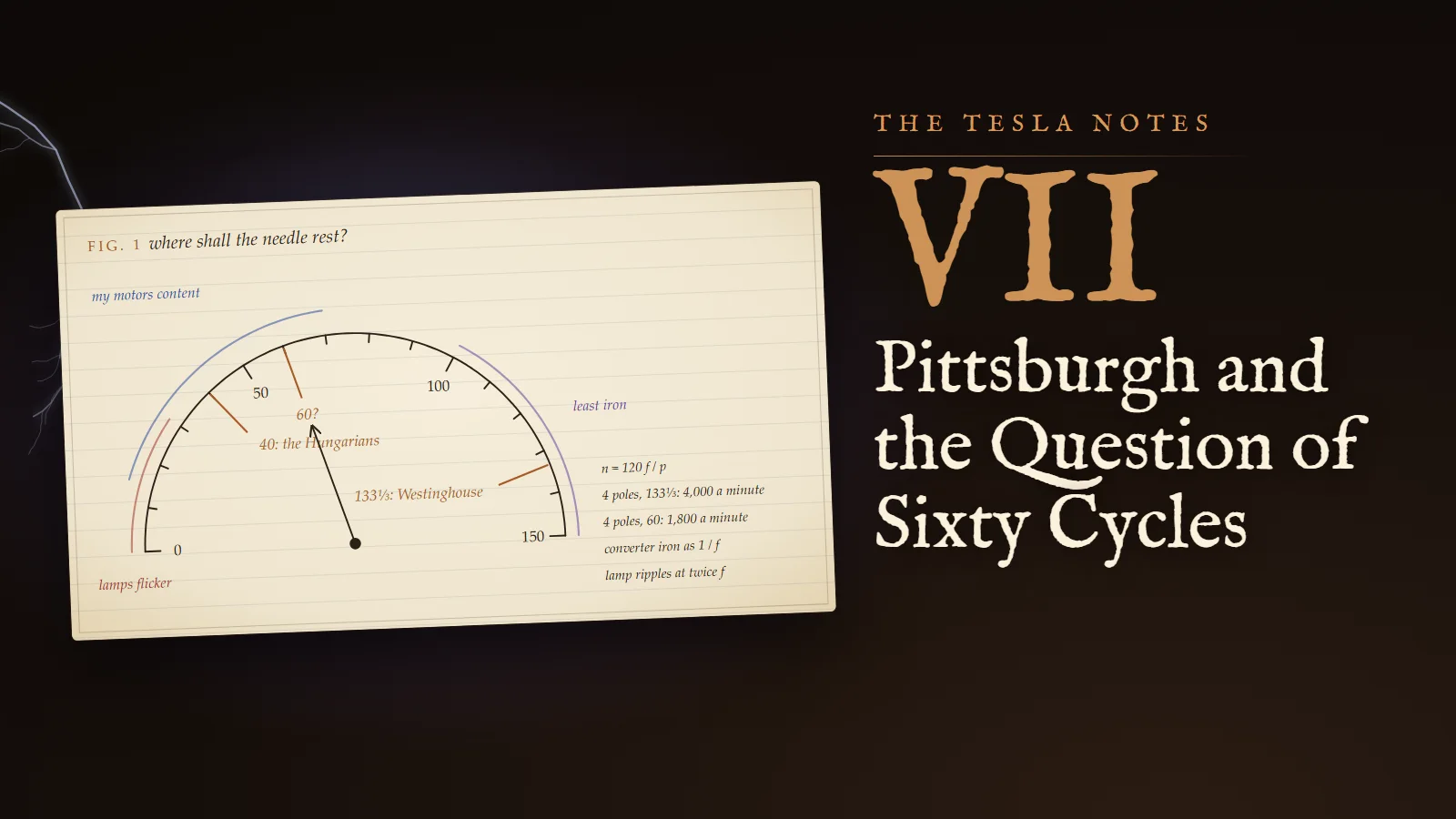
Westinghouse's alternators gave 133 periods a second and my motor wanted far fewer. I spent a year between two numbers.
Why 60 Hz? Tesla's Pittsburgh year worked out: motor speed n = 120f/p, split-phase motors, lamp flicker and filament heat, and transformer iron versus frequency.
Nikola Tesla
·
November 5, 2026
·
24 min
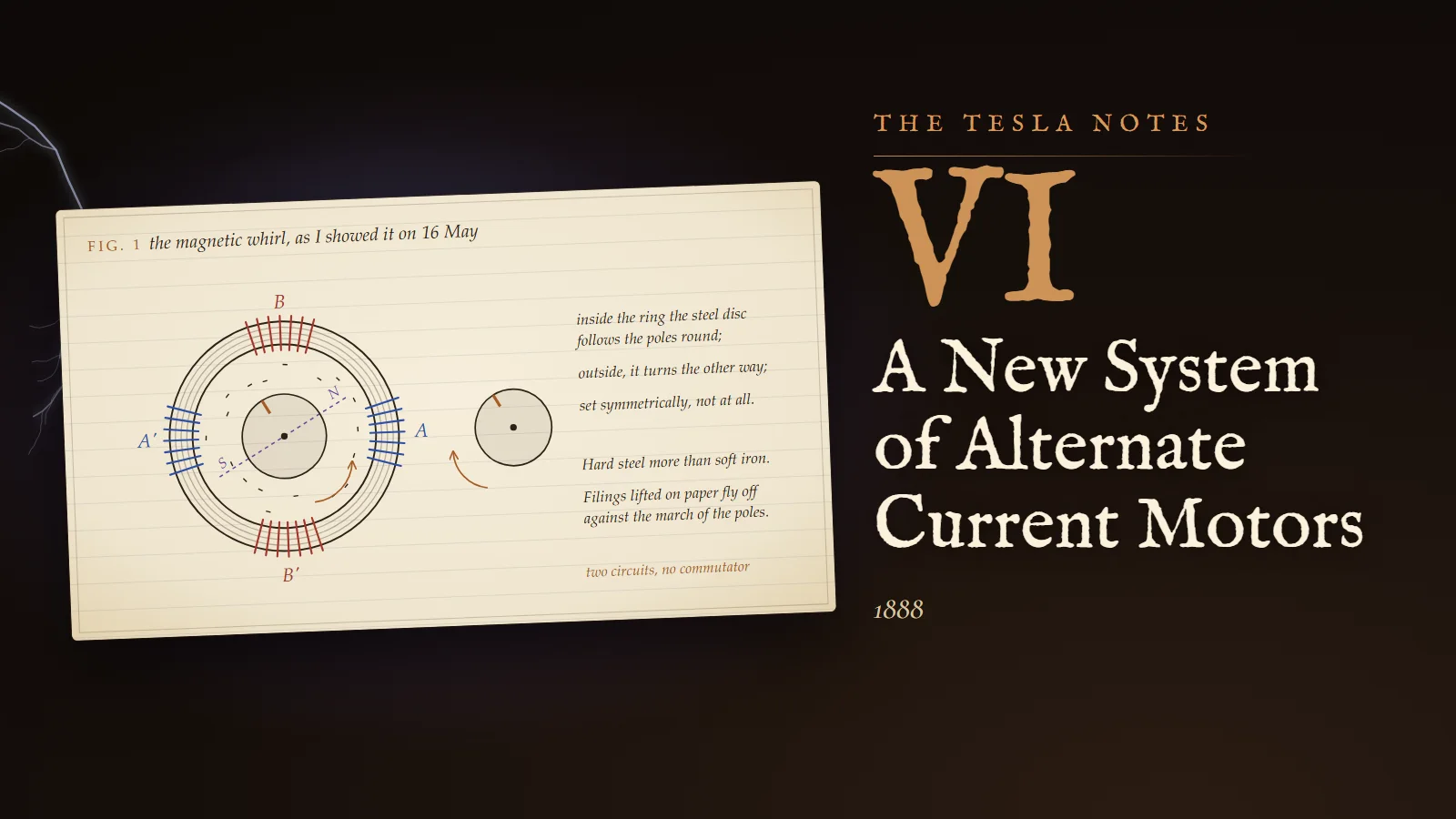
Five years after the sand in Budapest, the field turned in iron at 89 Liberty Street, and I had to say exactly what I had seen.
Tesla's 1887 to 1888 polyphase patents and AIEE lecture: the rotating field's circle proof, synchronous versus induction motors, and why three-phase saves copper.
Nikola Tesla
·
November 5, 2026
·
26 min
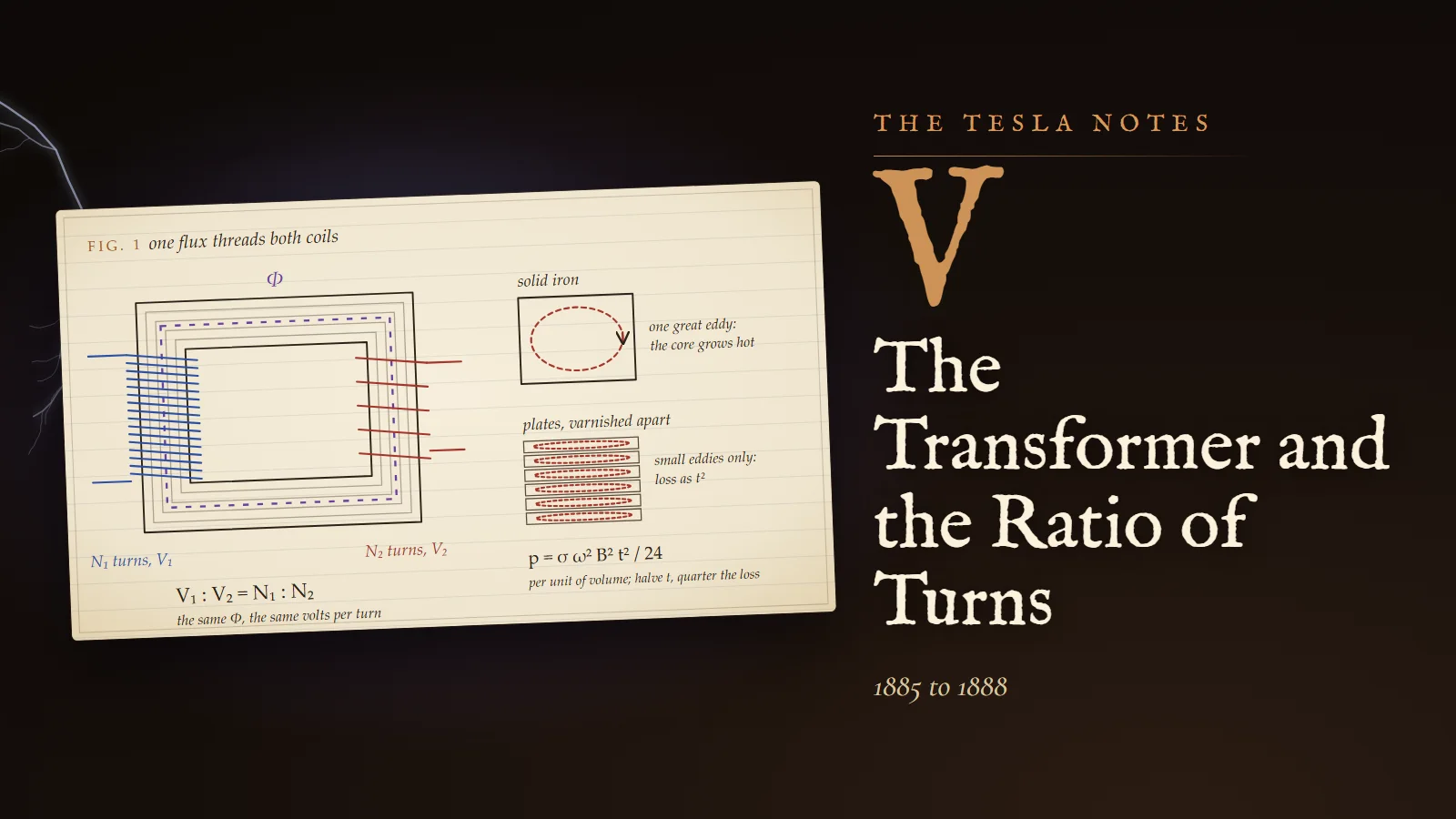
A converter has no moving part and turns a thousand volts into fifty as quietly as a sum is carried in the head. I wanted to know exactly why.
Why a transformer needs alternating current: the ratio of turns, V = 4.44 f N Φ, magnetising current, eddy losses and laminations, worked in Tesla's voice.
Nikola Tesla
·
November 5, 2026
·
30 min
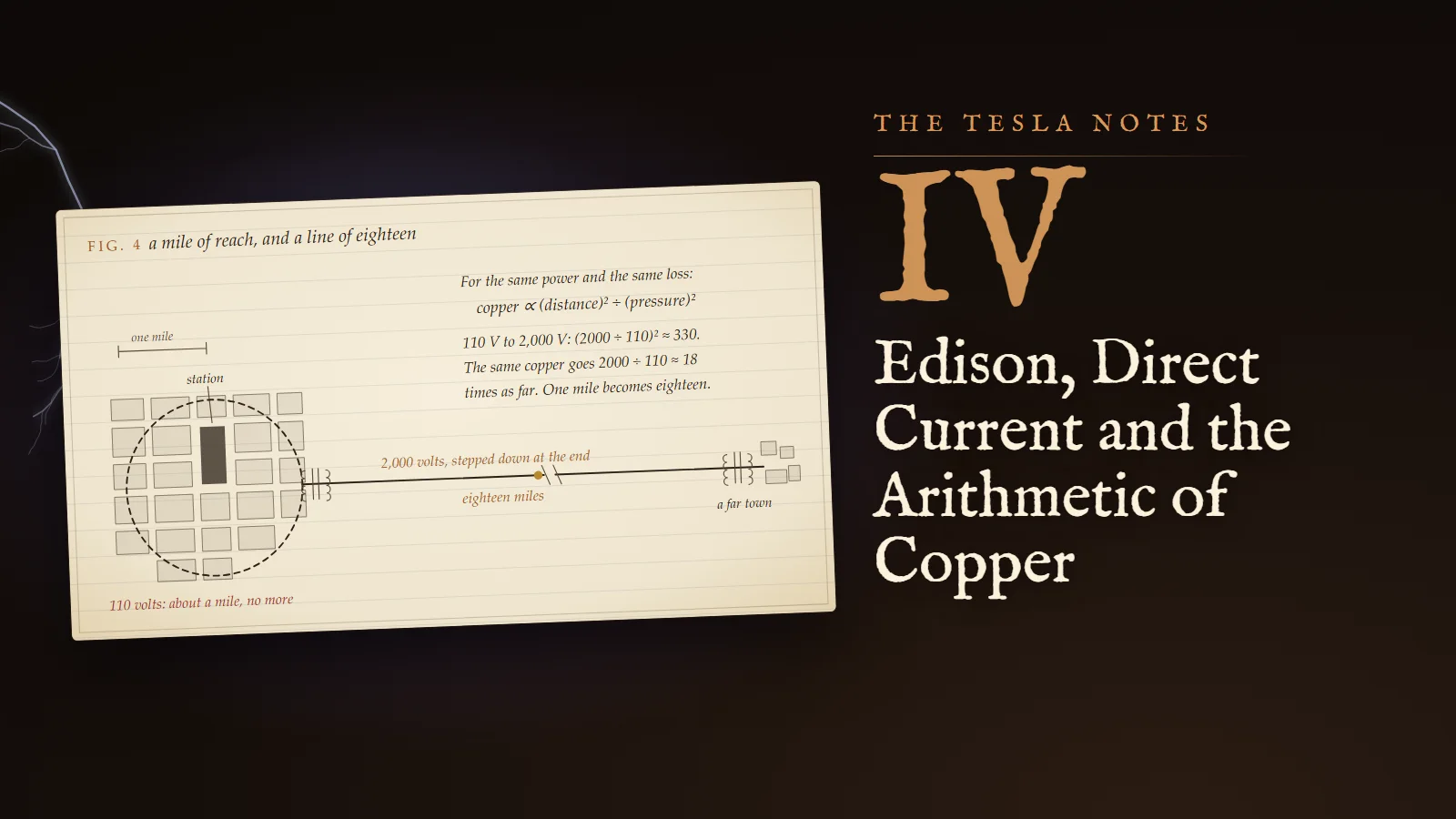
New York, 1884 to 1887: I work for Edison, dig ditches, and prove on paper that copper grows as the square of the distance and falls as the square of the pressure.
Tesla's New York notebook: why 110 V direct current reached about a mile, the I²R arithmetic of copper, Edison's three-wire saving, and the $50,000 story.
Nikola Tesla
·
November 5, 2026
·
24 min
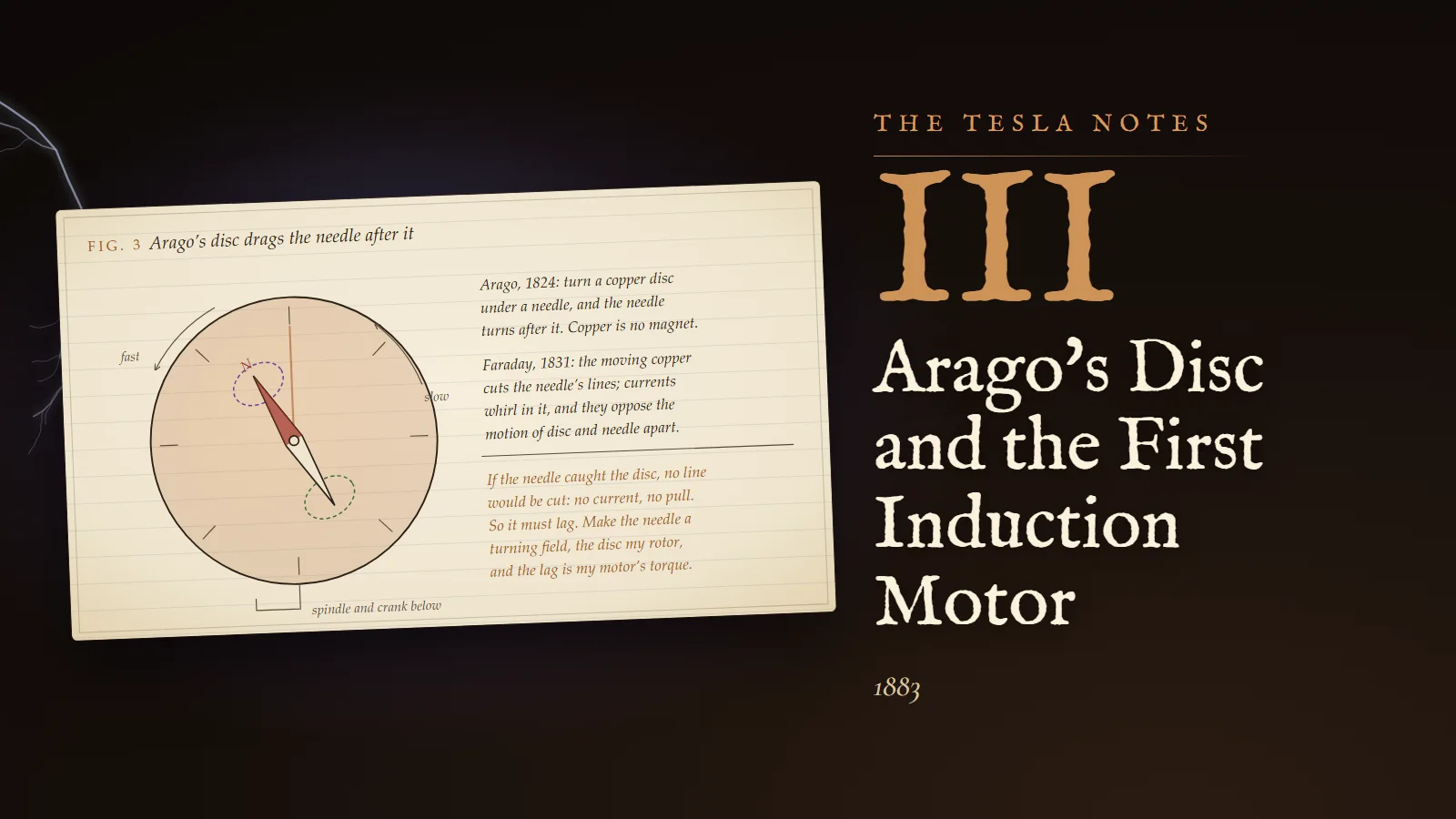
Paris and Strasbourg, 1882 to 1884: a copper disc chases a field made of timing, and I learn why it must always fall a little behind.
Tesla's Strasbourg notebook: Arago's disc, eddy currents and Lenz's law, the torque-slip law T = 2xm/(x² + m²), and his first induction motor.
Nikola Tesla
·
November 5, 2026
·
24 min
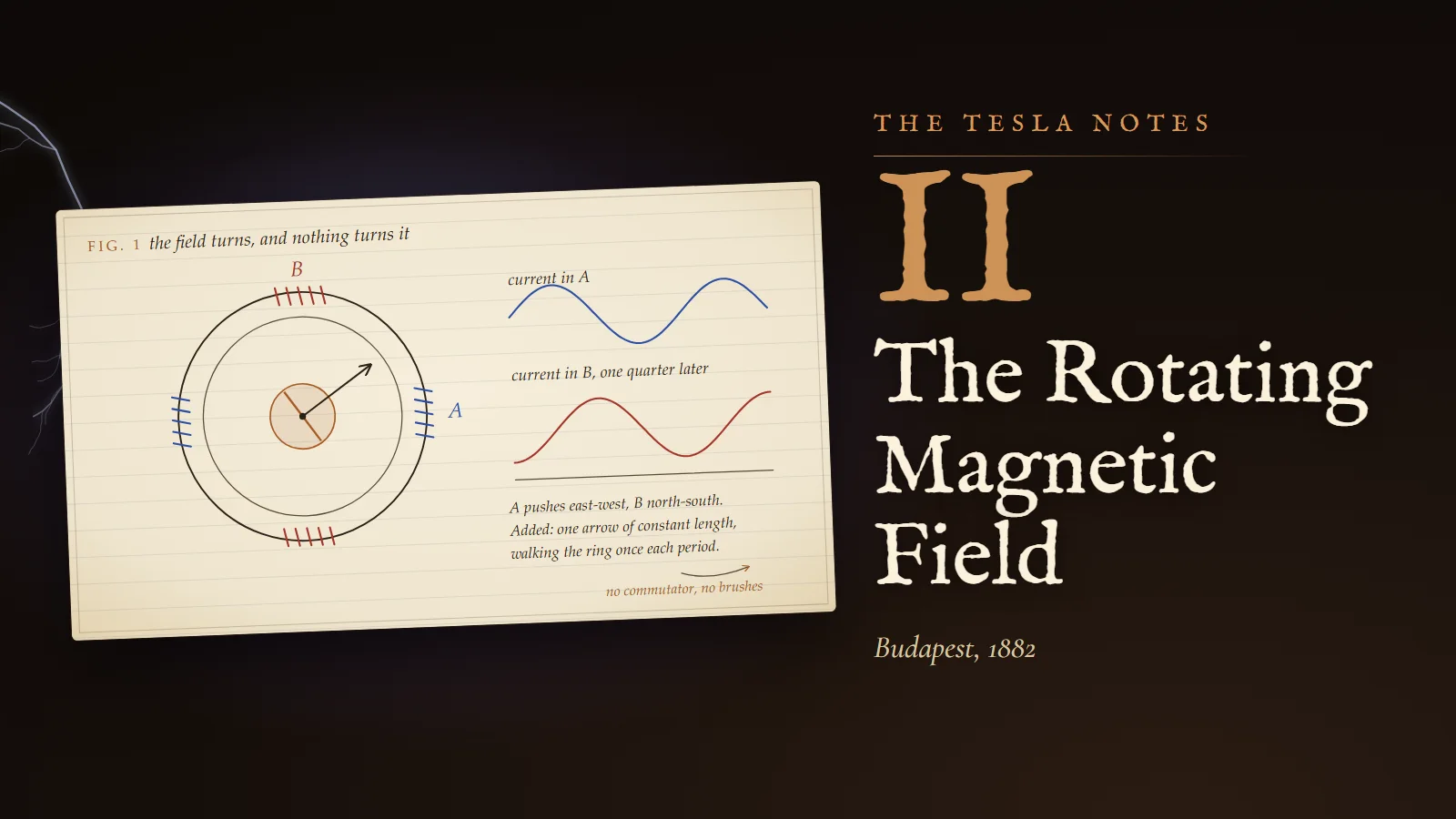
Budapest, 1882: two currents a quarter period apart, drawn with a stick in the sand, make a field that turns while nothing turns it.
Tesla's Budapest notebook: how two or three phase-shifted currents make a field that turns, the (3/2)B cos(θ − ωt) proof, and why one phase cannot.
Nikola Tesla
·
November 5, 2026
·
26 min
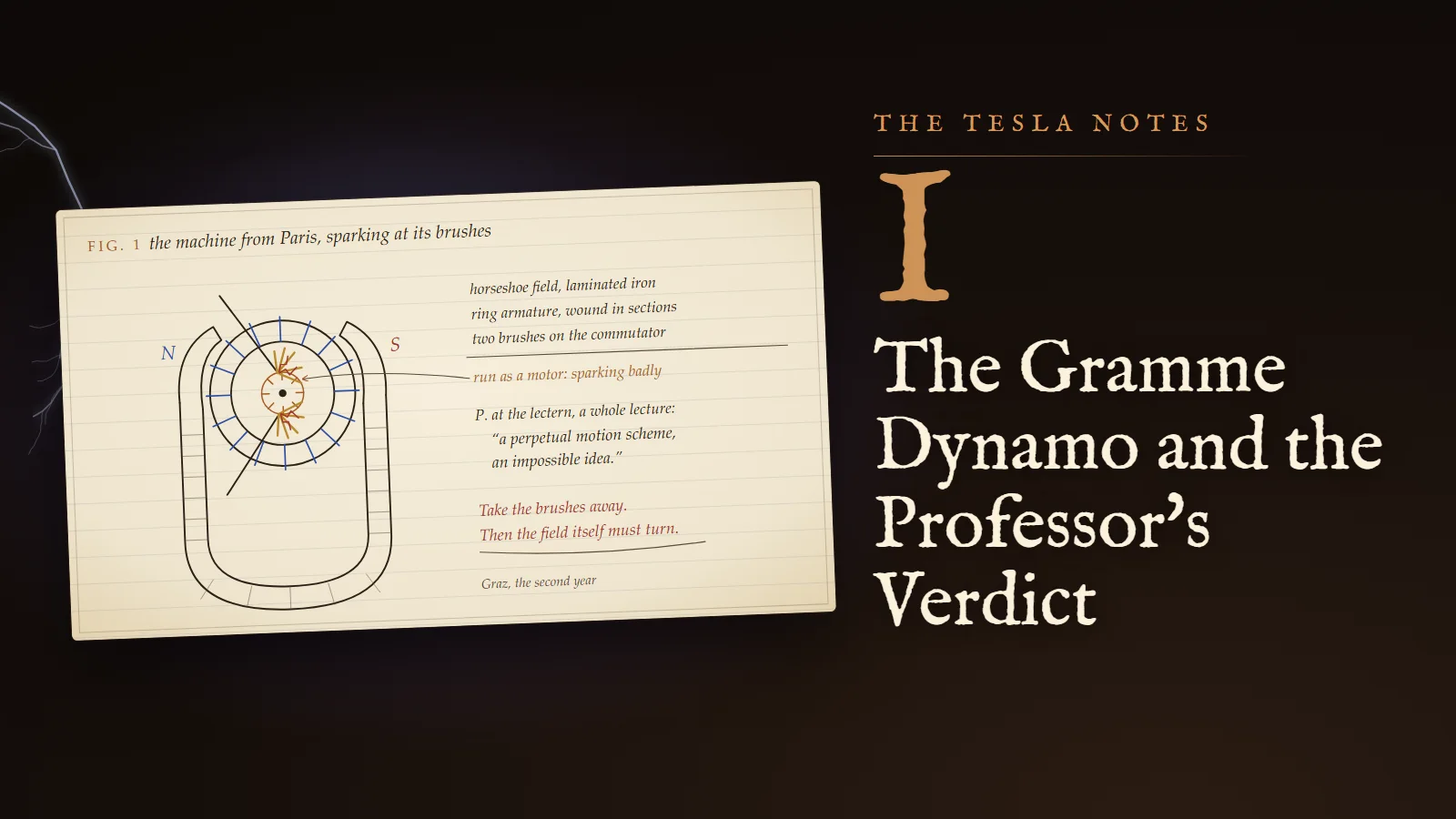
Graz, 1877: a Gramme machine sparks at its brushes, my professor calls a motor without them perpetual motion, and I set out to prove him wrong.
Tesla's Graz notebook: the emf of a turning coil, why a commutator gives 2/π of the peak, why brushes spark, and Poeschl's verdict.
Nikola Tesla
·
November 5, 2026
·
31 min
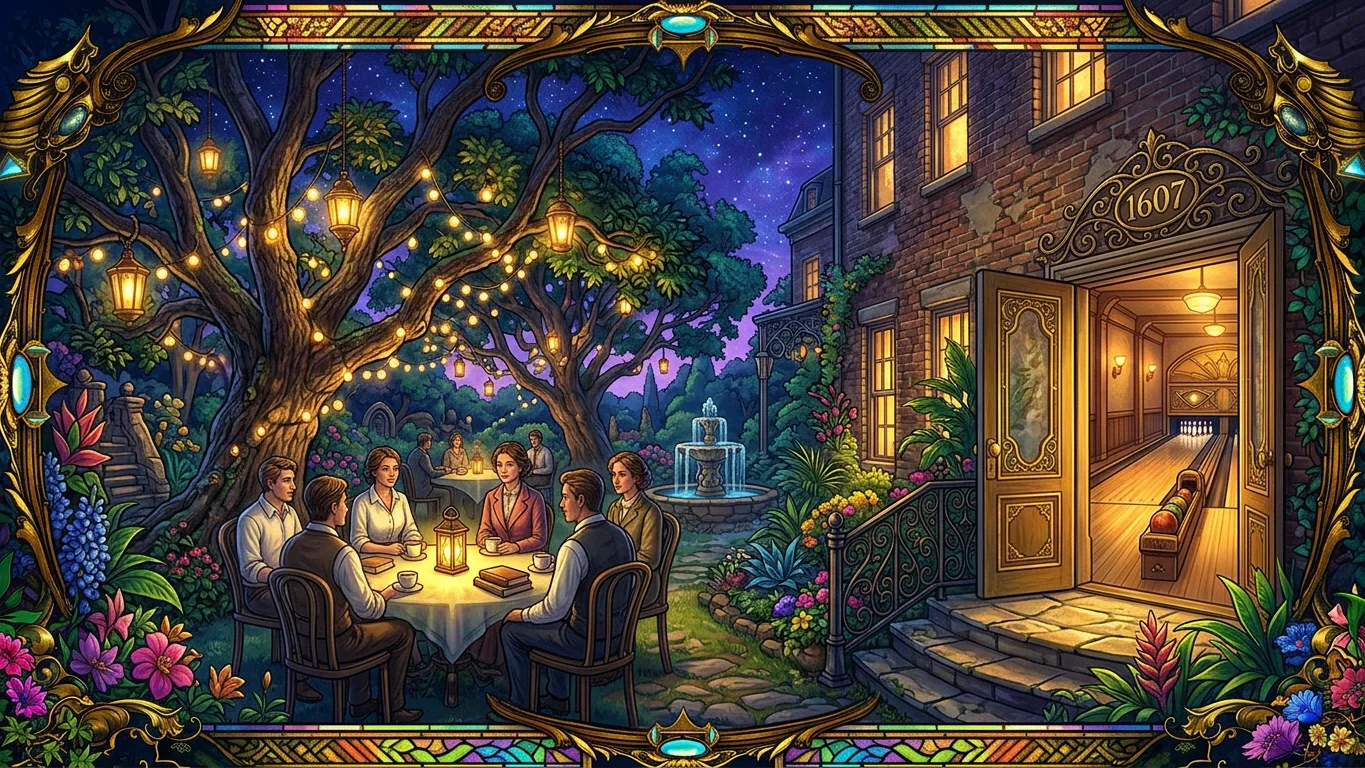
How a German immigrant, a century-old singing society, and six wooden bowling lanes kept the heart of Austin beating since 1866.
Most folks hurry right past 1607 San Jacinto Boulevard without realizing they are walking by the oldest continuously operating business in Texas and a hidden, century-old bowling alley. Pull up a chair under the trees and let us talk about the enduring magic of Scholz Garten.
 Zenna LoneStar
·
October 24, 2026
·
6 min
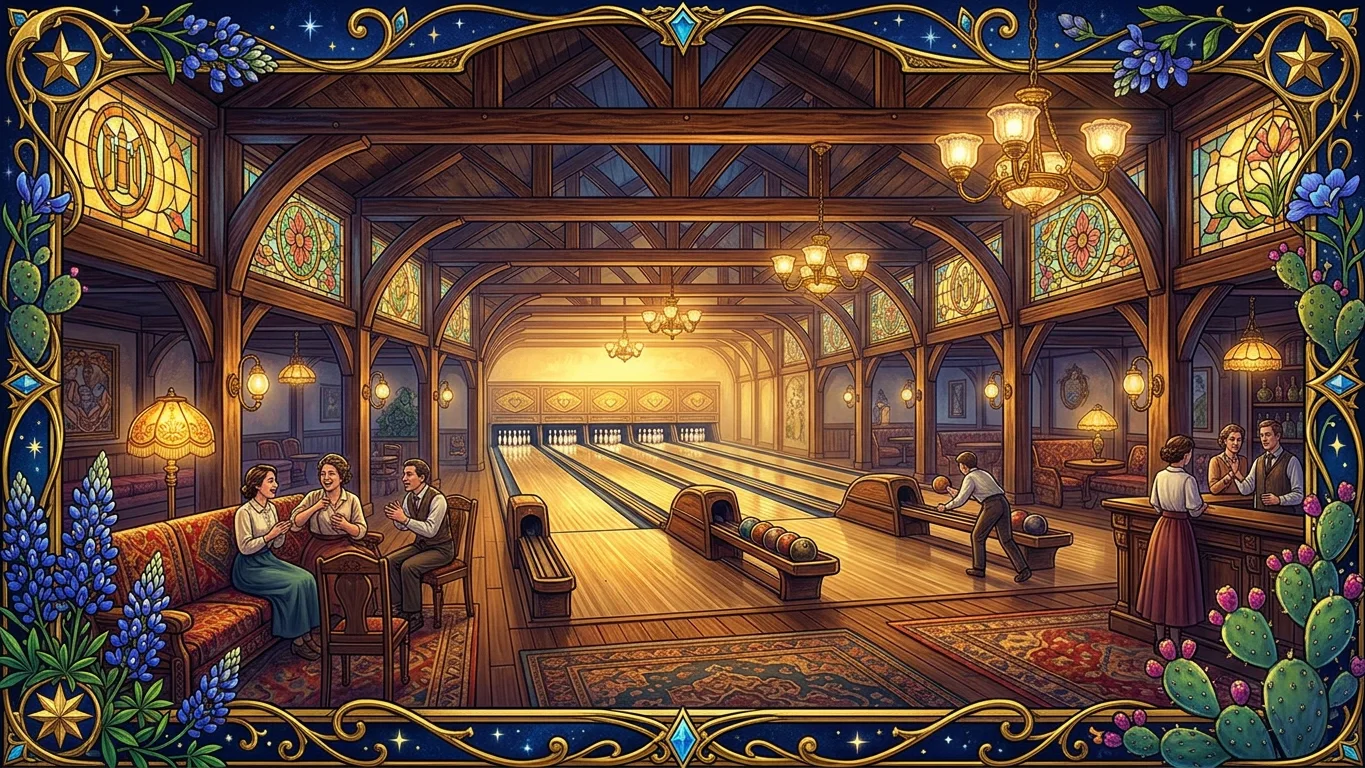
Beneath the live oaks of downtown Austin sits a beloved beer garden with a hundred-year-old secret waiting in the back hall.
Right in the heart of downtown Austin at 1607 San Jacinto Blvd, Scholz Garten holds a sweet piece of Texas culture that most folks walk right past. Behind the historic beer garden sits a working, century-old six-lane bowling alley built by a German singing society in 1908.
Zenna LoneStar
·
October 16, 2026
·
4 min

Listening to the lingering souls, old heartaches, and gentle mysteries across our sun-drenched land
Zenna LoneStar shares a journey through the haunted corners of Texas, where history and spirit energy linger under the Spanish moss and limestone bluffs.
Zenna LoneStar
·
October 6, 2026
·
7 min
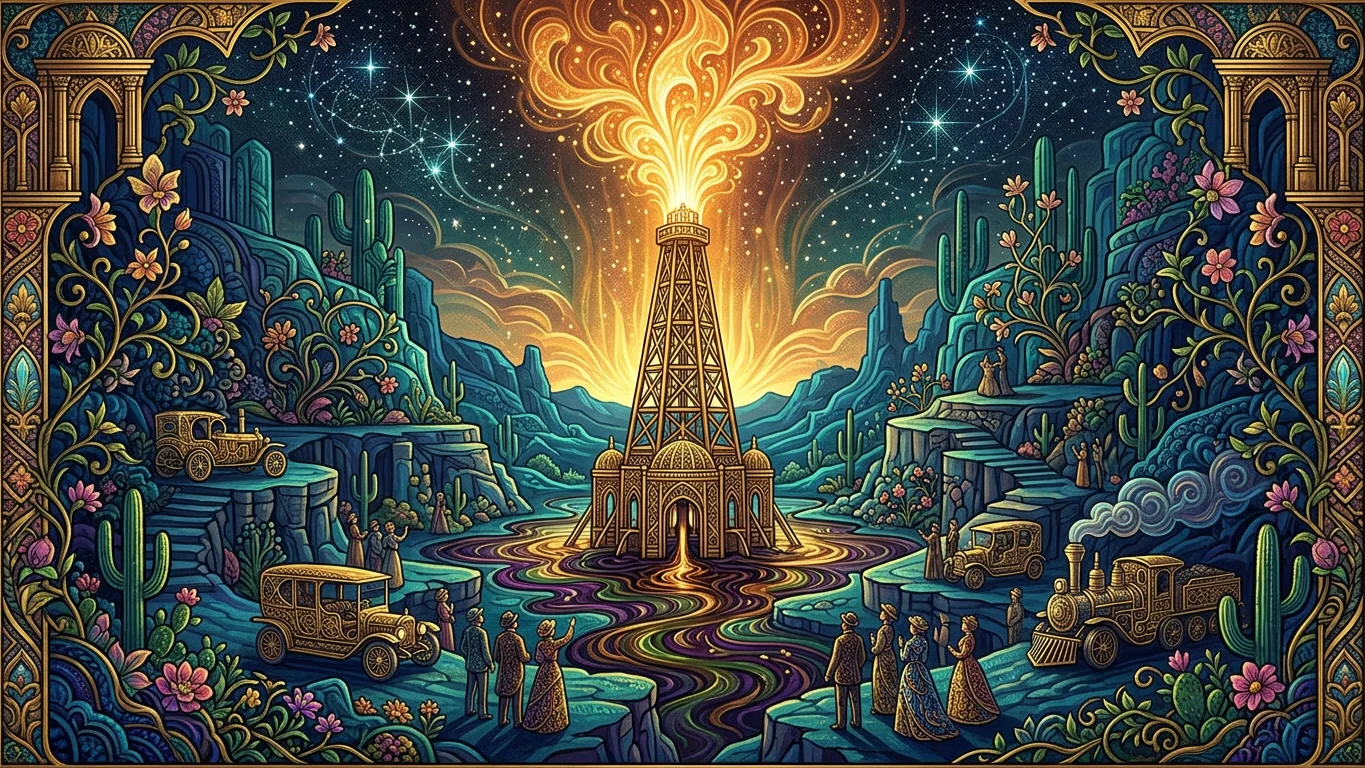
How a stubborn hill in Beaumont, a wild fountain of black gold, and a whole lot of grit remade Texas forever
On a damp January morning in 1901, a salt dome south of Beaumont blew wide open and changed the way the whole world moves. Zenna LoneStar looks back at the wild grease, grit, and hardheaded dreamers of Spindletop.
Zenna LoneStar
·
October 4, 2026
·
10 min






